
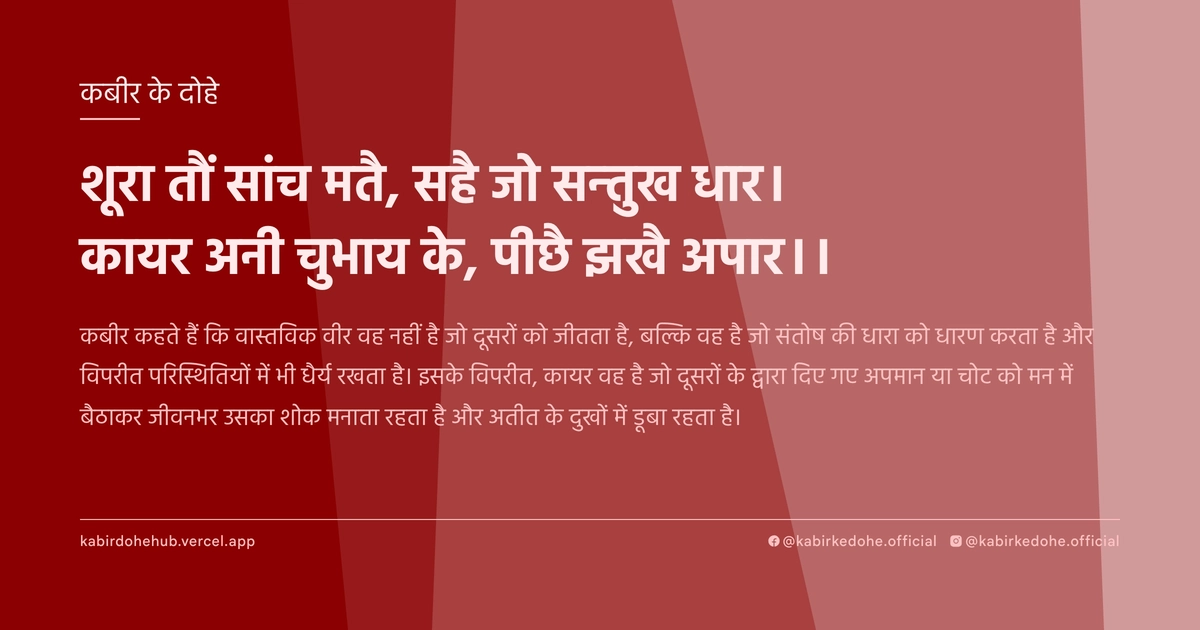
शूरा तौं सांच मतै, सहै जो सन्तुख धार।
कायर अनी चुभाय के, पीछै झखै अपार।।
Shoora taun saanch matai, sahai jo santukh dhaar. Kaayar ani chubhay ke, peeche jhakhai apaar.
इस पृष्ठ पर इस कबीर दोहे का अर्थ (meaning), हिंदी व्याख्या और अंग्रेज़ी अनुवाद, दार्शनिक विश्लेषण और व्यावहारिक जीवन सीख दी गई है। यह दोहा धैर्य (Patience) विषय से जुड़ा है — Kabir doha meaning and explanation in Hindi and English.
अर्थ (Meaning):
कबीर कहते हैं कि वास्तविक वीर वह नहीं है जो दूसरों को जीतता है, बल्कि वह है जो संतोष की धारा को धारण करता है और विपरीत परिस्थितियों में भी धैर्य रखता है। इसके विपरीत, कायर वह है जो दूसरों के द्वारा दिए गए अपमान या चोट को मन में बैठाकर जीवनभर उसका शोक मनाता रहता है और अतीत के दुखों में डूबा रहता है।
Kabir asserts that true bravery does not lie in conquering others, but in the ability to embody the flow of contentment and endure hardships with equanimity. In contrast, the coward is one who allows the wounds of insult or injury to fester within, spending a lifetime lamenting the past and remaining trapped in the cycle of resentment.
व्याख्या (Interpretation):
इस दोहे में कबीर 'वीरता' की पारंपरिक परिभाषा को पूरी तरह बदल देते हैं। यहाँ वीरता का अर्थ शारीरिक बल या युद्ध जीतना नहीं, बल्कि 'संतोष' (Contentment) को धारण करना है। यह निर्गुण भक्ति का सार है, जहाँ साधक बाहरी दुनिया के द्वंद्वों से ऊपर उठकर अपनी आंतरिक शांति में स्थित होता है। 'सन्तुख धार' का अर्थ है संतोष की एक ऐसी निरंतर धारा जिसमें अहंकार का विसर्जन हो जाता। जब मनुष्य माया के प्रभाव में होता है, तो वह बाहरी अपमान को अपनी पहचान मान लेता है, जो कि अद्वैत वेदांत के अनुसार एक भ्रम है क्योंकि आत्मा वास्तव में अछूती और शुद्ध है। कायरता यहाँ शारीरिक डर नहीं, बल्कि मानसिक कमजोरी है—अतीत की कड़वाहट को पकड़ कर रखना। यह विरोधाभास है कि जो व्यक्ति दूसरों को डराता है, वह वास्तव में अपने भीतर के डर और असुरक्षा से भाग रहा होता है, जबकि शांत रहने वाला व्यक्ति वास्तव में सबसे शक्तिशाली है।
In this couplet, Kabir completely redefines the traditional notion of 'bravery.' Here, courage is not about physical prowess or victory in battle, but about embodying 'Santukh' or contentment. This is the essence of Nirgun Bhakti, where the seeker transcends the dualities of the external world to reside in inner peace. The 'flow of contentment' represents a state where the ego is dissolved. When under the influence of Maya (illusion), a human mistakes external insults for their true identity, which according to Advaita Vedanta is a fallacy, as the Atman is inherently untouched and pure. Cowardice here is not physical fear, but mental fragility—the act of clinging to past bitterness. It is a profound paradox: the one who seeks to dominate others is actually fleeing from their own internal insecurity, while the one who remains equanimous is the truly powerful soul.
दार्शनिक विश्लेषण (Philosophical Analysis):
कबीर का यह दर्शन उस समय के सामाजिक परिवेश पर एक तीखा प्रहार था जहाँ वीरता को केवल तलवार और रक्तपात से जोड़ा जाता था। उन्होंने वीरता का मनोवैज्ञानिक और आध्यात्मिक रूपांतरण किया। यह दृष्टिकोण सूफीवाद के 'नफ़्स' (अहंकार) के दमन से मिलता-जुलता है, जहाँ सबसे बड़ा जिहाद स्वयं के भीतर के क्रोध और ईर्ष्या पर विजय पाना है। कबीर यहाँ यह स्पष्ट करते हैं कि जो व्यक्ति बाहरी चोटों से विचलित होता है, वह वास्तव में अपनी 'अहंकार-केंद्रित' पहचान से चिपका हुआ है।
अद्वैत वेदांत के परिप्रेक्ष्य में, जब तक 'मैं' और 'मेरा' का भाव रहता है, तब तक अपमान और सम्मान का द्वंद्व बना रहता है। जैसे ही साधक यह अनुभव करता है कि वह ब्रह्म का ही अंश है, बाहरी दुनिया की प्रतिक्रियाएं केवल लहरों की तरह होती हैं जो समुद्र की गहराई को प्रभावित नहीं करतीं। कबीर का 'संतोष' कोई निष्क्रियता नहीं है, बल्कि एक सक्रिय मानसिक स्थिति है जहाँ व्यक्ति सत्य को स्वीकार करता है और प्रतिक्रिया के बजाय प्रतिक्रिया-शून्यता (non-reactivity) को चुनता है।
ritualism या कर्मकांडों के प्रति उनकी अस्वीकृति यहाँ भी झलकती है; वे बाहरी दिखावे की वीरता के बजाय आंतरिक चरित्र की शुद्धता पर जोर देते हैं। वे समझाते हैं कि जाति या कुल की श्रेष्ठता का अहंकार वास्तव में एक मानसिक बीमारी है जो व्यक्ति को कायर बनाती है, क्योंकि वह अपनी झूठी प्रतिष्ठा को बचाने के लिए हर समय भयभीत रहता है।
मनोवैज्ञानिक स्तर पर, कबीर 'रुमिनेशन' (एक ही दुख को बार-बार सोचना) की प्रक्रिया को कायरता कहते हैं। जब हम किसी के द्वारा दिए गए दुख को 'पीछे झखै' (याद करके दुखी होना) करते हैं, तो हम अपनी ऊर्जा को नष्ट करते हैं। यह मानसिक बंधन ही हमें आध्यात्मिक प्रगति से रोकता है।
अंततः, यह दोहा हमें सिखाता है कि वास्तविक मुक्ति तब मिलती है जब हम क्षमा को एक कमजोरी नहीं, बल्कि एक सर्वोच्च शक्ति के रूप में स्वीकार करते हैं। यह अहंकार के विसर्जन की प्रक्रिया है, जहाँ व्यक्ति स्वयं को ब्रह्मांडीय चेतना के साथ जोड़ता है और व्यक्तिगत चोटों को तुच्छ समझने लगता है।
Kabir's philosophy here is a sharp critique of the social milieu of his era, where bravery was exclusively linked to the sword and bloodshed. He performs a psychological and spiritual transmutation of courage. This perspective aligns with the Sufi concept of conquering the 'Nafs' (ego), where the greatest struggle is the internal battle against anger and jealousy. Kabir clarifies that one who is disturbed by external injuries is merely clinging to an 'ego-centric' identity.
From the lens of Advaita Vedanta, as long as the sense of 'I' and 'Mine' persists, the duality of insult and honor remains. Once the seeker realizes they are an extension of Brahman, external reactions become mere ripples that do not affect the depths of the ocean. Kabir's 'contentment' is not passivity, but an active mental state where one accepts truth and chooses non-reactivity over reaction.
His rejection of ritualism is evident here; he emphasizes the purity of inner character over the outward display of valor. He explains that the ego of caste or lineage is actually a mental ailment that renders a person cowardly, as they live in constant fear of protecting a false reputation.
On a psychological level, Kabir identifies 'rumination'—the act of obsessing over past pain—as cowardice. When we dwell on injuries inflicted by others, we deplete our spiritual energy. This mental bondage is precisely what obstructs spiritual evolution.
Ultimately, this couplet teaches that true liberation occurs when we accept forgiveness not as a weakness, but as a supreme power. It is the process of ego-annihilation, where the individual aligns with universal consciousness and begins to view personal grievances as insignificant.
मूल संदेश (Core Message):
- बाहरी जीत भ्रम है, आंतरिक शांति ही वास्तविक विजय है।
- अतीत के दुखों को पकड़ना मानसिक गुलामी और कायरता है।
- संतोष वह ढाल है जिसे कोई भी अपमान भेद नहीं सकता।
- अहंकार का विसर्जन ही मनुष्य को वास्तविक वीर बनाता है।
- प्रतिक्रिया न करना कमजोरी नहीं, बल्कि सर्वोच्च मानसिक शक्ति है।
- External victory is an illusion; inner peace is the only true conquest.
- Clinging to past sorrows is a form of mental slavery and cowardice.
- Contentment is the shield that no insult can ever pierce.
- The dissolution of ego is what transforms a human into a true warrior.
- Non-reactivity is not weakness, but the highest form of mental strength.
व्यावहारिक उदाहरण (Practical Example):
वाराणसी के घाटों पर रहने वाला एक वृद्ध बुनकर था, जिसका नाम माधव था। माधव अपनी कला में निपुण था, लेकिन उसके पड़ोस में एक अहंकारी व्यापारी रहता था जो अक्सर माधव की गरीबी का मजाक उड़ाता और उसकी मेहनत को तुच्छ बताता था। व्यापारी अक्सर सबके सामने माधव को अपमानित करता, उसे 'अक्षम' और 'भाग्यहीन' कहता।
शुरुआत में, माधव इस अपमान से बहुत दुखी रहता था। वह रात भर जागकर सोचता कि उस व्यापारी ने उसे क्या कहा और वह उसका जवाब क्यों नहीं दे पाया। वह अपने मन में प्रतिशोध की आग जलाता और खुद को कमजोर महसूस करता। यह वही 'कायरता' थी जिसका जिक्र कबीर ने किया—अतीत के घावों को कुरेदना।
एक दिन माधव ने कबीर के इस दोहे को सुना और गहराई से विचार किया। उसने महसूस किया कि उसका दुख व्यापारी के शब्दों से नहीं, बल्कि इस बात से था कि वह अपनी पहचान उस व्यापारी की नजरों में ढूंढ रहा था। उसने तय किया कि वह अपनी शांति को किसी और के हाथ की कठपुतली नहीं बनने देगा।
अगले दिन, जब व्यापारी ने फिर से उसे सबके सामने नीचा दिखाया, माधव ने न तो क्रोध किया और न ही दुखी हुआ। उसने बस एक मंद मुस्कान के साथ व्यापारी की ओर देखा और अपना काम जारी रखा। उसने मन ही मन उस व्यापारी के प्रति करुणा महसूस की, क्योंकि वह समझ गया कि जो व्यक्ति दूसरों को नीचा दिखाता है, वह वास्तव में भीतर से बहुत अशांत और असुरक्षित होता है।
व्यापारी यह देखकर हैरान रह गया कि उसके शब्दों का अब माधव पर कोई असर नहीं हो रहा था। जब अपमान का कोई प्रभाव नहीं पड़ा, तो व्यापारी का अहंकार टूटने लगा। वह माधव की इस अचल शांति से प्रभावित हुआ और धीरे-धीरे उसका व्यवहार बदलने लगा।
माधव ने अब अपनी पूरी ऊर्जा अपनी बुनाई और ध्यान में लगा दी। उसने पाया कि जब उसने दूसरों की राय की परवाह करना छोड़ दिया, तो उसकी कला में एक नई चमक आ गई। वह अब वास्तव में 'शूरा' (वीर) बन चुका था क्योंकि उसने संतोष की धारा को अपना लिया था।
उसने सीखा कि असली जीत बहस जीतने में नहीं, बल्कि अपनी आंतरिक शांति को बनाए रखने में है। वह अब किसी के द्वारा दिए गए अपमान को अपने साथ घर नहीं ले जाता था।
समय के साथ, वह अहंकारी व्यापारी स्वयं माधव के पास आया और उससे क्षमा मांगी। माधव ने उसे सहजता से क्षमा कर दिया, क्योंकि उसके भीतर अब कोई कड़वाहट बची ही नहीं थी।
यह रूपांतरण माधव के जीवन में एक स्थायी शांति लेकर आया। उसने सिद्ध किया कि धैर्य और संतोष ही सबसे बड़ा शस्त्र हैं।
आज माधव वाराणसी के उस क्षेत्र में केवल एक बुनकर के रूप में नहीं, बल्कि एक शांत और प्रबुद्ध व्यक्तित्व के रूप में जाना जाता है, जिसने बिना लड़े ही युद्ध जीत लिया।
In the ghats of Varanasi lived an elderly weaver named Madhav. Madhav was masterful in his craft, but his neighbor was an arrogant merchant who frequently mocked Madhav's poverty and belittled his hard work. The merchant would often humiliate Madhav in public, calling him 'incapable' and 'unfortunate.'
Initially, Madhav was deeply distressed by these insults. He would stay awake all night, ruminating on what the merchant had said and lamenting why he couldn't fight back. He nurtured a fire of revenge within, feeling weak and defeated. This was the very 'cowardice' Kabir spoke of—picking at old wounds.
One day, Madhav heard this specific Doha and contemplated it deeply. He realized that his suffering did not stem from the merchant's words, but from the fact that he was seeking his identity through the merchant's eyes. He decided that he would no longer let his peace be a puppet in someone else's hands.
The next day, when the merchant again tried to demean him publicly, Madhav neither reacted with anger nor sadness. He simply looked at the merchant with a gentle smile and continued his work. Internally, he felt compassion for the merchant, realizing that someone who belittles others is actually deeply restless and insecure inside.
The merchant was stunned to see that his words no longer had any effect on Madhav. When the insults failed to provoke a reaction, the merchant's ego began to crumble. He became fascinated by Madhav's unshakable peace, and gradually, his own behavior began to change.
Madhav now channeled all his energy into his weaving and meditation. He discovered that once he stopped caring about others' opinions, a new brilliance emerged in his art. He had truly become a 'Shoora' (brave soul) because he had embraced the flow of contentment.
He learned that true victory is not in winning an argument, but in maintaining one's internal equilibrium. He stopped carrying the burden of others' negativity back to his home.
Over time, the arrogant merchant approached Madhav and asked for forgiveness. Madhav forgave him effortlessly, for there was no longer any bitterness left within him to cling to.
This transformation brought a permanent peace to Madhav's life. He proved that patience and contentment are the most powerful weapons one can possess.
Today, Madhav is known in that part of Varanasi not just as a weaver, but as a calm and enlightened soul who won a war without ever fighting a battle.
अभ्यास मार्गदर्शन (Practice Guidance):
- प्रतिदिन 20 मिनट 'साक्षी भाव' का अभ्यास करें: जब कोई आपको अपमानित करे, तो तुरंत प्रतिक्रिया देने के बजाय, अपने भीतर उठने वाले क्रोध को एक तीसरे व्यक्ति की तरह देखें।
- आत्म-पूछताछ जर्नल: हर रात लिखें कि आज किस बात ने आपको विचलित किया? क्या वह चोट वास्तविक थी या आपके अहंकार की कल्पना?
- मौन व्रत: सप्ताह में एक दिन पूर्ण मौन का पालन करें ताकि आप बाहरी शोर के बजाय आंतरिक संतोष की धारा को सुन सकें।
- डायग्नोस्टिक चेकलिस्ट: यदि आप अभी भी पुराने झगड़ों के बारे में सोचकर दुखी होते हैं, तो आप 'कायर' अवस्था में हैं। यदि आप विपरीत परिस्थिति में भी मुस्कुरा सकते हैं, तो आप 'शूरा' मार्ग पर हैं।
- Practice 'Witness Consciousness' for 20 minutes daily: When insulted, instead of reacting immediately, observe the rising anger within you as if you are a third-party observer.
- Self-Inquiry Journaling: Every night, write down what disturbed you today. Was the injury real, or was it a projection of your ego?
- Vow of Silence: Observe complete silence for one day a week to tune out external noise and listen to the internal flow of contentment.
- Diagnostic Checklist: If you still feel distressed while remembering old conflicts, you are in the 'cowardly' state. If you can smile amidst adversity, you are on the path of the 'Shoora'.
चिंतन प्रश्न (Reflection Questions):
- आप अपनी पहचान को दूसरों की प्रशंसा या निंदा से कितना जोड़ते हैं?
- वह कौन सी पुरानी चोट है जिसे आप आज भी पकड़ कर बैठे हैं, और वह आपको आगे बढ़ने से कैसे रोक रही है?
- क्या आपकी 'वीरता' केवल दूसरों पर हावी होने में है, या स्वयं के क्रोध को नियंत्रित करने में?
- यदि आपका सामाजिक पद और प्रतिष्ठा छीन ली जाए, तो क्या आपके पास कोई आंतरिक आधार बचेगा?
- आप अपनी डिजिटल पहचान (Social Media Ego) को बचाने के लिए कितनी मानसिक ऊर्जा व्यर्थ करते हैं?
- क्या आप वास्तव में क्षमा करते हैं, या केवल क्षमा का ढोंग करते हुए भीतर कड़वाहट पालते हैं?
- To what extent do you link your identity to the praise or criticism of others?
- What is that old wound you are still clinging to, and how is it preventing your evolution?
- Is your 'bravery' merely about dominating others, or about controlling your own anger?
- If your social status and reputation were stripped away, would you have any internal foundation left?
- How much mental energy do you waste protecting your digital identity (Social Media Ego)?
- Do you truly forgive, or do you merely pretend to forgive while harboring bitterness within?