
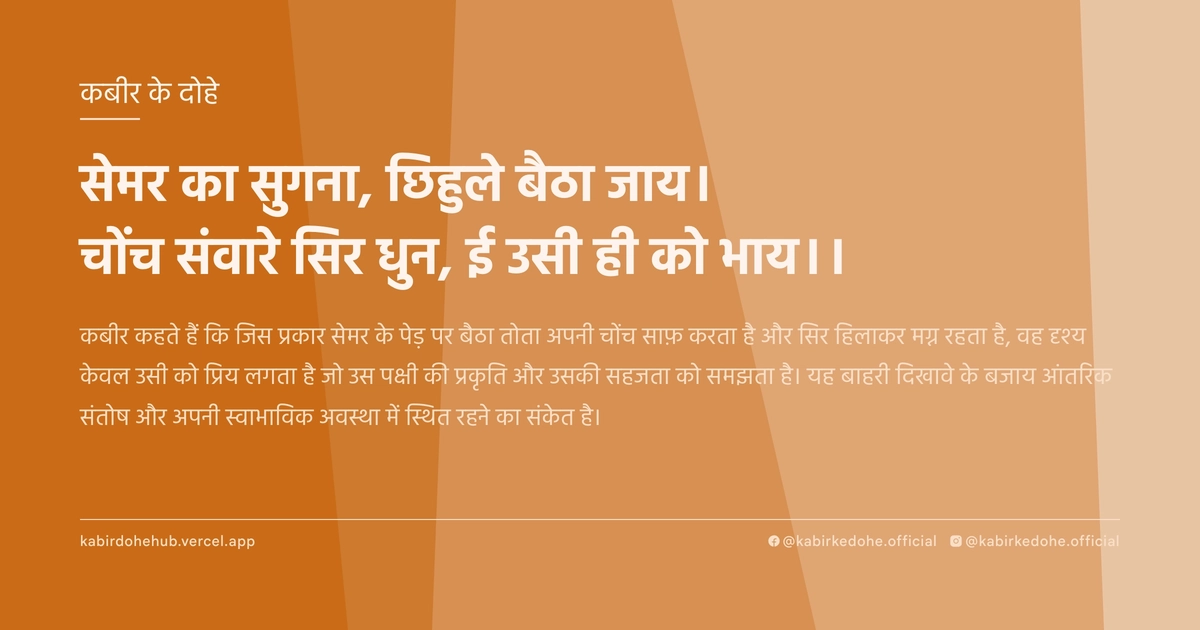
सेमर का सुगना, छिहुले बैठा जाय।
चोंच संवारे सिर धुन, ई उसी ही को भाय।।
Semar ka sugna, chihule baitha jaaye. Chonch sanvare sir dhun, ee usi hi ko bhaay.
इस पृष्ठ पर इस कबीर दोहे का अर्थ (meaning), हिंदी व्याख्या और अंग्रेज़ी अनुवाद, दार्शनिक विश्लेषण और व्यावहारिक जीवन सीख दी गई है। यह दोहा अहंकार (The Ego) विषय से जुड़ा है — Kabir doha meaning and explanation in Hindi and English.
अर्थ (Meaning):
कबीर कहते हैं कि जिस प्रकार सेमर के पेड़ पर बैठा तोता अपनी चोंच साफ़ करता है और सिर हिलाकर मग्न रहता है, वह दृश्य केवल उसी को प्रिय लगता है जो उस पक्षी की प्रकृति और उसकी सहजता को समझता है। यह बाहरी दिखावे के बजाय आंतरिक संतोष और अपनी स्वाभाविक अवस्था में स्थित रहने का संकेत है।
Kabir observes a parrot perched upon a Semar tree, meticulously grooming its beak and swaying its head in a state of natural contentment. He suggests that such a sight is pleasing only to those who understand the essence of the bird's nature, emphasizing that true peace lies in being aligned with one's inherent nature rather than seeking external validation.
व्याख्या (Interpretation):
यहाँ 'सेमर का सुगना' (तोता) उस साधक का प्रतीक है जो संसार के शोर से दूर अपनी अंतरात्मा में स्थित है। 'चोंच संवारना' और 'सिर धुनना' बाहरी कर्मकांडों के बजाय आंतरिक शुद्धि और आत्म-चिंतन की प्रक्रिया को दर्शाता है। यह निर्गुण भक्ति का सार है, जहाँ ईश्वर किसी मूर्ति में नहीं बल्कि स्वयं के भीतर की सहजता में पाया जाता है। माया हमें बाहरी आडंबरों की ओर खींचती है, जबकि यह दोहा हमें बताता है कि सत्य केवल उसे ही 'भाता' है जिसने अहंकार का त्याग कर दिया है। यह अद्वैत वेदांत के उस सिद्धांत को पुष्ट करता है जहाँ आत्मा और परमात्मा का मिलन केवल तब होता है जब व्यक्ति अपनी वास्तविक प्रकृति को पहचान लेता है।
The 'parrot of the Semar tree' serves as a metaphor for the spiritual seeker who has retreated from the cacophony of the material world to reside within the sanctuary of the self. The act of 'grooming the beak' and 'swaying the head' symbolizes the process of internal purification and mindful contemplation, contrasting sharply with superficial religious rituals. In the context of Nirgun Bhakti, this illustrates that the Divine is not found in external idols but in the effortless alignment with one's true nature. Maya lures the mind toward complexity and prestige, yet Kabir asserts that this simplicity is pleasing only to the one who has dissolved the ego. This reflects the Advaita Vedanta principle where the realization of non-duality occurs only when the seeker ceases to struggle and simply 'is'.
दार्शनिक विश्लेषण (Philosophical Analysis):
कबीर का यह दोहा उस समय के सामाजिक और धार्मिक परिवेश पर एक सूक्ष्म प्रहार है जहाँ धर्म केवल बाहरी वस्त्रों, मालाओं और तिलक तक सीमित हो गया था। कबीर ने हमेशा कर्मकांडवाद (Ritualism) का विरोध किया और 'सहज' मार्ग पर बल दिया। उनके लिए आध्यात्मिकता कोई कठिन तपस्या नहीं, बल्कि अपनी मूल प्रकृति में वापस लौटने की प्रक्रिया है।
दार्शनिक स्तर पर, यह सूफी मत के 'फना' (अहंकार का विनाश) और अद्वैत वेदांत के 'साक्षी भाव' का संगम है। तोता जिस तरह अपनी धुन में मग्न है, वह उस अवस्था को दर्शाता है जहाँ साधक दुनिया की परवाह किए बिना अपने आंतरिक आनंद में लीन रहता है। यहाँ 'भाय' (प्रिय लगना) शब्द महत्वपूर्ण है; यह इंगित करता है कि आध्यात्मिक सत्य सबके लिए नहीं है, बल्कि केवल उनके लिए है जो इसे ग्रहण करने की पात्रता रखते हैं।
कबीर यहाँ जाति और वर्ग के भेदभाव को मिटाकर एक सार्वभौमिक सत्य प्रस्तुत करते हैं। जिस प्रकार एक पक्षी की सहजता किसी जाति की नहीं होती, उसी प्रकार आत्मा की प्यास और परमात्मा का मिलन किसी सामाजिक श्रेणी का मोहताज नहीं है। यह मनुष्य को उसकी सामाजिक पहचान (Social Identity) से ऊपर उठाकर उसकी आध्यात्मिक पहचान (Spiritual Identity) की ओर ले जाता है।
मनोवैज्ञानिक दृष्टिकोण से, यह दोहा 'Mindfulness' या सचेतनता का प्राचीन उदाहरण है। जब हम अपनी वर्तमान स्थिति को बिना किसी निर्णय (Judgment) के स्वीकार करते हैं, तब हम उस तोते की तरह सहज हो जाते हैं। अहंकार हमें हमेशा 'कुछ और' बनने के लिए प्रेरित करता है, जबकि कबीर 'जो है' उसी में पूर्णता देखने की प्रेरणा देते हैं।
अंततः, यह दोहा हमें सिखाता है कि सत्य सरल है, लेकिन हमारी जटिल इच्छाएं उसे कठिन बना देती हैं। जब साधक अपनी चोंच (वाणी) और सिर (विचार) को संवार लेता है, तो वह उस परम आनंद को प्राप्त करता है जिसे शब्दों में व्यक्त नहीं किया जा सकता, केवल अनुभव किया जा सकता है।
This couplet emerges from a historical era dominated by rigid religious orthodoxy, where spirituality was often reduced to the wearing of specific threads, beads, or the application of sectarian marks. Kabir’s lifelong crusade against ritualism is encapsulated here; he advocates for the 'Sahaj' (natural/spontaneous) path, suggesting that enlightenment is not a product of strenuous effort but a return to one's primordial state.
Philosophically, this is a convergence of the Sufi concept of 'Fana' (annihilation of the self) and the Advaita Vedantic state of 'Sakshi' (the witness). The parrot, absorbed in its own rhythm, represents the seeker who has transcended the need for external validation. The word 'Bhaay' (to be pleasing) is pivotal; it implies that spiritual truth is not a commodity for the masses but a revelation reserved for those whose hearts have become fertile ground through the shedding of ego.
Kabir effectively dismantles caste and class hierarchies by using a bird as his protagonist. Just as a bird's grace is independent of any social rank, the soul's longing for the Divine is universal. He urges the seeker to move beyond the 'social mask' and embrace the 'spiritual essence,' arguing that the Divine is accessible to all, regardless of their birth or profession.
From a psychological perspective, this is an early articulation of mindfulness. The parrot exists in a state of total presence, grooming itself without anxiety about the future or regret for the past. While the ego constantly pushes the individual to become 'something more,' Kabir suggests that liberation lies in the radical acceptance of 'what is.'
Ultimately, the poem posits that Truth is inherently simple, yet human complexity—driven by desire and duality—makes it seem elusive. Once the seeker refines their speech (the beak) and their thoughts (the head), they enter a state of grace where the distinction between the observer and the observed vanishes, leaving only a profound, silent joy.
मूल संदेश (Core Message):
- बाहरी आडंबर केवल भ्रम हैं, आंतरिक शांति ही वास्तविक सत्य है।
- अहंकार का त्याग ही परमात्मा से मिलन का एकमात्र द्वार है।
- सहजता में ही सबसे बड़ी शक्ति और गहनतम शांति निहित है।
- सत्य को खोजने की कोशिश छोड़ें, बस सत्य के साथ होना सीखें।
- अपनी मूल प्रकृति को पहचानना ही वास्तविक आध्यात्मिक उपलब्धि है।
- External rituals are mere illusions; inner stillness is the only truth.
- The dissolution of ego is the sole gateway to Divine union.
- The greatest power and deepest peace reside in natural simplicity.
- Stop trying to find the Truth; learn to simply be the Truth.
- Recognizing your primordial nature is the ultimate spiritual achievement.
व्यावहारिक उदाहरण (Practical Example):
एक समय की बात है, वाराणसी के घाटों पर रामदीन नाम का एक वृद्ध बुनकर रहता था। रामदीन अपने जीवन के अंतिम पड़ाव पर था, लेकिन उसका मन अशांत था। वह शहर के सबसे बड़े पंडितों और संतों के पास गया, कठिन व्रत रखे और हज़ारों मील की यात्राएं कीं, ताकि वह 'मोक्ष' का कोई गुप्त मंत्र पा सके। वह जितना अधिक प्रयास करता, उसका तनाव उतना ही बढ़ता जाता।
एक दोपहर, जब वह थककर एक पुराने सेमर के पेड़ के नीचे बैठा था, उसने देखा कि एक छोटा सा तोता अपनी चोंच को टहनी से रगड़कर साफ़ कर रहा है और बीच-बीच में अपना सिर हिलाकर किसी गहरी धुन में मग्न है। वह पक्षी न तो किसी मंदिर की ओर देख रहा था और न ही किसी मंत्र का जाप कर रहा था, फिर भी उसके चेहरे पर एक असीम शांति थी।
रामदीन ने सोचा, "मैं वर्षों से शास्त्रों को पढ़ रहा हूँ, फिर भी मैं इस पक्षी से अधिक बेचैन क्यों हूँ?" उसे अचानक महसूस हुआ कि वह मोक्ष को एक 'लक्ष्य' मानकर उसका पीछा कर रहा था, जबकि मोक्ष वास्तव में 'पीछा करना छोड़ देने' की अवस्था है।
उसने महसूस किया कि उसकी सारी बेचैनी इस बात की थी कि वह दुनिया की नज़रों में एक 'महान साधक' दिखना चाहता था। वह तोता किसी को दिखाने के लिए शांत नहीं था; वह बस शांत था।
रामदीन ने उसी क्षण अपनी सारी धार्मिक किताबों और बाहरी आडंबरों को त्याग दिया। उसने वापस अपने करघे (loom) पर जाना शुरू किया, लेकिन अब वह धागों को केवल कपड़े के लिए नहीं, बल्कि ध्यान के साथ बुनने लगा।
अब वह काम करते हुए भी उसी तोते की तरह मग्न रहने लगा। जब लोग उससे पूछते कि उसने क्या पाया, तो वह बस मुस्कुरा देता।
उसकी शांति अब किसी बाहरी चमत्कार पर निर्भर नहीं थी, बल्कि उसकी अपनी सहजता में थी। उसने जान लिया था कि ईश्वर कहीं दूर नहीं, बल्कि वर्तमान क्षण की पूर्णता में है।
रामदीन का जीवन अब एक उत्सव बन गया था। उसने सीखा कि जब हम खुद को संवारना (आंतरिक शुद्धि) शुरू करते हैं, तो पूरा ब्रह्मांड हमें प्रिय लगने लगता है।
उसकी यह रूपांतरण यात्रा इस बात का प्रमाण थी कि सत्य किसी कठिन मार्ग पर नहीं, बल्कि सहजता के भीतर छिपा है।
अंततः, वह बुनकर जिसे दुनिया साधारण मानती थी, वास्तव में उस तोते की तरह एक मुक्त आत्मा बन गया था।
In the ancient lanes of Varanasi, there lived an elderly weaver named Ramdin. Though he had spent his life in the service of his craft, his heart was a storm of unrest. He spent his twilight years chasing 'Moksha,' visiting the most renowned pundits, observing grueling fasts, and undertaking arduous pilgrimages to find a secret mantra for liberation. The harder he strove, the more anxious he became.
One sweltering afternoon, exhausted and defeated, Ramdin collapsed under the shade of an old Semar tree. As he rested, his eyes fell upon a small parrot perched on a branch. The bird was meticulously cleaning its beak against the bark and swaying its head in a rhythmic, silent dance, seemingly lost in its own world of bliss.
Ramdin watched in silence and thought, "I have studied the scriptures for decades, yet why am I more restless than this tiny bird?" A sudden realization struck him: he had been treating liberation as a destination to be reached, whereas liberation is actually the state of ceasing the chase.
He realized that his unrest stemmed from a hidden ego—the desire to be recognized as a 'great seeker' in the eyes of the world. The parrot was not performing peace for an audience; it simply was peace.
In that moment of clarity, Ramdin let go of his obsession with ritualistic perfection. He returned to his loom, but his approach had changed. He no longer wove cloth just for survival; he wove each thread as a form of meditation.
He began to live his life with the same effortless presence as the parrot. When neighbors asked him what secret he had discovered, he would only offer a gentle, knowing smile.
His tranquility was no longer dependent on external miracles or divine interventions; it was anchored in his own natural state of being.
Ramdin's life transformed into a quiet celebration. He understood that the Divine is not found in the distance, but in the absolute fullness of the present moment.
His journey proved that Truth does not reside at the end of a difficult path, but within the simplicity of one's own existence.
Ultimately, the weaver, whom the world viewed as ordinary, became a liberated soul, mirroring the effortless grace of the parrot on the Semar tree.
अभ्यास मार्गदर्शन (Practice Guidance):
- दैनिक अवलोकन: प्रतिदिन 15 मिनट किसी प्राकृतिक तत्व (जैसे पक्षी, पत्ता या बादल) को बिना किसी निर्णय के देखें। यह आपके मन को 'साक्षी भाव' में लाने का अभ्यास है।
- वाणी का शोधन: 'चोंच संवारने' के प्रतीक के रूप में, दिन भर में कम से कम एक बार अपनी वाणी का विश्लेषण करें। क्या आपके शब्द अहंकार से प्रेरित थे या करुणा से?
- सहजता का अभ्यास: किसी भी कार्य को करते समय (जैसे खाना बनाना या चलना) उसे 'लक्ष्य' के बजाय 'प्रक्रिया' के रूप में अनुभव करें। परिणाम की चिंता छोड़ें।
- डायग्नोस्टिक चेकलिस्ट: यदि आप अभी भी दूसरों से अपनी तुलना कर रहे हैं या बाहरी प्रशंसा के लिए कार्य कर रहे हैं, तो आप 'माया' के प्रभाव में हैं। यदि आप अकेलेपन में भी पूर्ण महसूस करते हैं, तो आप 'सहज' मार्ग पर हैं।
- Daily Observation: Spend 15 minutes daily observing a natural element (a bird, a leaf, or a cloud) without judgment. This trains the mind in 'Sakshi Bhava' (the witness state).
- Refining Speech: As a practice of 'grooming the beak,' analyze your speech throughout the day. Were your words driven by ego or by genuine compassion?
- The Art of Effortlessness: While performing any mundane task (like cooking or walking), focus on the process rather than the goal. Release the attachment to the outcome.
- Diagnostic Checklist: If you are still comparing yourself to others or acting for external validation, you are under the influence of Maya. If you feel complete even in solitude, you are aligned with the Sahaj path.
चिंतन प्रश्न (Reflection Questions):
- मेरी सार्वजनिक छवि और मेरे आंतरिक एकांत के बीच कितना अंतर है?
- मैं अपनी 'आध्यात्मिक प्रगति' का प्रदर्शन करने के लिए किन सूक्ष्म तरीकों का उपयोग करता हूँ?
- यदि दुनिया से मेरी सारी उपलब्धियाँ और पहचान छीन ली जाए, तो क्या मैं फिर भी स्वयं में पूर्ण रहूँगा?
- मेरे जीवन में ऐसा कौन सा 'शोर' है जो मुझे मेरी सहज प्रकृति से दूर ले जा रहा है?
- क्या मैं वास्तव में शांत हूँ, या मैं केवल शांति का अभिनय कर रहा हूँ?
- How wide is the gap between my public persona and my internal solitude?
- In what subtle ways do I perform my 'spiritual progress' for the validation of others?
- If all my achievements and identities were stripped away, would I still feel complete within myself?
- What is the specific 'noise' in my life that prevents me from returning to my natural state?
- Am I truly at peace, or am I merely performing the act of being peaceful?