
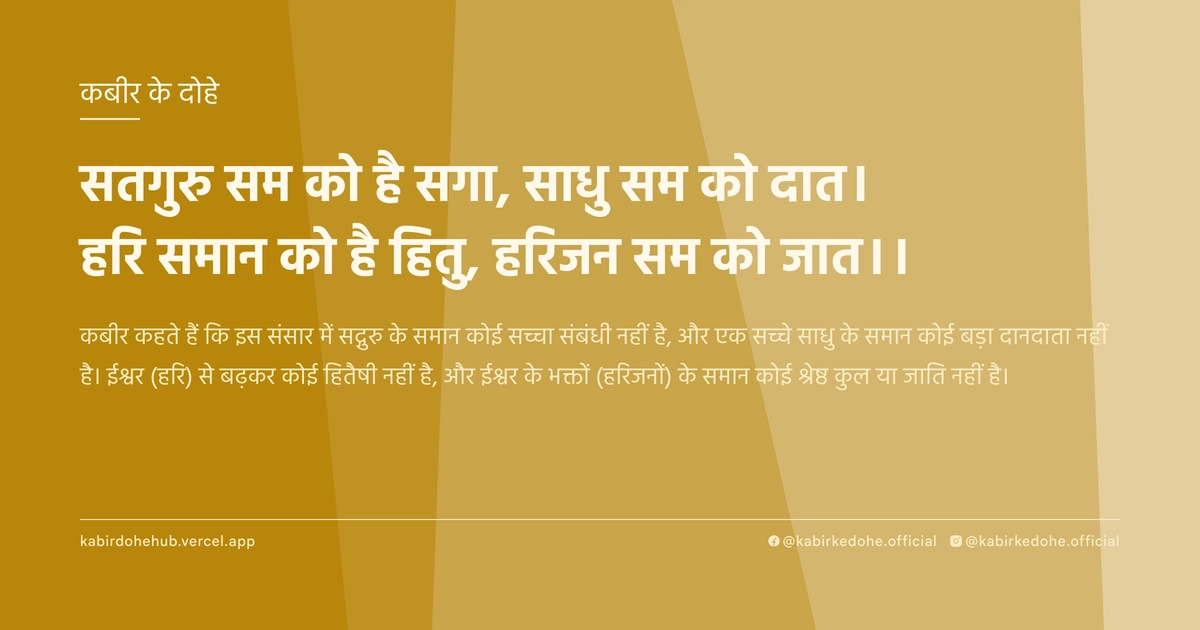
सतगुरु सम को है सगा, साधु सम को दात।
हरि समान को है हितु, हरिजन सम को जात।।
Satguru sam ko hai saga, sadhu sam ko daat. Hari samaan ko hai hitu, harijan sam ko jaat.
इस पृष्ठ पर इस कबीर दोहे का अर्थ (meaning), हिंदी व्याख्या और अंग्रेज़ी अनुवाद, दार्शनिक विश्लेषण और व्यावहारिक जीवन सीख दी गई है। यह दोहा गुरु महत्व (The Guru's Importance) विषय से जुड़ा है — Kabir doha meaning and explanation in Hindi and English.
अर्थ (Meaning):
कबीर कहते हैं कि इस संसार में सद्गुरु के समान कोई सच्चा संबंधी नहीं है, और एक सच्चे साधु के समान कोई बड़ा दानदाता नहीं है। ईश्वर (हरि) से बढ़कर कोई हितैषी नहीं है, और ईश्वर के भक्तों (हरिजनों) के समान कोई श्रेष्ठ कुल या जाति नहीं है।
Kabir asserts that in this transient world, there is no kinsman as true as the Satguru, nor a benefactor as selfless as a realized saint. There is no well-wisher more profound than the Divine (Hari), and no lineage or caste more noble than that of the devotees of the Divine.
व्याख्या (Interpretation):
यह दोहा बाहरी रिश्तों और सामाजिक श्रेणियों की निरर्थकता को दर्शाता है। 'सगा' शब्द यहाँ केवल रक्त संबंधों को नहीं, बल्कि उस आध्यात्मिक जुड़ाव को इंगित करता है जो आत्मा को परमात्मा से मिलाता है। सद्गुरु वह सेतु है जो माया के पर्दे को हटाकर जीव को उसके वास्तविक स्वरूप से परिचित कराता है। साधु का 'दात' या दान भौतिक वस्तुएं नहीं, बल्कि वह बोध है जो अज्ञानता को मिटाता है। हरि का हित निस्वार्थ है क्योंकि वह स्वयं हमारा ही विस्तार है। अंततः, 'हरिजन' शब्द यहाँ जातिगत पहचान को पूरी तरह नकारते हुए एक ऐसी आध्यात्मिक श्रेणी का निर्माण करता है जहाँ केवल प्रेम और भक्ति ही एकमात्र योग्यता है। यह अद्वैत भाव की पराकाष्ठा है जहाँ व्यक्ति अपनी सामाजिक पहचान को त्यागकर सार्वभौमिक चेतना में विलीन हो जाता है।
This couplet highlights the futility of external relationships and social hierarchies. The term 'saga' (kinsman) refers not to biological ties, but to the spiritual kinship that aligns the soul with the Absolute. The Satguru acts as the bridge, dissolving the veil of Maya to reveal the seeker's true essence. The 'daat' (gift) of a saint is not material wealth, but the transmission of awakening that eradicates ignorance. The benevolence of Hari is absolute because the Divine is the very essence of our being. Finally, the term 'harijan' here completely transcends caste identity, establishing a spiritual lineage where love and devotion are the only credentials. This is the pinnacle of Advaita, where the individual sheds social masks to merge into universal consciousness, realizing that the only true identity is the one shared with the Divine.
दार्शनिक विश्लेषण (Philosophical Analysis):
कबीर का यह दृष्टिकोण उनके समय के कट्टरपंथी धार्मिक ढांचे के विरुद्ध एक सशक्त विद्रोह था। उन्होंने देखा कि लोग जाति, कुल और बाहरी कर्मकांडों में उलझे हुए हैं, जबकि सत्य उनके भीतर ही विद्यमान है। यहाँ 'सतगुरु' का महत्व इसलिए है क्योंकि बिना मार्गदर्शन के मन माया के जाल में फँसा रहता है। यह विचार सूफी मत के 'पीर' और वेदांत के 'गुरु' के समान है, जहाँ गुरु केवल एक व्यक्ति नहीं, बल्कि एक सिद्धांत है जो अहंकार का विनाश करता है।
निर्गुण भक्ति के संदर्भ में, कबीर ईश्वर को किसी विशेष आकार या मंदिर में नहीं, बल्कि हर जीव के भीतर देखते हैं। जब वे कहते हैं कि 'हरिजन' ही श्रेष्ठ जाति है, तो वे सामाजिक स्तरीकरण की जड़ों पर प्रहार कर रहे हैं। उनके लिए पवित्रता जन्म से नहीं, बल्कि आंतरिक शुद्धि और समर्पण से आती है। यह सामाजिक समानता का एक क्रांतिकारी आह्वान था जिसने दलितों और वंचितों को आध्यात्मिक गरिमा प्रदान की।
दार्शनिक स्तर पर, यह दोहा 'अद्वैत' (Non-duality) की ओर संकेत करता है। जब साधक यह अनुभव करता है कि वह और हरि अलग नहीं हैं, तब 'हित' (well-wishing) का अर्थ बदल जाता है। अब यह एक बाहरी व्यक्ति द्वारा किया गया उपकार नहीं, बल्कि स्वयं का स्वयं के प्रति प्रेम बन जाता है। अहंकार का विसर्जन ही वह वास्तविक 'दान' है जो एक साधु प्रदान करता है।
सूफीवाद के 'फना' (annihilation) के सिद्धांत की तरह, यहाँ भी स्वयं को मिटाने की बात है। जब तक 'मैं' और 'मेरा' का भाव रहता है, तब तक सच्चा सगा या हितैषी नहीं मिल सकता। केवल जब व्यक्ति अपनी पहचान को ईश्वर की इच्छा में विलीन कर देता है, तब उसे वास्तविक शांति प्राप्त होती है।
अंततः, कबीर हमें यह समझाते हैं कि भौतिक संसार के संबंध क्षणभंगुर हैं। परिवार, संपत्ति और पद केवल भ्रम हैं। केवल वह संबंध स्थायी है जो आत्मा का परमात्मा से है। यह विश्लेषण हमें यह सिखाता है कि सच्ची मानवता किसी धर्म या जाति में नहीं, बल्कि उस करुणा और प्रेम में है जो हमें एक-दूसरे से जोड़ता है।
Kabir's perspective represents a potent rebellion against the rigid religious frameworks of his era. He observed a society entangled in caste, lineage, and external rituals, while the Truth remained dormant within. The emphasis on the 'Satguru' is critical because, without a guide, the mind remains trapped in the labyrinth of Maya. This mirrors the Sufi concept of the 'Pir' and the Vedantic 'Guru'—where the teacher is not merely a person, but a principle that annihilates the ego.
In the context of Nirgun Bhakti, Kabir perceives the Divine not in specific forms or temples, but within every living being. By asserting that 'Harijan' (devotees of God) constitute the only noble caste, he strikes at the very roots of social stratification. For him, purity is not a birthright but a result of internal purification and surrender. This was a revolutionary call for social equality, granting spiritual dignity to the marginalized and oppressed.
Philosophically, this couplet points toward Advaita (Non-duality). When the seeker realizes that they and the Divine are not separate, the meaning of 'hit' (benevolence) transforms. It is no longer a favor bestowed by an external entity, but the soul's innate love for itself. The dissolution of the ego is the true 'gift' that a realized saint provides to the disciple.
Similar to the Sufi doctrine of 'Fana' (annihilation), there is a demand here to erase the self. As long as the notions of 'I' and 'Mine' persist, one cannot find a true kinsman. Only when the individual merges their identity into the Divine Will does true peace emerge. The struggle is not against others, but against the illusion of separation.
Ultimately, Kabir teaches that material relationships are ephemeral. Family, wealth, and status are mere mirages. The only enduring bond is that between the Atman and Brahman. This analysis reveals that true humanity does not reside in a specific religion or caste, but in the compassion and love that unite all existence into a single, breathing entity.
मूल संदेश (Core Message):
- रक्त संबंध अस्थायी हैं, आध्यात्मिक संबंध शाश्वत हैं।
- सच्चा गुरु वह है जो आपके अहंकार को नष्ट कर दे।
- ईश्वर की भक्ति ही एकमात्र वास्तविक कुल और जाति है।
- बाहरी कर्मकांडों से ऊपर उठकर आंतरिक प्रेम को खोजें।
- जब 'मैं' मिटता है, तब संपूर्ण ब्रह्मांड 'सगा' बन जाता है।
- Blood ties are ephemeral; spiritual bonds are eternal.
- The true Guru is one who annihilates your ego.
- Devotion to the Divine is the only authentic lineage.
- Rise above external rituals to discover internal love.
- When the 'I' vanishes, the entire universe becomes kin.
व्यावहारिक उदाहरण (Practical Example):
वाराणसी के घाटों पर रहने वाली एक वृद्ध विधवा, जानकी, का जीवन अत्यंत एकाकी था। उनके अपने बच्चे विदेश चले गए थे और उन्होंने उन्हें भुला दिया था। जानकी हर दिन मंदिर जाती थीं, लेकिन उन्हें कभी वह शांति नहीं मिली जिसकी उन्हें तलाश थी। वे समाज की नजरों में 'अछूत' और 'असहाय' थीं, और उनके अपने परिवार ने भी उन्हें बोझ समझा था।
एक दिन उनकी मुलाकात एक फकीर से हुई जो घाट की सीढ़ियों पर चुपचाप बैठे थे। फकीर ने उनसे कोई मंत्र नहीं दिया, बस इतना कहा, 'माँ, तुम जिसे बाहर ढूँढ रही हो, वह तुम्हारे भीतर ही सो रहा है। तुम्हारे बच्चे तुम्हें भूल सकते हैं, लेकिन वह कभी नहीं भूलता जिसने तुम्हें बनाया है।'
जानकी को पहले तो यह बात साधारण लगी, लेकिन धीरे-धीरे उन्होंने महसूस किया कि उनकी उदासी वास्तव में उनके 'अहंकार' का हिस्सा थी—यह अहंकार कि 'मैं एक माँ हूँ और मेरे बच्चों ने मुझे धोखा दिया'। उन्होंने अपनी पहचान एक 'दुखी माँ' से बदलकर एक 'ईश्वर की संतान' के रूप में करना शुरू किया।
उन्होंने अपने आस-पास के अन्य बेसहारा वृद्धों की मदद करना शुरू किया। उन्होंने देखा कि जो लोग समाज द्वारा तिरस्कृत थे, वही वास्तव में उनके सबसे सच्चे 'सगे' बन गए। उन्होंने पाया कि एक अनजान व्यक्ति द्वारा दी गई सहानुभूति उनके अपने बेटों के महंगे उपहारों से कहीं अधिक मूल्यवान थी।
एक समय ऐसा आया जब जानकी ने महसूस किया कि उन्हें अब किसी बाहरी सहारे की आवश्यकता नहीं है। उन्होंने पाया कि जब वे दूसरों की सेवा करती हैं, तो उन्हें उसी 'हरि' का अनुभव होता है जिसकी बात फकीर ने की थी। उनकी आंतरिक रिक्तता अब एक असीम शांति से भर गई थी।
उनके जीवन में 'कबीर ट्विस्ट' तब आया जब उनके बेटे अचानक वापस आए और उन्हें एक आलीशान वृद्धाश्रम में ले जाने की बात करने लगे। जानकी ने मुस्कुराते हुए मना कर दिया। उन्होंने कहा, 'मेरे पास अब एक ऐसा सगा है जो कभी साथ नहीं छोड़ता, और एक ऐसा परिवार है जो पूरी दुनिया में फैला है।'
उन्होंने अपने बेटों को सिखाया कि रिश्ता खून से नहीं, बल्कि करुणा से बनता है। उन्होंने अपने जीवन के अंतिम वर्षों को एक ऐसी साधिका के रूप में बिताया जिसने भौतिक संबंधों की कड़ियों को तोड़कर आध्यात्मिक स्वतंत्रता प्राप्त की थी।
आज भी वाराणसी के उस घाट पर लोग जानकी की कहानी सुनते हैं, जिसने यह साबित किया कि जब हम अपनी संकीर्ण पहचान को त्याग देते हैं, तो पूरा ब्रह्मांड हमारा अपना बन जाता है।
Janaki, an elderly widow living on the ghats of Varanasi, led a life of profound loneliness. Her children had migrated abroad and effectively forgotten her. Though she visited the temple daily, she never found the peace she sought. In the eyes of society, she was 'untouchable' and 'helpless,' and even her own kin viewed her as a burden.
One day, she encountered a wandering fakir sitting silently on the stone steps. The fakir gave her no complex mantras, only a simple observation: 'Mother, the one you seek outside is sleeping within you. Your children may forget you, but the One who created you never does.'
At first, Janaki found this trivial. However, she gradually realized that her misery was rooted in her ego—the ego of being a 'wronged mother' and the identity of 'betrayal.' She began to shift her self-perception from a 'suffering mother' to a 'child of the Divine.'
She started helping other destitute elderly people around the ghats. She discovered that those who were cast out by society became her truest 'kinsmen.' She found that the empathy of a stranger was far more valuable than the expensive gifts her sons occasionally sent.
A time came when Janaki felt she no longer needed any external support. She realized that in serving others, she was experiencing the very 'Hari' the fakir had spoken of. Her internal void was now filled with an infinite, radiating peace.
The 'Kabir Twist' occurred when her sons suddenly returned, offering to move her to a luxury old-age home. Janaki smiled and declined. She told them, 'I now have a kinsman who never leaves my side, and a family that spans the entire universe.'
She taught her children that relationships are not forged in blood, but in compassion. She spent her final years as a seeker who had broken the chains of material attachment to attain spiritual liberation.
Even today, people on those ghats recall Janaki's story—a woman who proved that when we shed our narrow identities, the entire cosmos becomes our own.
अभ्यास मार्गदर्शन (Practice Guidance):
- प्रतिदिन 20 मिनट मौन ध्यान करें, जहाँ आप स्वयं को किसी भी सामाजिक भूमिका (पिता, पुत्र, कर्मचारी) से अलग कर केवल एक 'साक्षी' के रूप में देखें।
- एक डायरी लिखें जिसमें आप उन क्षणों को दर्ज करें जब आपने किसी अजनबी में ईश्वर का रूप देखा या किसी ऐसे व्यक्ति की मदद की जिससे आपको कोई लाभ नहीं था।
- व्यवहार परिवर्तन: सचेत रूप से उन लोगों के प्रति दया दिखाएं जिन्हें समाज 'नीचा' समझता है, यह महसूस करते हुए कि वे ही आपके वास्तविक आध्यात्मिक भाई-बहन हैं।
- निदान चेकलिस्ट: क्या मैं अभी भी अपनी पहचान अपनी जाति, पद या पारिवारिक संबंधों से जोड़ रहा हूँ? क्या मैं दूसरों की मदद इसलिए करता हूँ ताकि मुझे प्रशंसा मिले, या इसलिए क्योंकि मैं उनमें स्वयं को देखता हूँ?
- Practice 20 minutes of silent meditation daily, stripping away all social roles (parent, child, employee) and observing yourself solely as a 'Witness'.
- Maintain a journal recording moments where you recognized the Divine in a stranger or helped someone from whom you expected absolutely nothing in return.
- Behavioral Shift: Consciously extend kindness to those marginalized by society, realizing that they are your true spiritual siblings in the eyes of the Absolute.
- Diagnostic Checklist: Am I still anchoring my identity to caste, status, or familial ties? Do I help others for validation, or because I recognize my own essence in them?
चिंतन प्रश्न (Reflection Questions):
- यदि मेरी सारी सामाजिक पहचान (नाम, पद, जाति) छीन ली जाए, तो वास्तव में 'मैं' कौन हूँ?
- मैं जिन लोगों को अपना 'सगा' मानता हूँ, क्या मेरा उनसे जुड़ाव प्रेम पर आधारित है या केवल अपेक्षाओं पर?
- मेरे भीतर का वह कौन सा पूर्वाग्रह है जो मुझे कुछ लोगों को 'छोटा' समझने पर मजबूर करता है?
- क्या मैं वास्तव में एक गुरु की तलाश में हूँ, या मैं केवल अपनी मान्यताओं की पुष्टि करने वाला व्यक्ति चाहता हूँ?
- मेरे जीवन में 'दान' का क्या अर्थ है—क्या यह केवल भौतिक है, या मैं ज्ञान और करुणा का दान कर पा रहा हूँ?
- If all my social identities (name, status, caste) were stripped away, who would 'I' actually be?
- Are the people I call my 'kin' connected to me through genuine love, or merely through mutual expectations?
- What is the hidden bias within me that compels me to perceive certain people as 'inferior'?
- Am I truly seeking a Guru, or am I merely looking for someone to validate my existing beliefs?
- What does 'giving' mean in my life—is it purely material, or am I capable of donating wisdom and compassion?