
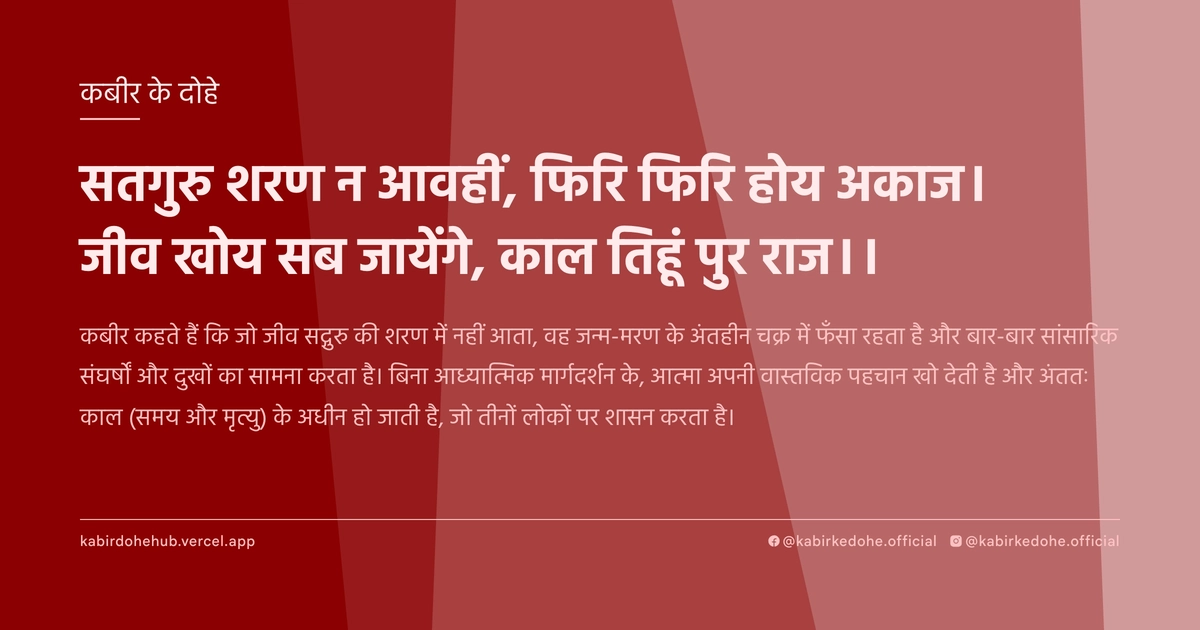
सतगुरु शरण न आवहीं, फिरि फिरि होय अकाज।
जीव खोय सब जायेंगे, काल तिहूं पुर राज।।
Satguru sharan na aavahin, phir phir hoye akaaj. Jeev khoy sab jaayenge, kaal tihu pur raaj.
इस पृष्ठ पर इस कबीर दोहे का अर्थ (meaning), हिंदी व्याख्या और अंग्रेज़ी अनुवाद, दार्शनिक विश्लेषण और व्यावहारिक जीवन सीख दी गई है। यह दोहा गुरु महत्व (The Guru's Importance) विषय से जुड़ा है — Kabir doha meaning and explanation in Hindi and English.
अर्थ (Meaning):
कबीर कहते हैं कि जो जीव सद्गुरु की शरण में नहीं आता, वह जन्म-मरण के अंतहीन चक्र में फँसा रहता है और बार-बार सांसारिक संघर्षों और दुखों का सामना करता है। बिना आध्यात्मिक मार्गदर्शन के, आत्मा अपनी वास्तविक पहचान खो देती है और अंततः काल (समय और मृत्यु) के अधीन हो जाती है, जो तीनों लोकों पर शासन करता है।
Kabir asserts that those who do not seek the refuge of a True Guru remain trapped in the endless cycle of birth and death, repeatedly facing worldly struggles and suffering. Without spiritual guidance, the soul loses its divine essence and eventually falls prey to Kaal (Time/Death), the sovereign ruler of the three realms of existence.
व्याख्या (Interpretation):
इस दोहे का शाब्दिक अर्थ है कि गुरु के बिना मोक्ष असंभव है। यहाँ 'सतगुरु' केवल एक व्यक्ति नहीं, बल्कि उस जागृत चेतना का प्रतीक है जो अज्ञानता के पर्दे को हटाती है। 'फिरि फिरि होय अकाज' उस पुनरावृत्ति को दर्शाता है जहाँ मनुष्य एक ही गलती को बार-बार करता है क्योंकि वह माया के प्रभाव में है। निर्गुण भक्ति के संदर्भ में, यह अद्वैत वेदांत की उस स्थिति को दर्शाता है जहाँ जीव स्वयं को ब्रह्म से अलग मानता है। जब तक यह द्वैत बना रहता है, जीव 'काल' यानी समय की सीमा और मृत्यु के भय से मुक्त नहीं हो पाता। यह विरोधाभास है कि हम जिसे अपना जीवन समझते हैं, वह वास्तव में काल का खेल है, और केवल आत्म-साक्षात्कार ही इस बंधन को काट सकता है।
Literally, the verse suggests that liberation is impossible without a True Guru. Here, 'Satguru' is not merely a physical person but a symbol of the awakened consciousness that strips away the veil of ignorance. 'Phir phir hoy akaaj' refers to the repetitive nature of human suffering, where the soul repeats the same karmic errors under the influence of Maya. In the context of Nirgun Bhakti, this aligns with Advaita Vedanta, where the soul perceives itself as separate from Brahman. As long as this duality persists, the individual remains subject to 'Kaal' (Time/Death), the ruler of the three worlds. The central paradox is that what we perceive as our independent life is actually a play of cosmic time, and only the realization of the non-dual Self can sever these chains.
दार्शनिक विश्लेषण (Philosophical Analysis):
कबीर का यह दोहा उस युग की उपज है जब धर्म केवल कर्मकांडों और बाहरी आडंबरों तक सीमित था। कबीर ने पुरोहितवाद और जाति व्यवस्था पर कड़ा प्रहार किया, क्योंकि उनका मानना था कि ईश्वर किसी मंदिर या मस्जिद में नहीं, बल्कि मनुष्य के भीतर है। यहाँ 'शरण' का अर्थ शारीरिक समर्पण नहीं, बल्कि अहंकार का विसर्जन है। जब तक 'मैं' जीवित है, तब तक सत्य का अनुभव नहीं हो सकता।
दार्शनिक रूप से, यह सूफीवाद के 'फना' (अहंकार का विनाश) और वेदांत के 'अहं ब्रह्मास्मि' के बीच का सेतु है। कबीर तर्क देते हैं कि बिना एक योग्य मार्गदर्शक के, मनुष्य अपनी इंद्रियों के भ्रम में उलझा रहता है। यह भ्रम ही 'माया' है, जो जीव को यह विश्वास दिलाती है कि वह शरीर है, जबकि वह वास्तव में अविनाशी आत्मा है।
काल (Time) को यहाँ एक शासक के रूप में चित्रित किया गया है। यह समय की वह धारा है जो हर चीज़ को नष्ट कर देती है। कबीर के अनुसार, जो व्यक्ति केवल भौतिक सुखों के पीछे भागता है, वह काल के जाल में फँस जाता है। आध्यात्मिक जागृति ही वह एकमात्र तरीका है जिससे समय की सीमाओं को पार किया जा सकता है।
यह शिक्षण मनोवैज्ञानिक रूपांतरण की बात करता है। जब जीव यह समझ जाता है कि उसकी बाहरी उपलब्धियाँ क्षणभंगुर हैं, तब वह आंतरिक शांति की खोज शुरू करता है। यह प्रक्रिया 'अविद्या' (अज्ञान) से 'विद्या' (ज्ञान) की ओर संक्रमण है।
अंततः, कबीर यह स्पष्ट करते हैं कि मोक्ष कोई बाहरी स्थान नहीं है जहाँ मृत्यु के बाद जाया जाए, बल्कि यह वर्तमान क्षण में अपनी वास्तविक प्रकृति को पहचानना है। जो इस सत्य को नहीं पहचानता, वह जन्म और मृत्यु के चक्र में भटकता रहता है।
This Doha emerges from an era where religion was confined to rituals and outward displays. Kabir fiercely critiqued priestly dominance and the caste system, asserting that the Divine resides within the human heart, not in temples or mosques. Here, 'refuge' does not mean physical submission but the dissolution of the ego. As long as the 'I' persists, the experience of Truth remains elusive.
Philosophically, this is a bridge between the Sufi concept of 'Fana' (annihilation of the self) and the Vedantic 'Aham Brahmasmi' (I am Brahman). Kabir argues that without a qualified guide, a human remains entangled in the delusions of the senses. This delusion is 'Maya,' which convinces the soul it is the body, whereas it is actually the eternal Atman.
'Kaal' (Time) is depicted as a sovereign ruler. It is the current of time that consumes everything. According to Kabir, those who chase material pleasures fall into the trap of Kaal. Spiritual awakening is the only mechanism to transcend the limitations of temporal existence.
This teaching emphasizes psychological transformation. When an individual realizes that external achievements are ephemeral, they begin the quest for inner peace. This process is the transition from 'Avidya' (ignorance) to 'Vidya' (knowledge).
Ultimately, Kabir clarifies that liberation is not a destination reached after death, but the recognition of one's true nature in the present moment. Those who fail to recognize this truth remain adrift in the cycle of samsara.
मूल संदेश (Core Message):
- अहंकार ही वह पर्दा है जो हमें सत्य से दूर रखता है।
- बाहरी अनुष्ठान केवल भ्रम हैं; वास्तविक पूजा अंतर्मन की शुद्धि है।
- गुरु वह दर्पण है जो हमें हमारे वास्तविक स्वरूप का दर्शन कराता है।
- समय (काल) केवल उन्हीं को बांधता है जो शरीर को ही सत्य मानते हैं।
- मुक्ति का मार्ग बाहरी यात्रा नहीं, बल्कि आंतरिक गहराई की यात्रा है।
- The ego is the only veil that separates us from the Ultimate Truth.
- External rituals are mere illusions; true worship is the purification of the inner self.
- The Guru is the mirror that reveals our authentic, divine nature.
- Time (Kaal) only binds those who mistake the physical body for the ultimate reality.
- The path to liberation is not an external journey, but a descent into inner depth.
व्यावहारिक उदाहरण (Practical Example):
एक समय की बात है, वाराणसी के घाटों पर रामदीन नाम का एक वृद्ध बुनकर रहता था। रामदीन अपनी कला में निपुण था, लेकिन उसका मन हमेशा अशांत रहता था। वह दिन भर कपड़े बुनता और रात को इस चिंता में डूब जाता कि उसका बेटा उसे सम्मान नहीं देता और उसकी संपत्ति कम हो रही है। वह अपनी सारी ऊर्जा बाहरी दुनिया को सुधारने और दूसरों से मान्यता पाने में लगा रहा था।
रामदीन अक्सर मंदिर जाता और पंडितों को भारी दान देता, यह सोचकर कि इससे उसे शांति मिलेगी। लेकिन जैसे ही वह मंदिर से बाहर निकलता, उसका क्रोध और ईर्ष्या फिर से लौट आते। वह एक चक्र में फँसा हुआ था—मेहनत, चिंता, दान और फिर वही मानसिक पीड़ा। उसे लगता था कि उसकी समस्याएँ बाहरी परिस्थितियों के कारण हैं।
एक दिन उसकी मुलाकात एक मौन साधु से हुई, जो घाट की सीढ़ियों पर बैठे थे। रामदीन ने उनसे अपनी व्यथा कही और पूछा कि शांति कैसे मिलेगी। साधु ने केवल एक बात कही, "तुम कपड़े तो बुन रहे हो, लेकिन अपने भीतर के अहंकार के धागों को नहीं देख रहे। तुम बाहरी दुनिया को बदलने की कोशिश कर रहे हो, जबकि बदलना खुद को है।"
रामदीन को पहले यह बात समझ नहीं आई। उसने सोचा कि यह केवल शब्दों का खेल है। लेकिन साधु ने उसे एक प्रयोग दिया: "अगले सात दिनों तक, जब भी तुम क्रोध करो या चिंता करो, बस यह देखो कि वह भावना कहाँ से आ रही है। उसे रोकने की कोशिश मत करो, बस उसे एक साक्षी की तरह देखो।"
शुरुआत में रामदीन को बहुत कठिनाई हुई। उसे महसूस हुआ कि उसका पूरा जीवन एक 'अकाज' (व्यर्थ कार्य) था, क्योंकि वह हमेशा दूसरों की नजरों में अपनी कीमत ढूँढ रहा था। उसे एहसास हुआ कि वह 'काल' के उस जाल में था जहाँ समय केवल तनाव और पछतावे में बीत रहा था।
धीरे-धीरे, रामदीन ने देखा कि उसकी अशांति का कारण उसका बेटा या उसकी गरीबी नहीं थी, बल्कि उसकी अपनी यह धारणा थी कि उसे 'सम्मान' मिलना ही चाहिए। यह 'मैं' की भावना ही उसका सबसे बड़ा बंधन थी।
एक सुबह, जब वह करघे पर बैठा था, उसे अचानक एक गहरा अनुभव हुआ। उसे महसूस हुआ कि वह बुनकर नहीं है, बल्कि वह चेतना है जो इस पूरे खेल को देख रही है। उसका अहंकार पिघल गया और वह एक गहरी शांति में डूब गया।
अब रामदीन अपने बेटे से उम्मीदें नहीं करता था। वह कपड़े इसलिए नहीं बुनता था कि उसे दुनिया से तारीफ मिले, बल्कि इसलिए बुनता था क्योंकि बुनना ही उसकी साधना बन गया था।
उसका व्यवहार बदल गया। वह अब दूसरों की गलतियों पर क्रोध नहीं करता था, बल्कि करुणा से उन्हें देखता था। उसने जान लिया था कि सद्गुरु का मार्गदर्शन बाहरी आदेश नहीं, बल्कि आंतरिक जागरूकता है।
रामदीन अब भी वही पुराना बुनकर था, लेकिन उसके भीतर का संसार बदल चुका था। वह अब काल के शासन से मुक्त होकर वर्तमान के आनंद में जीने लगा था।
Once, in the ghats of Varanasi, lived an elderly weaver named Ramdeen. Ramdeen was a master of his craft, yet his mind was perpetually restless. He spent his days weaving cloth and his nights drowning in anxiety that his son did not respect him and his wealth was dwindling. He invested all his energy into fixing the external world and seeking validation from others.
Ramdeen frequently visited temples and gave lavish donations to priests, believing this would bring him peace. However, the moment he stepped out, his anger and jealousy returned. He was trapped in a cycle—toil, anxiety, donation, and the same mental agony. He believed his problems were caused by external circumstances.
One day, he encountered a silent monk sitting on the steps of the ghat. Ramdeen shared his distress and asked how to find peace. The monk said only one thing: "You are weaving cloth, but you do not see the threads of ego within you. You are trying to change the world, while the only thing that needs changing is yourself."
At first, Ramdeen did not understand. He thought it was mere wordplay. But the monk gave him an experiment: "For the next seven days, whenever you feel anger or anxiety, simply observe where that emotion is coming from. Do not try to stop it; just watch it as a witness."
Initially, Ramdeen struggled. He realized his entire life had been an 'akaaj' (futile effort) because he was always searching for his value in the eyes of others. He saw that he was caught in the trap of 'Kaal,' where time was spent only in stress and regret.
Gradually, Ramdeen noticed that the cause of his unrest was not his son or his poverty, but his own deep-seated belief that he 'deserved' respect. This sense of 'I' was his greatest bondage.
One morning, while sitting at his loom, he had a profound realization. He felt that he was not the weaver, but the consciousness observing the entire play. His ego dissolved, and he sank into a deep silence.
Ramdeen stopped expecting things from his son. He no longer wove cloth for the praise of the world; weaving itself became his meditation.
His behavior transformed. He no longer reacted to others' mistakes with anger but looked at them with compassion. He understood that the guidance of a True Guru is not an external command, but an internal awakening.
Ramdeen remained the same old weaver, but the world within him had changed. He was now free from the dominion of Kaal, living in the bliss of the present moment.
अभ्यास मार्गदर्शन (Practice Guidance):
- प्रतिदिन 20 मिनट 'साक्षी भाव' का अभ्यास करें: अपने विचारों को बिना किसी निर्णय के देखें, जैसे आप किसी और के विचार देख रहे हों।
- आत्म-पूछताछ जर्नल: हर रात लिखें कि आज किस बात पर आपका अहंकार आहत हुआ और वह 'मैं' कौन था जिसे चोट पहुँची?
- व्यवहारिक परिवर्तन: दिन में कम से कम एक बार किसी ऐसे व्यक्ति की मदद करें जिससे आपका मतभेद हो, बिना किसी अपेक्षा के।
- निदान चेकलिस्ट: क्या आप अभी भी अपनी खुशी दूसरों की प्रतिक्रियाओं पर निर्भर रखते हैं? क्या आप अतीत के पछतावे या भविष्य की चिंता में अधिक समय बिताते हैं? यदि हाँ, तो आप अभी भी 'काल' के प्रभाव में हैं।
- Practice 'Witness Consciousness' for 20 minutes daily: Observe your thoughts without judgment, as if you are watching someone else's mind.
- Self-Inquiry Journaling: Every night, record instances where your ego felt bruised and ask, 'Who is this "I" that felt hurt?'
- Behavioral Shift: At least once a day, help someone you disagree with, without any expectation of gratitude or return.
- Diagnostic Checklist: Do you still depend on others' reactions for your happiness? Do you spend more time in past regrets or future anxieties? If yes, you are still under the dominion of 'Kaal'.
चिंतन प्रश्न (Reflection Questions):
- आपकी वह कौन सी पहचान है जिसे आप खोने से सबसे ज्यादा डरते हैं?
- क्या आपका 'आध्यात्मिक' होना वास्तव में आपकी ईगो को और अधिक संतुष्ट कर रहा है?
- यदि आज आपकी सारी सामाजिक प्रतिष्ठा छीन ली जाए, तो आपके भीतर क्या बचेगा?
- आप किन आदतों को बार-बार दोहरा रहे हैं, यह जानते हुए भी कि वे आपको दुख देती हैं?
- क्या आप वास्तव में सत्य की खोज में हैं, या केवल अपनी बेचैनी का समाधान ढूँढ रहे हैं?
- Which part of your identity are you most terrified of losing?
- Is your 'spirituality' actually serving to further inflate your ego?
- If all your social status were stripped away today, what would remain inside you?
- Which patterns of behavior do you repeat endlessly, despite knowing they cause you pain?
- Are you truly seeking the Truth, or are you merely looking for a remedy for your restlessness?