
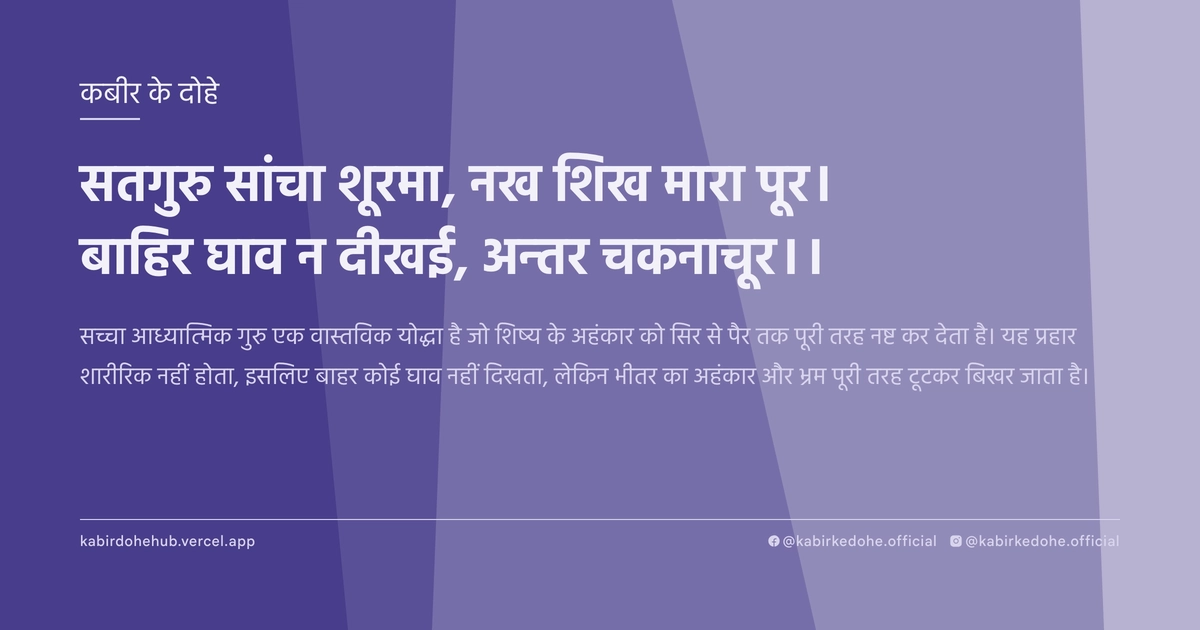
सतगुरु सांचा शूरमा, नख शिख मारा पूर।
बाहिर घाव न दीखई, अन्तर चकनाचूर।।
Satguru saancha shoorma, nakh shikh maara poor. Baahir ghaav na deekhai, antar chaknachoor.
इस पृष्ठ पर इस कबीर दोहे का अर्थ (meaning), हिंदी व्याख्या और अंग्रेज़ी अनुवाद, दार्शनिक विश्लेषण और व्यावहारिक जीवन सीख दी गई है। यह दोहा गुरु महत्व (The Guru's Importance) विषय से जुड़ा है — Kabir doha meaning and explanation in Hindi and English.
अर्थ (Meaning):
सच्चा आध्यात्मिक गुरु एक वास्तविक योद्धा है जो शिष्य के अहंकार को सिर से पैर तक पूरी तरह नष्ट कर देता है। यह प्रहार शारीरिक नहीं होता, इसलिए बाहर कोई घाव नहीं दिखता, लेकिन भीतर का अहंकार और भ्रम पूरी तरह टूटकर बिखर जाता है।
The true spiritual master is a genuine warrior who strikes the disciple from head to toe, obliterating the ego entirely. This assault is not physical, leaving no external wounds, yet the internal structure of the false ego is shattered into a thousand pieces.
व्याख्या (Interpretation):
इस दोहे में 'शूरमा' शब्द का प्रयोग गुरु के लिए किया गया है, जो पारंपरिक वीरता के विपरीत, चेतना के स्तर पर युद्ध लड़ते हैं। 'नख शिख' का अर्थ है कि अहंकार का कोई भी कोना सुरक्षित नहीं बचता। यह निरगुण भक्ति का सार है जहाँ ईश्वर किसी मूर्ति में नहीं, बल्कि स्वयं के भीतर के अज्ञान के विनाश में मिलता है। माया द्वारा निर्मित 'मैं' की छवि को जब गुरु का ज्ञान भेदता है, तो वह द्वैत का अंत होता है। यह प्रक्रिया दर्दनाक हो सकती है क्योंकि यह हमारी पहचान को मिटाती है, लेकिन यही मुक्ति का एकमात्र मार्ग है। अंततः, यह आत्मा और ब्रह्म की एकता (अद्वैत) की ओर ले जाता है, जहाँ केवल सत्य शेष रहता है।
In this couplet, the term 'warrior' is applied to the Guru, who fights a battle not of steel, but of consciousness. 'Nakh shikh' implies that no corner of the ego remains untouched or safe. This encapsulates the essence of Nirgun Bhakti, where the Divine is found not in idols, but in the annihilation of one's own ignorance. When the Guru's wisdom pierces the image of 'I' constructed by Maya, the duality of existence ends. This process can be agonizing as it dismantles the perceived identity, yet it is the sole path to liberation. Ultimately, it leads to the non-duality of Atman and Brahman, where only the Absolute Truth remains.
दार्शनिक विश्लेषण (Philosophical Analysis):
कबीर का यह दृष्टिकोण उनके समय के कर्मकांडीय धर्म के विरुद्ध एक तीव्र प्रहार था। जहाँ पंडित और मुल्ला बाहरी शुद्धि और रीति-रिवाजों पर जोर देते थे, कबीर ने आंतरिक रूपांतरण की बात की। उनके लिए 'धर्म' का अर्थ मंदिर जाना नहीं, बल्कि अहंकार का विसर्जन था।
यह दर्शन अद्वैत वेदांत के 'नेति नेति' (यह नहीं, वह नहीं) के सिद्धांत से मेल खाता है, जहाँ सत्य तक पहुँचने के लिए पहले हर उस चीज़ को नकारना पड़ता है जो सत्य नहीं है। गुरु यहाँ एक उत्प्रेरक है जो शिष्य के मानसिक भ्रमों को नष्ट करता है।
सूफीवाद के 'फना' (Fana) के विचार के साथ इसका गहरा संबंध है, जिसका अर्थ है ईश्वर में स्वयं का विलीन हो जाना। जब तक 'मैं' मौजूद है, तब तक 'वह' (परमात्मा) प्रकट नहीं हो सकता। अहंकार का 'चकनाचूर' होना ही वास्तव में परमात्मा का उदय है।
मनोवैज्ञानिक स्तर पर, यह 'ईगो डेथ' की प्रक्रिया है। कबीर समझाते हैं कि जिसे हम अपना व्यक्तित्व समझते हैं, वह वास्तव में सामाजिक अनुकूलन और डर का एक संचय है। गुरु इस कृत्रिम खोल को तोड़ता है ताकि वास्तविक स्वरूप बाहर आ सके।
अतः, यह दोहा केवल गुरु की महिमा नहीं है, बल्कि एक कठोर आध्यात्मिक सर्जरी का वर्णन है। यह चेतावनी देता है कि वास्तविक आध्यात्मिक प्रगति सुखद नहीं, बल्कि विनाशकारी होती है—पुराने व्यक्तित्व का विनाश ताकि नया, दिव्य व्यक्तित्व जन्म ले सके।
Kabir's perspective serves as a fierce critique of the ritualistic religion of his era. While the pundits and mullahs emphasized external purity and formal rites, Kabir advocated for internal transmutation. For him, 'religion' was not about visiting temples, but the dissolution of the ego.
This philosophy aligns with the Advaita Vedanta principle of 'Neti Neti' (not this, not that), where reaching the Truth requires the negation of everything that is not Truth. The Guru acts as the catalyst who shatters the disciple's mental delusions.
There is a profound connection here to the Sufi concept of 'Fana' (annihilation), the idea of the self dissolving into the Divine. As long as the 'I' exists, the 'He' (the Absolute) cannot manifest. The 'shattering' of the ego is, in reality, the emergence of the Divine.
On a psychological level, this describes the process of 'ego death.' Kabir explains that what we perceive as our personality is merely an accumulation of social conditioning and fear. The Guru breaks this artificial shell so the authentic essence can emerge.
Thus, this couplet is not merely praising the Guru, but describing a rigorous spiritual surgery. It warns that genuine spiritual progress is not pleasant, but destructive—the destruction of the old persona so a new, divine identity can be born.
मूल संदेश (Core Message):
- अहंकार वह पर्दा है जो सत्य को ओझल करता है।
- सच्चा ज्ञान वह है जो हमें छोटा महसूस कराकर शून्य करता है।
- बाहरी शांति अक्सर आंतरिक उथल-पुथल का मुखौटा होती है।
- गुरु का प्रहार विनाश नहीं, बल्कि वास्तविक पुनर्जन्म है।
- जब 'मैं' मिटता है, तभी 'परमात्मा' प्रकट होता है।
- The ego is the veil that obscures the Absolute Truth.
- True knowledge is that which reduces us to zero by exposing our insignificance.
- External peace is often a mask for internal turmoil.
- The Guru's strike is not destruction, but a genuine rebirth.
- Only when the 'I' vanishes does the Divine manifest.
व्यावहारिक उदाहरण (Practical Example):
वाराणसी के एक पुराने घाट पर माधव नाम का एक वृद्ध बुनकर रहता था। वह अपने काम में निपुण था, लेकिन उसे अपनी कला का बहुत अहंकार था। वह मानता था कि उसके जैसा महीन कपड़ा पूरे शहर में कोई नहीं बुन सकता।
एक दिन उसकी मुलाकात एक फकीर से हुई, जिसने माधव के काम की प्रशंसा नहीं की, बल्कि उसकी आँखों में झाँककर कहा, 'तू धागे नहीं, अपनी जिद बुन रहा है।'
माधव को यह बात चुभी। उसने फकीर को चुनौती दी कि वह उसकी कला में कमी बताए। फकीर ने मुस्कुराते हुए कहा, 'कमी कपड़े में नहीं, उस हाथ में है जो सोचता है कि वह श्रेष्ठ है।'
अगले कुछ हफ्तों तक, फकीर ने माधव के हर गर्वपूर्ण दावे को तर्क और मौन से काट दिया। वह माधव के उन हिस्सों पर प्रहार करता जहाँ वह सबसे अधिक अहंकारी महसूस करता था।
एक शाम, फकीर ने माधव से कहा, 'यदि तू वास्तव में महान कलाकार है, तो वह कपड़ा बुन जो तेरे अहंकार को ढक सके।' माधव ने कोशिश की, लेकिन उसे एहसास हुआ कि उसका अहंकार इतना विशाल है कि दुनिया का कोई भी कपड़ा उसे नहीं ढक सकता।
उस क्षण माधव का गर्व टूट गया। उसे महसूस हुआ कि उसकी पूरी पहचान केवल एक 'श्रेष्ठ बुनकर' होने के भ्रम पर टिकी थी। वह फूट-फूट कर रोने लगा।
बाहर से माधव वैसा ही दिख रहा था—वही पुराना बुनकर, वही कपड़े। लेकिन भीतर से वह पूरी तरह बदल चुका था। उसका 'मैं' चकनाचूर हो गया था।
अब वह कपड़े केवल पैसे या प्रसिद्धि के लिए नहीं, बल्कि सेवा और प्रेम के लिए बुनने लगा। उसकी कला में अब एक ऐसी शांति थी जो पहले कभी नहीं थी, क्योंकि अब बुनने वाला 'मैं' गायब था, केवल बुनना शेष था।
On an old ghat in Varanasi lived an elderly weaver named Madhav. He was masterly in his craft, but he possessed a towering ego regarding his skill. He believed no one in the entire city could weave fabric as fine as his.
One day, he encountered a wandering fakir. Instead of praising Madhav's work, the fakir looked into his eyes and said, 'You are not weaving threads; you are weaving your own stubbornness.'
This stung Madhav. He challenged the fakir to point out a flaw in his art. The fakir smiled and replied, 'The flaw is not in the cloth, but in the hand that believes itself to be superior.'
Over the next few weeks, the fakir dismantled every proud claim Madhav made using logic and silence. He struck exactly at those points where Madhav felt most superior.
One evening, the fakir told Madhav, 'If you are truly a great artist, weave a cloth that can cover your ego.' Madhav tried, but he suddenly realized his ego was so vast that no cloth in the world could possibly cover it.
In that moment, Madhav's pride shattered. He realized his entire identity was built upon the illusion of being a 'superior weaver.' He broke down in tears.
Externally, Madhav looked the same—the same old weaver, the same clothes. But internally, he was completely transformed. His 'I' had been shattered into pieces.
He began weaving not for money or fame, but for service and love. There was now a peace in his art that had never existed before, because the 'weaver' had vanished, leaving only the act of weaving.
अभ्यास मार्गदर्शन (Practice Guidance):
- प्रतिदिन 20 मिनट मौन बैठें और अपने भीतर उठने वाले 'मैं' (अहंकार) के विचारों को केवल देखें, बिना किसी निर्णय के।
- एक डायरी लिखें जिसमें आप उन क्षणों को दर्ज करें जब आपको अपनी श्रेष्ठता का अनुभव हुआ और फिर विश्लेषण करें कि वह भावना कहाँ से आई।
- सचेत व्यवहार: दिन में कम से कम एक बार किसी ऐसे व्यक्ति की मदद करें जिसे आप 'अपने स्तर से नीचे' समझते हैं, और महसूस करें कि आप दोनों का मूल तत्व एक ही है।
- निदान चेकलिस्ट: क्या आप आलोचना सुनकर क्रोधित होते हैं? क्या आप दूसरों को सुधारने की तीव्र इच्छा रखते हैं? यदि हाँ, तो आपका अहंकार अभी भी अक्षुण्ण है।
- Sit in silence for 20 minutes daily and simply observe the thoughts of 'I' (ego) arising within, without judgment.
- Keep a journal recording moments when you felt a sense of superiority, then analyze the root source of that emotion.
- Conscious Behavior: At least once a day, help someone you perceive as 'below your level' and realize that the fundamental essence of both is identical.
- Diagnostic Checklist: Do you react with anger to criticism? Do you have an intense urge to 'correct' others? If yes, your ego remains intact.
चिंतन प्रश्न (Reflection Questions):
- यदि आपकी सभी उपलब्धियाँ और पद छीन लिए जाएँ, तो आपके पास क्या बचेगा?
- आपकी वह कौन सी 'छवि' है जिसे आप दुनिया के सामने बनाए रखने के लिए सबसे अधिक संघर्ष करते हैं?
- क्या आप वास्तव में सत्य की खोज कर रहे हैं, या केवल अपनी मान्यताओं की पुष्टि चाहते हैं?
- आपके भीतर का वह कौन सा हिस्सा है जो किसी की बात सुनने पर तुरंत रक्षात्मक (defensive) हो जाता है?
- क्या आप उस शून्य को स्वीकार करने के लिए तैयार हैं जहाँ आपकी कोई व्यक्तिगत पहचान नहीं होगी?
- If all your achievements and titles were stripped away, what would remain of you?
- What is the specific 'image' of yourself that you struggle most to maintain before the world?
- Are you truly seeking the Truth, or are you merely seeking confirmation of your existing beliefs?
- Which part of you becomes instantly defensive when someone challenges your perspective?
- Are you prepared to accept the void where your personal identity ceases to exist?