
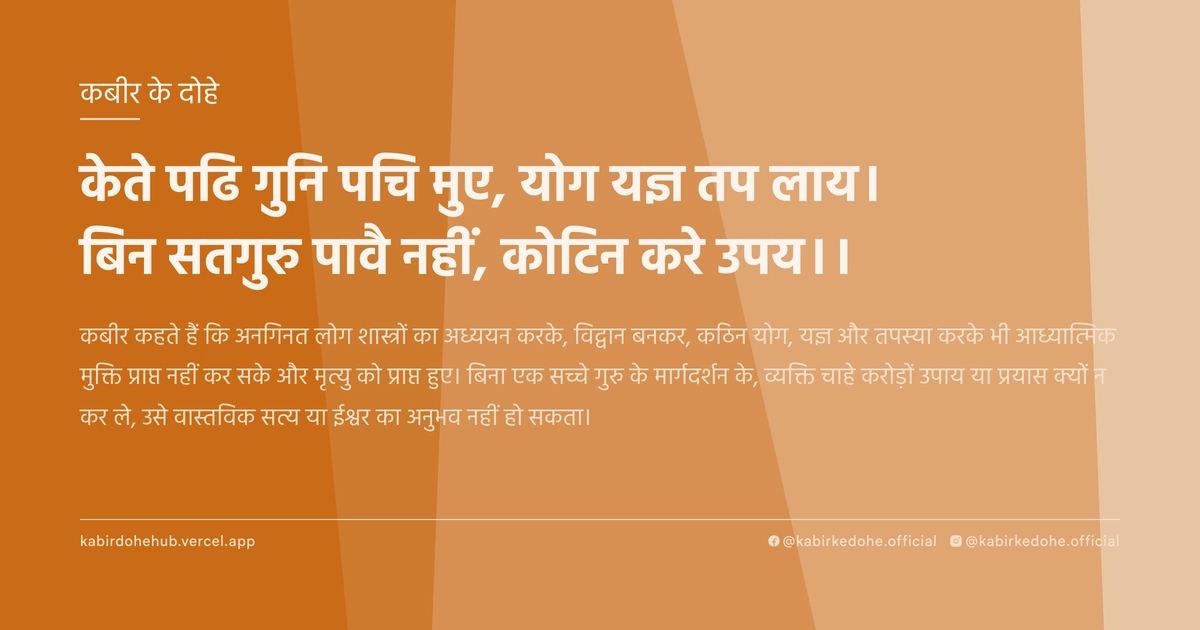
केते पढि गुनि पचि मुए, योग यज्ञ तप लाय।
बिन सतगुरु पावै नहीं, कोटिन करे उपय।।
Kete padhi guni pachi mue, yog yagya tap laay. Bin satguru paavai nahi, kotin kare upay.
इस पृष्ठ पर इस कबीर दोहे का अर्थ (meaning), हिंदी व्याख्या और अंग्रेज़ी अनुवाद, दार्शनिक विश्लेषण और व्यावहारिक जीवन सीख दी गई है। यह दोहा गुरु महत्व (The Guru's Importance) विषय से जुड़ा है — Kabir doha meaning and explanation in Hindi and English.
अर्थ (Meaning):
कबीर कहते हैं कि अनगिनत लोग शास्त्रों का अध्ययन करके, विद्वान बनकर, कठिन योग, यज्ञ और तपस्या करके भी आध्यात्मिक मुक्ति प्राप्त नहीं कर सके और मृत्यु को प्राप्त हुए। बिना एक सच्चे गुरु के मार्गदर्शन के, व्यक्ति चाहे करोड़ों उपाय या प्रयास क्यों न कर ले, उसे वास्तविक सत्य या ईश्वर का अनुभव नहीं हो सकता।
Kabir asserts that countless individuals have perished despite their scholarly pursuits, mastery of texts, and rigorous adherence to yoga, ritual sacrifices, and austerities. He emphasizes that without the grace and guidance of a True Guru (Satguru), one cannot attain ultimate liberation, regardless of how many millions of external methods or spiritual techniques they employ.
व्याख्या (Interpretation):
इस दोहे का शाब्दिक अर्थ है कि केवल किताबी ज्ञान या बाहरी अनुष्ठान मोक्ष नहीं दिलाते। रूपक के स्तर पर, 'पढ़ना' और 'तप' अहंकार की वृद्धि के साधन बन जाते हैं, जहाँ साधक अपनी उपलब्धि पर गर्व करने लगता है। यह निर्गुण भक्ति का सार है: ईश्वर किसी कर्मकांड में नहीं, बल्कि हृदय की शुद्धता में है। माया यहाँ उस भ्रम के रूप में है जो हमें विश्वास दिलाता है कि हम अपनी बौद्धिक क्षमता से सत्य को 'जीत' सकते हैं। अद्वैत वेदांत के अनुसार, जब तक 'मैं' (अहंकार) जीवित है, तब तक ब्रह्म का अनुभव असंभव है। सतगुरु वह दर्पण है जो साधक को उसके अपने भ्रमों से परिचित कराता है और उसे आत्मा और परमात्मा की एकता का बोध कराता है।
Literally, the verse warns that academic learning and ritualistic penance are insufficient for liberation. Metaphorically, 'studying' and 'austerity' often become fuel for the ego, where the seeker mistakes intellectual accumulation for spiritual realization. This aligns with Nirgun Bhakti, suggesting that the Formless Divine is not captured by rituals but by the purity of the heart. Maya manifests here as the illusion that truth can be 'acquired' through effort or intellect. According to Advaita Vedanta, as long as the 'I' (ego) persists, the non-duality of Atman and Brahman remains hidden. The Satguru acts as the catalyst or the mirror, stripping away the seeker's delusions to reveal the inherent unity of the self and the universe.
दार्शनिक विश्लेषण (Philosophical Analysis):
कबीर का यह दोहा उस समय के सामाजिक और धार्मिक परिवेश पर एक तीखा प्रहार है, जहाँ ब्राह्मणवादी कर्मकांड और बाहरी आडंबरों का बोलबाला था। कबीर ने स्पष्ट किया कि मोक्ष किसी विशेष जाति, शास्त्र या कठिन शारीरिक तपस्या का परिणाम नहीं है, बल्कि यह आंतरिक रूपांतरण की प्रक्रिया है। वे यहाँ 'ज्ञान' और 'बोध' के बीच के अंतर को रेखांकित करते हैं। शास्त्र केवल संकेत देते हैं, लेकिन अनुभव केवल गुरु के सानिध्य में आता है।
दार्शनिक रूप से, यह सूफी मत के 'पीर' और वेदांत के 'गुरु' की अवधारणा का संगम है। सूफीवाद में 'फना' (अहंकार का विनाश) अनिवार्य है, और कबीर का मानना है कि बिना गुरु के व्यक्ति अपने अहंकार के जाल में इतना उलझ जाता है कि वह स्वयं को ही सत्य मान बैठता है। वह 'उपाय' शब्द का प्रयोग उन सभी कृत्रिम तरीकों के लिए करते हैं जो मनुष्य ईश्वर तक पहुँचने के लिए अपनाता है, जबकि मार्ग वास्तव में समर्पण का है।
कबीर का विरोध धर्म से नहीं, बल्कि धर्म के नाम पर पाले गए अहंकार से है। वे तर्क देते हैं कि यदि केवल पढ़ने से मुक्ति मिलती, तो सभी विद्वान मुक्त होते। यह विचार इस बात पर जोर देता है कि आध्यात्मिक यात्रा एक 'अनलर्निंग' (unlearning) की प्रक्रिया है, जहाँ व्यक्ति को वह सब भूलना पड़ता है जो उसने दुनिया से सीखा है।
यहाँ 'सतगुरु' केवल एक व्यक्ति नहीं, बल्कि वह चेतना है जो साधक को उसके वास्तविक स्वरूप से मिलाती है। यह अद्वैत की उस स्थिति की ओर इशारा है जहाँ ज्ञाता, ज्ञान और ज्ञेय का भेद समाप्त हो जाता है। बिना इस मार्गदर्शन के, साधक केवल एक चक्रव्यूह में घूमता रहता है।
अंततः, यह विश्लेषण हमें बताता है कि सच्ची भक्ति बाहरी प्रदर्शन में नहीं, बल्कि आंतरिक मौन और समर्पण में निहित है। कबीर हमें चेतावनी देते हैं कि हम अपनी आध्यात्मिक उपलब्धियों के जाल में न फंसें, क्योंकि वही जाल हमारी मुक्ति का सबसे बड़ा अवरोध बन जाता है।
This Doha is a sharp critique of the socio-religious climate of Kabir's era, dominated by Brahmanical rituals and outward displays of piety. Kabir clarifies that liberation is not a product of a specific caste, scripture, or grueling physical austerity, but a process of internal transformation. He highlights the critical distinction between 'knowledge' (information) and 'realization' (experience). Scriptures provide signs, but the actual experience occurs only under the guidance of a realized master.
Philosophically, this is a convergence of the Sufi concept of the 'Pir' and the Vedantic 'Guru'. In Sufism, 'Fana' (the annihilation of the ego) is essential; Kabir believes that without a Guru, a seeker becomes so entangled in their own ego that they mistake their intellectual constructs for Truth. The term 'upay' (methods) refers to the artificial ladders humans build to reach the Divine, whereas the true path is one of total surrender.
Kabir's opposition is not toward religion itself, but toward the ego cultivated in the name of religion. He argues that if mere study led to liberation, all scholars would be free. This emphasizes that the spiritual journey is a process of 'unlearning,' where one must shed the conditioned identities imposed by society.
Here, the 'Satguru' is not merely a human teacher but the awakened consciousness that connects the seeker to their true nature. This points toward the Advaita state where the distinction between the knower, the known, and the knowledge dissolves. Without this guidance, the seeker merely wanders in a conceptual labyrinth.
Ultimately, this analysis reveals that true devotion lies not in external performance but in internal silence and surrender. Kabir warns us not to fall into the trap of our own spiritual achievements, as those very achievements often become the greatest obstacles to liberation.
मूल संदेश (Core Message):
- किताबी ज्ञान केवल सूचना है, बोध नहीं।
- अहंकार ही वह पर्दा है जो सत्य को ढकता है।
- बाहरी कर्मकांड आंतरिक रिक्तता को नहीं भर सकते।
- सच्चा गुरु वह है जो आपको आपसे मिला दे।
- समर्पण ही वह एकमात्र उपाय है जो वास्तव में काम करता है।
- Bookish knowledge is mere information, not realization.
- The ego is the veil that obscures the Truth.
- External rituals cannot fill internal emptiness.
- A true Guru is one who introduces you to yourself.
- Surrender is the only 'method' that truly works.
व्यावहारिक उदाहरण (Practical Example):
वाराणसी के घाटों पर रहने वाले एक वृद्ध बुनकर, माधव, का जीवन केवल धागों और करघे के इर्द-गिर्द घूमता था। माधव ने अपने जीवन के तीस साल केवल धार्मिक ग्रंथों को पढ़ने और कठिन उपवास करने में बिता दिए थे। वह शहर के सबसे बड़े विद्वानों के साथ शास्त्रार्थ करता और स्वयं को आध्यात्मिक रूप से श्रेष्ठ मानता था। उसने अपनी पूरी संपत्ति बड़े-बड़े यज्ञों और अनुष्ठानों में लगा दी, यह सोचकर कि इससे उसे मोक्ष प्राप्त होगा।
लेकिन माधव के भीतर एक गहरी अशांति थी। वह जितना अधिक पढ़ता, उतना ही अधिक दूसरों को तुच्छ समझने लगता। उसका ज्ञान उसके अहंकार का पोषण कर रहा था, न कि उसकी आत्मा का। वह अक्सर सोचता था कि आखिर कमी कहाँ रह गई, जबकि उसने सभी नियमों का पालन किया था।
एक दिन, घाट की एक छोटी सी कुटिया में रहने वाले एक मौन साधु से उसकी मुलाकात हुई। वह साधु न तो पढ़ा-लिखा था और न ही किसी विशेष संप्रदाय का पालन करता था। माधव ने गर्व से साधु को अपने द्वारा पढ़े गए ग्रंथों की सूची सुनाई और अपनी तपस्याओं का वर्णन किया।
साधु ने केवल एक बार उसकी आँखों में देखा और मुस्कुराते हुए पूछा, "माधव, तुमने किताबों में तो बहुत कुछ पढ़ा, लेकिन क्या तुमने कभी उस मौन को पढ़ा है जो तुम्हारे भीतर चीख रहा है? क्या तुम्हारा ज्ञान तुम्हें विनम्र बना पाया, या उसने तुम्हें केवल एक और ऊँची दीवार दे दी?"
यह प्रश्न माधव के लिए एक बिजली के झटके की तरह था। उसे एहसास हुआ कि उसने अब तक केवल 'उपाय' किए थे, सत्य को खोजा नहीं था। वह जिस ज्ञान पर गर्व कर रहा था, वह वास्तव में उसे सत्य से दूर ले जा रहा था क्योंकि वह ज्ञान 'मैं' के अहंकार से प्रेरित था।
माधव ने महसूस किया कि वह एक ऐसे अंधेरे कमरे में था जहाँ वह टॉर्च की रोशनी में दीवारों को देख रहा था, जबकि खिड़की बाहर खुली थी। साधु ने उसे कोई नई किताब नहीं दी, बल्कि उसे केवल यह सिखाया कि कैसे अपने अहंकार को धीरे-धीरे विसर्जित करना है।
अगले कुछ महीनों में, माधव ने ग्रंथों को पढ़ना बंद नहीं किया, लेकिन उनका उद्देश्य बदल गया। अब वह ज्ञान को अपनी श्रेष्ठता सिद्ध करने के लिए नहीं, बल्कि स्वयं को समझने के लिए पढ़ता था। उसने देखा कि जब वह दूसरों की सेवा बिना किसी अपेक्षा के करता है, तो वह शांति उसे किसी यज्ञ से नहीं मिली।
उसने अपने करघे पर काम करते हुए पाया कि हर धागा ईश्वर की एक अभिव्यक्ति है। अब वह केवल एक बुनकर नहीं था, बल्कि वह जीवन के ताने-बाने में परमात्मा की उपस्थिति को महसूस करने लगा।
माधव का रूपांतरण तब पूरा हुआ जब उसने अपनी सारी विद्वता का त्याग कर दिया और एक साधारण सेवक की तरह जीने लगा। उसने पाया कि जिस मोक्ष को वह किताबों में खोज रहा था, वह वास्तव में उसके अहंकार के मिटने के साथ ही प्रकट हो गया।
अंत में, माधव ने समझा कि सतगुरु वह नहीं है जो आपको जानकारी दे, बल्कि वह है जो आपको आपकी जानकारी के बोझ से मुक्त कर दे।
Madhav, an elderly weaver living on the ghats of Varanasi, spent his life revolving around threads and looms. For thirty years, Madhav dedicated himself to reading religious texts and observing rigorous fasts. He engaged in scholarly debates with the city's greatest intellectuals and considered himself spiritually superior. He spent his entire wealth on grand rituals and sacrifices, believing these were the keys to liberation.
However, a deep restlessness persisted within Madhav. The more he read, the more he looked down upon others. His knowledge was nourishing his ego rather than his soul. He often wondered where he was failing, despite his strict adherence to every religious rule.
One day, he met a silent ascetic living in a small hut by the river. This ascetic was neither formally educated nor affiliated with any specific sect. With pride, Madhav listed the scriptures he had mastered and described his austerities to the monk.
The monk looked into his eyes, smiled, and asked, "Madhav, you have read much in books, but have you ever read the silence that is screaming within you? Has your knowledge made you humble, or has it merely given you another high wall to hide behind?"
This question hit Madhav like a bolt of lightning. He realized that he had only been employing 'methods' (upay) and had never actually sought the Truth. The knowledge he prized was actually distancing him from the Divine because it was fueled by the ego of 'I'.
Madhav felt as if he had been in a dark room, using a flashlight to examine the walls, while the window to the outside world remained wide open. The ascetic did not give him a new book; instead, he taught him how to gradually dissolve his ego.
Over the next few months, Madhav did not stop reading, but his purpose changed. He no longer read to prove his superiority, but to understand his own ignorance. He discovered that the peace he found while serving others without expectation surpassed any peace he had gained from rituals.
While working at his loom, he began to see every thread as an expression of the Divine. He was no longer just a weaver; he began to feel the presence of the Eternal in the warp and weft of life.
Madhav's transformation was complete when he renounced his identity as a scholar and began living as a simple servant of humanity. He found that the liberation he sought in books manifested the moment his ego vanished.
In the end, Madhav understood that a Satguru is not one who provides information, but one who liberates you from the burden of your own information.
अभ्यास मार्गदर्शन (Practice Guidance):
- दैनिक आत्म-निरीक्षण: प्रतिदिन 20 मिनट मौन बैठें और विचार करें कि क्या आपका आध्यात्मिक अभ्यास आपको विनम्र बना रहा है या आपके अहंकार को बढ़ा रहा है।
- अहंकार की पहचान: जब भी आप किसी से श्रेष्ठ महसूस करें, तुरंत रुकें और स्वयं से पूछें, 'यह श्रेष्ठता कहाँ से आ रही है? क्या यह सत्य है या केवल एक मानसिक छवि?'
- सेवा का अभ्यास: बिना किसी प्रशंसा की इच्छा के किसी ऐसे व्यक्ति की मदद करें जिससे आपको कोई लाभ न हो, ताकि 'कर्ता' होने का भाव मिट सके।
- डायग्नोस्टिक चेकलिस्ट: यदि आप दूसरों की गलतियों पर अधिक ध्यान देते हैं और अपनी आध्यात्मिक उपलब्धियों पर गर्व करते हैं, तो आप अभी भी 'उपाय' के जाल में हैं। यदि आप स्वयं को शून्य महसूस करते हैं और सबके प्रति करुणा रखते हैं, तो आप सही मार्ग पर हैं।
- Daily Self-Inquiry: Sit in silence for 20 minutes daily and contemplate whether your spiritual practices are making you more humble or inflating your ego.
- Ego Identification: Whenever you feel superior to someone, stop immediately and ask, 'Where is this superiority coming from? Is it Truth, or merely a mental image?'
- Practice of Service: Help someone from whom you have nothing to gain, without any desire for praise, to dissolve the sense of being the 'doer'.
- Diagnostic Checklist: If you focus more on others' mistakes and take pride in your spiritual achievements, you are still trapped in 'upay' (methods). If you feel a sense of void/nothingness and hold compassion for all, you are on the right path.
चिंतन प्रश्न (Reflection Questions):
- क्या मेरी आध्यात्मिक पहचान मेरे सामाजिक अहंकार का एक नया रूप तो नहीं है?
- मैं जिन ग्रंथों को पढ़ता हूँ, क्या वे मुझे दूसरों के प्रति अधिक संवेदनशील बना रहे हैं या अधिक निर्णायक?
- यदि मुझसे मेरी सारी उपाधियाँ और ज्ञान छीन लिया जाए, तो मेरे भीतर क्या बचेगा?
- क्या मैं सत्य को खोज रहा हूँ, या मैं केवल यह साबित करना चाहता हूँ कि मैं सत्य को जानता हूँ?
- मेरे जीवन में 'सतगुरु' का अर्थ क्या है—एक व्यक्ति, एक सिद्धांत, या मेरी अपनी अंतरात्मा की जागृति?
- Is my spiritual identity merely a new form of my social ego?
- Do the texts I read make me more sensitive to others, or more judgmental?
- If all my titles and knowledge were stripped away, what would remain within me?
- Am I seeking the Truth, or am I merely trying to prove that I know the Truth?
- What does 'Satguru' mean in my life—a person, a principle, or the awakening of my own inner conscience?