
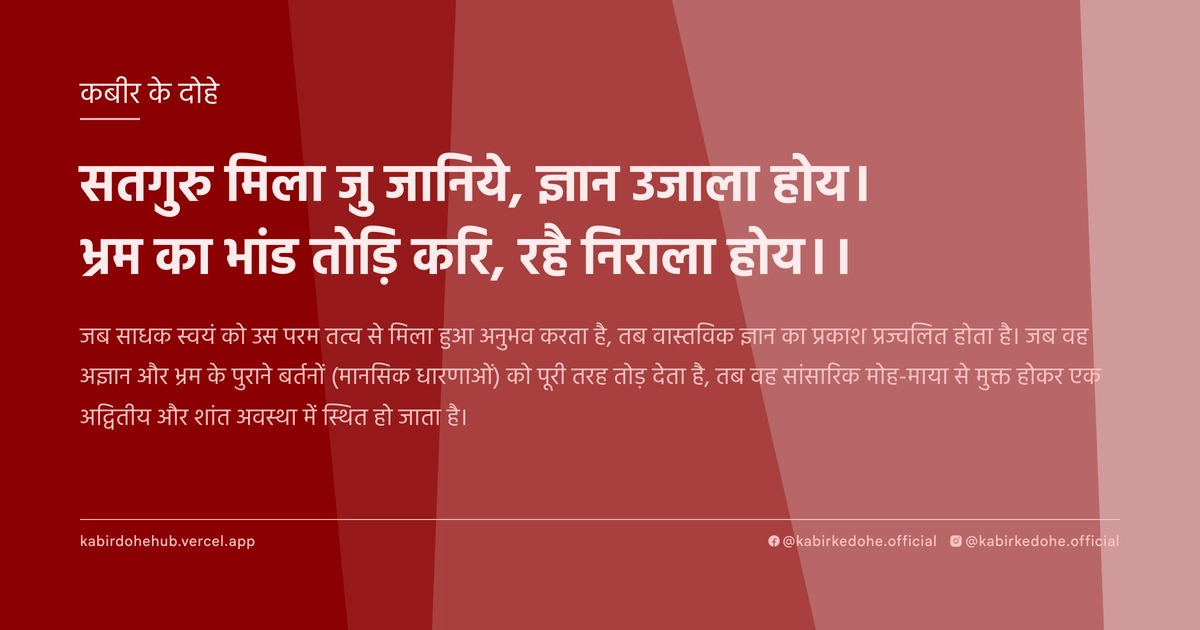
सतगुरु मिला जु जानिये, ज्ञान उजाला होय।
भ्रम का भांड तोड़ि करि, रहै निराला होय।।
Satguru mila ju jaaniye, gyan ujala hoye. Bhram ka bhand todikari, rahai nirala hoye.
इस पृष्ठ पर इस कबीर दोहे का अर्थ (meaning), हिंदी व्याख्या और अंग्रेज़ी अनुवाद, दार्शनिक विश्लेषण और व्यावहारिक जीवन सीख दी गई है। यह दोहा अंतर ज्योति (The Inner Light) विषय से जुड़ा है — Kabir doha meaning and explanation in Hindi and English.
अर्थ (Meaning):
जब साधक स्वयं को उस परम तत्व से मिला हुआ अनुभव करता है, तब वास्तविक ज्ञान का प्रकाश प्रज्वलित होता है। जब वह अज्ञान और भ्रम के पुराने बर्तनों (मानसिक धारणाओं) को पूरी तरह तोड़ देता है, तब वह सांसारिक मोह-माया से मुक्त होकर एक अद्वितीय और शांत अवस्था में स्थित हो जाता है।
When the seeker realizes their union with the Supreme Truth, the light of true knowledge dawns. By shattering the vessel of illusion—the rigid mental constructs and false identities—one transcends the mundane cycle of duality and attains a state of singular, liberated existence.
व्याख्या (Interpretation):
इस दोहे का शाब्दिक अर्थ है कि मिलन के बोध से ही ज्ञान का उदय होता है। यहाँ 'भ्रम का भांड' हमारी उन पूर्वधारणाओं, अहंकार और सामाजिक पहचानों का प्रतीक है जिनमें हमने सत्य को कैद करने की कोशिश की है। कबीर निरगुण भक्ति की बात करते हैं, जहाँ ईश्वर किसी मूर्ति में नहीं बल्कि चेतना के भीतर है। जब यह 'भांड' टूटता है, तो आत्मा और परमात्मा का द्वैत समाप्त हो जाता है, जो अद्वैत वेदांत के 'अहं ब्रह्मास्मि' के समान है। यह विखंडन दर्दनाक हो सकता है, लेकिन यही मुक्ति का एकमात्र मार्ग है। अंततः, 'निराला' होने का अर्थ है उस शून्य में विलीन होना जहाँ कोई दूसरा नहीं बचता।
Literally, the verse suggests that knowledge is a byproduct of union. The 'vessel of illusion' (bhram ka bhaand) symbolizes the cognitive frameworks, egoic identities, and cultural conditioning that we mistake for reality. Kabir invokes the essence of Nirgun Bhakti, where the Divine is not an external entity but the very fabric of consciousness. The act of 'breaking the vessel' represents the violent collapse of the ego, mirroring the Advaita Vedanta realization that the Atman and Brahman are non-dual. This process is a spiritual alchemy: the destruction of the false self to reveal the eternal self. To become 'niraala' is to exist in a state of singular transcendence, beyond the reach of opposites like joy and sorrow.
दार्शनिक विश्लेषण (Philosophical Analysis):
कबीर का यह दर्शन उस समय के कट्टरपंथी धार्मिक वातावरण के विरुद्ध एक विद्रोह था, जहाँ ज्ञान को केवल ग्रंथों के रटने या कर्मकांडों में खोजा जाता था। वे तर्क देते हैं कि जब तक मन 'भ्रम के भांड' यानी संकीर्ण मान्यताओं से भरा है, तब तक नया प्रकाश प्रवेश नहीं कर सकता। यह दृष्टिकोण सूफी मत के 'फना' (अहंकार का विनाश) से गहराई से मेल खाता है, जहाँ प्रेमी अपने अस्तित्व को मिटाकर ही प्रिय (ईश्वर) में समाता है।
अद्वैत वेदांत के परिप्रेक्ष्य में, यह दोहा माया के आवरण के हटने की प्रक्रिया है। कबीर यह स्पष्ट करते हैं कि ज्ञान कोई बाहरी सूचना नहीं है, बल्कि एक आंतरिक अनुभव है। वे जाति और धर्म की दीवारों को निरर्थक मानते हैं क्योंकि ये सभी उसी 'भ्रम के भांड' का हिस्सा हैं जो मनुष्य को उसकी वास्तविक प्रकृति से अलग करते हैं।
मनोवैज्ञानिक स्तर पर, यह 'संज्ञानात्मक विसंगति' (cognitive dissonance) के समाधान जैसा है। जब हमारी पुरानी मान्यताएं सत्य के अनुभव से टकराती हैं, तो वे टूटती हैं। कबीर इस टूटने को सकारात्मक मानते हैं। वे सिखाते हैं कि जब तक हम अपनी पुरानी पहचान को पकड़े रहेंगे, हम उस अनंत प्रकाश को नहीं देख पाएंगे जो हमारे भीतर ही विद्यमान है।
यह दर्शन कर्मकांडीय धर्म को नकार कर 'सहज' मार्ग पर जोर देता है। यहाँ ज्ञान का अर्थ है—स्वयं का बोध। यह बोध किसी मंदिर या मस्जिद में नहीं, बल्कि उस मौन में मिलता है जहाँ विचार शांत हो जाते हैं। कबीर का 'निराला' होना वास्तव में उस पूर्णता की प्राप्ति है जहाँ व्यक्ति दुनिया में रहते हुए भी उससे अछूता रहता है।
अंततः, यह दोहा हमें सिखाता है कि आध्यात्मिक प्रगति संचय (accumulation) में नहीं, बल्कि त्याग (elimination) में है। हमें ज्ञान इकट्ठा नहीं करना है, बल्कि उस अज्ञान को मिटाना है जो ज्ञान के मार्ग में बाधा है। यही वह बिंदु है जहाँ भक्त, भगवान और भक्ति एक ही हो जाते हैं।
Kabir’s philosophy emerges as a radical critique of the dogmatic religious climate of his era, where knowledge was erroneously equated with the rote memorization of scriptures or the performance of elaborate rituals. He posits that as long as the mind is occupied by the 'vessel of illusion'—the rigid structures of social conditioning and intellectual pride—the light of truth cannot penetrate. This aligns profoundly with the Sufi concept of 'Fana,' the annihilation of the self, where the lover must cease to exist as a separate entity to merge with the Beloved.
From the lens of Advaita Vedanta, this doha describes the piercing of the veil of Maya. Kabir emphasizes that true Gnosis (Jnana) is not an external acquisition of information but an internal awakening. He views caste hierarchies and religious labels as mere fractures within the 'vessel of illusion,' serving only to alienate the individual from their primordial essence.
Psychologically, this process mirrors the collapse of a flawed mental model. When a lived experience of truth contradicts a long-held belief, the belief system shatters. Kabir frames this destruction not as a loss, but as a liberation. He suggests that the ego's desperate attempt to maintain its identity is the primary obstacle to experiencing the infinite light that is already present within.
His approach prioritizes the 'Sahaja' (natural/spontaneous) path over institutionalized religion. Knowledge, in this context, is the experiential realization of non-duality. This realization occurs not in the sanctuary of a temple or mosque, but in the profound silence where the noise of the conceptual mind ceases.
Ultimately, the doha teaches that spiritual evolution is not a process of accumulation but of subtraction. It is not about adding new beliefs, but about stripping away the delusions that obscure the truth. At this juncture, the seeker, the seeking, and the sought merge into a single, indivisible reality.
मूल संदेश (Core Message):
- बाहरी ज्ञान केवल सूचना है, आंतरिक मिलन ही वास्तविक प्रकाश है।
- पुरानी धारणाओं को तोड़ना ही आध्यात्मिक जागृति की पहली शर्त है।
- अहंकार की पहचान जब मिटती है, तब आत्मा का विस्तार होता है।
- सत्य किसी बर्तन में नहीं समाता, वह स्वयं अनंत आकाश है।
- द्वैत का अंत ही वह बिंदु है जहाँ मनुष्य 'निराला' हो जाता है।
- External knowledge is mere information; internal union is the true light.
- Shattering old preconceptions is the primary prerequisite for spiritual awakening.
- When the identity of the ego vanishes, the soul expands into infinity.
- Truth cannot be contained in a vessel; it is the boundless sky itself.
- The end of duality is the point where the human becomes 'niraala' (singular).
व्यावहारिक उदाहरण (Practical Example):
वाराणसी के एक पुराने घाट पर रहने वाले एक वृद्ध बुनकर थे, जिनका नाम माधव था। माधव अपनी कला में निपुण थे, लेकिन उनका मन हमेशा इस बात से व्यथित रहता था कि वे एक 'निम्न' जाति से आते हैं और उन्हें कभी उच्च आध्यात्मिक ज्ञान प्राप्त नहीं होगा। उन्होंने अपना पूरा जीवन शास्त्रों को पढ़ने और पंडितों की चापलूसी करने में बिता दिया ताकि वे 'शुद्ध' कहला सकें।
माधव ने एक बहुत बड़ा संग्रह बनाया था—महंगे वस्त्र, दुर्लभ पुस्तकें और कई धार्मिक प्रमाण पत्र। वे मानते थे कि इन चीजों का संचय ही उन्हें ईश्वर के करीब ले जाएगा। उनका अहंकार उनके ज्ञान के इस 'भांड' में सुरक्षित था।
एक दिन, एक फकीर उनके पास आया जिसने माधव के सभी संग्रहों को देखा और मुस्कुराते हुए कहा, 'तुमने बर्तन तो बहुत सुंदर सजाए हैं, लेकिन क्या तुमने कभी देखा है कि बर्तन के अंदर की गंदगी प्रकाश को रोकती है?'
माधव को पहले तो गुस्सा आया, लेकिन फकीर ने उनसे एक सरल प्रश्न पूछा: 'यदि तुम अपनी जाति, अपने नाम और अपनी सारी उपलब्धियों को अभी इसी क्षण भूल जाओ, तो तुम कौन हो?'
माधव ने जवाब देने की कोशिश की, लेकिन उनके पास कोई शब्द नहीं थे। उस क्षण, उनके भीतर एक गहरा सन्नाटा छा गया। उन्हें महसूस हुआ कि जिस 'सम्मान' और 'शुद्धता' को वे जीवन भर खोज रहे थे, वह वास्तव में एक बोझ था जिसे वे ढो रहे थे।
अचानक, उनके मन का वह 'भ्रम का भांड' टूट गया। उन्हें अहसास हुआ कि वे न तो एक बुनकर हैं, न ही किसी जाति के सदस्य, और न ही किसी शास्त्र के ज्ञाता। वे केवल एक शुद्ध चेतना हैं जो उस अनंत परमात्मा का हिस्सा है।
इस बोध के बाद, माधव का व्यवहार पूरी तरह बदल गया। उन्होंने अपनी महंगी पुस्तकों और प्रमाण पत्रों का मोह छोड़ दिया। अब वे केवल बुनते थे, लेकिन उनके बुनने की क्रिया एक प्रार्थना बन गई थी।
वे अब पंडितों के पास नहीं जाते थे, बल्कि घाट पर बैठने वाले हर इंसान में उसी एक नूर को देखते थे। उनकी आँखों में एक ऐसी चमक थी जो पहले कभी नहीं थी—यह वह 'ज्ञान उजाला' था जिसकी कबीर बात करते हैं।
माधव अब 'निराला' हो चुके थे। वे समाज में तो थे, लेकिन समाज की धारणाओं से मुक्त थे। उनकी शांति अब बाहरी परिस्थितियों पर निर्भर नहीं थी, क्योंकि उन्होंने स्वयं को उस परम तत्व से मिला हुआ पा लिया था।
उनके जीवन का यह रूपांतरण इस बात का प्रमाण था कि जब हम अपनी कृत्रिम पहचान को तोड़ते हैं, तभी हम अपनी वास्तविक पहचान को पा सकते हैं।
In the ancient ghats of Varanasi lived an elderly weaver named Madhav. Madhav was a master of his craft, yet his heart was perpetually heavy with the belief that his 'low' caste status barred him from attaining high spiritual enlightenment. He spent his entire life studying scriptures and seeking validation from high priests, hoping to be deemed 'pure.'
Madhav had built a vast collection—expensive fabrics, rare manuscripts, and numerous religious certifications. He believed that the accumulation of these markers of piety would bring him closer to the Divine. His ego was safely housed within this 'vessel' of acquired knowledge.
One day, a wandering Sufi ascetic visited him. After observing Madhav's treasures, the ascetic smiled and said, 'You have decorated your vessels beautifully, but have you noticed that the grime inside the vessel blocks the light?'
Madhav was initially offended, but the ascetic asked a simple, piercing question: 'If you were to forget your caste, your name, and all your achievements this very moment, who would you be?'
Madhav tried to answer, but found himself void of words. In that sudden silence, a profound stillness descended upon him. He realized that the 'honor' and 'purity' he had chased for decades were actually burdens he had been dragging behind him.
At that moment, the 'vessel of illusion' within him shattered. He understood that he was neither a weaver, nor a member of a caste, nor a scholar of texts. He was simply pure consciousness, an inseparable spark of the Infinite.
Following this realization, Madhav's behavior underwent a total transformation. He ceased clinging to his manuscripts and certifications. He continued to weave, but the act of weaving became a living meditation, a prayer in thread.
He no longer sought the approval of priests; instead, he saw the same divine light in every soul that crossed his path on the ghats. A radiance appeared in his eyes that had never been there before—the 'light of knowledge' Kabir spoke of.
Madhav had become 'niraala'—singular and unique. He existed within society, yet remained untouched by its labels and judgments. His peace was no longer contingent on external validation because he had experienced his union with the Absolute.
His life's transformation served as a testament that only when we shatter our artificial identities can we finally encounter our authentic Self.
अभ्यास मार्गदर्शन (Practice Guidance):
- दैनिक मौन अभ्यास: प्रतिदिन 20 मिनट पूर्ण मौन में बैठें। विचारों को रोकने की कोशिश न करें, बस उन्हें एक 'भांड' की तरह देखें जो धीरे-धीरे खाली हो रहा है।
- स्व-पूछताछ (Self-Inquiry): दिन में तीन बार खुद से पूछें—'मैं कौन हूँ?' जब मन 'नाम, पद या रिश्ता' बताए, तो उसे धीरे से नकारें और उस शून्य को महसूस करें जो उत्तर के पीछे है।
- अहंकार का विसर्जन: किसी ऐसे व्यक्ति की मदद करें जिससे आप घृणा करते हैं या जिसे आप खुद से कमतर समझते हैं। देखें कि क्या आपका 'श्रेष्ठता का भाव' टूट रहा है।
- निदान चेकलिस्ट: यदि आप अभी भी दूसरों की आलोचना कर रहे हैं या अपनी पहचान (जाति, धर्म, डिग्री) पर गर्व महसूस कर रहे हैं, तो समझें कि 'भ्रम का भांड' अभी भी मौजूद है।
- Daily Silence Practice: Sit in absolute silence for 20 minutes daily. Do not fight your thoughts; instead, observe them as a 'vessel' that is gradually being emptied.
- Self-Inquiry (Atma-Vichara): Three times a day, ask yourself—'Who am I?' When the mind offers answers like 'name, profession, or relation,' gently discard them and feel the void behind the answer.
- Ego Dissolution: Perform an act of selfless service for someone you dislike or perceive as inferior. Observe whether your sense of 'superiority' begins to shatter.
- Diagnostic Checklist: If you still find yourself judging others or deriving pride from your identity (caste, religion, degree), recognize that the 'vessel of illusion' remains intact.
चिंतन प्रश्न (Reflection Questions):
- मेरी कौन सी ऐसी 'पहचान' है जिसे खोने के विचार मात्र से मुझे डर लगता है?
- क्या मेरा ज्ञान मुझे विनम्र बना रहा है, या यह मेरे अहंकार के लिए एक नया 'भांड' बन गया है?
- मैं दुनिया को अपनी आँखों से देखता हूँ या उन धारणाओं से जो मुझे दूसरों ने दी हैं?
- यदि मेरी सारी सामाजिक उपलब्धियाँ छीन ली जाएँ, तो मेरे भीतर क्या बचेगा?
- क्या मैं सत्य को खोजने का प्रयास कर रहा हूँ, या केवल अपने मौजूदा विश्वासों की पुष्टि करना चाहता हूँ?
- मेरे जीवन का वह कौन सा 'भ्रम' है जिसे तोड़ने की हिम्मत मैं आज नहीं जुटा पा रहा हूँ?
- Which part of my identity do I fear losing the most, and why does that fear exist?
- Is my knowledge making me humble, or has it become a new 'vessel' for my ego?
- Do I perceive the world through my own direct experience or through the lenses imposed by others?
- If all my social achievements were stripped away, what would remain of me?
- Am I genuinely seeking the truth, or am I merely seeking confirmation of my existing beliefs?
- What is the specific 'illusion' in my life that I am currently too afraid to shatter?