
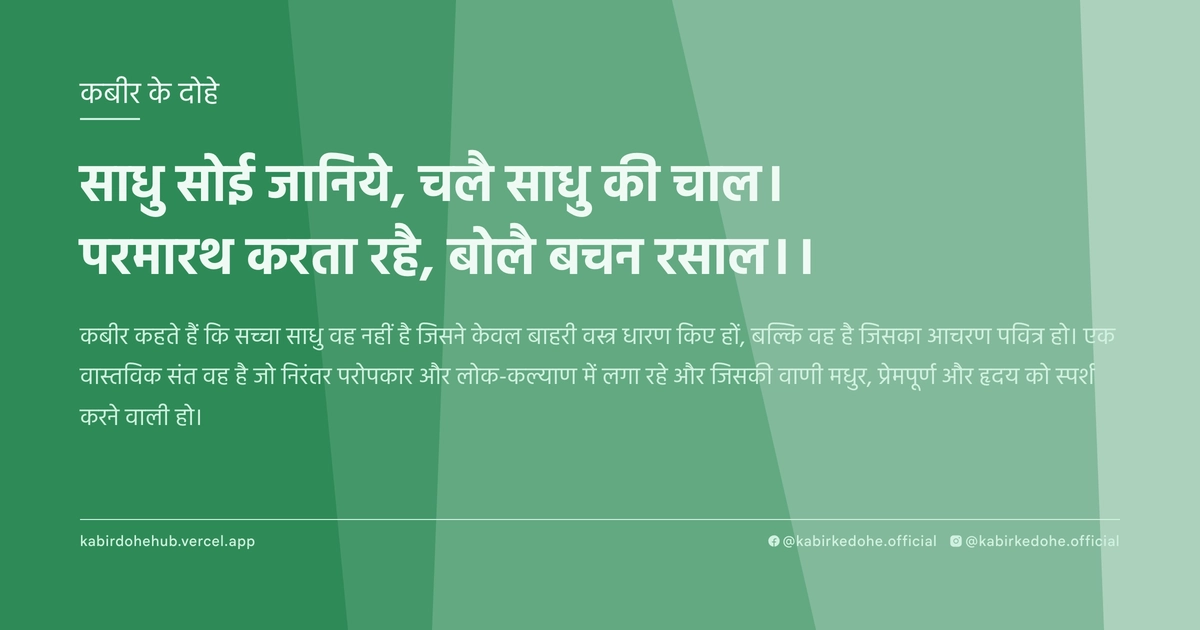
साधु सोई जानिये, चलै साधु की चाल।
परमारथ करता रहै, बोलै बचन रसाल।।
Sadhu soi jaaniye, chalai sadhu ki chaal. Parmarth karta rahai, bolai bachan rasaal.
इस पृष्ठ पर इस कबीर दोहे का अर्थ (meaning), हिंदी व्याख्या और अंग्रेज़ी अनुवाद, दार्शनिक विश्लेषण और व्यावहारिक जीवन सीख दी गई है। यह दोहा सत्संग (Satsang) विषय से जुड़ा है — Kabir doha meaning and explanation in Hindi and English.
अर्थ (Meaning):
कबीर कहते हैं कि सच्चा साधु वह नहीं है जिसने केवल बाहरी वस्त्र धारण किए हों, बल्कि वह है जिसका आचरण पवित्र हो। एक वास्तविक संत वह है जो निरंतर परोपकार और लोक-कल्याण में लगा रहे और जिसकी वाणी मधुर, प्रेमपूर्ण और हृदय को स्पर्श करने वाली हो।
Kabir asserts that a true seeker or saint is not defined by outward appearances or religious attire, but by their conduct. A genuine 'Sadhu' is one who consistently engages in selfless service for the greater good and speaks words that are sweet, compassionate, and spiritually nourishing.
व्याख्या (Interpretation):
इस दोहे का शाब्दिक अर्थ है कि साधु की पहचान उसके व्यवहार से होती है। गहरे स्तर पर, कबीर 'साधु' शब्द को एक सामाजिक पद से हटाकर एक आंतरिक अवस्था में ले जाते हैं। यहाँ 'साधु की चाल' का अर्थ है वह चेतना जिसमें अहंकार का पूर्ण विसर्जन हो चुका है। यह निर्गुण भक्ति का सार है, जहाँ ईश्वर किसी मंदिर या मस्जिद में नहीं, बल्कि निस्वार्थ सेवा और प्रेम में बसता है। माया का प्रभाव तब समाप्त होता है जब व्यक्ति 'स्व' से ऊपर उठकर 'सर्व' के कल्याण की सोचता है। यह अद्वैत वेदांत के उस सत्य को दर्शाता है जहाँ आत्मा और परमात्मा का भेद मिट जाता है और केवल करुणा शेष रहती है। अंततः, यह दोहा बाहरी आडंबरों और आंतरिक सत्य के बीच के विरोधाभास को उजागर करता है।
Literally, the verse suggests that a saint is recognized by their actions. Metaphorically, Kabir shifts the definition of 'Sadhu' from a social identity to an internal state of being. The 'walk of a saint' symbolizes a consciousness where the ego has been completely dissolved. This aligns with Nirgun Bhakti, where the Divine is not found in idols but in selfless service and universal love. The veil of Maya is lifted when an individual transcends the 'I' to embrace the 'All.' It reflects the non-duality of Advaita Vedanta, where the distinction between the self and the Absolute vanishes, leaving only compassion. Ultimately, the Doha highlights the paradox between external religious performance and internal spiritual realization.
दार्शनिक विश्लेषण (Philosophical Analysis):
कबीर का यह दोहा उस समय के सामाजिक परिवेश पर एक तीखा प्रहार है जहाँ धर्म केवल कर्मकांडों और बाहरी प्रतीकों (जैसे गेरुआ वस्त्र या माला) तक सीमित हो गया था। कबीर ने स्पष्ट किया कि आध्यात्मिक पात्रता का मापदंड ज्ञान की मात्रा नहीं, बल्कि चरित्र की शुद्धता है। वे ritualism का खंडन करते हुए यह बताते हैं कि यदि वाणी में मिठास नहीं और कर्म में परोपकार नहीं, तो सारी तपस्या व्यर्थ है।
दार्शनिक रूप से, यह सूफी मत के 'इन्सान-ए-कामिल' (पूर्ण मनुष्य) की अवधारणा से मेल खाता है, जहाँ प्रेम और सेवा ही ईश्वर तक पहुँचने का एकमात्र मार्ग है। कबीर यहाँ यह समझा रहे हैं कि 'परमारथ' (परमार्थ) केवल दान देना नहीं है, बल्कि दूसरे के दुख को अपना समझना है। यह अहंकार के विलोपन की प्रक्रिया है; जब 'मैं' मरता है, तभी 'साधु' का जन्म होता है।
अद्वैत वेदांत के परिप्रेक्ष्य में, जब साधक यह अनुभव करता है कि पूरी सृष्टि एक ही चेतना का विस्तार है, तो सेवा स्वाभाविक हो जाती है। यहाँ सेवा कोई 'कार्य' नहीं बल्कि 'अवस्था' बन जाती है। कबीर चेतावनी देते हैं कि जो लोग केवल शास्त्र पढ़कर खुद को ज्ञानी समझते हैं लेकिन उनके व्यवहार में कठोरता है, वे वास्तव में माया के जाल में और गहरे फंसे हुए हैं।
मनोवैज्ञानिक स्तर पर, यह दोहा बाहरी पहचान (Persona) और वास्तविक आत्म (Self) के बीच के अंतर को स्पष्ट करता है। समाज अक्सर बाहरी प्रतीकों को सम्मान देता है, लेकिन कबीर आंतरिक रूपांतरण पर जोर देते हैं। वे सिखाते हैं कि आध्यात्मिक प्रगति का प्रमाण बाहरी प्रशंसा नहीं, बल्कि आंतरिक शांति और दूसरों के प्रति करुणा है।
अंततः, कबीर का संदेश यह है कि धर्म का वास्तविक उद्देश्य मनुष्य को अधिक मानवीय बनाना है। यदि धर्म व्यक्ति को अहंकारी या श्रेष्ठता की भावना से भर देता है, तो वह धर्म नहीं बल्कि एक मानसिक बीमारी है। सच्चा साधु वह है जो अपनी दिव्यता को दूसरों की सेवा के माध्यम से प्रकट करता है।
This Doha is a sharp critique of the socio-religious climate of Kabir's era, where spirituality had been reduced to mere rituals and external symbols, such as saffron robes or prayer beads. Kabir clarifies that the benchmark of spiritual eligibility is not the volume of one's knowledge, but the purity of one's character. He rejects ritualism, arguing that all penance is futile if the tongue lacks sweetness and the heart lacks the drive for altruism.
Philosophically, this resonates with the Sufi concept of 'Al-Insan al-Kamil' (the Perfect Human), where love and service are the only true paths to the Divine. Kabir explains that 'Parmarath' (altruism) is not merely the act of charity, but the profound realization that another's suffering is one's own. It is a process of ego-annihilation; only when the 'I' dies can the 'Sadhu' be born.
From the perspective of Advaita Vedanta, when a seeker realizes that the entire universe is an extension of a single consciousness, service becomes spontaneous. Service ceases to be a 'task' and becomes a 'state of being.' Kabir warns that those who consider themselves enlightened simply by reading scriptures, yet remain harsh in behavior, are deeper trapped in the illusion of Maya.
Psychologically, the verse distinguishes between the 'Persona' (the social mask) and the 'True Self.' While society often rewards external symbols of piety, Kabir emphasizes internal transformation. He teaches that the evidence of spiritual progress is not external acclaim, but inner peace and an instinctive compassion for others.
Ultimately, Kabir's message is that the true purpose of religion is to make a human more human. If religion instills a sense of superiority or arrogance, it is not spirituality but a psychological ailment. A true saint is one who manifests their divinity through the humble service of others.
मूल संदेश (Core Message):
- बाहरी वेशभूषा आध्यात्मिक सत्य का प्रमाण नहीं है।
- सच्ची साधना अहंकार के विसर्जन और परोपकार में है।
- वाणी की मधुरता हृदय की शुद्धता का प्रतिबिंब है।
- कर्मकांडों से ऊपर उठकर मानवता की सेवा ही वास्तविक धर्म है।
- जब 'मैं' मिटता है, तभी ईश्वरीय गुण प्रकट होते हैं।
- External attire is not evidence of spiritual truth.
- True discipline lies in the dissolution of ego and altruism.
- The sweetness of speech reflects the purity of the heart.
- Serving humanity beyond rituals is the only authentic religion.
- Divine qualities emerge only when the 'I' is erased.
व्यावहारिक उदाहरण (Practical Example):
वाराणसी के एक पुराने घाट पर माधव नाम का एक वृद्ध नाविक रहता था। वह बहुत कम कमाता था, लेकिन उसका स्वभाव अत्यंत सरल था। उसी घाट के पास एक बड़े मंदिर के मुख्य पुजारी रहते थे, जो शास्त्रों के प्रकांड विद्वान थे और हमेशा रेशमी वस्त्र पहनते थे। पुजारी अक्सर लोगों को धर्म और नैतिकता पर लंबे भाषण देते थे, लेकिन उनका व्यवहार कठोर था और वे छोटे नाविकों को तुच्छ समझते थे।
माधव कोई शास्त्र नहीं जानता था, लेकिन वह हर उस व्यक्ति की मदद करता था जो मुसीबत में होता। एक बार एक विदेशी यात्री घाट पर गिर गया और घायल हो गया। पुजारी ने उसे देखा, लेकिन अपनी शुद्धता बनाए रखने के लिए उसके पास नहीं गए और केवल उपदेश दिया कि उसे धैर्य रखना चाहिए।
माधव ने बिना सोचे अपनी नाव छोड़ी, यात्री को सहारा दिया, उसे अपने छोटे से घर ले गया और उसकी मरहम-पट्टी की। उसने अपनी सीमित कमाई से उसके लिए भोजन का प्रबंध किया। कई दिनों तक माधव ने उस अजनबी की सेवा की जैसे वह उसका अपना परिजन हो।
जब वह यात्री ठीक हुआ, तो उसने देखा कि पुजारी केवल शब्दों से धर्म की बात कर रहे थे, जबकि माधव अपने कर्मों से धर्म जी रहा था। यात्री ने माधव के चरणों में सिर झुकाया और कहा कि उसने इस शहर में कई पंडित देखे, लेकिन 'साधु' उसे केवल माधव में मिला।
यह देखकर पुजारी को गहरा धक्का लगा। उन्हें एहसास हुआ कि उनकी सारी विद्या, उनके महंगे वस्त्र और उनके उपदेश व्यर्थ थे क्योंकि उनमें करुणा का अभाव था। उन्होंने महसूस किया कि वे केवल 'साधु' दिखने का प्रयास कर रहे थे, जबकि माधव वास्तव में 'साधु' थे।
पुजारी के भीतर का अहंकार टूट गया। उन्होंने अपनी कठोरता को त्याग दिया और माधव से क्षमा मांगी। उन्होंने सीखा कि वास्तविक आध्यात्मिकता मंदिर की दीवारों में नहीं, बल्कि एक घायल मनुष्य की सेवा में है।
अगले कुछ महीनों में, पुजारी का व्यवहार पूरी तरह बदल गया। अब वे केवल उपदेश नहीं देते थे, बल्कि स्वयं घाट की सफाई में मदद करते और गरीबों के साथ बैठकर भोजन करते थे।
माधव की निस्वार्थ 'चाल' ने एक विद्वान के अहंकार को मिटाकर उसे वास्तव में एक साधु बना दिया। यह कबीर के उस सत्य का प्रमाण था कि परोपकार और मधुर वाणी ही वास्तविक धर्म है।
On an ancient ghat in Varanasi lived an elderly boatman named Madhav. He earned very little, but his nature was profoundly simple and kind. Nearby lived the head priest of a grand temple, a scholar of immense renown who always wore fine silk robes. The priest frequently delivered long sermons on morality and religion, yet his demeanor was harsh, and he viewed the humble boatmen with disdain.
Madhav knew no scriptures, but he helped anyone in distress without hesitation. One day, a foreign traveler slipped on the ghats and was seriously injured. The priest saw him but, fearing for his ritual purity, refused to touch him, offering only a cold lecture on the necessity of patience in suffering.
Madhav immediately abandoned his boat, rushed to the traveler, and carried him to his small hut to tend to his wounds. He used his meager earnings to provide food and medicine, caring for the stranger for several days as if he were his own kin.
When the traveler recovered, he realized that while the priest spoke of religion with words, Madhav lived religion through his actions. The traveler bowed to Madhav, stating that although he had met many pundits in the city, he found a true 'Sadhu' only in Madhav.
This realization struck the priest deeply. He understood that his vast knowledge, expensive robes, and endless sermons were hollow because they lacked compassion. He realized he was merely pretending to be a saint, while Madhav actually was one.
The priest's ego shattered. He renounced his rigidity and sought Madhav's forgiveness. He learned that true spirituality does not reside within temple walls but in the service of a suffering human being.
Over the following months, the priest's behavior transformed completely. He stopped merely preaching and began helping clean the ghats and eating with the poor.
Madhav's selfless 'walk' had annihilated the scholar's ego, turning him into a true seeker. This served as a living testament to Kabir's truth: that altruism and sweet speech are the only authentic markers of faith.
अभ्यास मार्गदर्शन (Practice Guidance):
- दैनिक अभ्यास: प्रतिदिन कम से कम एक ऐसा कार्य करें जिससे किसी अन्य को लाभ हो, और वह कार्य पूरी तरह गुप्त रहे।
- वाणी का संयम: दिन भर में किसी भी व्यक्ति से बात करते समय यह जांचें कि क्या आपके शब्दों में कठोरता है। यदि हाँ, तो तुरंत उसे प्रेमपूर्ण शब्दों से बदलें।
- आत्म-चिंतन जर्नल: रात को सोने से पहले लिखें—'आज मैंने अपनी श्रेष्ठता का भाव कहाँ महसूस किया?' और उसे मिटाने का प्रयास करें।
- डायग्नोस्टिक चेकलिस्ट: क्या मैं दूसरों की मदद इसलिए करता हूँ ताकि लोग मुझे 'अच्छा' कहें? (यदि हाँ, तो यह सेवा नहीं, अहंकार है)। क्या मेरी वाणी मेरे आंतरिक क्रोध को छिपाने का मुखौटा है?
- Daily Practice: Perform at least one act of selfless service daily that remains completely anonymous to others.
- Speech Mindfulness: Throughout the day, monitor your interactions. If you detect harshness or judgment in your tone, consciously pivot to words of compassion and kindness.
- Self-Inquiry Journaling: Before sleep, reflect and write: 'In which moment today did I feel superior to another?' Work on dissolving that feeling of hierarchy.
- Diagnostic Checklist: Am I helping others to be perceived as 'good' or 'spiritual'? (If yes, this is ego, not service). Is my polite speech merely a mask for internal anger?
चिंतन प्रश्न (Reflection Questions):
- क्या मेरी धार्मिक या आध्यात्मिक पहचान मेरे भीतर के अहंकार को पोषण दे रही है?
- यदि मुझसे मेरे सभी पद, उपाधियाँ और वस्त्र छीन लिए जाएँ, तो क्या मेरी करुणा अभी भी शेष रहेगी?
- मैं उन लोगों के साथ कैसा व्यवहार करता हूँ जिनसे मुझे जीवन में कोई लाभ मिलने की उम्मीद नहीं है?
- क्या मेरी 'मधुर वाणी' वास्तव में प्रेम से उपजी है, या यह केवल सामाजिक शिष्टाचार का एक मुखौटा है?
- मेरे जीवन का कौन सा हिस्सा अभी भी 'दिखावे' के अधीन है, और मैं उसे सत्य में कैसे बदल सकता हूँ?
- Is my religious or spiritual identity nourishing a hidden sense of superiority within me?
- If all my titles, positions, and clothes were stripped away, would my compassion still remain?
- How do I treat those from whom I expect absolutely no benefit or return in life?
- Is my 'sweet speech' born of genuine love, or is it merely a mask of social etiquette?
- Which part of my life is still governed by 'performance' for others, and how can I align it with truth?