
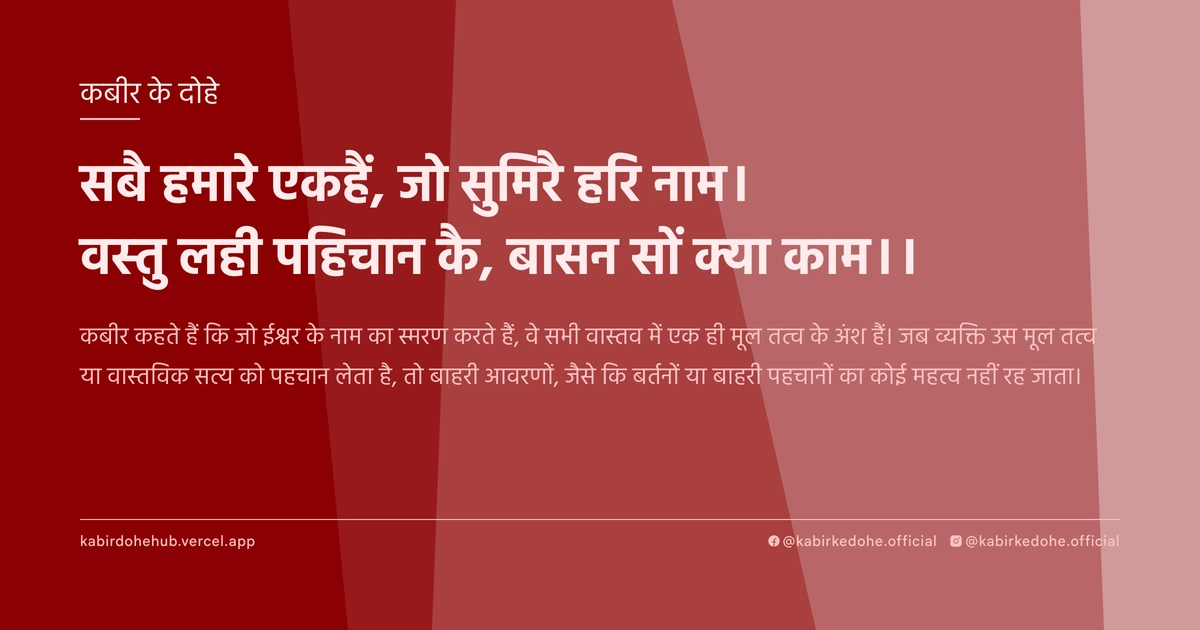
सबै हमारे एकहैं, जो सुमिरै हरि नाम।
वस्तु लही पहिचान कै, बासन सों क्या काम।।
Sabai hamare ekhain, jo sumirai hari naam. Vastu lahi pahichan kai, baasan son kya kaam.
इस पृष्ठ पर इस कबीर दोहे का अर्थ (meaning), हिंदी व्याख्या और अंग्रेज़ी अनुवाद, दार्शनिक विश्लेषण और व्यावहारिक जीवन सीख दी गई है। यह दोहा निर्गुण ब्रह्म (Nirguna Brahman) विषय से जुड़ा है — Kabir doha meaning and explanation in Hindi and English.
अर्थ (Meaning):
कबीर कहते हैं कि जो ईश्वर के नाम का स्मरण करते हैं, वे सभी वास्तव में एक ही मूल तत्व के अंश हैं। जब व्यक्ति उस मूल तत्व या वास्तविक सत्य को पहचान लेता है, तो बाहरी आवरणों, जैसे कि बर्तनों या बाहरी पहचानों का कोई महत्व नहीं रह जाता।
Kabir asserts that all those who meditate upon the Divine Name are essentially one. Once the true essence or the primordial substance is recognized, the external containers—the superficial identities and forms—become irrelevant and meaningless.
व्याख्या (Interpretation):
इस दोहे का शाब्दिक अर्थ है कि परमात्मा की भक्ति करने वाले सभी समान हैं। रूपक के माध्यम से, कबीर 'वस्तु' को आत्मा या ब्रह्म कहते हैं और 'बासन' (बर्तन) को शरीर, जाति, धर्म और सामाजिक स्थिति का प्रतीक बताते हैं। यह निर्गुण भक्ति का सार है, जहाँ ईश्वर किसी आकार में नहीं बल्कि सर्वव्यापी चेतना में है। माया हमें बर्तनों (विविधताओं) में उलझाए रखती है, जबकि अद्वैत वेदांत के अनुसार आत्मा और ब्रह्म एक ही हैं। जब साधक इस एकता को अनुभव करता है, तो वह द्वैत के भ्रम से मुक्त हो जाता है। यह विरोधाभास है कि हम अलग दिखने वाले बर्तनों में एक ही जल की खोज करते हैं, जबकि जल ही एकमात्र सत्य है।
Literally, the couplet states that all devotees of the Divine are one. Metaphorically, Kabir identifies the 'substance' (vastu) as the Atman or Brahman, and the 'vessels' (baasan) as the physical body, caste, religion, and social status. This is the quintessence of Nirgun Bhakti, where the Divine is not a shaped entity but an omnipresent consciousness. Maya keeps us entangled in the diversity of vessels, whereas Advaita Vedanta posits the non-duality of the individual soul and the universal spirit. When the seeker experiences this oneness, the illusion of duality dissolves. The central paradox lies in our tendency to prioritize the container over the content, forgetting that the essence remains unchanged regardless of the vessel.
दार्शनिक विश्लेषण (Philosophical Analysis):
कबीर का यह दर्शन उनके युग के कट्टरपंथी धार्मिक विभाजन के विरुद्ध एक सशक्त प्रहार था। उन्होंने देखा कि लोग बाहरी कर्मकांडों और जातिगत श्रेष्ठता के अहंकार में डूबे हुए थे, जबकि सत्य अत्यंत सरल और आंतरिक था। कबीर का दृष्टिकोण सूफीवाद के 'वहदत-अल-वजूद' (अस्तित्व की एकता) और वेदांत के अद्वैतवाद का एक अद्भुत संगम है। वे तर्क देते हैं कि यदि हम सभी एक ही ईश्वरीय प्रकाश से उत्पन्न हुए हैं, तो भेदभाव का आधार केवल अज्ञानता है।
यहाँ 'हरि नाम' का अर्थ केवल शब्दों का जाप नहीं, बल्कि उस परम चेतना के साथ एकाकार होना है। कबीर ritualism (कर्मकांड) को पूरी तरह नकारते हैं क्योंकि बर्तन को सजाने से उसके भीतर के जल की शुद्धता नहीं बदलती। उनके लिए धर्म वह नहीं जो मंदिर या मस्जिद में मिले, बल्कि वह है जो मनुष्य को मनुष्य से जोड़े।
मनोवैज्ञानिक स्तर पर, यह दोहा 'अहंकार' के विसर्जन की बात करता है। जब तक व्यक्ति अपनी पहचान को 'बर्तन' (पद, प्रतिष्ठा, कुल) से जोड़ता है, वह अलग महसूस करता है। जैसे ही वह अपनी पहचान को 'वस्तु' (शुद्ध चेतना) से जोड़ता है, उसका अहंकार समाप्त हो जाता है।
यह विश्लेषण स्पष्ट करता है कि कबीर का मार्ग केवल भक्ति का नहीं, बल्कि गहन आत्म-साक्षात्कार का है। वे हमें चेतावनी देते हैं कि बाहरी पहचानों के प्रति आसक्ति एक मानसिक कारागार है।
अंततः, यह दर्शन हमें सिखाता है कि सत्य सार्वभौमिक है। चाहे वह किसी भी भाषा, देश या धर्म के बर्तन में रखा हो, उसकी प्रकृति अपरिवर्तनीय है। यह मानवता के लिए एक सार्वभौमिक आह्वान है कि वे अपनी साझा दिव्यता को पहचानें।
Kabir's philosophy serves as a potent critique of the rigid religious divisions of his era. He observed a society obsessed with ritualistic purity and caste superiority, while the truth remained simple and internal. His perspective is a masterful synthesis of the Sufi concept of 'Wahdat-al-Wujud' (Unity of Existence) and the non-dualism of Advaita Vedanta. He argues that if all beings emanate from the same divine light, then discrimination is rooted solely in ignorance.
In this context, 'Hari Naam' does not signify the mere repetition of a word, but the realization of oneness with the supreme consciousness. Kabir rejects ritualism entirely, asserting that decorating the vessel does not alter the purity of the water within. For him, true religion is not found in temples or mosques, but in the bridge that connects one human soul to another.
Psychologically, this doha addresses the annihilation of the ego. As long as an individual identifies with the 'vessel'—their status, lineage, or title—they experience separation. The moment they identify with the 'substance'—pure consciousness—the ego dissolves into the infinite.
This analysis reveals that Kabir's path is not merely one of devotion, but of profound self-realization. He warns that attachment to external identities is a mental prison that obscures the inherent divinity of the self.
Ultimately, this philosophy teaches that truth is universal. Regardless of the vessel—be it language, nationality, or faith—the essence remains immutable. It is a universal call to humanity to recognize their shared divine origin.
मूल संदेश (Core Message):
- बाहरी पहचान केवल एक आवरण है, सत्य नहीं।
- परमात्मा की खोज बाहर नहीं, अपनी मूल प्रकृति में करें।
- भेदभाव अज्ञानता की उपज है, ज्ञान का नहीं।
- अहंकार का विसर्जन ही वास्तविक मुक्ति का मार्ग है।
- हम सब एक ही अनंत चेतना के विभिन्न प्रतिबिंब हैं।
- External identity is merely a veil, not the ultimate truth.
- Seek the Divine not in the outer world, but in your primordial nature.
- Discrimination is a product of ignorance, not of wisdom.
- The dissolution of ego is the only path to true liberation.
- We are all diverse reflections of the same infinite consciousness.
व्यावहारिक उदाहरण (Practical Example):
वाराणसी के एक पुराने घाट पर रामदीन नाम का एक वृद्ध नाविक रहता था। वह जीवन भर लोगों को नदी पार कराता रहा, लेकिन उसका मन हमेशा इस बात से दुखी रहता था कि वह एक निम्न जाति का नाविक है और बड़े पंडितों के सामने झुकना पड़ता है। वह खुद को एक 'टूटे हुए बर्तन' की तरह देखता था, जिसकी समाज में कोई कीमत नहीं थी।
एक दिन उसकी मुलाकात एक घुमक्कड़ साधु से हुई, जिसने कबीर का यह दोहा सुनाया। साधु ने रामदीन को दो अलग-अलग बर्तनों में रखा पानी दिखाया—एक सोने का था और एक मिट्टी का। साधु ने पूछा, "क्या सोने के बर्तन का पानी पीने से तुम्हारी प्यास अलग तरह से बुझेगी?"
रामदीन ने कहा, "नहीं महाराज, पानी तो पानी ही है।"
साधु मुस्कुराया और बोला, "यही सत्य है। तुम खुद को मिट्टी का बर्तन मान रहे हो और दूसरों को सोने का, लेकिन तुम्हारे भीतर की चेतना वही है जो उस पंडित के भीतर है। तुम दोनों एक ही तत्व हो।"
इस सरल सत्य ने रामदीन के भीतर एक विस्फोट किया। उसने महसूस किया कि उसकी पीड़ा उसकी जाति से नहीं, बल्कि उसकी इस गलत पहचान से थी कि वह केवल एक 'नाविक' है।
अगले दिन से रामदीन का व्यवहार बदल गया। उसने अब झुकना बंद कर दिया, लेकिन घृणा के कारण नहीं, बल्कि एक गहरे आत्म-सम्मान के कारण। वह अब यात्रियों को केवल नदी पार नहीं कराता था, बल्कि उनसे प्रेम और समानता के साथ बात करता था।
उसने देखा कि जब उसने खुद को 'बर्तन' के बजाय 'तत्व' के रूप में देखा, तो उसे दूसरों में भी वही दिव्यता दिखने लगी। वह अब पंडितों से डरता नहीं था, बल्कि उन्हें अपने जैसे ही एक जिज्ञासु मनुष्य के रूप में देखने लगा।
उसकी शांति देखकर घाट के अन्य लोग भी प्रभावित हुए। रामदीन ने अपनी नाव को केवल जीविका का साधन नहीं, बल्कि एक सेतु बना दिया जहाँ हर व्यक्ति अपनी सामाजिक पहचान पीछे छोड़कर केवल एक आत्मा बनकर यात्रा करता था।
रामदीन का जीवन अब एक उत्सव बन गया था। उसने जान लिया था कि उसकी असली पहचान वह नहीं है जो दुनिया ने उसे दी है, बल्कि वह है जो वह वास्तव में है—परमात्मा का एक अंश।
On an ancient ghat in Varanasi lived an elderly boatman named Ramdin. He had spent his entire life ferrying people across the river, yet his heart was heavy with the sorrow of his low caste, feeling compelled to bow before the high priests. He viewed himself as a 'broken vessel,' devoid of value in the eyes of society.
One day, he encountered a wandering monk who recited this specific doha of Kabir. The monk presented two containers of water—one made of gold and the other of humble clay. He asked, "Will the water from the golden vessel quench your thirst differently than the water from the clay one?"
Ramdin replied, "No, Maharaj, water is simply water."
The monk smiled and said, "This is the truth. You perceive yourself as a clay vessel and others as gold, but the consciousness within you is the same as that within the priest. You are both the same substance."
This simple truth triggered a profound internal shift in Ramdin. He realized that his suffering did not stem from his caste, but from the false identity he had adopted—believing he was merely a 'boatman.'
From the next day, Ramdin's demeanor changed. He stopped bowing out of fear, replacing it with a deep, quiet self-respect. He no longer just ferried passengers; he spoke to them with an innate love and a sense of equality.
He discovered that once he stopped identifying as the 'vessel' and started identifying as the 'essence,' he began to see that same divinity in everyone else. He no longer feared the priests; instead, he saw them as fellow seekers of truth.
His newfound peace began to influence others on the ghat. Ramdin transformed his boat from a mere tool of livelihood into a bridge where every passenger left their social identity behind and traveled simply as a soul.
Ramdin's life became a celebration. He finally understood that his true identity was not the label the world had imposed upon him, but the eternal spark of the Divine that resided within.
अभ्यास मार्गदर्शन (Practice Guidance):
- दैनिक चिंतन: प्रतिदिन 10 मिनट मौन बैठें और विचार करें कि आपकी सामाजिक पहचान (नाम, पद, धर्म) के बिना आप वास्तव में कौन हैं।
- आत्म-पूछताछ जर्नल: एक डायरी लिखें जिसमें उन क्षणों को दर्ज करें जब आपने किसी को उनकी बाहरी पहचान के आधार पर judged किया, और फिर उसे इस दोहे के प्रकाश में चुनौती दें।
- व्यवहार परिवर्तन: दिन में कम से कम एक बार किसी ऐसे व्यक्ति के साथ अत्यंत सम्मानपूर्वक व्यवहार करें जिसे समाज 'तुच्छ' मानता है, यह याद रखते हुए कि आप दोनों एक ही तत्व हैं।
- डायग्नोस्टिक चेकलिस्ट: क्या मैं अभी भी अपनी उपलब्धियों या पद पर गर्व कर रहा हूँ? क्या मुझे दूसरों की जाति या धर्म से फर्क पड़ता है? यदि हाँ, तो मैं अभी भी 'बर्तन' में उलझा हुआ हूँ।
- Daily Contemplation: Spend 10 minutes in silence daily, contemplating who you are stripped of all social identities (name, title, religion).
- Self-Inquiry Journal: Maintain a journal recording moments where you judged someone based on external markers, then challenge those perceptions using the lens of this doha.
- Behavioral Shift: Once a day, interact with profound respect with someone whom society deems 'insignificant,' consciously remembering that you both share the same divine essence.
- Diagnostic Checklist: Am I still deriving pride from my achievements or status? Do I still feel a distinction based on another's caste or faith? If yes, I am still entangled in the 'vessel'.
चिंतन प्रश्न (Reflection Questions):
- यदि आपसे आपका नाम, पेशा और धर्म छीन लिया जाए, तो आपके पास क्या बचेगा?
- आपकी कौन सी 'बाहरी पहचान' आपको दूसरों से श्रेष्ठ महसूस कराती है, और वह वास्तव में कितनी खोखली है?
- क्या आप अपनी डिजिटल पहचान (सोशल मीडिया प्रोफाइल) को ही अपना वास्तविक अस्तित्व मान बैठे हैं?
- आप किन लोगों को 'मिट्टी का बर्तन' समझते हैं और क्यों?
- क्या आप वास्तव में समानता में विश्वास करते हैं, या आप केवल अपनी पसंद के लोगों के साथ समानता चाहते हैं?
- If your name, profession, and religion were stripped away, what would remain of you?
- Which 'external identity' makes you feel superior to others, and how hollow is that feeling in reality?
- Have you mistaken your digital identity (social media profile) for your actual existence?
- Whom do you subconsciously perceive as 'clay vessels,' and why?
- Do you truly believe in equality, or do you only desire equality for those you personally like?