
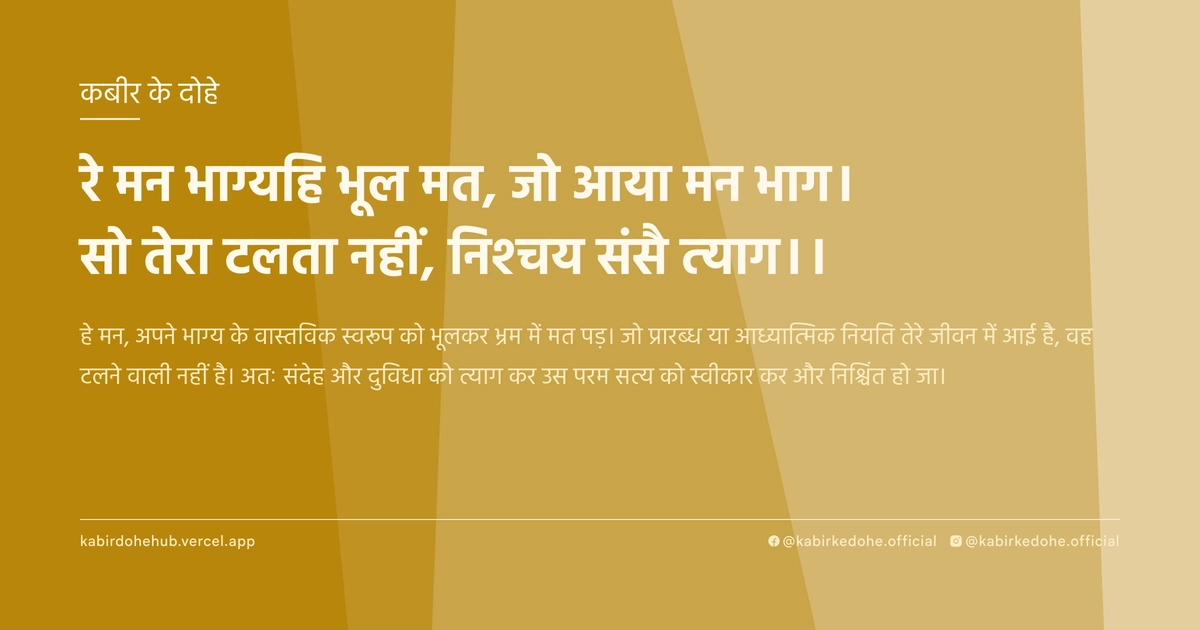
रे मन भाग्यहि भूल मत, जो आया मन भाग।
सो तेरा टलता नहीं, निश्चय संसै त्याग।।
Re man bhagyahi bhool mat, jo aaya man bhag. So tera talta nahin, nishchay sansai tyag.
इस पृष्ठ पर इस कबीर दोहे का अर्थ (meaning), हिंदी व्याख्या और अंग्रेज़ी अनुवाद, दार्शनिक विश्लेषण और व्यावहारिक जीवन सीख दी गई है। यह दोहा धैर्य (Patience) विषय से जुड़ा है — Kabir doha meaning and explanation in Hindi and English.
अर्थ (Meaning):
हे मन, अपने भाग्य के वास्तविक स्वरूप को भूलकर भ्रम में मत पड़। जो प्रारब्ध या आध्यात्मिक नियति तेरे जीवन में आई है, वह टलने वाली नहीं है। अतः संदेह और दुविधा को त्याग कर उस परम सत्य को स्वीकार कर और निश्चिंत हो जा।
O mind, do not forget the true nature of your destiny or wander in delusion. That which has arrived as your karmic allotment or spiritual fate cannot be avoided or erased. Therefore, abandon all doubts and uncertainties, and embrace the certainty of the Divine will.
व्याख्या (Interpretation):
इस दोहे का शाब्दिक अर्थ है कि मनुष्य को अपने भाग्य के प्रति सजग रहना चाहिए। गहरे स्तर पर, कबीर यहाँ 'भाग्य' को केवल बाहरी संयोग नहीं, बल्कि 'प्रारब्ध' और 'ईश्वरीय इच्छा' के रूप में परिभाषित कर रहे हैं। यह निर्गुण भक्ति का वह पहलू है जहाँ साधक यह समझता है कि अहंकार द्वारा किया गया संघर्ष व्यर्थ है। माया हमें यह विश्वास दिलाती है कि हम अपनी इच्छाओं से सब कुछ नियंत्रित कर सकते हैं, जबकि वास्तव में हम उस विराट चेतना के अधीन हैं। जब मन संदेह (संशय) को त्याग देता है, तब वह द्वैत से अद्वैत की ओर बढ़ता है, जहाँ 'मैं' और 'मेरा भाग्य' का भेद मिट जाता है और केवल ब्रह्म शेष रहता है।
Literally, the verse warns the mind against ignoring its destiny. Metaphorically, Kabir redefines 'fate' not as blind luck, but as 'Prarabdha'—the ripened fruit of past actions and the overarching Divine Will. In the context of Nirgun Bhakti, this is a call to surrender the ego's illusion of control. Maya tricks the individual into believing that personal striving can override cosmic law. By urging the mind to abandon 'Sansai' (doubt), Kabir points toward the non-duality of Advaita Vedanta, where the distinction between the seeker and the destiny dissolves. The paradox is that true freedom is found not in changing one's fate, but in the absolute acceptance of it, which annihilates the suffering caused by resistance.
दार्शनिक विश्लेषण (Philosophical Analysis):
कबीर का यह दृष्टिकोण उनके युग के कर्मकांडीय और बाहरी आडंबरों के विरुद्ध एक प्रहार है। जहाँ लोग तीर्थयात्राओं और अनुष्ठानों के माध्यम से अपना भाग्य बदलने की कोशिश करते थे, कबीर आंतरिक रूपांतरण पर जोर देते हैं। वे बताते हैं कि भाग्य कोई बाहरी वस्तु नहीं, बल्कि आत्मा की यात्रा का एक हिस्सा है।
अद्वैत वेदांत के अनुसार, जब तक व्यक्ति स्वयं को शरीर और मन मानता है, वह सुख-दुख और लाभ-हानि के चक्र में फँसा रहता है। कबीर यहाँ 'मन' को संबोधित कर रहे हैं क्योंकि मन ही वह केंद्र है जहाँ मोह और अहंकार निवास करते हैं। जब मन यह स्वीकार कर लेता है कि जो होना है वह होगा, तो वह मानसिक तनाव से मुक्त हो जाता है।
सूफी मत के 'रज़ा' (ईश्वरीय इच्छा के प्रति समर्पण) के समान, कबीर यहाँ पूर्ण समर्पण की बात कर रहे हैं। यह समर्पण कायरता नहीं, बल्कि सर्वोच्च साहस है। यह अहंकार की उस दीवार को गिरा देता है जो मनुष्य को परमात्मा से अलग करती है।
सांस्कृतिक रूप से, कबीर ने जाति और वर्ग के भेदों को नकारते हुए यह सिखाया कि आध्यात्मिक सत्य सबके लिए समान है। भाग्य का अर्थ यहाँ सामाजिक स्थिति नहीं, बल्कि आत्मा की वह अवस्था है जिसे केवल साधना और समर्पण से समझा जा सकता है।
अंततः, यह दोहा मनोवैज्ञानिक रूपांतरण की प्रक्रिया है। संदेह का त्याग करने का अर्थ है—वर्तमान क्षण में पूरी तरह उपस्थित होना। जब हम भविष्य की चिंता या अतीत के पछतावे को छोड़कर वर्तमान की वास्तविकता को स्वीकार करते हैं, तब हम वास्तव में मुक्त होते हैं।
Kabir’s perspective serves as a profound critique of the ritualistic and superficial practices of his era. While contemporaries sought to alter their destiny through pilgrimages and complex rituals, Kabir emphasized internal alchemy. He posits that 'fate' is not an external imposition but an intrinsic part of the soul's evolutionary journey.
Drawing from Advaita Vedanta, the suffering of the human condition stems from the false identification with the ego. As long as the individual perceives themselves as a separate entity, they remain trapped in the duality of gain and loss. By addressing the 'mind,' Kabir targets the seat of attachment and pride, urging a shift from the illusory 'I' to the universal 'Self.'
This teaching mirrors the Sufi concept of 'Raza'—absolute submission to the Divine Will. This is not a passive resignation but an active, spiritual courage. It is the process of 'Fana' (annihilation of the ego), where the individual's will merges with the Cosmic Will, removing the veil of separation.
Historically, Kabir challenged the caste hierarchy by asserting that spiritual liberation is accessible to all, regardless of birth. He redefined destiny not as a social lot, but as a spiritual trajectory that can only be navigated through sincerity and devotion to the Formless (Nirgun).
Psychologically, the call to abandon doubt is a call to mindfulness. Resistance to reality is the primary source of mental anguish. By accepting the inevitability of certain life events, the seeker ceases the internal war, leading to a state of equanimity (Samatva) and profound inner peace.
मूल संदेश (Core Message):
- प्रतिरोध ही पीड़ा का मूल कारण है।
- भाग्य का अर्थ दंड नहीं, बल्कि आध्यात्मिक विकास का अवसर है।
- संदेह का त्याग ही मानसिक शांति का एकमात्र द्वार है।
- अहंकार की इच्छाओं का अंत ही वास्तविक स्वतंत्रता है।
- ईश्वरीय इच्छा के साथ लयबद्ध होना ही सर्वोच्च योग है।
- Resistance is the primary root of all human suffering.
- Fate is not a punishment, but an opportunity for spiritual evolution.
- Abandoning doubt is the only gateway to enduring mental peace.
- True liberation is the cessation of the ego's desperate desires.
- Aligning oneself with the Divine Will is the highest form of Yoga.
व्यावहारिक उदाहरण (Practical Example):
वाराणसी के एक पुराने घाट पर रहने वाली एक वृद्ध विधवा, जानकी, का जीवन अभावों से भरा था। उसने अपना पूरा जीवन अपने परिवार की सेवा में लगा दिया, लेकिन अंत में वह अकेली रह गई। वह अक्सर मंदिर की सीढ़ियों पर बैठकर अपनी किस्मत को कोसती और सोचती कि उसने कौन सा पाप किया कि उसे यह अंत मिला।
एक दिन उसने एक फकीर को सुना जो कबीर के इस दोहे का पाठ कर रहा था। जानकी ने पूछा, 'क्या मेरा दुख मेरा भाग्य है? क्या मैं इसे बदल नहीं सकती?' फकीर ने मुस्कुराकर कहा, 'दुख भाग्य नहीं है, बल्कि इस दुख से लड़ने की तुम्हारी जिद तुम्हारा बंधन है। जो बीत गया वह प्रारब्ध था, लेकिन उसे स्वीकार न करना तुम्हारा वर्तमान मोह है।'
जानकी को पहली बार समझ आया कि वह वर्षों से एक ऐसी लड़ाई लड़ रही थी जिसे जीता नहीं जा सकता। उसने अपनी स्थिति को कोसना बंद कर दिया। उसने यह स्वीकार किया कि उसका अकेलापन उसकी नियति का हिस्सा है, लेकिन इस अकेलेपन में वह ईश्वर को खोज सकती है।
उसने अपने छोटे से घर को अन्य बेसहारा महिलाओं के लिए एक आश्रय बना लिया। अब वह अपनी स्थिति पर रोने के बजाय, दूसरों के आँसू पोंछने लगी।
उसका व्यवहार पूरी तरह बदल गया। जो क्रोध और कड़वाहट उसके चेहरे पर थी, वह अब एक शांत मुस्कान में बदल गई थी।
उसने महसूस किया कि जब उसने अपनी 'किस्मत' से लड़ना छोड़ा, तो उसे वह शांति मिली जो उसे हज़ारों प्रार्थनाओं से नहीं मिली थी।
उसका जीवन अब अभावों में भी समृद्ध था क्योंकि उसने 'संशय' को त्याग कर 'निश्चय' को अपना लिया था।
यह जानकी का 'कबीर ट्विस्ट' था—भाग्य को बदलने की कोशिश छोड़कर, भाग्य के साथ जीने की कला सीखना।
Janaki, an elderly widow living on an ancient ghat in Varanasi, led a life of immense hardship. She had spent her entire existence serving her family, yet found herself utterly alone in her twilight years. She would often sit on the temple steps, cursing her fate and wondering what sin she had committed to deserve such loneliness.
One day, she overheard a wandering dervish reciting this specific Doha of Kabir. Janaki asked, 'Is my suffering my fate? Can I not change it?' The dervish smiled and replied, 'The suffering is not the fate; rather, your stubborn resistance to this suffering is your bondage. What has passed was Prarabdha, but your refusal to accept it is your current delusion.'
For the first time, Janaki realized she had been fighting a war that could not be won. She stopped railing against her circumstances. She accepted that her solitude was a part of her journey, but realized that within this very solitude, she could find the Divine.
She transformed her small, dilapidated hut into a sanctuary for other homeless and abandoned women. Instead of weeping over her own lot, she began wiping the tears of others.
Her demeanor shifted completely. The bitterness and anger that had etched lines into her face were replaced by a serene, luminous smile.
She discovered that when she stopped fighting her 'destiny,' she attained a peace that thousands of desperate prayers had failed to provide.
Her life, though materially poor, became spiritually opulent because she had traded 'doubt' for 'certainty.'
This was Janaki's 'Kabir Twist'—shifting from the futile attempt to change fate to the masterful art of living in harmony with it.
अभ्यास मार्गदर्शन (Practice Guidance):
- प्रतिदिन 20 मिनट मौन रहकर यह चिंतन करें कि जीवन की कौन सी घटनाएँ आपके नियंत्रण से बाहर हैं और उन्हें पूर्णतः स्वीकार करें।
- एक 'स्वीकृति जर्नल' (Acceptance Journal) बनाएँ। उन स्थितियों को लिखें जिनसे आप लड़ रहे हैं, और फिर लिखें: 'यह मेरी यात्रा का हिस्सा है, मैं इसे स्वीकार करता हूँ'।
- जब भी मन में भविष्य को लेकर भय या संदेह उत्पन्न हो, तो स्वयं से पूछें: 'क्या यह संदेह मुझे सत्य के करीब ले जा रहा है या केवल अहंकार को बढ़ा रहा है?'
- निदान चेकलिस्ट: यदि आप छोटी बातों पर चिड़चिड़े हो रहे हैं या अतीत के पछतावे में डूबे हैं, तो समझें कि आप अभी भी 'संशय' में हैं और 'निश्चय' से दूर हैं।
- Spend 20 minutes in daily silence, contemplating the events of your life that are beyond your control, and consciously practice total acceptance of them.
- Maintain an 'Acceptance Journal.' List the situations you are currently resisting, and then write: 'This is part of my soul's journey; I embrace it without judgment.'
- Whenever fear or doubt about the future arises, ask yourself: 'Is this doubt bringing me closer to the Truth, or is it merely fueling the ego's need for control?'
- Diagnostic Checklist: If you find yourself irritable over minor inconveniences or trapped in past regrets, recognize that you are still dwelling in 'Sansai' (doubt) and are distant from 'Nishchay' (certainty).
चिंतन प्रश्न (Reflection Questions):
- आप अपनी नियति के किन हिस्सों से सबसे अधिक लड़ रहे हैं, और वह लड़ाई आपको क्या सिखा रही है?
- क्या आपका 'संदेह' वास्तव में सत्य की खोज है, या केवल अपनी इच्छाओं को थोपने का एक तरीका?
- यदि आपकी वर्तमान स्थिति कभी न बदले, तो क्या आप फिर भी आंतरिक शांति पा सकते हैं?
- आपकी सार्वजनिक छवि (Public Identity) आपके आंतरिक संघर्षों को कितना छिपाती है?
- क्या आप अपनी असफलताओं को 'भाग्य' कहकर अपनी जिम्मेदारी से बच रहे हैं, या वास्तव में समर्पण कर रहे हैं?
- Which parts of your destiny are you fighting most fiercely, and what is that struggle teaching you about your ego?
- Is your 'doubt' truly a search for truth, or is it merely a mechanism to impose your will upon reality?
- If your current life circumstances never changed, would you still be capable of finding inner peace?
- To what extent does your public identity mask the shadows of your internal conflicts and resistances?
- Are you using 'fate' as an excuse to avoid responsibility, or are you practicing genuine spiritual surrender?