
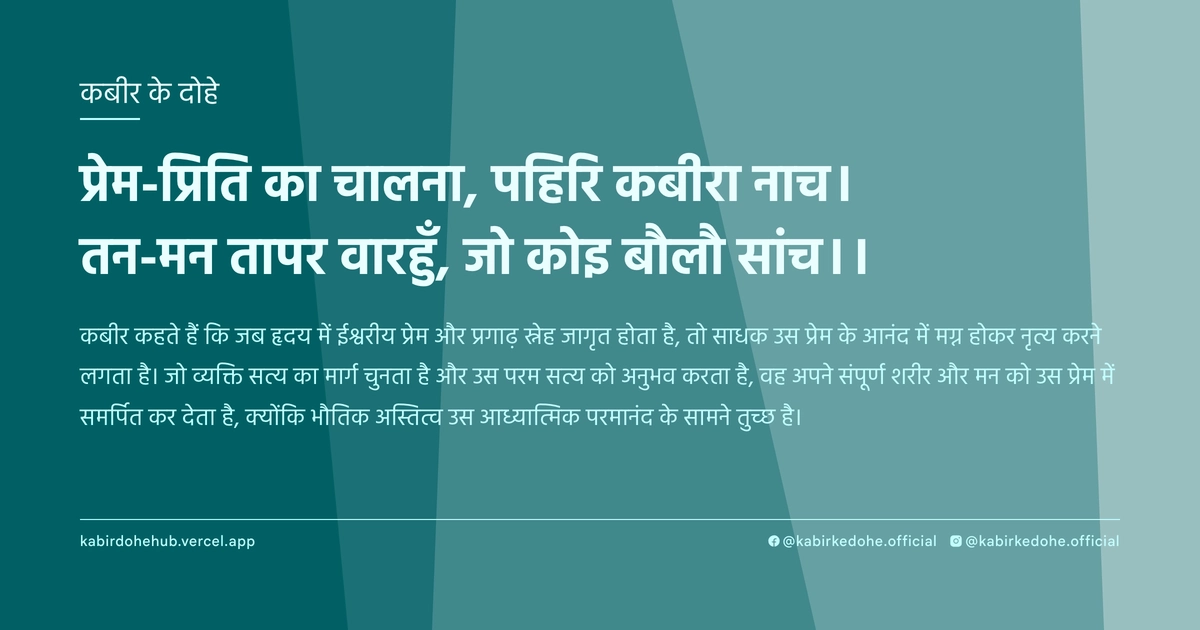
प्रेम-प्रिति का चालना, पहिरि कबीरा नाच।
तन-मन तापर वारहुँ, जो कोइ बौलौ सांच।।
Prem-priti ka chaalna, pahiri kabira naach. Tan-man taapar vaarhun, jo koi baulau saanch.
इस पृष्ठ पर इस कबीर दोहे का अर्थ (meaning), हिंदी व्याख्या और अंग्रेज़ी अनुवाद, दार्शनिक विश्लेषण और व्यावहारिक जीवन सीख दी गई है। यह दोहा भक्ति (Bhakti) विषय से जुड़ा है — Kabir doha meaning and explanation in Hindi and English.
अर्थ (Meaning):
कबीर कहते हैं कि जब हृदय में ईश्वरीय प्रेम और प्रगाढ़ स्नेह जागृत होता है, तो साधक उस प्रेम के आनंद में मग्न होकर नृत्य करने लगता है। जो व्यक्ति सत्य का मार्ग चुनता है और उस परम सत्य को अनुभव करता है, वह अपने संपूर्ण शरीर और मन को उस प्रेम में समर्पित कर देता है, क्योंकि भौतिक अस्तित्व उस आध्यात्मिक परमानंद के सामने तुच्छ है।
Kabir asserts that when divine love and profound affection awaken within the heart, the seeker begins to dance in the ecstasy of that love. One who walks the path of truth and experiences the Ultimate Reality willingly surrenders their entire physical and mental existence to this love, recognizing that the material self is insignificant compared to this spiritual bliss.
व्याख्या (Interpretation):
इस दोहे का शाब्दिक अर्थ है कि प्रेम के वस्त्र पहनकर कबीर नाच रहे हैं। यहाँ 'नाच' केवल शारीरिक गति नहीं, बल्कि आत्मा की वह उन्मुक्त अवस्था है जहाँ अहंकार का विसर्जन हो जाता है। यह निर्गुण भक्ति का चरम है, जहाँ भक्त और भगवान के बीच का द्वैत समाप्त हो जाता है। माया का पर्दा हटते ही आत्मा को अपनी वास्तविक पहचान 'ब्रह्म' के रूप में मिलती है। यह विरोधाभास है कि पूर्ण समर्पण (तन-मन वारना) ही वास्तव में पूर्ण प्राप्ति है। जब साधक 'सांच' यानी सत्य को बोलता और जीता है, तब वह संसार के बंधनों से मुक्त होकर उस अनंत नृत्य का हिस्सा बन जाता है जिसे शिव का तांडव या सूफी समा कहा जा सकता है।
Literally, the verse describes Kabir wearing the garment of love and dancing. Here, 'dance' is not mere physical movement but the liberated state of the soul where the ego is dissolved. This represents the pinnacle of Nirgun Bhakti, where the duality between the devotee and the Divine vanishes. As the veil of Maya lifts, the Atman recognizes its non-dual identity as Brahman. It is a profound paradox: total surrender (sacrificing body and mind) is the only path to total attainment. When the seeker speaks and embodies 'Saanch' (Truth), they break free from worldly shackles to join the eternal cosmic dance, akin to the Tandava or the Sufi Sama, where the individual rhythm merges into the universal beat.
दार्शनिक विश्लेषण (Philosophical Analysis):
कबीर का यह दोहा उस युग की उपज है जब धर्म कर्मकांडों और बाहरी आडंबरों में जकड़ा हुआ था। कबीर ने मंदिर-मस्जिद के विवादों से ऊपर उठकर 'प्रेम' को ही एकमात्र धर्म घोषित किया। यह दृष्टिकोण अद्वैत वेदांत के करीब है, जहाँ जीव और ईश्वर की एकता पर बल दिया गया है। कबीर का 'प्रेम' कामुक या सांसारिक नहीं, बल्कि 'इश्क-ए-हकीकी' (ईश्वरीय प्रेम) है, जो सूफी मत का आधार है।
यहाँ 'तन-मन वारने' का अर्थ आत्मघाती होना नहीं, बल्कि 'अहंकार' की मृत्यु है। जब तक 'मैं' जीवित है, तब तक 'वह' (परमात्मा) प्रकट नहीं हो सकता। यह मनोवैज्ञानिक रूपांतरण की प्रक्रिया है जहाँ व्यक्ति अपनी सीमित पहचान को त्यागकर असीमित चेतना में विलीन हो जाता है। कबीर का विद्रोह उन पंडितों और मुल्लाओं के खिलाफ था जो सत्य को किताबों में खोजते थे, जबकि सत्य हृदय के प्रेम में निहित था।
दार्शनिक स्तर पर, यह दोहा 'शून्य' की अवस्था को दर्शाता है। जब साधक पूरी तरह रिक्त हो जाता है, तभी वह ईश्वरीय ऊर्जा से भर पाता है। यह भक्ति मार्ग का वह बिंदु है जहाँ ज्ञान और कर्म दोनों प्रेम में समाहित हो जाते हैं। यह सिखाता है कि सत्य केवल बौद्धिक विमर्श का विषय नहीं है, बल्कि एक जीवंत अनुभव है जिसे केवल प्रेम के माध्यम से ही प्राप्त किया जा सकता है।
कबीर की यह दृष्टि जाति और वर्ण व्यवस्था पर प्रहार करती है क्योंकि प्रेम किसी जाति या धर्म को नहीं पहचानता। यह सार्वभौमिक मानवता का आह्वान है। जब प्रेम प्रधान होता है, तो सामाजिक भेदभाव स्वतः समाप्त हो जाते हैं।
अंततः, यह विश्लेषण स्पष्ट करता है कि कबीर के लिए 'सत्य' और 'प्रेम' एक ही सिक्के के दो पहलू हैं। बिना प्रेम के सत्य कठोर और शुष्क है, और बिना सत्य के प्रेम केवल मोह है। इन दोनों का मिलन ही वह 'नाच' है जो मोक्ष का मार्ग प्रशस्त करता है।
This couplet emerges from an era where religion was shackled by rigid rituals and outward displays. Kabir transcended the conflicts of temple and mosque, declaring 'Love' as the only true religion. This perspective aligns closely with Advaita Vedanta, emphasizing the essential oneness of the individual soul (Jiva) and the Universal Soul (Ishvara).
Kabir's 'Love' is not erotic or mundane; it is 'Ishq-e-Haqiqi' (Divine Love), the cornerstone of Sufism. The act of 'sacrificing body and mind' does not imply physical suicide, but the death of the 'Ahamkara' (ego). As long as the 'I' exists, the 'Divine' cannot manifest. This is a process of psychological transmutation where the individual sheds their limited identity to merge into infinite consciousness.
Kabir's rebellion was directed at the clergy who sought truth in scriptures, while he maintained that truth resides in the heart's love. Philosophically, this verse points toward the state of 'Shunya' (Void). Only when the seeker becomes completely empty can they be filled with divine energy. At this juncture of the Bhakti path, both knowledge (Jnana) and action (Karma) are absorbed into love.
This vision strikes at the root of the caste system, for love recognizes no caste or creed. It is a call for universal humanity. When love predominates, social stratifications naturally dissolve, as the soul's longing transcends earthly labels.
Ultimately, this analysis reveals that for Kabir, 'Truth' and 'Love' are two sides of the same coin. Truth without love is cold and sterile; love without truth is mere attachment. The union of these two is the 'Dance' that paves the way to liberation (Moksha).
मूल संदेश (Core Message):
- अहंकार का विसर्जन ही ईश्वरीय प्रेम का प्रवेश द्वार है।
- सत्य केवल शब्दों में नहीं, बल्कि प्रेमपूर्ण आचरण में बसता है।
- पूर्ण समर्पण ही आत्मा की वास्तविक स्वतंत्रता का मार्ग है।
- बाहरी कर्मकांडों से ऊपर उठकर हृदय की शुद्धता को खोजें।
- जब 'मैं' मिटता है, तब 'परमात्मा' का नृत्य शुरू होता है।
- The dissolution of ego is the gateway to Divine Love.
- Truth resides not in words, but in loving conduct.
- Total surrender is the path to the soul's true liberation.
- Rise above external rituals to seek the purity of the heart.
- When the 'I' vanishes, the dance of the Divine begins.
व्यावहारिक उदाहरण (Practical Example):
वाराणसी के एक पुराने घाट पर रामदीन नाम का एक वृद्ध नाविक रहता था। उसका जीवन केवल नाव चलाने और पर्यटकों से पैसे लेने तक सीमित था। वह स्वभाव से चिड़चिड़ा था और अपने परिवार तथा साथी नाविकों से अक्सर झगड़ता रहता था। उसके भीतर एक गहरा असंतोष था, जिसे वह क्रोध के माध्यम से व्यक्त करता था।
एक दिन, उसने एक फकीर को देखा जो घाट की सीढ़ियों पर बैठकर बिना किसी कारण के मुस्कुरा रहा था और धीरे-धीरे झूम रहा था। रामदीन ने उससे पूछा, 'बाबा, आपके पास न धन है, न घर, फिर भी आप इतने खुश कैसे हैं?' फकीर ने केवल इतना कहा, 'मैं उस प्रेम के नशे में हूँ जिसे पाने के लिए दुनिया जंग लड़ती है, पर वह तो मुफ्त में मिलता है।'
रामदीन को पहले यह बात बकवास लगी, लेकिन फकीर की आँखों की शांति ने उसे झकझोर दिया। उसने महसूस किया कि वह अपनी पूरी ज़िंदगी 'पाने' की कोशिश में बिता चुका है, लेकिन उसने कभी 'देने' या 'प्रेम करने' का प्रयास नहीं किया। उसने अपनी नाव की कमाई का एक छोटा हिस्सा उन गरीब बच्चों को पढ़ाना शुरू किया जो घाट पर कचरा चुनते थे।
शुरुआत में यह केवल एक कर्तव्य था, लेकिन धीरे-धीरे उसे उन बच्चों की मुस्कान में एक अजीब सा सुकून मिलने लगा। उसने पाया कि जब वह बिना किसी स्वार्थ के दूसरों की मदद करता है, तो उसका आंतरिक क्रोध शांत होने लगता है। वह अब केवल एक नाविक नहीं रहा, बल्कि उन बच्चों के लिए एक मार्गदर्शक बन गया।
एक समय ऐसा आया जब रामदीन को अपनी नाव चलाने में भी एक संगीत सुनाई देने लगा। वह अब पर्यटकों से झगड़ता नहीं था, बल्कि उनसे प्रेमपूर्वक बात करता था। उसके व्यवहार में जो परिवर्तन आया, उसने उसके परिवार के रिश्तों को भी बदल दिया। उसकी पत्नी, जो वर्षों से उससे रूठी हुई थी, अब उसके साथ बैठकर हँसने लगी।
रामदीन ने अनुभव किया कि उसका 'अहंकार'—वह हिस्सा जो कहता था कि 'मैं सही हूँ और बाकी सब गलत'—धीरे-धीरे मिट रहा था। वह अब उस 'प्रेम-प्रिति' के प्रभाव में था जिसका जिक्र कबीर ने किया था। वह अब भौतिक लाभ के लिए नहीं, बल्कि उस आनंद के लिए काम करता था जो दूसरों की सेवा से मिलता है।
एक शाम, जब वह गंगा की लहरों को देख रहा था, उसे महसूस हुआ कि वह और यह नदी, यह हवा, और वे बच्चे, सब एक ही चेतना का हिस्सा हैं। वह खुशी से झूम उठा। उसके इस 'नाच' में कोई संगीत नहीं था, फिर भी वह दुनिया के सबसे सुरीले संगीत में डूबा हुआ था।
रामदीन का जीवन अब एक उत्सव बन गया था। उसने जान लिया था कि सत्य केवल शब्दों में नहीं, बल्कि उस निस्वार्थ प्रेम में है जो मनुष्य को मनुष्य से जोड़ता है। उसने अपना तन-मन उस सेवा और प्रेम में वार दिया था, और बदले में उसे वह शांति मिली जो करोड़ों रुपयों से नहीं खरीदी जा सकती थी।
On an ancient ghat in Varanasi lived an elderly boatman named Ramdeen. His life was confined to rowing his boat and collecting money from tourists. He was irritable by nature, frequently quarreling with his family and fellow boatmen. Within him lay a deep dissatisfaction, which he expressed through anger.
One day, he noticed a fakir sitting on the steps of the ghat, smiling for no apparent reason and swaying gently. Ramdeen asked, 'Baba, you have neither wealth nor a home, yet how are you so happy?' The fakir simply replied, 'I am intoxicated by a love that the world fights wars to obtain, yet it is given for free.'
Initially, Ramdeen found this absurd, but the peace in the fakir's eyes shook him. He realized he had spent his entire life trying to 'acquire,' but had never attempted to 'give' or 'love.' He began using a small portion of his earnings to educate poor children who scavenged trash on the ghats.
At first, it was merely a duty, but gradually he found a strange solace in the children's smiles. He discovered that when he helped others without selfishness, his internal anger began to subside. He was no longer just a boatman; he became a mentor to those children.
A time came when Ramdeen began to hear a melody even while rowing his boat. He stopped arguing with tourists and started speaking to them with genuine affection. The transformation in his behavior altered his family dynamics; his wife, who had been estranged for years, began laughing with him again.
Ramdeen felt his 'ego'—the part that insisted 'I am right and everyone else is wrong'—slowly eroding. He was now under the influence of the 'Prem-Priti' (Divine Love) mentioned by Kabir. He worked not for material gain, but for the joy derived from selfless service.
One evening, while watching the ripples of the Ganges, he felt that he, the river, the wind, and the children were all part of the same consciousness. He began to sway in joy. There was no music in his 'dance,' yet he was immersed in the most melodious music in the world.
Ramdeen's life had become a celebration. He understood that truth is not found in words, but in the selfless love that connects one human to another. He had surrendered his body and mind to that love, and in return, he received a peace that millions of rupees could not buy.
अभ्यास मार्गदर्शन (Practice Guidance):
- प्रतिदिन 20 मिनट मौन रहकर हृदय के केंद्र में प्रेम की भावना का ध्यान करें। यह सोचें कि आप और पूरा ब्रह्मांड एक ही प्रेममय ऊर्जा से जुड़े हैं।
- स्व-पूछताछ जर्नल: प्रतिदिन एक ऐसी घटना लिखें जहाँ आपने अपने अहंकार (Eego) को प्राथमिकता दी और विश्लेषण करें कि यदि आप प्रेम और करुणा को प्राथमिकता देते, तो परिणाम क्या होता।
- व्यवहार परिवर्तन: दिन में कम से कम एक ऐसा कार्य करें जो पूरी तरह निस्वार्थ हो, जिसका कोई सामाजिक या व्यक्तिगत लाभ न हो, और उस कार्य के दौरान अपनी आंतरिक स्थिति का अवलोकन करें।
- निदान चेकलिस्ट: क्या मैं दूसरों की गलतियों पर क्रोधित होता हूँ? क्या मैं अपनी पहचान (पद, जाति, धर्म) को श्रेष्ठ मानता हूँ? यदि हाँ, तो यह संकेत है कि 'प्रेम-प्रिति' अभी जागृत नहीं हुई है।
- Spend 20 minutes daily in silence, meditating on the feeling of love at the center of your heart. Contemplate how you and the entire universe are connected by the same loving energy.
- Self-Inquiry Journal: Daily record one instance where you prioritized your ego and analyze how the outcome would have differed if you had prioritized love and compassion.
- Behavioral Shift: Perform at least one completely selfless act daily with no social or personal gain, and observe your internal state during and after the act.
- Diagnostic Checklist: Do I react with anger to others' mistakes? Do I consider my identity (status, caste, religion) superior? If yes, it is a sign that 'Prem-Priti' has not yet awakened.
चिंतन प्रश्न (Reflection Questions):
- मेरी वह कौन सी 'पहचान' है जिसे मैं सबसे अधिक सहेज कर रखता हूँ, और क्या वह वास्तव में मेरा अस्तित्व है या केवल एक मुखौटा?
- क्या मेरा प्रेम वास्तव में निस्वार्थ है, या यह केवल मेरी अपनी इच्छाओं की पूर्ति का एक माध्यम है?
- जब मैं किसी की निंदा करता हूँ, तो मैं वास्तव में उस व्यक्ति की बात कर रहा होता हूँ या अपने भीतर के किसी अंधेरे हिस्से की?
- यदि आज मेरा सारा सामाजिक सम्मान और पद छीन लिया जाए, तो मेरे भीतर क्या बचेगा?
- क्या मैं सत्य को बोलने का साहस रखता हूँ, भले ही वह सत्य मेरे अपने विश्वासों को चुनौती दे?
- Which 'identity' do I cling to most fiercely, and is it truly my existence or merely a mask?
- Is my love truly selfless, or is it simply a medium for fulfilling my own desires?
- When I criticize someone, am I actually talking about that person or a hidden shadow within myself?
- If all my social status and titles were stripped away today, what would remain within me?
- Do I have the courage to speak the truth, even if that truth challenges my own deepest beliefs?