
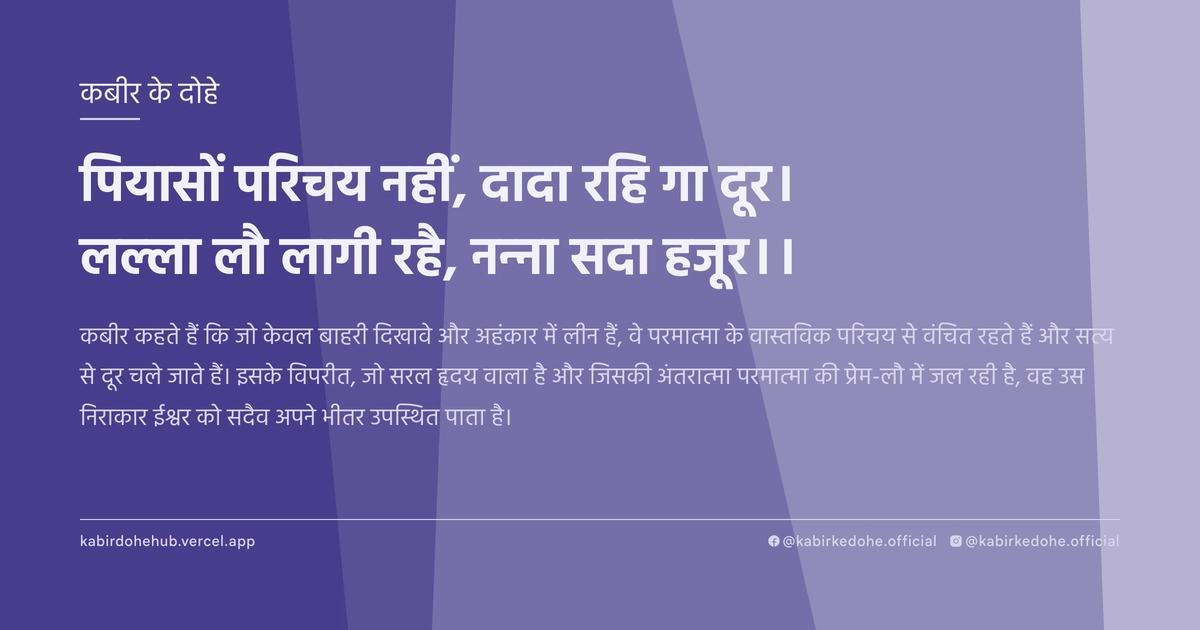
पियासों परिचय नहीं, दादा रहि गा दूर।
लल्ला लौ लागी रहै, नन्ना सदा हजूर।।
Piyason parichay nahin, dada rahi ga door. Lalla lau lagi rahai, nanna sada hazoor.
इस पृष्ठ पर इस कबीर दोहे का अर्थ (meaning), हिंदी व्याख्या और अंग्रेज़ी अनुवाद, दार्शनिक विश्लेषण और व्यावहारिक जीवन सीख दी गई है। यह दोहा भक्ति (Bhakti) विषय से जुड़ा है — Kabir doha meaning and explanation in Hindi and English.
अर्थ (Meaning):
कबीर कहते हैं कि जो केवल बाहरी दिखावे और अहंकार में लीन हैं, वे परमात्मा के वास्तविक परिचय से वंचित रहते हैं और सत्य से दूर चले जाते हैं। इसके विपरीत, जो सरल हृदय वाला है और जिसकी अंतरात्मा परमात्मा की प्रेम-लौ में जल रही है, वह उस निराकार ईश्वर को सदैव अपने भीतर उपस्थित पाता है।
Kabir asserts that those consumed by outward pretension and the ego remain strangers to the true identity of the Divine, drifting further away from reality. Conversely, the one with a simple heart, whose soul is ignited by the fire of longing, finds the Formless Eternal eternally present within their own being.
व्याख्या (Interpretation):
इस दोहे का शाब्दिक अर्थ है कि अहंकारी व्यक्ति ईश्वर से दूर रहता है, जबकि सरल व्यक्ति उसके निकट होता है। गहरे स्तर पर, 'दादा' यहाँ उस अहंकार का प्रतीक है जो स्वयं को ईश्वर से अलग मानता है, जो माया के प्रभाव में है। 'लल्ला' उस शुद्ध चेतना या बालक जैसी सरलता का प्रतीक है जो बिना किसी शर्त के समर्पित है। यह निर्गुण भक्ति का सार है जहाँ ईश्वर किसी मंदिर या मस्जिद में नहीं, बल्कि हृदय की तड़प में मिलता है। अद्वैत वेदांत के अनुसार, जब 'मैं' (अहंकार) मिटता है, तब केवल 'वह' (ब्रह्म) शेष रहता है। यह विरोधाभास है कि जिसे हम बाहर खोज रहे हैं, वह हमारे भीतर ही है, बशर्ते हम अपनी पहचान के झूठे मुखौटों को उतार फेंकें।
Literally, the verse suggests that the arrogant remain distant from God, while the simple remain close. Metaphorically, 'Dada' represents the inflated ego that perceives a separation between the self and the Divine, trapped in the veil of Maya. 'Lalla' symbolizes the pristine consciousness or child-like innocence that surrenders unconditionally. This is the essence of Nirgun Bhakti, where the Divine is found not in shrines, but in the intensity of spiritual longing. According to Advaita Vedanta, when the 'I' (ego) dissolves, only 'That' (Brahman) remains. It presents the central paradox: the object of our external search is the very subject searching, provided we shed the false masks of identity.
दार्शनिक विश्लेषण (Philosophical Analysis):
कबीर का यह कालखंड धार्मिक कट्टरता और कर्मकांडों का समय था। उन्होंने देखा कि लोग बाहरी पहचान—जाति, धर्म, और पद—को ही सत्य मान बैठे थे। इस दोहे में वे 'परिचय' शब्द का प्रयोग कर रहे हैं, जो यह संकेत देता है कि ईश्वर के साथ संबंध बौद्धिक नहीं, बल्कि अनुभवात्मक है। वे ritualism का खंडन करते हुए बताते हैं कि माला जपने या तीर्थ यात्रा करने से वह 'परिचय' नहीं मिलता जो हृदय की सरलता से मिलता है।
दार्शनिक रूप से, यह सूफी मत के 'फना' (अहंकार का विनाश) और अद्वैत के 'अहं ब्रह्मास्मि' का संगम है। जब साधक अपनी व्यक्तिगत पहचान को मिटा देता है, तो वह सार्वभौमिक चेतना में विलीन हो जाता है। यहाँ 'लौ' का अर्थ है वह तीव्र इच्छा जो अशुद्धियों को जला देती है।
कबीर यहाँ मनोवैज्ञानिक परिवर्तन की बात कर रहे हैं। वे कहते हैं कि जब तक मनुष्य खुद को 'बड़ा' (दादा) समझता है, वह अपनी लघुता के कारण सत्य को देख नहीं पाता। सत्य केवल उसी को दिखता है जो स्वयं को शून्य कर लेता है।
यह शिक्षण हमें सिखाता है कि भक्ति कोई बाहरी क्रिया नहीं, बल्कि आंतरिक रूपांतरण है। यह अहंकार के उस सूक्ष्म स्तर पर प्रहार करता है जो हमें विश्वास दिलाता है कि हम ईश्वर से अलग हैं।
अंततः, यह दोहा इस सत्य की स्थापना करता है कि परमात्मा की उपस्थिति किसी विशेष योग्यता या ज्ञान पर निर्भर नहीं है, बल्कि केवल प्रेम और सरलता की मांग करती है।
Kabir operated in an era defined by rigid religious orthodoxy and superficial ritualism. He observed that people had mistaken external identities—caste, creed, and status—for ultimate truth. In this verse, the use of 'parichay' (introduction/acquaintance) indicates that the relationship with the Divine is experiential, not intellectual. He rejects ritualism, suggesting that chanting beads or pilgrimages cannot grant the intimacy that heart-felt simplicity provides.
Philosophically, this is a confluence of the Sufi concept of 'Fana' (annihilation of the self) and the Advaitic 'Aham Brahmasmi' (I am Brahman). When the seeker erases their individual identity, they merge into the universal consciousness. The 'lau' (flame) represents the intense longing that incinerates spiritual impurities.
Kabir addresses a psychological transformation. He argues that as long as a human perceives themselves as 'great' (Dada), their very inflation blinds them to the truth. Truth is visible only to those who render themselves as a void, a zero.
This teaching emphasizes that devotion is not an external act but an internal alchemy. It strikes at the subtle layer of ego that convinces us of our separation from the Source.
Ultimately, the doha establishes that the presence of the Divine does not depend on specific qualifications or scholarly knowledge, but demands only love and an uncomplicated heart.
मूल संदेश (Core Message):
- अहंकार सत्य और ईश्वर के बीच की सबसे बड़ी बाधा है।
- बौद्धिक ज्ञान अक्सर आध्यात्मिक अंधता का कारण बन जाता है।
- परमात्मा केवल सरल और समर्पित हृदय में निवास करता है।
- स्वयं को शून्य करना ही पूर्णता को प्राप्त करने का एकमात्र मार्ग है।
- प्रेम की तड़प किसी भी कर्मकांड से अधिक शक्तिशाली है।
- Ego is the primary obstacle between the self and the Truth.
- Intellectual accumulation often leads to spiritual blindness.
- The Divine resides only in a heart that is simple and surrendered.
- Rendering oneself as a zero is the only path to attaining the Infinite.
- The flame of longing is more powerful than any ritualistic act.
व्यावहारिक उदाहरण (Practical Example):
एक समय की बात है, बनारस के घाटों पर रहने वाली एक वृद्ध विधवा थी, जिसका नाम जानकी था। जानकी का जीवन अत्यंत कठिन था, वह दूसरों के घरों में छोटे-मोटे काम करके अपना गुजारा करती थी। वह पढ़ी-लिखी नहीं थी और न ही उसे कोई जटिल शास्त्र पता था।
उसी शहर में एक बहुत बड़ा विद्वान पंडित रहता था, जिसने वेदों और पुराणों का गहन अध्ययन किया था। वह पंडित अपनी विद्वत्ता के कारण बहुत अहंकारी था और मानता था कि केवल उसके जैसे ज्ञानी ही ईश्वर तक पहुँच सकते हैं। वह अक्सर जानकी जैसी महिलाओं का उपहास करता था कि वे बिना मंत्रों के कैसे प्रार्थना करती हैं।
पंडित दिन भर कठिन अनुष्ठान करता, घंटों मंत्रोच्चार करता और अपनी श्रेष्ठता का प्रदर्शन करता। लेकिन उसके मन में शांति नहीं थी; वह हमेशा इस चिंता में रहता था कि लोग उसे कितना बड़ा विद्वान मानते हैं।
दूसरी ओर, जानकी जब भी काम से थककर लौटती, तो बस चुपचाप गंगा किनारे बैठ जाती। वह कोई मंत्र नहीं पढ़ती थी, बस अपनी आँखों में आँसू भरकर उस निराकार ईश्वर को पुकारती। उसके लिए ईश्वर कोई दूर बैठा न्यायाधीश नहीं, बल्कि उसका सबसे करीबी मित्र था।
एक दिन शहर में एक महान संत आए। पंडित उनके पास गया और अपनी लंबी सूची पेश की कि उसने कितनी पुस्तकें पढ़ी हैं और कितने यज्ञ किए हैं। संत ने उसकी ओर देखा और मुस्कुराए, पर कुछ नहीं बोले।
तभी जानकी वहाँ से गुजरी। उसने संत के पैर छुए और बस इतना कहा, "बाबा, मैं तो अनपढ़ हूँ, बस अपने राम की याद में जलती रहती हूँ।" संत की आँखों में चमक आ गई। उन्होंने पंडित से कहा, "तुमने किताबों में ईश्वर को पढ़ा है, लेकिन इस स्त्री ने ईश्वर को महसूस किया है।"
पंडित को गहरा धक्का लगा। उसे समझ आया कि उसका 'विद्वान' होने का अहंकार (दादा) ही उसके और ईश्वर के बीच की सबसे बड़ी दीवार थी। वह जिसे ज्ञान समझ रहा था, वह वास्तव में एक पर्दा था।
उस रात पंडित ने अपनी सारी पुस्तकें एक तरफ रखीं और पहली बार जानकी की तरह सरल होकर रोया। उसने महसूस किया कि जब तक वह 'बड़ा' बना रहा, वह ईश्वर से दूर था। जैसे ही उसने अपनी लघुता को स्वीकार किया, उसे अपने भीतर एक असीम शांति का अनुभव हुआ।
उस दिन के बाद, पंडित ने दिखावा छोड़ दिया और जानकी के साथ बैठकर मौन प्रार्थना करना शुरू किया। उसने सीखा कि ईश्वर को पाने के लिए ज्ञान की नहीं, बल्कि प्रेम की लौ की आवश्यकता होती है।
Once, on the ghats of Varanasi, lived an elderly widow named Janki. Her life was arduous; she eked out a living by doing odd jobs in other people's homes. She was illiterate and knew nothing of complex scriptures.
In the same city lived a renowned scholar-priest who had mastered the Vedas and Puranas. This priest was profoundly arrogant due to his erudition, believing that only intellectuals like himself could reach the Divine. He often mocked women like Janki for praying without formal mantras.
The priest spent his days in rigorous rituals, chanting for hours and projecting his superiority. Yet, he lacked inner peace; he was perpetually anxious about how much the world revered his scholarship.
On the other hand, whenever Janki returned exhausted from work, she would simply sit by the Ganges. She recited no mantras; she merely called out to the Formless Divine with tears in her eyes. To her, God was not a distant judge, but her closest friend.
One day, a great saint visited the city. The priest approached him, presenting a long list of the books he had read and the sacrifices he had performed. The saint looked at him and smiled, but remained silent.
Just then, Janki passed by. She touched the saint's feet and simply said, "Baba, I am illiterate; I only burn in the longing for my Ram." A spark lit up in the saint's eyes. He turned to the priest and said, "You have read about God in books, but this woman has felt God in her soul."
The priest was shaken. He realized that his ego as a 'scholar' (Dada) was the very wall separating him from the Divine. What he perceived as knowledge was actually a veil.
That night, the priest set aside his books and, for the first time, wept with the simplicity of Janki. He felt that as long as he remained 'great,' he was distant. The moment he embraced his smallness, he experienced an infinite peace within.
From that day on, the priest abandoned pretense and began meditating in silence beside Janki. He learned that reaching the Divine requires not the accumulation of knowledge, but the flame of pure love.
अभ्यास मार्गदर्शन (Practice Guidance):
- प्रतिदिन 20 मिनट मौन बैठें और अपने भीतर के 'अहंकार' (वह हिस्सा जो खुद को दूसरों से श्रेष्ठ या अलग मानता है) को केवल एक साक्षी की तरह देखें।
- एक डायरी लिखें जिसमें आप उन क्षणों को दर्ज करें जब आपने अपनी बौद्धिक श्रेष्ठता का उपयोग किसी को नीचा दिखाने के लिए किया, और फिर उसे क्षमा मांगकर मिटाएं।
- व्यवहार परिवर्तन: दिन में कम से कम एक बार किसी ऐसे व्यक्ति की सेवा करें जिसे समाज 'छोटा' समझता है, और उस प्रक्रिया में अपनी लघुता का अनुभव करें।
- डायग्नोस्टिक चेकलिस्ट: क्या मैं अपनी उपलब्धियों के बारे में बात करते समय गर्व महसूस करता हूँ? क्या मैं दूसरों की सरलता को मूर्खता समझता हूँ? यदि हाँ, तो मैं अभी भी 'दादा' की स्थिति में हूँ।
- Sit in silence for 20 minutes daily, observing your 'ego' (the part of you that feels superior or separate from others) as a detached witness.
- Maintain a journal recording moments where you used intellectual superiority to belittle others, then consciously dissolve that ego through forgiveness.
- Behavioral Shift: At least once a day, serve someone whom society deems 'lowly,' and in that process, consciously experience your own smallness.
- Diagnostic Checklist: Do I feel a surge of pride when discussing my achievements? Do I mistake others' simplicity for ignorance? If yes, I am still residing in the state of 'Dada'.
चिंतन प्रश्न (Reflection Questions):
- मेरा वह कौन सा 'डिजिटल अहंकार' है जो मुझे सोशल मीडिया पर एक आदर्श छवि बनाए रखने के लिए मजबूर करता है, जबकि भीतर मैं रिक्त हूँ?
- क्या मैं वास्तव में सत्य की खोज कर रहा हूँ, या मैं केवल अपनी श्रेष्ठता को सिद्ध करने के लिए आध्यात्मिक शब्दावली का उपयोग कर रहा हूँ?
- मेरे जीवन का वह कौन सा हिस्सा है जहाँ मैं 'बड़ा' दिखने की कोशिश करता हूँ और इस प्रक्रिया में अपनी सहजता खो देता हूँ?
- यदि मेरी सारी उपाधियाँ, पद और उपलब्धियाँ छीन ली जाएँ, तो क्या मेरा अस्तित्व अभी भी मूल्यवान होगा?
- क्या मेरी प्रार्थनाएँ ईश्वर को पाने के लिए हैं, या केवल मेरी अपनी इच्छाओं की पुष्टि के लिए?
- What is that 'digital ego' forcing me to maintain a curated image on social media, while I remain empty within?
- Am I truly seeking the Truth, or am I merely using spiritual terminology to validate my own superiority?
- In which area of my life do I strive to appear 'great,' and in doing so, lose my natural spontaneity?
- If all my titles, positions, and achievements were stripped away, would my existence still hold intrinsic value?
- Are my prayers intended to reach the Divine, or are they merely attempts to confirm my own desires?