
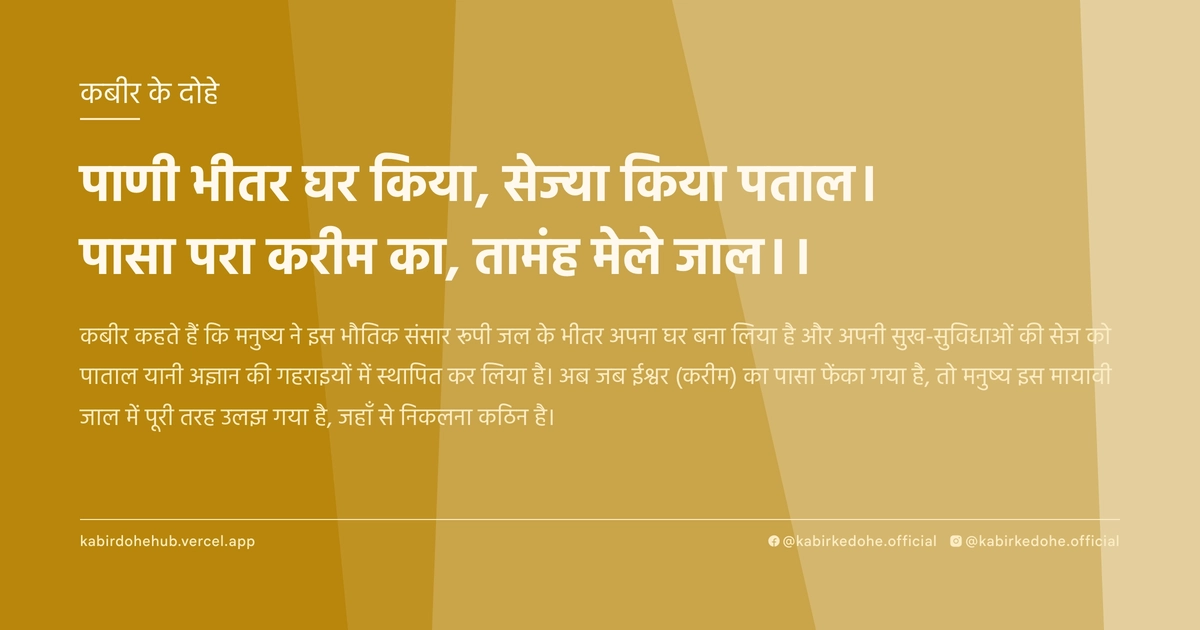
पाणी भीतर घर किया, सेज्या किया पताल।
पासा परा करीम का, तामंह मेले जाल।।
Pani bhitar ghar kiya, sejya kiya patal. Pasa para karim ka, tamanh mele jaal.
इस पृष्ठ पर इस कबीर दोहे का अर्थ (meaning), हिंदी व्याख्या और अंग्रेज़ी अनुवाद, दार्शनिक विश्लेषण और व्यावहारिक जीवन सीख दी गई है। यह दोहा निर्गुण ब्रह्म (Nirguna Brahman) विषय से जुड़ा है — Kabir doha meaning and explanation in Hindi and English.
अर्थ (Meaning):
कबीर कहते हैं कि मनुष्य ने इस भौतिक संसार रूपी जल के भीतर अपना घर बना लिया है और अपनी सुख-सुविधाओं की सेज को पाताल यानी अज्ञान की गहराइयों में स्थापित कर लिया है। अब जब ईश्वर (करीम) का पासा फेंका गया है, तो मनुष्य इस मायावी जाल में पूरी तरह उलझ गया है, जहाँ से निकलना कठिन है।
Kabir asserts that man has constructed his home within the waters of this material existence and placed his bed of comfort in the depths of ignorance. Now that the divine dice of the Almighty (Kareem) have been cast, the soul finds itself entangled in the intricate web of Maya, struggling to break free from the illusions of the physical world.
व्याख्या (Interpretation):
इस दोहे का शाब्दिक अर्थ है कि मनुष्य ने संसार की माया में अपना ठिकाना बना लिया है। यहाँ 'पाणी' (जल) संसार की चंचलता और माया का प्रतीक है, जिसमें डूबना आसान है पर तैरना कठिन। 'पताल' उस गहरे अज्ञान को दर्शाता है जहाँ मनुष्य अपनी वासनाओं और अहंकार को सुख मानता है। यह निर्गुण भक्ति का संकेत है कि जब तक हम स्वयं को शरीर और भौतिक संपत्ति से जोड़ते हैं, हम ईश्वर के खेल (पासे) के मोहरे बने रहते हैं। अद्वैत वेदांत के अनुसार, यह द्वैत का भ्रम है जहाँ आत्मा स्वयं को ब्रह्म से अलग मानकर संसार में घर ढूंढती है। अंततः, यह जाल हमारी अपनी इच्छाओं का है, जिसे केवल आत्म-ज्ञान के माध्यम से ही काटा जा सकता है।
Literally, the verse describes a soul building a home in water and a bed in the abyss. Metaphorically, 'water' represents the fluid, unstable nature of Maya, while the 'abyss' symbolizes the profound ignorance (Avidya) where one mistakes transient pleasures for eternal peace. This aligns with Nirgun Bhakti, suggesting that the soul's identification with the physical form is a trap. In the context of Advaita Vedanta, the 'dice' represent the cosmic play (Lila) of Brahman, where the individual soul (Atman) forgets its divine nature and becomes a pawn in the game of duality. The 'net' is the psychological construct of desire and attachment; the paradox lies in the fact that the prisoner is also the jailer, creating the very illusion that binds them.
दार्शनिक विश्लेषण (Philosophical Analysis):
कबीर का यह दोहा उस युग की उपज है जब समाज कर्मकांडों और बाहरी दिखावों में डूबा था। कबीर ने 'करीम' शब्द का प्रयोग कर सूफी मत और हिंदू भक्ति परंपरा के समन्वय को दर्शाया है, यह बताते हुए कि ईश्वर चाहे किसी भी नाम से पुकारा जाए, वह निराकार और सर्वव्यापी है। यहाँ ritualism का खंडन है क्योंकि कबीर कहते हैं कि मंदिर या मस्जिद में घर बनाने से अधिक महत्वपूर्ण है कि हम माया के इस जाल को पहचानें।
दार्शनिक स्तर पर, यह अद्वैत वेदांत के 'माया' सिद्धांत से जुड़ा है। माया वह शक्ति है जो सत्य को ढक देती है और असत्य को सत्य दिखाती है। मनुष्य जब अपनी पहचान शरीर, जाति या पद से करता है, तो वह वास्तव में 'पाताल' में अपनी सेज बिछा रहा होता है। यह एक मनोवैज्ञानिक पतन है जहाँ चेतना संकुचित हो जाती है।
सूफीवाद के नजरिए से, यह 'नफ्स' (अहंकार) के विनाश की बात है। जब तक इंसान अपनी इच्छाओं के जाल में फंसा है, वह 'करीम' की वास्तविक इच्छा को नहीं समझ सकता। कबीर यहाँ चेतावनी देते हैं कि भौतिक सुख केवल एक भ्रम है जो अंततः दुःख और बंधन का कारण बनता है।
कबीर का प्रहार उन लोगों पर है जो धर्म को केवल बाहरी नियमों में देखते हैं। वे तर्क देते हैं कि वास्तविक आध्यात्मिक यात्रा बाहर नहीं, बल्कि भीतर की ओर है। जब तक हम संसार को अपना स्थायी घर मानेंगे, हम ईश्वर के खेल में केवल एक मोहरा रहेंगे, खिलाड़ी नहीं।
अंततः, यह विश्लेषण हमें सिखाता है कि मुक्ति का मार्ग त्याग में नहीं, बल्कि सही दृष्टि (विवेक) में है। जब व्यक्ति यह जान लेता है कि वह जल (माया) नहीं बल्कि वह चैतन्य है जो जल को देख रहा है, तब वह इस जाल से मुक्त हो जाता है। यह अहंकार का पूर्ण विलोपन है, जहाँ 'मैं' समाप्त होता है और केवल 'वह' शेष रहता है।
Kabir’s verse emerges from an era dominated by rigid ritualism and caste hierarchies. By using the term 'Kareem' (the Generous/Merciful), Kabir bridges the gap between Sufi mysticism and the Bhakti movement, emphasizing that the Divine is formless (Nirgun) and transcends religious labels. He rejects the notion that salvation is found through external rites, arguing instead that the primary obstacle is the internal entanglement in Maya.
Philosophically, this connects to the Advaita Vedanta concept of Maya—the cosmic illusion that veils the ultimate reality. When a human identifies with the ego, social status, or physical body, they are effectively building a 'home in water,' a structure destined to collapse. This represents a psychological descent where consciousness is narrowed to the same level as primal desires.
From a Sufi perspective, this is the struggle with the 'Nafs' (the lower self). The 'net' is the web of attachments that prevent the seeker from achieving 'Fana' (annihilation of the ego) in the Divine. Kabir suggests that the cosmic dice have been cast, and the soul's current state of suffering is a result of its own misplaced priorities and attachments.
Kabir challenges the literalist interpretation of religion. He posits that spiritual liberation is not about changing one's location or performing specific acts, but about a fundamental shift in perception. The 'game' is the play of existence, and the only way to stop being a pawn is to realize one's identity as the Eternal Witness rather than the temporary actor.
Ultimately, this analysis reveals that the path to liberation is through 'Viveka' (discernment). By recognizing the transience of the material world, the seeker stops investing emotional energy into the 'watery home' and begins the journey toward the unchanging Truth. It is the transition from the illusion of separation to the realization of non-duality.
मूल संदेश (Core Message):
- संसार की नश्वरता को पहचानें, यह केवल एक अस्थायी पड़ाव है।
- बाहरी प्रतिष्ठा का मोह ही आत्मा का सबसे बड़ा बंधन है।
- अहंकार का विसर्जन ही माया के जाल से निकलने का एकमात्र मार्ग है।
- ईश्वर के खेल को स्वीकार करें, लेकिन उसके मोहरे न बनें।
- सच्चा घर आत्मा के भीतर है, भौतिक वस्तुओं में नहीं।
- विवेक का उपयोग कर भ्रम और सत्य के बीच अंतर करना सीखें।
- Recognize the transience of the world; it is but a temporary shelter.
- The craving for external prestige is the soul's heaviest chain.
- The annihilation of the ego is the only way to break Maya's net.
- Accept the divine play, but refuse to be a mere pawn in it.
- The true home resides within the spirit, not in material accumulation.
- Use discernment to distinguish between the illusion and the Absolute Truth.
व्यावहारिक उदाहरण (Practical Example):
वाराणसी के घाटों पर रहने वाले एक वृद्ध विधवा, जानकी, का जीवन इस दोहे का जीवंत उदाहरण है। जानकी ने अपना पूरा जीवन केवल परंपराओं और सामाजिक मर्यादाओं के पालन में बिताया। उन्होंने अपने मन में यह घर बनाया था कि यदि वह हर नियम का पालन करेंगी, तो उन्हें समाज में सम्मान मिलेगा और मृत्यु के बाद मोक्ष प्राप्त होगा। उनके लिए 'पाणी' वह सामाजिक प्रतिष्ठा थी जिसे उन्होंने अपना स्थायी ठिकाना मान लिया था।
वह हर दिन घंटों पूजा-पाठ करतीं, लेकिन उनका मन हमेशा इस बात में लगा रहता कि दूसरे उनके बारे में क्या सोच रहे हैं। उनकी 'सेज' पाताल में थी, क्योंकि उनकी खुशी दूसरों की स्वीकृति पर टिकी थी। वह वास्तव में एक अदृश्य जाल में फंसी थीं, जहाँ धर्म केवल एक सामाजिक मुखौटा बन गया था।
एक दिन उनकी मुलाकात एक घुमक्कड़ फकीर से हुई, जिसने उनसे पूछा, 'माँ, तुम इस नदी के किनारे घर बना रही हो, क्या तुम्हें पता है कि नदी की लहरें सब कुछ बहा ले जाती हैं?' जानकी को पहले तो यह बात अजीब लगी, लेकिन फिर उन्होंने गहराई से सोचा।
उन्होंने महसूस किया कि जिस 'सम्मान' के लिए उन्होंने अपनी पूरी इच्छाएं मार दीं, वह सम्मान केवल बाहरी था। उनके भीतर का शून्य कभी नहीं भरा। उन्होंने महसूस किया कि वह वास्तव में एक ऐसे जाल में थीं जहाँ वह खुद को खो चुकी थीं।
फकीर ने उन्हें समझाया कि असली घर वह है जो भीतर है, न कि वह जो दुनिया की नजरों में है। जानकी ने धीरे-धीरे बाहरी दिखावे को छोड़ना शुरू किया। उन्होंने उन लोगों की मदद करना शुरू किया जिन्हें समाज ने ठुकरा दिया था, बिना इस चिंता के कि लोग क्या कहेंगे।
यह उनका 'कबीर ट्विस्ट' था। उन्होंने अपनी पहचान एक 'आदर्श विधवा' से बदलकर एक 'स्वतंत्र आत्मा' के रूप में की। उन्होंने पाया कि जब उन्होंने दूसरों की नजरों में अपनी छवि बनाने का प्रयास छोड़ दिया, तो उन्हें वह शांति मिली जिसकी तलाश में वह वर्षों से पूजा कर रही थीं।
अब वह घाट पर बैठती तो थीं, लेकिन अब वह लहरों से डरती नहीं थीं, बल्कि लहरों के साथ बहना सीख गई थीं। उन्होंने समझ लिया था कि संसार का घर पानी पर बना है, इसलिए वहां स्थिरता ढूंढना व्यर्थ है।
अंत में, जानकी ने अपनी भौतिक और मानसिक आसक्तियों का त्याग किया। वह अब उस 'जाल' से मुक्त थीं। उनकी खुशी अब किसी बाहरी पासे के गिरने पर निर्भर नहीं थी, बल्कि उनके अपने भीतर की स्थिरता में थी।
Janaki, an elderly widow living on the ghats of Varanasi, embodies the struggle described in this Doha. For decades, Janaki built her life around the rigid adherence to social norms and traditions. She believed that by following every ritual perfectly, she would earn social respect and eventually attain salvation. This social prestige was the 'water' in which she had built her emotional home.
Every day, she spent hours in prayer, yet her mind was perpetually occupied with how others perceived her. Her 'bed' was in the abyss of ignorance because her sense of worth was entirely dependent on external validation. She was caught in an invisible net where religion had become a mere social mask rather than a spiritual path.
One day, she encountered a wandering dervish who asked her, 'Mother, you are building a home on the banks of this river; do you not know that the current sweeps everything away?' Initially, Janaki was puzzled, but the question planted a seed of introspection.
She began to realize that the 'respect' she had sacrificed her own desires for was superficial. The void within her remained unfilled. She recognized that she was trapped in a web of expectations, where her identity was defined by her limitations rather than her essence.
The dervish explained that the only true home is the one found within, not the one constructed in the eyes of the world. Janaki slowly began to shed her preoccupation with outward appearances. She started helping the marginalized people of the ghats, ignoring the whispers of the judgmental society.
This was her 'Kabir Twist.' She shifted her identity from being a 'model widow' to a 'free soul.' She discovered that when she stopped trying to curate her image for others, she found the peace that years of ritualistic prayer had failed to provide.
She still sat by the river, but she no longer feared the waves; she learned to flow with them. She understood that building a permanent home in the material world is as futile as building on water.
In the end, Janaki liberated herself from the net of attachment. Her happiness no longer depended on the 'cast of the dice'—the whims of fate or society—but on the unwavering stillness she had discovered within herself.
अभ्यास मार्गदर्शन (Practice Guidance):
- दैनिक चिंतन: प्रतिदिन 15 मिनट मौन बैठें और विचार करें कि आपकी कौन सी इच्छाएं आपको मानसिक रूप से बांध रही हैं। पूछें, 'यदि यह सब छिन जाए, तो मैं कौन हूँ?'
- आत्म-पूछताछ जर्नल: एक डायरी लिखें जिसमें उन सामाजिक मुखौटों की सूची बनाएं जिन्हें आप दुनिया के सामने पहनते हैं। विश्लेषण करें कि ये मुखौटों आपको वास्तविक सत्य से कैसे दूर ले जा रहे हैं।
- व्यवहारिक परिवर्तन: सप्ताह में एक बार ऐसा कार्य करें जो आपकी 'छवि' या 'प्रतिष्ठा' के विरुद्ध हो लेकिन नैतिक रूप से सही हो, ताकि आप अहंकार के जाल को तोड़ सकें।
- डायग्नोस्टिक चेकलिस्ट: (1) क्या मेरी खुशी दूसरों की प्रशंसा पर निर्भर है? (2) क्या मैं छोटी बातों पर विचलित हो जाता हूँ? (3) क्या मैं अपनी पहचान केवल अपने पद या रिश्तों से जोड़ता हूँ? यदि हाँ, तो आप अभी भी 'पानी के घर' में हैं।
- Daily Contemplation: Spend 15 minutes in silence daily, observing the desires that bind you. Ask yourself: 'If all my titles and possessions were stripped away, who would I be?'
- Self-Inquiry Journaling: Maintain a journal listing the social masks you wear. Analyze how these personas distance you from your authentic self and the ultimate truth.
- Behavioral Shift: Once a week, perform an act of kindness or truth that may challenge your public 'image' or 'reputation' but is ethically right, thereby weakening the net of ego.
- Diagnostic Checklist: (1) Is my happiness dependent on external validation? (2) Do I feel easily shaken by trivial changes in circumstances? (3) Do I define myself solely by my roles or possessions? If yes, you are still residing in the 'home of water'.
चिंतन प्रश्न (Reflection Questions):
- आपकी वह कौन सी 'मानसिक सेज' है जिसे आप सुख समझते हैं, लेकिन वह वास्तव में आपकी प्रगति में बाधा है?
- यदि आज आपकी सारी सामाजिक पहचान (नाम, पद, रिश्ता) छीन ली जाए, तो आपके भीतर क्या बचेगा?
- आप अपनी डिजिटल पहचान (Social Media Ego) को बनाए रखने के लिए अपनी वास्तविक शांति का कितना बलिदान कर रहे हैं?
- क्या आप धर्म का पालन ईश्वर से जुड़ने के लिए कर रहे हैं, या केवल इसलिए ताकि आप 'धार्मिक' दिखें?
- आपके जीवन का वह कौन सा 'जाल' है जिसे आपने खुद बुना है और अब उसमें फंसे होने का शोक मना रहे हैं?
- क्या आप वास्तव में स्वतंत्र हैं, या आप केवल अपनी पसंद की बेड़ियों में बंधे हुए हैं?
- What is that 'mental bed' of comfort you cling to, which is actually hindering your spiritual evolution?
- If all your social identifiers—name, title, and relationships—were stripped away today, what would remain of you?
- How much of your inner peace are you sacrificing to maintain your digital ego and curated online persona?
- Do you practice your faith to connect with the Divine, or simply to be perceived as 'spiritual' by others?
- Which 'net' in your life did you weave yourself, only to now lament being trapped within it?
- Are you truly free, or have you simply become fond of the chains you chose for yourself?