
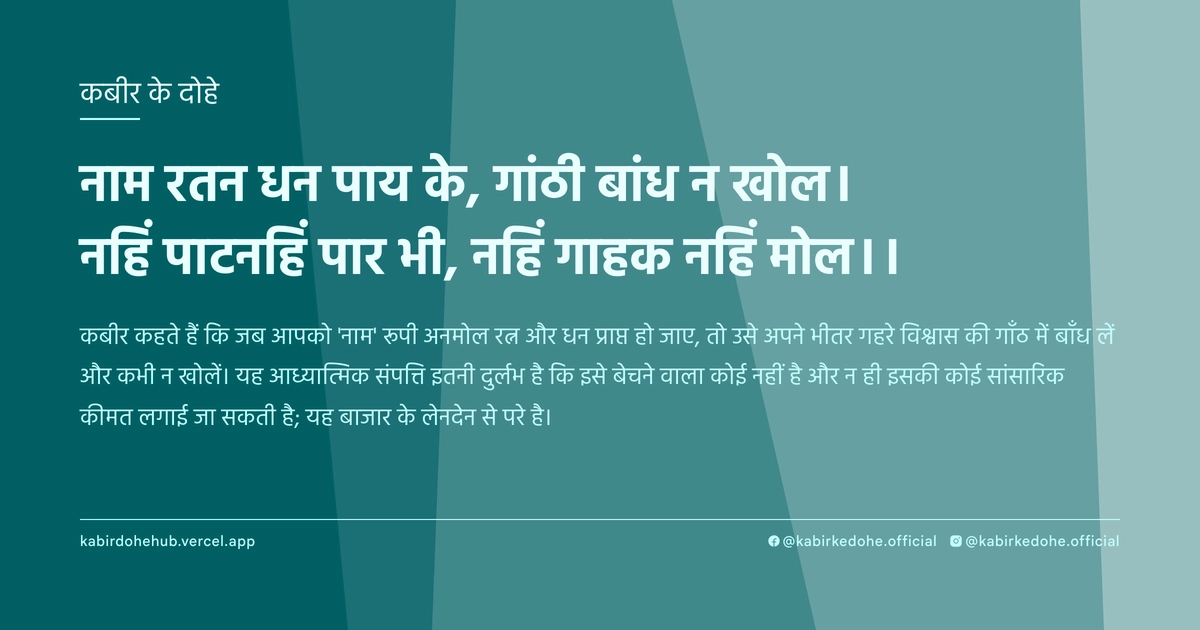
नाम रतन धन पाय के, गांठी बांध न खोल।
नहिं पाटनहिं पार भी, नहिं गाहक नहिं मोल।।
Naam ratan dhan paay ke, gaanthi baandh na khol. Nahin paatanahi paar bhi, nahin gaahak nahin mol.
इस पृष्ठ पर इस कबीर दोहे का अर्थ (meaning), हिंदी व्याख्या और अंग्रेज़ी अनुवाद, दार्शनिक विश्लेषण और व्यावहारिक जीवन सीख दी गई है। यह दोहा भक्ति (Bhakti) विषय से जुड़ा है — Kabir doha meaning and explanation in Hindi and English.
अर्थ (Meaning):
कबीर कहते हैं कि जब आपको 'नाम' रूपी अनमोल रत्न और धन प्राप्त हो जाए, तो उसे अपने भीतर गहरे विश्वास की गाँठ में बाँध लें और कभी न खोलें। यह आध्यात्मिक संपत्ति इतनी दुर्लभ है कि इसे बेचने वाला कोई नहीं है और न ही इसकी कोई सांसारिक कीमत लगाई जा सकती है; यह बाजार के लेनदेन से परे है।
Kabir advises that once you have attained the priceless jewel and wealth of the 'Name' (the Divine Remembrance), bind it securely within the knot of your soul and never let it go. This spiritual treasure is beyond the reach of worldly commerce; there is no seller to trade it, no buyer to purchase it, and no earthly price that can quantify its infinite value.
व्याख्या (Interpretation):
शाब्दिक रूप से, कबीर एक व्यापारी की भाषा का उपयोग कर रहे हैं, लेकिन उनका संकेत आंतरिक चेतना की ओर है। 'नाम' यहाँ केवल शब्द नहीं, बल्कि उस निराकार ब्रह्म (Nirgun Brahman) का अनुभव है जो हर कण में व्याप्त है। 'गाँठ बाँधना' का अर्थ है इस अनुभव को अहंकार या बाहरी प्रदर्शन के लिए प्रकट न करना, बल्कि इसे आत्मसात करना। यह माया के उस भ्रम को तोड़ता है जहाँ मनुष्य बाहरी वस्तुओं में सुख खोजता है। यहाँ द्वैत का अंत होता है और साधक यह समझता है कि वह स्वयं वही रत्न है जिसे वह खोज रहा था। यह एक आध्यात्मिक विरोधाभास है: वह धन जो खर्च नहीं किया जा सकता, वही वास्तव में सबसे मूल्यवान है।
Literally, Kabir employs the lexicon of a merchant, yet his direction is toward internal consciousness. 'Naam' here is not a mere word or label, but the experiential realization of the Formless Absolute (Nirgun Brahman) pervading every atom. 'Binding the knot' signifies the act of internalizing this realization, preventing it from leaking away through the ego's desire for external validation or spiritual pride. It shatters the illusion of Maya, where humans seek fulfillment in transient material acquisitions. Here, duality dissolves, and the seeker realizes that they themselves are the jewel they were searching for. It presents a spiritual paradox: the only wealth that cannot be traded or spent is the only wealth that possesses true, eternal value.
दार्शनिक विश्लेषण (Philosophical Analysis):
कबीर का यह दोहा उस युग की उपज है जब धर्म कर्मकांडों और बाहरी आडंबरों में जकड़ा हुआ था। उन्होंने स्पष्ट रूप से मंदिर, मस्जिद और जातिगत श्रेष्ठता को नकारते हुए 'सहज' मार्ग पर जोर दिया। यह विचार अद्वैत वेदांत के करीब है, जहाँ आत्मा और परमात्मा की एकता की बात की गई है। कबीर का 'नाम' सूफी मत के 'जिक्र' के समान है, जहाँ निरंतर स्मरण के माध्यम से ईश्वर से मिलन होता है।
यहाँ 'धन' का अर्थ भौतिक संपत्ति नहीं, बल्कि 'चित्त की शुद्धि' है। कबीर चेतावनी देते हैं कि यदि इस अनुभव को अहंकार (Ego) के साथ जोड़ा गया, तो यह नष्ट हो जाएगा। वे बताते हैं कि आध्यात्मिक ज्ञान कोई ऐसी वस्तु नहीं है जिसे एक व्यक्ति से दूसरे व्यक्ति को सौंपा जा सके; यह एक आंतरिक जागृति है।
सामाजिक संदर्भ में, कबीर एक जुलाहे थे, और उन्होंने व्यापारिक शब्दावली का उपयोग करके यह समझाया कि आध्यात्मिक सत्य किसी भी सामाजिक वर्ग की बपौती नहीं है। यह ज्ञान न तो ब्राह्मणों के ग्रंथों में सीमित है और न ही मुल्लाओं की आयतों में, बल्कि यह हृदय की पवित्रता में निहित है।
मनोवैज्ञानिक स्तर पर, 'गाँठ बाँधना' एकाग्रता और स्थिरता का प्रतीक है। जब मन बाहरी दुनिया के शोर से विचलित होता है, तो वह इस आंतरिक रत्न को खो देता है। कबीर हमें सिखाते हैं कि बाहरी दुनिया की खोज वास्तव में एक भटकाव है।
अंततः, यह दोहा हमें यह समझाता है कि मोक्ष किसी बाहरी स्थान पर जाने से नहीं, बल्कि अपने भीतर के उस सत्य को पहचानने और उसे सहेजने से मिलता है जिसे हम अक्सर अनदेखा कर देते हैं।
This couplet emerges from an era where religion was stifled by rigid rituals and external ostentation. Kabir explicitly rejected the hegemony of temples, mosques, and caste hierarchies, emphasizing the 'Sahaj' (natural/spontaneous) path. This philosophy aligns closely with Advaita Vedanta, which posits the fundamental non-duality of the Atman (individual soul) and Brahman (universal consciousness).
Kabir's concept of 'Naam' mirrors the Sufi practice of 'Zikr' (remembrance), where the constant invocation of the Divine leads to annihilation of the self and union with the Truth. Here, 'wealth' does not refer to material accumulation but to the 'purification of the psyche.' Kabir warns that if this realization is entwined with the ego, it evaporates instantly.
He asserts that spiritual gnosis is not a commodity to be transferred from teacher to student like a textbook; it is an internal awakening. In a social context, as a weaver, Kabir utilized mercantile metaphors to democratize spirituality, proving that truth is not the monopoly of the priestly class or the scholarly elite.
Psychologically, 'binding the knot' symbolizes concentration and stability. When the mind is scattered by the noise of the external world, it loses touch with this inner jewel. Kabir teaches that the external quest is often a distraction from the internal reality.
Ultimately, this verse illuminates that liberation (Mukti) is not achieved by traveling to a distant pilgrimage site, but by recognizing and preserving the intrinsic truth within, which is often neglected in the pursuit of ephemeral desires.
मूल संदेश (Core Message):
- बाहरी खोज एक भ्रम है; सत्य केवल भीतर है।
- आध्यात्मिक अनुभव को अहंकार के प्रदर्शन से बचाएं।
- सच्चा धन वह है जो भौतिक बाजार से परे है।
- मौन और आंतरिक स्थिरता ही वास्तविक सुरक्षा है।
- आत्मा का मिलन ही जीवन का एकमात्र स्थायी लाभ है।
- The external quest is an illusion; Truth resides only within.
- Shield your spiritual realizations from the glare of the ego.
- True wealth is that which exists beyond the reach of any market.
- Silence and inner stability are the only genuine forms of security.
- Union with the Soul is the only permanent profit of human existence.
व्यावहारिक उदाहरण (Practical Example):
वाराणसी के घाटों पर रहने वाली एक वृद्ध विधवा, जानकी, का जीवन केवल दूसरों की सेवा और मंदिर की सीढ़ियों पर बिताए समय तक सीमित था। वह मानती थी कि मोक्ष केवल कठिन तपस्या और बाहरी अनुष्ठानों से मिलेगा। वह हर दिन घंटों मंत्र जाप करती, लेकिन उसके मन में अभी भी समाज के प्रति एक सूक्ष्म शिकायत और अपने अकेलेपन का दुख था।
एक दिन उसकी मुलाकात एक घुमक्कड़ साधु से हुई जिसने उसे कबीर का यह दोहा सुनाया। साधु ने उससे कहा, 'माँ, तुम बाहर जो खोज रही हो, वह तुम्हारे भीतर पहले से ही मौजूद है। बस उसे पहचानो और उसे अपनी आत्मा की गाँठ में बाँध लो।'
जानकी ने पहले तो इसे नजरअंदाज किया, लेकिन फिर उसने प्रयोग करना शुरू किया। उसने बाहरी जाप के बजाय, अपने भीतर की शांति को महसूस करना शुरू किया। उसने महसूस किया कि जब वह किसी भूखे को भोजन कराती है, तो उस समय जो संतोष उसे मिलता है, वही 'नाम' है।
धीरे-धीरे, उसकी प्रार्थनाएँ प्रदर्शन से हटकर प्रेम में बदल गईं। उसने महसूस किया कि वह अब अकेलेपन से नहीं डरती, क्योंकि उसने अपने भीतर एक ऐसा साथी पा लिया था जो कभी उसका साथ नहीं छोड़ता।
एक समय ऐसा आया जब शहर के बड़े पंडित उसकी शांति देखकर हैरान रह गए। उन्होंने उससे उसकी विधि पूछी, लेकिन जानकी ने केवल मुस्कुराकर कहा, 'मैंने बस अपनी गाँठ कस ली है।'
उसने अब किसी बाहरी मान्यता की परवाह करना छोड़ दिया। उसका जीवन एक जीवित प्रार्थना बन गया था।
वह अब केवल मंदिर नहीं जाती थी, बल्कि वह स्वयं एक मंदिर बन गई थी जहाँ हर आने वाला शांति महसूस करता था।
उसकी इस आंतरिक संपत्ति ने उसे उस मानसिक शांति तक पहुँचाया जिसे वह दशकों तक बाहरी अनुष्ठानों में खोज रही थी।
अंत में, जानकी ने यह जान लिया कि सबसे बड़ा धन वह है जिसे कोई चुरा नहीं सकता और जिसे किसी बाजार में बेचा नहीं जा सकता।
यह उसका 'कबीर ट्विस्ट' था—बाहरी खोज का आंतरिक समर्पण में परिवर्तन।
Janaki, an elderly widow living on the ghats of Varanasi, spent her days in service to others and endless hours on the temple steps. She believed that liberation was only possible through rigorous penance and external rituals. She chanted mantras for hours, yet her heart harbored a subtle resentment toward society and the deep ache of loneliness.
One day, she encountered a wandering ascetic who recited this specific Doha of Kabir. The ascetic told her, 'Mother, what you seek outside already exists within you. Simply recognize it and bind it securely in the knot of your soul.'
Initially, Janaki dismissed this as simplistic, but she eventually began to experiment. Instead of focusing on the mechanical repetition of chants, she started observing the silence within. She realized that the profound contentment she felt while feeding a hungry stranger was, in itself, the 'Naam'.
Gradually, her prayers shifted from performance to pure love. She discovered that she no longer feared loneliness because she had found a companion within who would never depart.
There came a time when the high priests of the city were astonished by her radiating peace. When they asked for her secret method, Janaki only smiled and replied, 'I have simply tightened my knot.'
She ceased caring for external validations or religious labels. Her very existence became a living prayer.
She no longer just visited the temple; she became a temple where anyone who approached her felt an immediate sense of serenity.
This internal wealth brought her to a state of mental equilibrium that she had spent decades searching for in external rites.
Ultimately, Janaki understood that the greatest treasure is that which cannot be stolen and cannot be traded in any marketplace.
This was her 'Kabir Twist'—the transformation from an external quest to an internal surrender.
अभ्यास मार्गदर्शन (Practice Guidance):
- प्रतिदिन 20 मिनट मौन रहकर अपने भीतर की 'ध्वनि' को सुनने का प्रयास करें, शब्दों को नहीं, बल्कि उस शांति को महसूस करें।
- एक डायरी लिखें जिसमें आप उन क्षणों को दर्ज करें जब आपने बिना किसी स्वार्थ के प्रेम महसूस किया; इसे अपना 'आध्यात्मिक धन' मानें।
- जब भी अहंकार या क्रोध महसूस हो, स्वयं से पूछें: 'क्या मैं इस क्षण अपने आंतरिक रत्न को खो रहा हूँ?'
- निदान चेकलिस्ट: यदि आप दूसरों की प्रशंसा के लिए अपनी आध्यात्मिक उपलब्धियों का बखान कर रहे हैं, तो आपकी 'गाँठ' खुल रही है। यदि आप मौन में भी पूर्ण महसूस करते हैं, तो आप इस ज्ञान को जी रहे हैं।
- Spend 20 minutes daily in absolute silence, attempting to listen to the 'inner sound'—not the words, but the profound stillness beneath them.
- Maintain a journal recording moments of selfless love and compassion; categorize these experiences as your 'spiritual wealth'.
- Whenever ego or anger arises, ask yourself: 'Am I letting my inner jewel slip away in this moment of reactivity?'
- Diagnostic Checklist: If you find yourself boasting about your spiritual progress for social validation, your 'knot' is loosening. If you feel complete and whole even in total solitude, you are embodying this wisdom.
चिंतन प्रश्न (Reflection Questions):
- मेरी वह कौन सी 'आध्यात्मिक पहचान' है जिसे मैं दूसरों को दिखाने के लिए उपयोग करता हूँ?
- यदि मेरा सारा सामाजिक सम्मान और पद छीन लिया जाए, तो मेरे भीतर क्या बचेगा?
- मैं अपनी शांति को बाहरी परिस्थितियों का गुलाम क्यों बनाता हूँ?
- क्या मैं सत्य को खोज रहा हूँ, या केवल सत्य के होने का दावा करना चाहता हूँ?
- मेरे जीवन का वह कौन सा हिस्सा है जहाँ मैं अभी भी 'मोल-भाव' कर रहा हूँ, जबकि मुझे समर्पण करना चाहिए?
- Which part of my 'spiritual identity' do I curate specifically for the gaze of others?
- If all my social status and accolades were stripped away, what would remain of my core?
- Why do I continue to make my inner peace a hostage to external circumstances?
- Am I genuinely seeking the Truth, or am I merely seeking the reputation of being truthful?
- In which area of my life am I still attempting to 'bargain' with existence, rather than surrendering to it?