
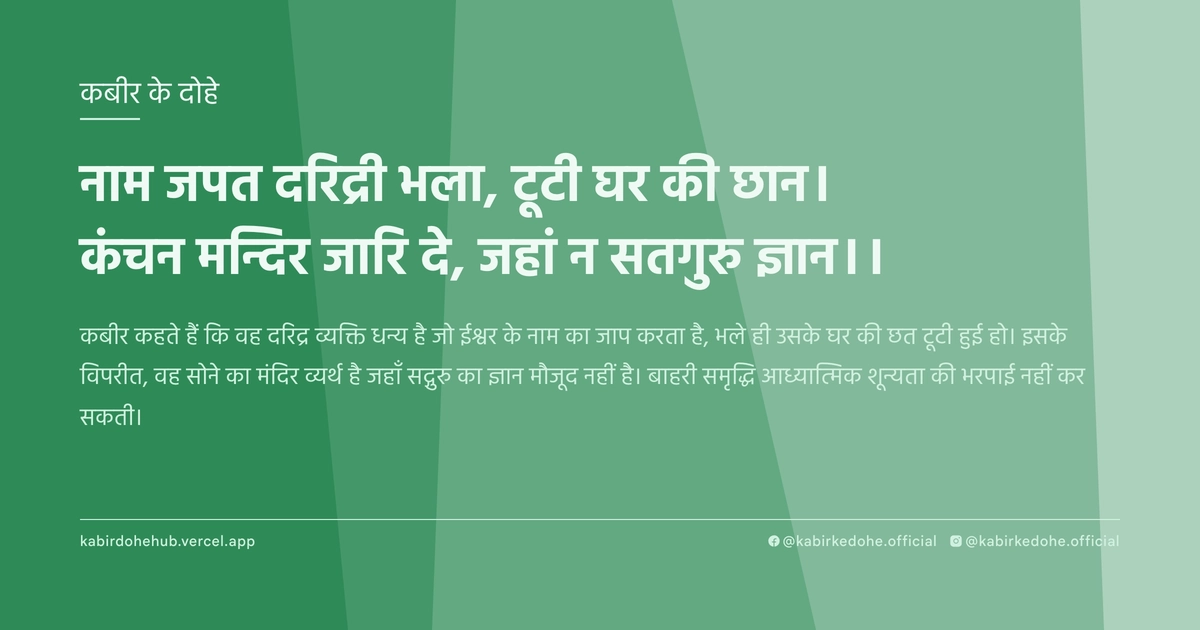
नाम जपत दरिद्री भला, टूटी घर की छान।
कंचन मन्दिर जारि दे, जहां न सतगुरु ज्ञान।।
Naam japat daridri bhala, tooti ghar ki chhaan. Kanchan mandir jaari de, jahan na satguru gyaan.
इस पृष्ठ पर इस कबीर दोहे का अर्थ (meaning), हिंदी व्याख्या और अंग्रेज़ी अनुवाद, दार्शनिक विश्लेषण और व्यावहारिक जीवन सीख दी गई है। यह दोहा गुरु महत्व (The Guru's Importance) विषय से जुड़ा है — Kabir doha meaning and explanation in Hindi and English.
अर्थ (Meaning):
कबीर कहते हैं कि वह दरिद्र व्यक्ति धन्य है जो ईश्वर के नाम का जाप करता है, भले ही उसके घर की छत टूटी हुई हो। इसके विपरीत, वह सोने का मंदिर व्यर्थ है जहाँ सद्गुरु का ज्ञान मौजूद नहीं है। बाहरी समृद्धि आध्यात्मिक शून्यता की भरपाई नहीं कर सकती।
Kabir asserts that a pauper who chants the Divine Name is far more fortunate than a wealthy person, even if their roof is leaking. A temple made of gold is useless and should be discarded if it lacks the illuminating wisdom of a true spiritual teacher. Material opulence is meaningless without inner awakening.
व्याख्या (Interpretation):
यह दोहा भौतिक अभाव और आध्यात्मिक संपदा के बीच के विरोधाभास को दर्शाता है। 'टूटी छत' सांसारिक गरीबी का प्रतीक है, जबकि 'नाम जपत' आत्मा की उच्च अवस्था को दर्शाता है। कबीर यहाँ 'कंचन मन्दिर' (सोने के मंदिर) के माध्यम से संगठित धर्म के आडंबर और अहंकार को चुनौती देते हैं। यह निरगुण भक्ति का सार है, जहाँ ईश्वर किसी भव्य इमारत में नहीं, बल्कि साधक के हृदय में निवास करता है। जब तक सद्गुरु का ज्ञान नहीं मिलता, बाहरी पूजा केवल एक भ्रम या 'माया' है। यह अद्वैत वेदांत के उस सिद्धांत की पुष्टि करता है जहाँ आत्मा का परमात्मा से मिलन केवल आंतरिक बोध से संभव है, न कि बाहरी कर्मकांडों से।
This couplet highlights the paradox between material deprivation and spiritual abundance. The 'broken roof' symbolizes worldly poverty, while 'chanting the Name' represents the soul's elevated state. Kabir uses the 'golden temple' as a metaphor for the vanity of organized religion and the ego's desire for external validation. This is the essence of Nirgun Bhakti, where the Divine resides not in a lavish structure, but within the practitioner's heart. Without the wisdom of a Satguru, external rituals are merely 'Maya' or illusion. It affirms the Advaita Vedanta principle that the union of Atman and Brahman is achieved through internal realization, not through the accumulation of gold or the construction of monuments.
दार्शनिक विश्लेषण (Philosophical Analysis):
कबीर का यह कथन उनके युग के सामाजिक और धार्मिक परिवेश पर एक तीखा प्रहार है। मध्यकालीन भारत में धर्म अक्सर भव्य मंदिरों और मस्जिदों के निर्माण तक सीमित हो गया था, जहाँ पुरोहित वर्ग ने ज्ञान पर एकाधिकार कर लिया था। कबीर इस व्यवस्था को नकारते हुए 'सहज मार्ग' की वकालत करते हैं। वे तर्क देते हैं कि भक्ति का मार्ग जाति, वर्ण या आर्थिक स्थिति से ऊपर है।
दार्शनिक स्तर पर, यह सूफी मत के 'फना' (अहंकार का विनाश) और अद्वैत के 'अहं ब्रह्मास्मि' के करीब है। जब साधक 'नाम' जपता है, तो वह वास्तव में अपने सीमित अहंकार को मिटाकर अनंत ब्रह्म में विलीन होने का प्रयास करता है। यहाँ 'नाम' केवल एक शब्द नहीं, बल्कि उस परम चेतना की आवृत्ति है जो व्यक्ति को माया के बंधनों से मुक्त करती है।
कबीर का 'कंचन मन्दिर' को जलाने का आह्वान प्रतीकात्मक है। वे भौतिक विनाश की बात नहीं कर रहे, बल्कि उस मानसिक संरचना को नष्ट करने की बात कर रहे हैं जो हमें यह विश्वास दिलाती है कि ईश्वर को प्रसन्न करने के लिए धन या भव्यता की आवश्यकता है। यह मनोवैज्ञानिक रूपांतरण की प्रक्रिया है, जहाँ व्यक्ति बाहरी दुनिया की खोज छोड़कर अंतर्मुखी होता है।
यह दोहा यह भी स्पष्ट करता है कि ज्ञान (Gyaan) और सूचना (Information) में अंतर है। मंदिर में शास्त्र हो सकते हैं, लेकिन सद्गुरु का ज्ञान वह अनुभव है जो जीवन को बदल देता है। बिना अनुभव के धर्म केवल एक बोझ है।
अंततः, कबीर यह स्थापित करते हैं कि वास्तविक समृद्धि 'संतोष' और 'बोध' में है। एक दरिद्र व्यक्ति जो आंतरिक शांति में है, वह उस सम्राट से कहीं अधिक समृद्ध है जो मानसिक अशांति और अहंकार के पिंजरे में कैद है। यह भौतिकवाद के विरुद्ध एक आध्यात्मिक क्रांति है।
Kabir's statement is a sharp critique of the social and religious milieu of his era. In medieval India, religion had become confined to the construction of lavish temples and mosques, where the priestly class monopolized spiritual knowledge. Kabir rejects this institutionalized structure, advocating instead for the 'Sahaj Marg' or the natural path of spontaneous devotion.
Philosophically, this aligns with the Sufi concept of 'Fana' (annihilation of the ego) and the Advaita principle of 'Aham Brahmasmi' (I am Brahman). When a seeker chants the 'Naam', they are not merely repeating a word but are attempting to dissolve their limited ego into the infinite consciousness. The 'Name' is a vibrational frequency of the Supreme Truth that liberates the individual from the shackles of Maya.
Kabir's call to 'burn the golden temple' is deeply symbolic. He is not advocating for physical arson but for the destruction of the mental construct that suggests the Divine can be appeased through wealth or architectural grandeur. This is a process of psychological transformation, shifting the focus from the external world to the internal landscape.
Furthermore, the couplet distinguishes between 'Gyaan' (experiential wisdom) and mere information. A temple may house scriptures, but the wisdom of a Satguru is a lived experience that transforms existence. Without this realization, religion remains a burdensome ritual rather than a liberating force.
Ultimately, Kabir establishes that true prosperity lies in 'Santosha' (contentment) and 'Bodha' (awakening). A pauper who possesses inner peace is far wealthier than an emperor imprisoned by mental turmoil and the cage of the ego. This is a spiritual revolution against the tide of materialism.
मूल संदेश (Core Message):
- बाहरी अभाव आध्यात्मिक पूर्णता के मार्ग में बाधा नहीं हैं।
- अहंकार से निर्मित भव्यता वास्तव में एक आध्यात्मिक कारागार है।
- सद्गुरु का ज्ञान ही एकमात्र कुंजी है जो माया के द्वार खोलती है।
- ईश्वर सोने की दीवारों में नहीं, बल्कि शुद्ध हृदय के कंपन में है।
- सच्ची समृद्धि आत्मा का परमात्मा के साथ एकाकार होना है।
- External deprivation is not an obstacle to spiritual perfection.
- Grandeur built by ego is actually a spiritual prison.
- The wisdom of the Satguru is the only key that unlocks the doors of Maya.
- The Divine resides not in golden walls, but in the vibration of a pure heart.
- True prosperity is the unification of the soul with the Universal Truth.
व्यावहारिक उदाहरण (Practical Example):
वाराणसी के एक पुराने घाट पर माधव नाम का एक वृद्ध नाविक रहता था। माधव के पास न तो रहने को पक्का घर था और न ही संचित धन। उसकी झोपड़ी की छत हर मानसून में टपकती थी, और वह अक्सर फटे कपड़ों में नजर आता था। शहर के लोग उसे 'दरिद्र' कहकर उपेक्षा करते थे।
उसी घाट के पास एक अत्यंत भव्य मंदिर था, जिसे शहर के सबसे अमीर व्यापारियों ने सोने और संगमरमर से सजाया था। मंदिर के पुजारी और संरक्षक अपनी समृद्धि पर गर्व करते थे और मानते थे कि उनकी भव्यता ही उनकी भक्ति का प्रमाण है। वे माधव जैसे लोगों को मंदिर की पवित्रता के नाम पर दूर रखते थे।
माधव का दिन नाव चलाने और बीच-बीच में निरंतर 'राम-नाम' के जाप में बीतता था। वह किसी बाहरी दिखावे में विश्वास नहीं करता था। उसके चेहरे पर एक ऐसी असीम शांति थी जो मंदिर के स्वर्ण मंडपों में बैठे तनावग्रस्त व्यापारियों के पास नहीं थी।
एक बार शहर में एक महान संत आए। व्यापारियों ने उन्हें अपने स्वर्ण मंदिर में आमंत्रित किया और अपनी दानवीरता का प्रदर्शन किया। संत ने मंदिर की भव्यता देखी, लेकिन वहां उन्हें केवल अहंकार और प्रतिस्पर्धा महसूस हुई। उन्होंने देखा कि पुजारी केवल रस्मों में उलझे थे, उनमें वास्तविक करुणा और ज्ञान का अभाव था।
जब संत घाट पर टहल रहे थे, तो उनकी नजर माधव पर पड़ी, जो अपनी टूटी झोपड़ी के बाहर बैठकर शांत भाव से नाम जप रहा था। संत ने माधव की आँखों में देखा और उन्हें वह दिव्य प्रकाश मिला जिसकी तलाश वे पूरे शहर में कर रहे थे।
संत ने सबके सामने घोषणा की, 'इस शहर का सबसे अमीर व्यक्ति वह नाविक है, जिसकी छत भले ही टूटी हो, लेकिन जिसका हृदय ईश्वर के नाम से आलोकित है। यह सोने का मंदिर केवल एक धातु का ढेर है, क्योंकि यहाँ सद्गुरु का वह ज्ञान नहीं है जो अहंकार को गला सके।'
यह सुनकर व्यापारियों और पुजारियों के अहंकार को गहरा धक्का लगा। उन्हें समझ आया कि उन्होंने पत्थर और सोने को पूजने में अपना जीवन बिता दिया, जबकि वास्तविक ईश्वर उस दरिद्र की सरलता और प्रेम में निवास करता था।
माधव के लिए यह कोई बदलाव नहीं था, क्योंकि वह पहले से ही मुक्त था। लेकिन शहर के लोगों के लिए यह एक 'कबीर ट्विस्ट' था। कई व्यापारियों ने अपनी विलासिता छोड़कर सेवा का मार्ग अपनाया और यह समझा कि सच्ची समृद्धि आत्मा की शुद्धि में है, न कि तिजोरियों के वजन में।
On an ancient ghat in Varanasi lived an elderly boatman named Madhav. Madhav possessed neither a sturdy house nor accumulated wealth. His hut's roof leaked every monsoon, and he was often seen in tattered clothes. The townspeople dismissed him as a 'pauper'.
Near the same ghat stood an incredibly magnificent temple, adorned with gold and marble by the city's wealthiest merchants. The priests and custodians took pride in this opulence, believing their grandeur was proof of their devotion. They kept people like Madhav away in the name of maintaining the temple's purity.
Madhav's days were spent rowing his boat and incessantly chanting the 'Naam' (Divine Name). He believed in no external show. His face bore an infinite peace that the stressed merchants, sitting within the golden pavilions, completely lacked.
One day, a great saint visited the city. The merchants invited him to their golden temple, showcasing their philanthropy. The saint observed the grandeur but felt only ego and competition. He noticed the priests were entangled in rituals, lacking genuine compassion and wisdom.
While walking along the ghat, the saint spotted Madhav, sitting outside his broken hut, chanting the Name in a state of profound stillness. Looking into Madhav's eyes, the saint found the divine light he had been searching for throughout the city.
The saint declared publicly, 'The wealthiest man in this city is that boatman, whose roof may be broken, but whose heart is illuminated by the Divine Name. This golden temple is merely a heap of metal, for it lacks the wisdom of the Satguru that can melt the ego.'
This revelation struck the merchants and priests deeply. They realized they had spent their lives worshipping stone and gold, while the true Divine resided in the simplicity and love of that pauper.
For Madhav, this was no change, for he was already free. But for the townspeople, it was a 'Kabir Twist'. Many merchants abandoned their luxury to embrace a life of service, understanding that true wealth lies in the purification of the soul, not the weight of their vaults.
अभ्यास मार्गदर्शन (Practice Guidance):
- प्रतिदिन 20 मिनट मौन रहकर 'नाम' या अपने इष्ट के मंत्र का जाप करें, ध्यान दें कि शब्द केवल ध्वनि न रहकर एक आंतरिक कंपन बन जाएं।
- एक डायरी लिखें जिसमें उन क्षणों को दर्ज करें जब आपने भौतिक वस्तुओं (जैसे नया फोन या गाड़ी) से खुशी पाने की कोशिश की और वह खुशी क्षणभंगुर निकली।
- व्यवहार परिवर्तन: सप्ताह में एक बार किसी ऐसे व्यक्ति की निस्वार्थ सेवा करें जिसे समाज 'दरिद्र' या 'अयोग्य' मानता हो, ताकि आपके भीतर का सूक्ष्म अहंकार नष्ट हो।
- निदान चेकलिस्ट: क्या आप अपनी पहचान अपनी संपत्ति या पद से जोड़ते हैं? क्या आप मंदिर/मस्जिद जाने के बाद भी भीतर अशांत महसूस करते हैं? यदि हाँ, तो आप 'कंचन मन्दिर' के भ्रम में हैं।
- Spend 20 minutes daily in silence chanting the 'Naam' or a mantra, focusing on transforming the word from a mere sound into an internal vibration.
- Maintain a journal recording moments where you sought happiness through material acquisitions (like a new gadget or car) and observed how fleeting that joy was.
- Behavioral Change: Once a week, perform selfless service for someone whom society deems 'poor' or 'unworthy' to dismantle the subtle ego within you.
- Diagnostic Checklist: Do you tie your identity to your possessions or status? Do you feel restless inside even after visiting a temple or mosque? If yes, you are trapped in the illusion of the 'Golden Temple'.
चिंतन प्रश्न (Reflection Questions):
- यदि आज आपकी सारी भौतिक संपत्ति छीन ली जाए, तो आपके पास ऐसा क्या बचेगा जिसे दुनिया 'कीमती' कहेगी?
- क्या आपका धर्म केवल बाहरी प्रतीकों (कपड़े, माला, मंदिर) तक सीमित है, या वह आपके व्यवहार में झलकता है?
- आपकी 'डिजिटल ईगो' (सोशल मीडिया प्रोफाइल) किस तरह के 'कंचन मन्दिर' का निर्माण कर रही है जिसे गिराने की आवश्यकता है?
- क्या आप किसी ऐसे व्यक्ति का सम्मान कर सकते हैं जो आपसे आर्थिक रूप से बहुत नीचे है लेकिन आध्यात्मिक रूप से बहुत ऊपर?
- आपके जीवन का वह कौन सा 'टूटा हुआ हिस्सा' है जिसे आप छिपाते हैं, लेकिन जो वास्तव में आपको विनम्र और ईश्वर के करीब लाता है?
- If all your material possessions were stripped away today, what would remain that the world would call 'precious'?
- Is your spirituality limited to external symbols (clothes, beads, temples), or does it manifest in your daily conduct?
- What kind of 'Golden Temple' is your digital ego (social media profile) constructing, and how can it be dismantled?
- Can you genuinely respect someone who is economically far below you but spiritually far above?
- Which 'broken part' of your life do you try to hide, yet is it actually the part that keeps you humble and close to the Divine?