
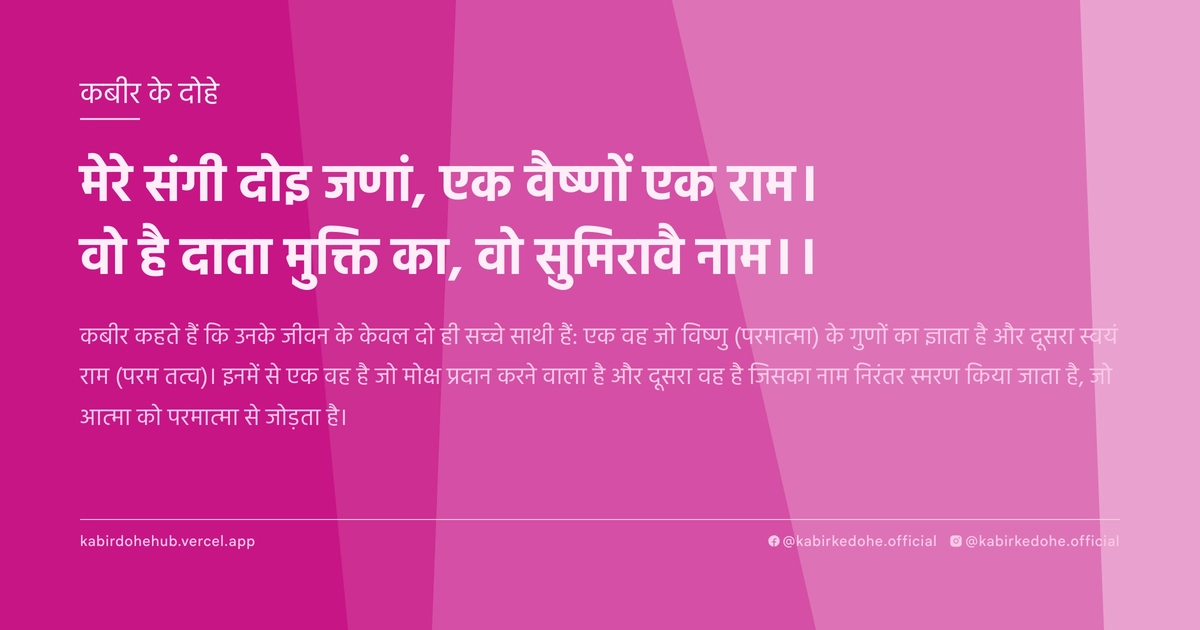
मेरे संगी दोइ जणां, एक वैष्णों एक राम।
वो है दाता मुक्ति का, वो सुमिरावै नाम।।
Mere sangi doi janaan, ek vaishno ek ram. Vo hai data mukti ka, vo sumiraavai naam.
इस पृष्ठ पर इस कबीर दोहे का अर्थ (meaning), हिंदी व्याख्या और अंग्रेज़ी अनुवाद, दार्शनिक विश्लेषण और व्यावहारिक जीवन सीख दी गई है। यह दोहा सत्संग (Satsang) विषय से जुड़ा है — Kabir doha meaning and explanation in Hindi and English.
अर्थ (Meaning):
कबीर कहते हैं कि उनके जीवन के केवल दो ही सच्चे साथी हैं: एक वह जो विष्णु (परमात्मा) के गुणों का ज्ञाता है और दूसरा स्वयं राम (परम तत्व)। इनमें से एक वह है जो मोक्ष प्रदान करने वाला है और दूसरा वह है जिसका नाम निरंतर स्मरण किया जाता है, जो आत्मा को परमात्मा से जोड़ता है।
Kabir declares that he possesses only two true companions: one who embodies the essence of the Preserver (Vaishno) and the other who is the Eternal Truth (Ram). One is the ultimate granter of liberation, and the other is the sacred vibration of the Name that anchors the soul to the Divine.
व्याख्या (Interpretation):
शाब्दिक रूप से, कबीर दो अलग सत्ताओं की बात कर रहे हैं, लेकिन आध्यात्मिक स्तर पर यह द्वैत का भ्रम है। 'वैष्णों' यहाँ उस आंतरिक गुरु या ज्ञान का प्रतीक है जो सृष्टि के पालनहार के गुणों को पहचानता है, जबकि 'राम' यहाँ दशरथ पुत्र नहीं, बल्कि निर्गुण ब्रह्म हैं जो कण-कण में व्याप्त हैं। यह दोहा आत्मा की उस अवस्था को दर्शाता है जहाँ साधक बाहरी दुनिया के शोर को छोड़कर केवल आंतरिक प्रकाश और परमात्मा के नाम के साथ एकाकार हो जाता है। यह माया के पर्दों को हटाकर उस अद्वैत स्थिति में पहुँचने की प्रक्रिया है जहाँ भक्त और भगवान के बीच का अंतर समाप्त हो जाता है। यहाँ 'नाम' केवल शब्द नहीं, बल्कि वह ध्वनि है जो ब्रह्मांड के मूल स्पंदन से मेल खाती है।
Literally, Kabir speaks of two entities, but spiritually, this is a dissolution of duality. 'Vaishno' symbolizes the inner guide or the wisdom that recognizes the sustaining qualities of the Divine, while 'Ram' refers not to the historical king, but to the Nirgun Brahman—the formless, omnipresent Absolute. This verse depicts the state of a seeker who has discarded worldly attachments to align with the inner light and the primordial vibration. It is the process of piercing the veil of Maya to reach the non-dual state where the devotee and the Divine merge. Here, the 'Name' is not a mere word, but the cosmic resonance that bridges the finite self with the infinite Whole.
दार्शनिक विश्लेषण (Philosophical Analysis):
कबीर का यह दोहा उनके युग के धार्मिक संघर्षों के बीच एक सेतु का कार्य करता है। उस समय समाज सगुण और निर्गुण, हिंदू और मुस्लिम धाराओं में विभाजित था। कबीर ने 'राम' और 'वैष्णव' शब्दों का प्रयोग करके यह सिद्ध किया कि ईश्वर किसी एक संप्रदाय की जागीर नहीं है। उनका दर्शन अद्वैत वेदांत से प्रेरित है, जहाँ आत्मा और ब्रह्म एक ही हैं। वे कर्मकांडों और बाहरी पूजा का खंडन करते हुए 'नाम स्मरण' पर जोर देते हैं, जो सूफी मत के 'जिक्र' के समान है।
यहाँ 'दाता मुक्ति का' वह अवस्था है जहाँ अहंकार का पूर्ण विनाश हो जाता है। जब तक 'मैं' मौजूद है, तब तक मुक्ति संभव नहीं है। कबीर समझाते हैं कि वास्तविक साथी वह नहीं है जो भौतिक सुख दे, बल्कि वह है जो हमें हमारे वास्तविक स्वरूप से परिचित कराए। यह मनोवैज्ञानिक रूपांतरण की प्रक्रिया है जहाँ साधक बाहरी दुनिया से अपनी पहचान हटाकर आंतरिक शून्य में विलीन हो जाता है।
ऐतिहासिक रूप से, कबीर ने जातिगत श्रेष्ठता को चुनौती दी। उन्होंने यह स्थापित किया कि मोक्ष किसी विशेष जाति या कुल के लिए आरक्षित नहीं है, बल्कि वह केवल उस व्यक्ति के लिए है जो सच्चे हृदय से परमात्मा का स्मरण करता है। यह सामाजिक समानता का एक आध्यात्मिक आधार था।
सूफीवाद के प्रभाव में, कबीर प्रेम और समर्पण को ज्ञान से ऊपर रखते हैं। उनके लिए 'राम' वह प्रेम है जो हृदय की गंदगी को साफ करता है। यह विश्लेषण स्पष्ट करता है कि कबीर का मार्ग केवल भक्ति का नहीं, बल्कि एक गहन आध्यात्मिक विज्ञान का है जो चेतना के स्तर को ऊपर उठाता है।
अंततः, यह दोहा हमें सिखाता है कि जीवन की भीड़ में हम अक्सर गलत साथियों का चुनाव करते हैं। कबीर हमें चेतावनी देते हैं कि केवल आध्यात्मिक सत्य और ईश्वरीय चेतना ही स्थायी साथी हैं। भौतिक संबंध क्षणभंगुर हैं, जबकि आत्मा का परमात्मा के साथ संबंध शाश्वत है।
This couplet serves as a bridge amidst the religious conflicts of Kabir's era, where society was fractured into Saguna and Nirgun, Hindu and Muslim streams. By employing terms like 'Ram' and 'Vaishno,' Kabir asserts that the Divine is not the monopoly of any single sect. His philosophy is deeply rooted in Advaita Vedanta, emphasizing the fundamental oneness of Atman and Brahman.
He rejects ritualism and external worship, emphasizing 'Nam Simran' (remembrance of the Name), which mirrors the Sufi practice of 'Zikr.' The 'granter of liberation' refers to the state where the ego is completely annihilated. As long as the 'I' exists, liberation remains an illusion. Kabir suggests that a true companion is not one who provides material comfort, but one who introduces the soul to its own primordial nature.
Historically, Kabir challenged caste hierarchies. He established that liberation is not reserved for a specific caste or lineage but is accessible to anyone who remembers the Divine with a sincere heart. This provided a spiritual foundation for social equality during a period of intense stratification.
Influenced by Sufism, Kabir places love and surrender above intellectual knowledge. For him, 'Ram' is the transformative love that purifies the heart. This analysis reveals that Kabir's path is not merely devotional but a profound spiritual science aimed at elevating consciousness.
Ultimately, the verse warns us against the fallacy of seeking permanence in worldly relationships. Kabir posits that only spiritual truth and divine consciousness are enduring companions. While material bonds are ephemeral, the union of the soul with the Absolute is eternal.
मूल संदेश (Core Message):
- बाहरी रिश्तों की क्षणभंगुरता को पहचानें।
- आंतरिक शांति ही एकमात्र स्थायी साथी है।
- नाम स्मरण केवल जाप नहीं, बल्कि चेतना का विस्तार है।
- अहंकार का विसर्जन ही वास्तविक मुक्ति का द्वार है।
- परमात्मा को मंदिर में नहीं, अपने भीतर खोजें।
- सत्य और प्रेम ही जीवन के अंतिम आधार हैं।
- Recognize the ephemeral nature of external relationships.
- Inner peace is the only enduring companion.
- Remembering the Name is not mere chanting, but an expansion of consciousness.
- The dissolution of ego is the only gateway to true liberation.
- Seek the Divine not in temples, but within your own being.
- Truth and Love are the ultimate foundations of existence.
व्यावहारिक उदाहरण (Practical Example):
एक समय की बात है, वाराणसी के घाटों पर माधव नाम का एक वृद्ध बुनकर रहता था। माधव अपनी पूरी जिंदगी बेहतरीन रेशमी वस्त्र बनाने में बिता चुका था, लेकिन उसका मन हमेशा अशांत रहता था। वह समाज में सम्मान चाहता था और अपनी कला के जरिए अमीर बनना चाहता था। वह दिन भर काम करता और रात को इस चिंता में डूबा रहता कि लोग उसके बारे में क्या सोचेंगे।
एक दिन माधव की मुलाकात एक फकीर से हुई, जिसने उससे पूछा, "माधव, तूने इतने सुंदर वस्त्र बुने, पर क्या कभी अपनी आत्मा के वस्त्रों को देखा?" माधव हैरान था। फकीर ने उसे समझाया कि वह जिन रिश्तों और सम्मान के पीछे भाग रहा है, वे सब रेत के घर हैं। उसने माधव को कबीर के इस दोहे के बारे में बताया कि कैसे केवल परमात्मा और सत्य ही हमारे स्थायी साथी हैं।
शुरुआत में माधव को यह बात समझ नहीं आई। उसने सोचा कि बिना समाज के साथ के इंसान अकेला कैसे रह सकता है? लेकिन फकीर ने उसे एक चुनौती दी: "एक महीने तक हर सुबह केवल अपने भीतर के राम को पुकारो और देखो कि तुम्हारा अकेलापन कैसे बदलता है।"
माधव ने ऐसा ही किया। उसने देखा कि जब वह दूसरों की प्रशंसा की उम्मीद छोड़कर केवल अपने काम को ईश्वर की सेवा मानकर करने लगा, तो उसका तनाव कम होने लगा। वह अब केवल कपड़ा नहीं बुन रहा था, बल्कि हर धागे में वह उस 'नाम' को महसूस करने लगा जिसकी बात फकीर ने की थी।
धीरे-धीरे माधव का व्यवहार बदलने लगा। वह अब उन लोगों की मदद करने लगा जो उससे गरीब थे, बिना किसी दिखावे के। उसने महसूस किया कि जब वह दूसरों में उसी 'राम' को देखने लगा, तो उसका अकेलापन गायब हो गया और उसकी जगह एक गहरी शांति ने ले ली।
एक दिन शहर का एक बड़ा व्यापारी उसके पास आया और उसे बहुत बड़ी रकम का ऑफर दिया ताकि वह उसके लिए विशेष वस्त्र बनाए। पहले का माधव लालच में पड़ जाता, लेकिन अब वह शांत था। उसने व्यापारी से कहा, "मैं वस्त्र बनाऊंगा, लेकिन मेरी कीमत पैसा नहीं, बल्कि तुम्हारी संतुष्टि और शांति होगी।"
व्यापारी माधव की इस निस्वार्थता और आंतरिक शांति को देखकर दंग रह गया। उसने महसूस किया कि माधव के पास वह धन है जो बाजार में नहीं मिलता। माधव ने अब अपनी पूरी पहचान एक 'बुनकर' से बदलकर एक 'साधक' की बना ली थी।
माधव की कहानी यह दिखाती है कि जब हम बाहरी दुनिया के झूठे साथियों को छोड़कर आंतरिक परमात्मा (राम) और ज्ञान (वैष्णव) को अपना साथी बनाते हैं, तो जीवन का संघर्ष समाप्त हो जाता है और एक अनंत आनंद का उदय होता है।
Once, on the ghats of Varanasi, lived an elderly weaver named Madhav. Madhav had spent his entire life crafting the finest silk garments, yet his mind was perpetually restless. He craved social validation and hoped his art would bring him immense wealth. He worked tirelessly by day, but spent his nights consumed by anxiety over how others perceived him.
One day, Madhav encountered a wandering fakir who asked him, "Madhav, you have woven such beautiful fabrics, but have you ever looked at the fabric of your own soul?" Madhav was bewildered. The fakir explained that the relationships and prestige he chased were merely castles of sand. He introduced him to Kabir's wisdom, explaining that only the Divine and Truth are our eternal companions.
Initially, Madhav struggled to grasp this. He wondered how a human could survive without social ties. The fakir challenged him: "For one month, every morning, call upon the Ram within you and observe how your loneliness transforms."
Madhav obeyed. He noticed that as he stopped seeking external validation and began treating his craft as a service to the Divine, his stress vanished. He was no longer just weaving cloth; he began to feel the 'Name'—the cosmic vibration—in every thread he crossed.
Gradually, Madhav's behavior shifted. He began helping those poorer than himself, devoid of any desire for recognition. He realized that by seeing the same 'Ram' in others, his loneliness disappeared, replaced by a profound, unshakable peace.
One day, a wealthy merchant approached him with a massive offer for exclusive garments. The old Madhav would have been blinded by greed, but the new Madhav remained serene. He told the merchant, "I will weave for you, but my price is not gold; it is your contentment and peace."
The merchant was stunned by Madhav's selfless nature and inner stillness. He realized that Madhav possessed a wealth that could not be bought in any market. Madhav had successfully shifted his identity from a mere 'weaver' to a 'seeker.'
Madhav's story illustrates that when we stop clinging to the illusory companions of the external world and embrace the inner Divine (Ram) and spiritual wisdom (Vaishno), the struggle of life ceases, and an infinite joy emerges.
अभ्यास मार्गदर्शन (Practice Guidance):
- प्रतिदिन 20 मिनट मौन रहकर अपने भीतर की ध्वनि (अनहद नाद) को सुनने का प्रयास करें, जिसे कबीर 'नाम' कहते हैं।
- एक डायरी लिखें जिसमें आप उन क्षणों को दर्ज करें जब आपका अहंकार (Ego) आपको दूसरों से अलग महसूस कराता है, और फिर विचार करें कि वह 'राम' तत्व वहां कैसे मौजूद है।
- व्यवहार परिवर्तन: दिन भर में कम से कम तीन ऐसे कार्य करें जिनमें आपका कोई व्यक्तिगत लाभ न हो, केवल सेवा भाव हो।
- निदान चेकलिस्ट: क्या आप अभी भी दूसरों की प्रशंसा के लिए जीवित हैं? क्या आप अकेलेपन से डरते हैं? यदि हाँ, तो आप अभी भी बाहरी साथियों पर निर्भर हैं, आंतरिक नहीं।
- Spend 20 minutes daily in absolute silence, attempting to listen to the inner sound (Anhad Naad), which Kabir refers to as the 'Name.'
- Maintain a journal recording moments when your ego creates a sense of separation from others, then contemplate how the 'Ram' element is present in that very gap.
- Behavioral Shift: Perform at least three selfless acts daily where there is no personal gain, only the intention of service.
- Diagnostic Checklist: Are you still living for external validation? Do you fear solitude? If yes, you are still relying on illusory companions rather than the internal Divine.
चिंतन प्रश्न (Reflection Questions):
- यदि आज आपकी सारी सामाजिक पहचान (पद, प्रतिष्ठा, रिश्ता) छीन ली जाए, तो आपके पास 'साथी' के रूप में क्या बचेगा?
- आपकी 'डिजिटल पहचान' (सोशल मीडिया) आपके वास्तविक आंतरिक स्वरूप को कितना ढक रही है?
- क्या आप वास्तव में अकेले रहने से डरते हैं, या आप उस सन्नाटे से डरते हैं जहाँ आपका अहंकार आपसे बात करता है?
- आपके जीवन में 'राम' (परम तत्व) का अनुभव कब हुआ—किसी मंदिर में या किसी की निस्वार्थ सेवा में?
- क्या आपका धर्म आपको दूसरों से जोड़ता है या आपको श्रेष्ठता का भ्रम देकर अलग करता है?
- If all your social identities (rank, prestige, relationships) were stripped away today, what would remain as your 'companion'?
- To what extent does your 'digital identity' mask your authentic internal self?
- Do you truly fear solitude, or do you fear the silence where your ego is forced to confront you?
- When did you actually experience 'Ram' (the Absolute)—in a temple or through a selfless act of service?
- Does your religious practice connect you to others, or does it isolate you by fueling an illusion of superiority?