
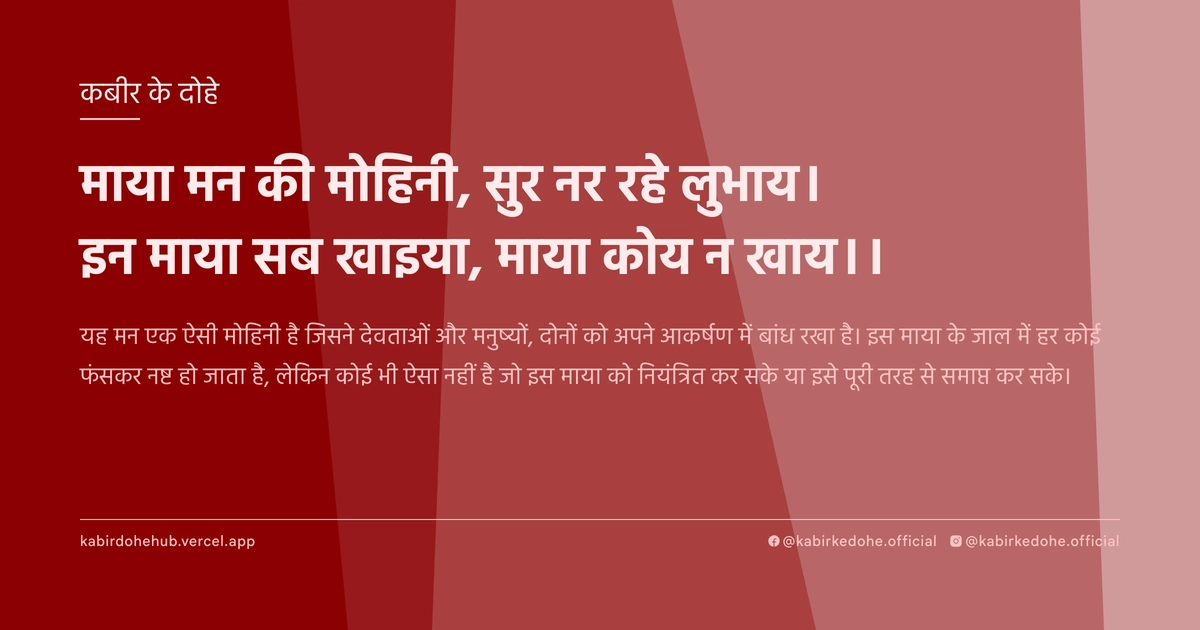
माया मन की मोहिनी, सुर नर रहे लुभाय।
इन माया सब खाइया, माया कोय न खाय।।
Maya man ki mohini, sur nar rahe lubhay. In maya sab khaiya, maya koy na khaye.
इस पृष्ठ पर इस कबीर दोहे का अर्थ (meaning), हिंदी व्याख्या और अंग्रेज़ी अनुवाद, दार्शनिक विश्लेषण और व्यावहारिक जीवन सीख दी गई है। यह दोहा माया (Maya) विषय से जुड़ा है — Kabir doha meaning and explanation in Hindi and English.
अर्थ (Meaning):
यह मन एक ऐसी मोहिनी है जिसने देवताओं और मनुष्यों, दोनों को अपने आकर्षण में बांध रखा है। इस माया के जाल में हर कोई फंसकर नष्ट हो जाता है, लेकिन कोई भी ऐसा नहीं है जो इस माया को नियंत्रित कर सके या इसे पूरी तरह से समाप्त कर सके।
The mind acts as a captivating enchantress that lures both celestial beings and mortals alike. Everyone is consumed by the illusions of Maya, yet no one is capable of consuming or overcoming Maya itself; it remains the predator while the soul remains the prey.
व्याख्या (Interpretation):
शाब्दिक अर्थ में, कबीर मन की चंचलता और माया के प्रभाव की बात कर रहे हैं। गहरे स्तर पर, 'मोहिनी' वह मानसिक प्रक्षेपण है जो हमें सत्य से दूर ले जाता है। यह निर्गुण भक्ति का सार है जहाँ साधक को यह समझना होता है कि बाहरी दुनिया एक भ्रम है। माया केवल बाहरी नहीं, बल्कि आंतरिक है—यह अहंकार का वह पर्दा है जो आत्मा और ब्रह्म के अद्वैत को छिपा देता है। जब तक मन की यह मोहिनी सक्रिय है, जीव संसार के द्वंद्वों में फंसा रहता है। इस विरोधाभास को समझना आवश्यक है कि हम माया में रहते हैं, पर माया हमसे ऊपर है जब तक हम अज्ञान में हैं। केवल आत्म-साक्षात्कार ही इस चक्र को तोड़ सकता है।
Literally, Kabir addresses the volatility of the mind and the grip of illusion. Metaphorically, the 'enchantress' is the psychological projection that diverts the seeker from the Absolute. This aligns with Nirgun Bhakti, where the practitioner recognizes the external world as a transient mirage. Maya is not merely external but internal—the veil of ego that obscures the non-duality of Atman and Brahman. As long as this mental enchantment persists, the soul remains trapped in the duality of pleasure and pain. The central paradox is that while we exist within Maya, we are consumed by it because we mistake the mask for the face. Only through the annihilation of the false self can the seeker transcend this cosmic play.
दार्शनिक विश्लेषण (Philosophical Analysis):
कबीर का यह दोहा उनके युग के सामाजिक और धार्मिक पाखंड के विरुद्ध एक प्रहार है। उस समय लोग बाहरी कर्मकांडों और मूर्तियों की पूजा में लीन थे, जिसे कबीर 'माया' का ही एक रूप मानते थे। वे तर्क देते हैं कि चाहे आप देवता (सुर) हों या मनुष्य (नर), यदि मन वश में नहीं है, तो आप माया के दास हैं। यह विचार अद्वैत वेदांत के करीब है, जहाँ जगत को 'मिथ्या' कहा गया है।
सूफी मत के 'नफ्स' (अहंकार) की अवधारणा यहाँ स्पष्ट दिखती है। कबीर कहते हैं कि मन की इच्छाएं ही वह मोहिनी हैं जो हमें सत्य से दूर रखती हैं। वे किसी विशेष धर्म की बात नहीं करते, बल्कि चेतना के स्तर की बात करते हैं। उनके लिए मुक्ति का मार्ग किसी मंदिर या मस्जिद में नहीं, बल्कि मन के इस भ्रम को पहचान लेने में है।
यहाँ 'खाइया' शब्द का प्रयोग बहुत गहरा है। इसका अर्थ केवल नष्ट होना नहीं, बल्कि आत्म-विस्मृति है। जब माया हमें 'खाती' है, तो हम अपनी वास्तविक दैवीय प्रकृति को भूल जाते हैं। यह एक मनोवैज्ञानिक प्रक्रिया है जहाँ व्यक्ति अपनी पहचान अपनी उपलब्धियों, रिश्तों और भौतिक वस्तुओं से जोड़ लेता है।
कबीर का दर्शन यह है कि माया को लड़कर नहीं जीता जा सकता, क्योंकि लड़ने वाला भी माया का ही हिस्सा है। इसे केवल 'साक्षी भाव' (Witness Consciousness) से देखा जा सकता है। जब आप यह जान लेते हैं कि आप यह मन नहीं हैं, बल्कि वह जो मन को देख रहा है, तब मोहिनी का प्रभाव समाप्त हो जाता है।
अंततः, यह दोहा हमें यह सिखाता है कि आध्यात्मिक यात्रा बाहरी दुनिया को बदलने की नहीं, बल्कि आंतरिक दृष्टि को बदलने की है। यह अहंकार के विसर्जन की प्रक्रिया है, जहाँ 'मैं' का अंत होता है और केवल 'वह' (ब्रह्म) शेष रहता है।
Kabir’s couplet is a sharp critique of the ritualistic and superficial spiritualism prevalent in his era. During a time of rigid caste hierarchies and idol worship, Kabir identified these external attachments as manifestations of Maya. He asserts that whether one is a celestial deity (Sur) or a mortal (Nar), both are susceptible to the mind's enchantments if consciousness remains clouded. This resonates deeply with Advaita Vedanta, which posits the world as 'Mithya' or a relative reality.
There is a strong parallel here with the Sufi concept of 'Nafs' (the lower self/ego). Kabir suggests that the 'enchantress' is actually the collection of our desires and attachments. He transcends religious boundaries, focusing instead on the state of consciousness. For Kabir, liberation is not found in the architecture of temples or mosques, but in the dismantling of the mental illusions that separate the individual from the Divine.
The use of the word 'khaiya' (to eat/consume) is profoundly symbolic. It does not merely imply destruction, but a total loss of self-awareness. When Maya 'consumes' us, we forget our innate divine nature. This is a psychological entrapment where the individual mistakenly identifies their essence with their social roles, possessions, and emotional traumas.
Kabir posits that Maya cannot be defeated through conflict, for the one who fights is also a product of Maya. The only escape is through 'Sakshi Bhav' or Witness Consciousness. By shifting the identity from the 'thinker' to the 'observer,' the spell of the enchantress is broken. The paradox is that the only way to stop being consumed is to stop identifying with the consumer.
Ultimately, this teaching emphasizes that the spiritual journey is not about altering the external landscape but about refining internal perception. It is a process of ego-annihilation, where the perceived separation between the self and the universe dissolves, leaving only the singular, formless Truth.
मूल संदेश (Core Message):
- मन का आकर्षण एक भ्रम है जो सत्य को ढकता है।
- बाहरी उपलब्धियां आत्मा की भूख को शांत नहीं कर सकतीं।
- अहंकार का विसर्जन ही वास्तविक स्वतंत्रता का द्वार है।
- माया से लड़ें नहीं, बल्कि उसे पहचान कर उससे अलग हो जाएं।
- शांति वहां है जहां 'मैं' का अस्तित्व समाप्त हो जाता है।
- सत्य निर्गुण है, वह किसी रूप या नाम का मोहताज नहीं।
- The mind's allure is a veil that obscures the Absolute Truth.
- External achievements cannot satiate the hunger of the soul.
- The dissolution of the ego is the only gateway to true freedom.
- Do not fight Maya; recognize it and detach from its grip.
- Peace resides where the notion of 'I' ceases to exist.
- Truth is formless; it is not bound by name, shape, or ritual.
व्यावहारिक उदाहरण (Practical Example):
एक समय की बात है, वाराणसी के घाटों पर माधव नाम का एक वृद्ध बुनकर रहता था। माधव अपनी कला में निपुण था, लेकिन उसका मन हमेशा इस बात से परेशान रहता था कि उसके बेटे उसे वह सम्मान नहीं देते जो वह चाहता था। वह दिन-रात इसी चिंता में डूबा रहता कि लोग उसके बारे में क्या सोचेंगे।
वह अक्सर मंदिर जाता और घंटों प्रार्थना करता कि ईश्वर उसे समाज में प्रतिष्ठा दिलाए। वह अपनी साड़ियों की बारीकी पर गर्व करता था और मानता था कि उसकी श्रेष्ठता ही उसकी पहचान है। लेकिन यह 'श्रेष्ठता' का भाव ही उसकी मोहिनी बन गया था।
एक दिन वह कबीर के एक अनुयायी से मिला, जिसने उससे पूछा, 'माधव, तुम इस कपड़े को बुन रहे हो या यह कपड़ा तुम्हें बुन रहा है?' माधव हैरान रह गया। उसने महसूस किया कि वह अपनी प्रतिष्ठा की इच्छा के धागों में खुद ही बंधा हुआ है।
उसने देखा कि वह जिस सम्मान की तलाश कर रहा था, वह वास्तव में उसके अहंकार की भूख थी। वह जितना अधिक सम्मान चाहता था, उतना ही अधिक वह दूसरों के व्यवहार का गुलाम बन जाता था।
उसने महसूस किया कि उसकी मानसिक स्थिति एक ऐसी मोहिनी की तरह थी जो उसे वर्तमान क्षण की शांति से दूर ले जा रही थी। वह अपनी कला का आनंद लेने के बजाय, कला के परिणाम से चिपका हुआ था।
माधव ने धीरे-धीरे अपनी पहचान को 'प्रतिष्ठित बुनकर' से हटाकर केवल 'एक सेवक' के रूप में देखना शुरू किया। उसने अपनी साड़ियाँ बिना किसी अहंकार के बनाना शुरू किया।
जैसे ही उसने 'मैं' और 'मेरा' का मोह छोड़ा, उसे वह शांति मिली जिसकी वह तलाश कर रहा था। अब उसे दूसरों की प्रशंसा की आवश्यकता नहीं थी क्योंकि वह अपने भीतर के संतोष से तृप्त था।
उसका जीवन बदल गया। अब वह केवल कपड़े नहीं बुनता था, बल्कि वह अपने मन के विकारों को बुनकर उन्हें सत्य की रोशनी में विलीन कर देता था।
उसने पाया कि जब उसने माया (सम्मान की भूख) को 'खाना' बंद किया, तो माया ने उसे खाना बंद कर दिया। वह अब स्वतंत्र था।
माधव की कहानी हमें सिखाती है कि जब हम अपनी पहचान बाहरी दुनिया के प्रतिबिंबों में ढूंढना बंद करते हैं, तभी हम वास्तव में मुक्त होते हैं।
Once, in the bustling ghats of Varanasi, lived an elderly weaver named Madhav. Madhav was a master of his craft, yet his heart was perpetually heavy with the grievance that his sons did not grant him the reverence he felt he deserved. He spent his days consumed by the thought of his social standing.
He frequented the temples, praying fervently that the gods would grant him prestige. He took immense pride in the intricacy of his weaves, believing that his superiority in art was his primary identity. However, this very sense of 'superiority' became the enchantress that bound him.
One day, he encountered a follower of Kabir, who asked him a piercing question: 'Madhav, are you weaving this cloth, or is this cloth weaving you?' Madhav was stunned. He suddenly realized that he was entangled in the threads of his own desire for validation.
He recognized that the respect he craved was actually the hunger of his ego. The more he sought external validation, the more he became a slave to the whims and behaviors of others.
He saw that his mental state was like a 'Mohini,' a seductive illusion that lured him away from the stillness of the present moment. He was no longer enjoying the act of creation; he was obsessed with the result.
Slowly, Madhav shifted his identity. He stopped seeing himself as a 'prestigious weaver' and began to see himself simply as a 'servant of the art.' He began to weave without the burden of pride.
As he released the attachment to 'I' and 'Mine,' he discovered the peace that had eluded him for decades. He no longer needed the applause of the world because he was nourished by internal contentment.
His life underwent a total transformation. He was no longer just weaving fabric; he was weaving his mental impurities into the light of truth, letting them dissolve.
He discovered that once he stopped trying to 'consume' the illusion of status, the illusion stopped consuming him. He was finally free.
Madhav’s story illustrates that when we cease searching for our identity in the reflections of the external world, we finally encounter our true essence.
अभ्यास मार्गदर्शन (Practice Guidance):
- दैनिक अभ्यास: प्रतिदिन 20 मिनट 'साक्षी भाव' का अभ्यास करें। अपने विचारों को ऐसे देखें जैसे आप सड़क पर चलती गाड़ियों को देख रहे हों, उनमें शामिल न हों।
- आत्म-पूछताछ जर्नल: हर रात लिखें—'आज किस विचार या इच्छा ने मुझे सबसे अधिक विचलित किया? क्या वह वास्तव में सत्य था या केवल मन की मोहिनी?'
- व्यवहारिक परिवर्तन: जब भी आप किसी की प्रशंसा या आलोचना महसूस करें, तुरंत रुकें और स्वयं से पूछें, 'यह कौन महसूस कर रहा है? मेरा अहंकार या मेरी आत्मा?'
- निदान चेकलिस्ट: आप जानते हैं कि आप माया के प्रभाव में हैं यदि: 1. आपकी खुशी दूसरों की राय पर निर्भर है। 2. आप अतीत के पछतावे या भविष्य की चिंता में खोए रहते हैं। 3. आप अपनी पहचान अपने पद, धन या रिश्तों से जोड़ते हैं।
- Daily Practice: Spend 20 minutes in 'Sakshi Bhav' (Witness Consciousness). Observe your thoughts as if you are watching cars pass on a street; do not board the vehicle of thought.
- Self-Inquiry Journal: Every night, record: 'Which thought or desire distracted me most today? Was it an absolute truth or merely the mind's enchantment?'
- Behavioral Shift: Whenever you feel a surge of pride from praise or pain from criticism, pause and ask: 'Who is experiencing this? My ego or my essence?'
- Diagnostic Checklist: You are under the spell of Maya if: 1. Your happiness depends on external validation. 2. You are chronically lost in past regrets or future anxieties. 3. You define your existence through your title, wealth, or relationships.
चिंतन प्रश्न (Reflection Questions):
- मेरी वह कौन सी 'छवि' है जिसे मैं दुनिया के सामने बनाए रखने के लिए सबसे अधिक संघर्ष करता हूँ?
- यदि मुझसे मेरी सारी उपलब्धियां और रिश्ते छीन लिए जाएं, तो 'मैं' कौन रहूँगा?
- क्या मेरी आध्यात्मिक खोज वास्तव में सत्य के लिए है, या यह केवल एक और सूक्ष्म अहंकार (Spiritual Ego) है?
- मैं किन चीजों को 'अपना' कहता हूँ, और क्या वे वास्तव में मेरे नियंत्रण में हैं?
- मेरे जीवन का वह कौन सा डर है जो मुझे वर्तमान क्षण में जीने से रोकता है?
- क्या मैं वास्तव में स्वतंत्र हूँ, या मैं केवल अपनी इच्छाओं की एक लंबी जंजीर में बंधा हुआ हूँ?
- What is the specific 'image' of myself that I struggle most to maintain in the eyes of the world?
- If all my achievements and relationships were stripped away, who would 'I' be?
- Is my spiritual quest truly for the Truth, or is it merely another subtle form of 'Spiritual Ego'?
- What things do I call 'mine,' and are they truly within my control?
- What is the core fear in my life that prevents me from existing fully in the present moment?
- Am I truly free, or am I merely bound by a long chain of my own desires?