
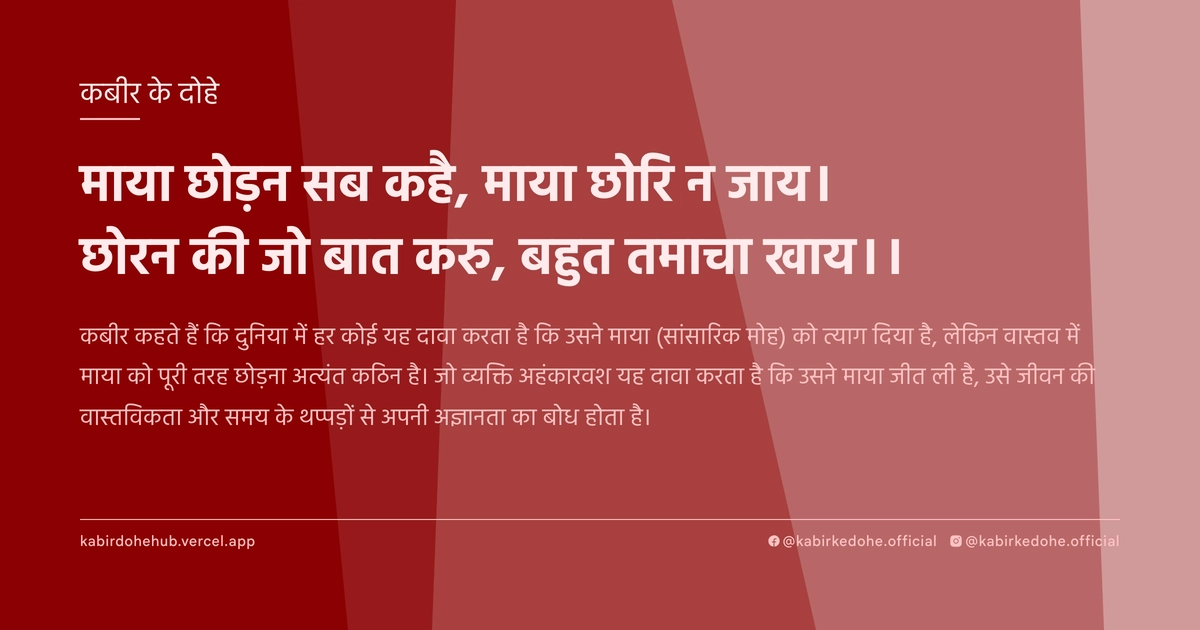
माया छोड़न सब कहै, माया छोरि न जाय।
छोरन की जो बात करु, बहुत तमाचा खाय।।
Maya chhodan sab kahai, maya chhori na jaaye. Chhoran ki jo baat karu, bahut tamacha khaaye.
इस पृष्ठ पर इस कबीर दोहे का अर्थ (meaning), हिंदी व्याख्या और अंग्रेज़ी अनुवाद, दार्शनिक विश्लेषण और व्यावहारिक जीवन सीख दी गई है। यह दोहा माया (Maya) विषय से जुड़ा है — Kabir doha meaning and explanation in Hindi and English.
अर्थ (Meaning):
कबीर कहते हैं कि दुनिया में हर कोई यह दावा करता है कि उसने माया (सांसारिक मोह) को त्याग दिया है, लेकिन वास्तव में माया को पूरी तरह छोड़ना अत्यंत कठिन है। जो व्यक्ति अहंकारवश यह दावा करता है कि उसने माया जीत ली है, उसे जीवन की वास्तविकता और समय के थप्पड़ों से अपनी अज्ञानता का बोध होता है।
Kabir observes that while everyone claims to have renounced Maya (worldly illusion), in reality, it is nearly impossible to fully detach from it. Those who boast of having conquered Maya are eventually humbled by the harsh realities of life, receiving 'slaps' from experience that expose their spiritual arrogance and ignorance.
व्याख्या (Interpretation):
इस दोहे का शाब्दिक अर्थ है कि माया का त्याग करना सरल नहीं है। गहरे स्तर पर, कबीर 'माया' को केवल धन या संपत्ति नहीं, बल्कि उस सूक्ष्म मानसिक आसक्ति के रूप में देखते हैं जो आत्मा को परमात्मा से अलग करती है। यह निर्गुण भक्ति का सार है, जहाँ साधक यह समझता है कि बाहरी त्याग (वस्त्र या घर छोड़ना) वास्तविक मुक्ति नहीं है। माया का असली जाल 'अहंकार' है; जब हम कहते हैं 'मैंने माया छोड़ दी', तो वह 'मैंने' ही माया का सबसे प्रबल रूप है। यह अद्वैत वेदांत के उस सिद्धांत को दर्शाता है जहाँ माया एक पर्दा है जिसे केवल ज्ञान और पूर्ण समर्पण से हटाया जा सकता है, न कि केवल शब्दों या दावों से। यहाँ 'तमाचा' प्रतीकात्मक है, जो उस आध्यात्मिक झटके को दर्शाता है जो तब लगता है जब हमारी झूठी धारणाएं वास्तविकता से टकराती हैं।
Literally, the verse warns against the vanity of claiming detachment. Metaphorically, Kabir defines Maya not merely as material wealth, but as the subtle psychological attachment that separates the Atman (soul) from Brahman (the Absolute). In the context of Nirgun Bhakti, true renunciation is internal, not external. The paradox lies in the statement 'I have renounced Maya'—the very sense of 'I' (the ego) is the ultimate manifestation of Maya. This aligns with Advaita Vedanta, where Maya is the cosmic illusion that veils the non-dual reality. The 'slap' mentioned is a spiritual catalyst; it represents the moment of crisis or failure that shatters the ego's delusion of mastery. It suggests that spiritual maturity comes not from claiming victory over the world, but from acknowledging one's vulnerability and the persistent grip of illusion.
दार्शनिक विश्लेषण (Philosophical Analysis):
कबीर का यह दोहा उनके युग के पाखंड और दिखावे पर एक तीखा प्रहार है। उस समय कई साधु-संत केवल गेरुआ वस्त्र पहनकर खुद को मायामुक्त घोषित कर देते थे, जबकि उनके भीतर वासना और अहंकार जीवित थे। कबीर इस 'बाहरी आडंबर' को नकारते हुए आंतरिक शुद्धि पर बल देते हैं। वे बताते हैं कि माया कोई बाहरी वस्तु नहीं है जिसे फेंका जा सके, बल्कि यह चेतना की एक अवस्था है।
दार्शनिक रूप से, यह सूफी मत के 'नफ़्स' (अहंकार) के विनाश और अद्वैत वेदांत के 'माया' सिद्धांत का संगम है। कबीर का तर्क है कि जब तक साधक यह महसूस करता है कि वह 'त्याग' कर रहा है, तब तक वह द्वैत (duality) में फँसा है। वास्तविक मुक्ति तब होती है जब त्याग करने वाला और त्याग की वस्तु, दोनों का अस्तित्व समाप्त हो जाए।
वे जाति और कर्मकांडों के विरोध में खड़े होकर यह समझाते हैं कि मोक्ष किसी विशेष पोशाक या मंत्र से नहीं, बल्कि सत्य के साक्षात्कार से मिलता है। माया का त्याग वास्तव में 'स्व' के विसर्जन की प्रक्रिया है। जो व्यक्ति खुद को माया से ऊपर समझता है, वह वास्तव में माया के सबसे गहरे जाल में फँसा होता है क्योंकि उसका अहंकार अब 'आध्यात्मिक श्रेष्ठता' का रूप ले चुका है।
मनोवैज्ञानिक स्तर पर, यह दोहा 'पुष्टि पूर्वाग्रह' (confirmation bias) की बात करता है। हम खुद को जैसा देखना चाहते हैं, वैसा ही दावा करते हैं। लेकिन जीवन की प्रतिकूल परिस्थितियाँ—विफलता, बीमारी या मृत्यु—वह 'तमाचा' हैं जो हमें हमारी वास्तविक स्थिति से परिचित कराते हैं।
अंततः, कबीर यह संदेश देते हैं कि विनम्रता ही एकमात्र मार्ग है। माया को जीतने का प्रयास उसे और मजबूत करता है; माया को स्वीकार करना और उसमें रहते हुए भी उससे अलिप्त रहना (जैसा कमल पानी में रहकर भी उससे अलग रहता है) ही वास्तविक साधना है।
This Doha is a scathing critique of the hypocrisy and performative asceticism prevalent during Kabir's era. Many self-proclaimed saints adopted saffron robes to signal renunciation while remaining enslaved by internal desires and ego. Kabir dismantles this 'external theater,' asserting that Maya is not an external object to be discarded but a state of consciousness that permeates the psyche.
Philosophically, this verse bridges the Sufi concept of 'Fana' (annihilation of the self) and the Advaita Vedanta theory of Maya. Kabir argues that as long as a seeker believes 'I am renouncing,' they remain trapped in duality. True liberation occurs only when the distinction between the renouncer and the renounced vanishes entirely. The act of claiming victory over Maya is, in itself, a manifestation of the ego's desire for spiritual superiority.
By rejecting ritualism and caste hierarchies, Kabir emphasizes that salvation is not found in specific garments or mantras but in the raw realization of Truth. He suggests that the most dangerous form of Maya is 'spiritual ego'—the belief that one has transcended the illusion. This is a subtle trap where the ego simply shifts its identity from a worldly master to a spiritual master.
Psychologically, the verse addresses the gap between our perceived self and our actual self. We often construct a narrative of enlightenment to shield ourselves from our insecurities. However, the 'slaps' of life—loss, failure, or sudden tragedy—serve as brutal corrective mechanisms that strip away these delusions and force the individual back to a state of honest humility.
Ultimately, Kabir teaches that the path to liberation is not through the aggressive conquest of Maya, but through a state of 'dispassionate involvement.' Like a lotus leaf that remains dry despite being submerged in water, the realized soul exists within the world of Maya without being stained by it, recognizing that the only way to truly 'leave' Maya is to realize it was never separate from the Divine play.
मूल संदेश (Core Message):
- माया बाहरी वस्तु नहीं, आंतरिक अहंकार है।
- मुक्ति का दावा करना ही मुक्ति में सबसे बड़ी बाधा है।
- सच्चा वैराग्य दिखावे में नहीं, स्वभाव में होता है।
- विनम्रता ही माया के जाल को काटने वाला एकमात्र शस्त्र है।
- जीवन के झटके हमें हमारी वास्तविक स्थिति का बोध कराते हैं।
- Maya is not an external object, but internal ego.
- Claiming liberation is the greatest obstacle to achieving it.
- True renunciation lies in nature, not in appearance.
- Humility is the only weapon that can cut through the web of Maya.
- Life's hardships are corrective shocks that reveal our true state.
व्यावहारिक उदाहरण (Practical Example):
एक समय की बात है, बनारस के एक पुराने मोहल्ले में माधव नाम का एक बुनकर रहता था। माधव ने अपनी पूरी युवावस्था धन कमाने और परिवार को सुख देने में बिता दी थी। उम्र के ढलते पड़ाव पर, उसने अचानक तय किया कि अब वह 'सच्चा संत' बनेगा। उसने अपने सारे कपड़े साधारण कर लिए, घर के एक कोने में चटाई बिछाई और पूरे मोहल्ले में यह घोषणा कर दी कि उसने माया का पूरी तरह त्याग कर दिया है।
वह अब लोगों को उपदेश देता कि कैसे संसार एक सपना है और मोह-माया केवल एक बंधन है। लोग उसकी सादगी देखकर प्रभावित होने लगे। माधव को अपनी इस 'उपलब्धि' पर बहुत गर्व होने लगा। वह मन ही मन सोचने लगा कि वह उस मोहल्ले का सबसे पवित्र व्यक्ति है, जबकि बाकी सब अभी भी लालच और क्रोध में डूबे हुए हैं।
एक दिन, उसके छोटे बेटे ने अपनी शादी के लिए कुछ पैसों की मांग की। माधव ने बड़े गर्व से कहा, 'बेटा, मैं अब माया से मुक्त हूँ, मुझे इन सांसारिक लेन-देन से क्या लेना-देना?' उसने अपने बेटे की जरूरत को अनदेखा कर दिया और अपनी 'वैराग्य' की छवि को बनाए रखने में लगा रहा।
कुछ समय बाद, माधव गंभीर रूप से बीमार पड़ गया। उसके पास इलाज के लिए पैसे नहीं थे क्योंकि उसने सब कुछ 'त्याग' दिया था। जिस समय उसे सहारे की सबसे ज्यादा जरूरत थी, उसने पाया कि उसकी आध्यात्मिक श्रेष्ठता का दावा उसे कोई वास्तविक सुख या सहारा नहीं दे रहा था।
तभी उसका वही बेटा, जिसे उसने ठुकराया था, अपनी कमाई से उसके लिए सबसे अच्छे वैद्य को लेकर आया। जब बेटे ने उसकी सेवा की, तो माधव की आँखों में आँसू आ गए। उसे अहसास हुआ कि जिस 'माया' को उसने शब्दों में त्याग दिया था, वह वास्तव में उसके भीतर 'अहंकार' बनकर बैठी थी।
उसे समझ आया कि उसने माया नहीं छोड़ी थी, बल्कि उसने केवल अपनी छवि बदली थी। उसका यह दावा कि 'मैं मुक्त हूँ', वास्तव में उसकी सबसे बड़ी मोह-माया थी। यह अहसास उसके लिए उस 'तमाचे' की तरह था जिसने उसकी नींद उड़ा दी।
माधव ने अब उपदेश देना बंद कर दिया। उसने अपनी कला (बुनाई) को फिर से शुरू किया, लेकिन इस बार वह धन के लिए नहीं, बल्कि सेवा के लिए बुनने लगा। उसने सीखा कि असली वैराग्य घर छोड़ने में नहीं, बल्कि घर में रहते हुए अहंकार को छोड़ने में है।
अब वह किसी को यह नहीं कहता था कि उसने माया जीत ली है। इसके बजाय, वह हर व्यक्ति में ईश्वर को देखने लगा और अपनी छोटी-छोटी खुशियों को बिना किसी अहंकार के स्वीकार करने लगा। उसकी शांति अब दावों में नहीं, बल्कि उसके कर्मों में झलकती थी।
In the ancient lanes of Varanasi, there lived a weaver named Madhav. Having spent his youth accumulating wealth and providing for his family, Madhav decided in his twilight years to become a 'true saint.' He simplified his attire, spread a thin mat in a corner of his house, and proclaimed to the entire neighborhood that he had completely renounced Maya.
He began preaching to the locals about how the world is a mere dream and how attachment is a shackle. People were impressed by his austerity. Consequently, Madhav developed a profound sense of pride in his 'achievement.' He secretly believed he was the most evolved soul in the colony, while others remained drowned in greed and anger.
One day, his youngest son approached him, asking for a small amount of money for his wedding. Madhav, draped in his newfound spiritual superiority, replied coldly, 'Son, I am now free from Maya. Why should I concern myself with these worldly transactions?' He ignored his son's genuine need to preserve his image as a detached ascetic.
Months later, Madhav fell gravely ill. He had no funds for treatment because he had 'renounced' everything. In his moment of greatest vulnerability, he realized that his claims of spiritual mastery provided no actual solace or support.
Unexpectedly, the same son he had dismissed arrived with the finest physician in the city, paying for everything from his own earnings. As his son tended to him with unconditional love, Madhav burst into tears. He realized that the 'Maya' he claimed to have discarded was actually residing within him as a towering ego.
He understood that he hadn't renounced the world; he had merely changed his costume. The claim 'I am free' was, in fact, his strongest attachment—an attachment to a curated spiritual identity. This realization hit him like a physical blow, the 'slap' Kabir spoke of, shattering his delusions.
Madhav stopped preaching. He returned to his loom, but this time he wove not for profit, but as a form of selfless service. He learned that true detachment is not about leaving one's home, but about leaving the ego while remaining in the home.
He never again claimed to have conquered Maya. Instead, he began to see the Divine in every person and accepted life's simple joys without the need for validation. His peace was no longer found in his words, but in the quiet humility of his actions.
अभ्यास मार्गदर्शन (Practice Guidance):
- प्रतिदिन 15 मिनट मौन बैठें और अपने उन दावों की सूची बनाएं जिन्हें आप दुनिया के सामने 'सत्य' के रूप में पेश करते हैं। पूछें: क्या यह सत्य है या मेरी छवि?
- जब भी आप किसी को नैतिक या आध्यात्मिक उपदेश दें, तो तुरंत रुकें और विचार करें कि क्या आप वास्तव में उस मार्ग पर चल रहे हैं या केवल अपनी श्रेष्ठता सिद्ध कर रहे हैं।
- एक 'अहंकार डायरी' रखें। जब भी आपको लगे कि आप दूसरों से अधिक 'जागरूक' या 'पवित्र' हैं, तो उस भावना को लिखें और विश्लेषण करें कि यह किस प्रकार की माया है।
- डायग्नोस्टिक चेकलिस्ट: यदि आप किसी की आलोचना करते समय खुद को 'सही' महसूस करते हैं, या यदि आपकी शांति आपकी प्रशंसा पर निर्भर है, तो समझ लें कि माया अभी भी हावी है।
- Spend 15 minutes in silence daily, listing the claims you present to the world as 'truths.' Ask yourself: Is this an actual truth, or a curated image of who I want to be?
- Whenever you feel the urge to give moral or spiritual advice to others, pause and reflect: Am I practicing this truth, or am I merely attempting to establish my superiority?
- Maintain an 'Ego Journal.' Whenever you feel more 'aware' or 'pure' than someone else, record that feeling and analyze how this specific thought is a manifestation of Maya.
- Diagnostic Checklist: If you feel a sense of righteousness while criticizing others, or if your inner peace depends on external validation and praise, recognize that Maya is still firmly in control.
चिंतन प्रश्न (Reflection Questions):
- मेरे जीवन का वह कौन सा 'आध्यात्मिक मुखौटा' है जिसे मैं दुनिया को दिखाने के लिए पहनता हूँ?
- क्या मैं वास्तव में चीजों को त्याग रहा हूँ, या मैं केवल उन चीजों को छोड़ रहा हूँ जिन्हें मैं अब नियंत्रित नहीं कर सकता?
- जब मैं खुद को दूसरों से बेहतर महसूस करता हूँ, तो वह भावना मुझे किस डर से बचा रही होती है?
- मेरे जीवन का वह सबसे बड़ा 'तमाचा' (विफलता) क्या था जिसने मेरे अहंकार को तोड़ा, और मैंने उससे क्या सीखा?
- यदि मेरी सारी सामाजिक और धार्मिक पहचान छीन ली जाए, तो मेरे भीतर क्या बचेगा?
- What is the 'spiritual mask' I wear to project an image of enlightenment to the world?
- Am I truly renouncing attachments, or am I simply letting go of things I can no longer control?
- When I feel superior to others, what underlying fear is that feeling trying to protect me from?
- What was the most brutal 'slap' (failure) of my life that shattered my ego, and what did it reveal about my nature?
- If all my social, professional, and religious identities were stripped away, what would actually remain of 'me'?