
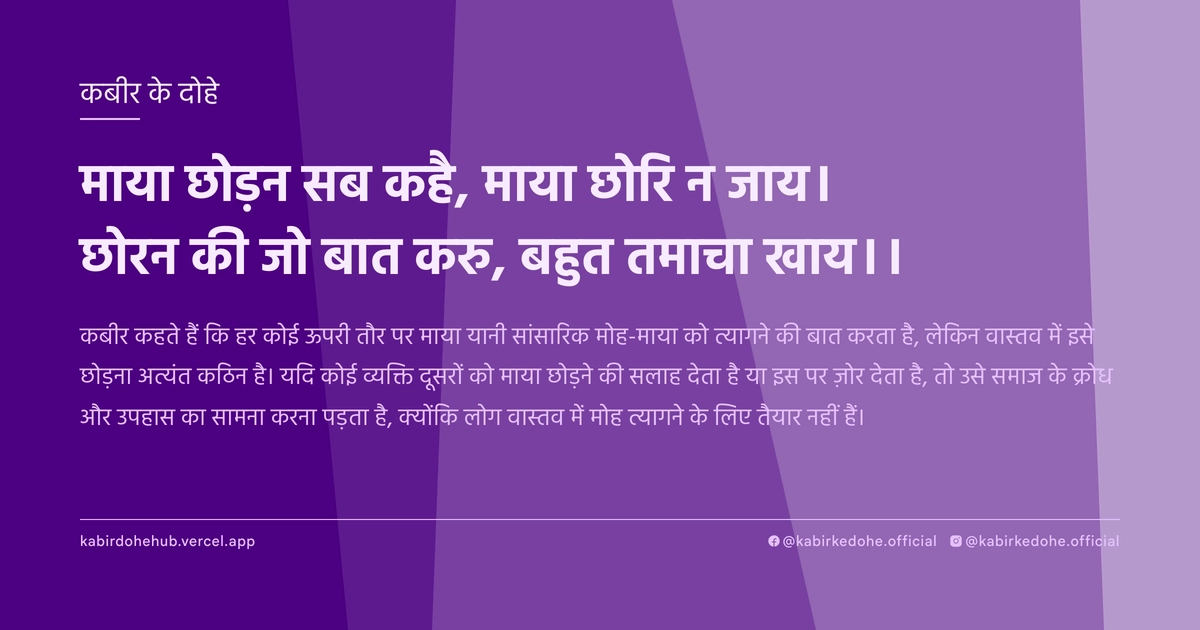
माया छोड़न सब कहै, माया छोरि न जाय।
छोरन की जो बात करु, बहुत तमाचा खाय।।
Maya chhodan sab kahai, maya chhori na jaaye. Chhoran ki jo baat karu, bahut tamacha khaye.
इस पृष्ठ पर इस कबीर दोहे का अर्थ (meaning), हिंदी व्याख्या और अंग्रेज़ी अनुवाद, दार्शनिक विश्लेषण और व्यावहारिक जीवन सीख दी गई है। यह दोहा माया (Maya) विषय से जुड़ा है — Kabir doha meaning and explanation in Hindi and English.
अर्थ (Meaning):
कबीर कहते हैं कि हर कोई ऊपरी तौर पर माया यानी सांसारिक मोह-माया को त्यागने की बात करता है, लेकिन वास्तव में इसे छोड़ना अत्यंत कठिन है। यदि कोई व्यक्ति दूसरों को माया छोड़ने की सलाह देता है या इस पर ज़ोर देता है, तो उसे समाज के क्रोध और उपहास का सामना करना पड़ता है, क्योंकि लोग वास्तव में मोह त्यागने के लिए तैयार नहीं हैं।
Kabir observes that while everyone speaks of renouncing 'Maya' (the illusory world of attachments), actually letting go of it is nearly impossible. He suggests that anyone who dares to preach the abandonment of worldly desires often faces ridicule or hostility, as people are deeply entrenched in their attachments and resent the mirror held up to their hypocrisy.
व्याख्या (Interpretation):
इस दोहे का शाब्दिक अर्थ है कि माया का त्याग करना आसान नहीं है। आध्यात्मिक स्तर पर, माया वह पर्दा है जो आत्मा को उसके वास्तविक स्वरूप (ब्रह्म) से अलग करता है। निर्गुण भक्ति के अनुसार, माया केवल धन-संपत्ति नहीं, बल्कि वह अहंकार है जो 'मैं' और 'मेरा' की भावना पैदा करता है। यह अद्वैत वेदांत के उस सिद्धांत को दर्शाता है जहाँ जीव स्वयं को पृथक मानकर दुख पाता है। कबीर यहाँ एक विरोधाभास प्रस्तुत करते हैं: हम मुक्ति चाहते हैं, लेकिन उन जंजीरों से प्यार करते हैं जिन्होंने हमें बांधा है। यह मानवीय स्थिति की विडंबना है कि हम सत्य की बात तो सुनना चाहते हैं, परंतु सत्य पर चलना नहीं चाहते।
Literally, the verse speaks of the difficulty of renouncing worldly illusions. Metaphorically, Maya is the cosmic veil that obscures the Atman's realization of its non-duality with Brahman. In the context of Nirgun Bhakti, Maya is not merely material wealth but the psychological construct of 'I' and 'Mine' that fuels the ego. The 'slap' mentioned is not just physical, but a symbolic representation of the societal resistance encountered when one challenges the collective delusion. Kabir highlights the central paradox of the human condition: the yearning for liberation coupled with an instinctive clinging to the very attachments that cause suffering. It is a critique of the superficiality of spiritual discourse versus the rigor of actual practice.
दार्शनिक विश्लेषण (Philosophical Analysis):
कबीर का यह दोहा उनके युग के धार्मिक पाखंड और कर्मकांडों पर एक तीखा प्रहार है। उस समय समाज बाहरी दिखावे और तीर्थयात्राओं में व्यस्त था, जबकि आंतरिक रूपांतरण की उपेक्षा की जा रही थी। कबीर ने स्पष्ट किया कि माया का त्याग केवल घर छोड़ने से नहीं, बल्कि मन के भीतर के मोह को मिटाने से होता है।
यह विचार अद्वैत वेदांत के 'माया' सिद्धांत से मेल खाता है, जहाँ संसार को मिथ्या माना गया है। कबीर का दृष्टिकोण सूफीवाद के 'फना' (अहंकार का विनाश) के करीब है, जहाँ साधक अपनी व्यक्तिगत पहचान को ईश्वर की विराटता में विलीन कर देता है। वे बताते हैं कि जब तक 'मैं' जीवित है, माया का प्रभाव बना रहेगा।
कबीर यहाँ जाति और धर्म के बंधनों को भी माया का हिस्सा मानते हैं। उनके अनुसार, जो व्यक्ति खुद को किसी विशेष जाति या संप्रदाय से जोड़ता है, वह माया के जाल में फंसा है। वे ritualism (कर्मकांड) का विरोध करते हैं क्योंकि वह माया को और अधिक सुदृढ़ करता है।
मनोवैज्ञानिक स्तर पर, यह दोहा संज्ञानात्मक विसंगति (cognitive dissonance) को दर्शाता है। मनुष्य जानता है कि मोह दुख का कारण है, फिर भी वह उसे छोड़ने का साहस नहीं जुटा पाता। कबीर इस मानसिक संघर्ष को उजागर करते हैं।
अंततः, यह विश्लेषण हमें सिखाता है कि आध्यात्मिक मार्ग पर चलने वाले को समाज के विरोध की अपेक्षा रखनी चाहिए। सत्य कड़वा होता है और वह अक्सर उन लोगों को असहज करता है जो भ्रम की नींद में सोए हुए हैं।
Kabir's verse is a sharp critique of the religious hypocrisy and ritualism prevalent during his era. While the society of his time was obsessed with external displays of piety and pilgrimages, Kabir emphasized the necessity of internal transformation. He asserts that renouncing Maya is not about physical abandonment of the home, but the psychological dissolution of attachment.
This aligns with the Advaita Vedanta concept of Maya as the cosmic illusion that hides the singular reality of Brahman. Kabir's approach mirrors the Sufi concept of 'Fana' (annihilation of the self), where the seeker must erase the ego to merge with the Divine. He argues that as long as the 'I' persists, the grip of Maya remains absolute.
Furthermore, Kabir views caste hierarchies and sectarian identities as extensions of Maya. By identifying with a social label, the individual further fragments their consciousness, moving away from the universal truth of Nirgun Bhakti. He rejects ritualism because it often serves as a spiritual anesthetic, making the ego feel righteous without requiring actual change.
Psychologically, the verse explores the tension between intellectual understanding and emotional attachment. Humans may intellectually acknowledge that attachment leads to suffering, yet they are emotionally incapable of letting go. Kabir exposes this dissonance with characteristic wit.
Ultimately, the analysis suggests that the path to truth is inherently lonely. The 'slap' is the inevitable reaction of a world built on illusions when confronted by someone who sees through them. It validates the struggle of the mystic against the tide of collective delusion.
मूल संदेश (Core Message):
- माया बाहर नहीं, हमारे भीतर के 'मैं' में बसी है।
- उपदेश देना आसान है, लेकिन आचरण में उतारना कठिन।
- अहंकार का त्याग ही वास्तविक मुक्ति का एकमात्र द्वार है।
- सत्य वह है जो हमें हमारी अपनी कमियों का दर्पण दिखाए।
- सांसारिक वस्तुओं का उपयोग करें, लेकिन उन्हें अपना स्वामी न बनने दें।
- Maya resides not in the world, but in the 'I' within us.
- Preaching is effortless; practicing is the ultimate struggle.
- The dissolution of ego is the only gateway to true liberation.
- Truth is that which mirrors our own hidden imperfections.
- Utilize worldly objects, but never allow them to become your master.
व्यावहारिक उदाहरण (Practical Example):
एक समय की बात है, बनारस के घाटों पर रामदीन नाम का एक वृद्ध बुनकर रहता था। रामदीन ने अपना पूरा जीवन रेशमी कपड़े बुनने में बिताया था। वह अपने काम में इतना निपुण था कि उसके बनाए कपड़ों की मांग दूर-दूर तक थी। लेकिन रामदीन के मन में एक गहरा दुख था—वह अपनी संपत्ति और अपनी कला के प्रति अत्यधिक आसक्त था।
वह अक्सर अन्य बुनकरों को उपदेश देता कि उन्हें धन का मोह नहीं करना चाहिए और ईश्वर की भक्ति में लीन रहना चाहिए। वह कहता था, "भाइयों, यह सब माया है, अंत में केवल राम नाम ही साथ जाएगा।"
एक दिन, उसके सबसे पुराने मित्र, जो एक साधारण साधु थे, ने उससे कहा, "रामदीन, तुम दूसरों को तो माया छोड़ने को कहते हो, लेकिन क्या तुम अपनी इस रेशमी करघे की मोह-माया छोड़ सकते हो?"
रामदीन ने तुरंत क्रोधित होकर उत्तर दिया, "यह मेरा व्यवसाय है! यह मेरी पहचान है! तुम मुझे क्या सिखाओगे?"
साधु मुस्कुराए और बोले, "यही वह तमाचा है जिसकी बात कबीर ने की थी। तुमने दूसरों को तो ज्ञान दिया, लेकिन जब बात तुम्हारी अपनी पहचान की आई, तो तुम्हारा अहंकार जाग गया।"
रामदीन को अपनी गलती का अहसास हुआ। उसने महसूस किया कि वह केवल शब्दों का खेल खेल रहा था। उसने देखा कि उसकी 'पहचान' ही उसकी सबसे बड़ी बेड़ी बन गई थी।
उसने धीरे-धीरे अपनी संपत्ति का एक बड़ा हिस्सा गरीबों में बांटना शुरू किया। उसने कपड़े बुनना नहीं छोड़ा, लेकिन अब वह कपड़े 'अपने' लिए नहीं, बल्कि 'सेवा' के भाव से बुनने लगा।
उसने पाया कि जब उसने स्वामित्व की भावना छोड़ी, तो उसका काम और अधिक निखर गया। अब वह वास्तव में स्वतंत्र था, क्योंकि उसने माया को बाहर नहीं, बल्कि अपने भीतर से विदा किया था।
Once, on the ghats of Varanasi, lived an elderly weaver named Ramdeen. Ramdeen had spent his entire life weaving exquisite silk fabrics. He was so skilled that his work was sought after far and wide. However, Ramdeen harbored a deep internal conflict—he was intensely attached to his wealth and his reputation as a master craftsman.
He frequently lectured other weavers, advising them not to be blinded by gold and to immerse themselves in the devotion of the Divine. He would proclaim, "Brothers, this is all Maya; in the end, only the name of the Lord remains."
One day, his oldest friend, a simple wandering monk, asked him, "Ramdeen, you tell others to renounce Maya, but can you renounce your attachment to this silk loom?"
Ramdeen reacted with immediate anger, shouting, "This is my profession! This is my identity! How dare you lecture me?"
The monk smiled gently and replied, "This is the 'slap' Kabir spoke of. You gave knowledge to others, but when it came to your own identity, your ego flared up."
Ramdeen was struck by the truth of these words. He realized he had been playing a game of words, using spirituality as a cloak for his own pride. He saw that his 'identity' had become his heaviest chain.
Slowly, he began to distribute a significant portion of his wealth among the poor. He did not stop weaving, but he stopped weaving for 'his' glory and started weaving as an act of service.
He discovered that once he let go of the sense of ownership, his art became even more refined. He was finally free, not because he left the world, but because he evicted the Maya from within his heart.
अभ्यास मार्गदर्शन (Practice Guidance):
- प्रतिदिन 15 मिनट मौन रहकर यह विचार करें कि आपकी कौन सी वस्तुएं या रिश्ते आपकी पहचान बन चुके हैं और आपको बांध रहे हैं।
- एक 'मोह-डायरी' लिखें: उन चीजों की सूची बनाएं जिन्हें आप 'मेरा' कहते हैं, और फिर पूछें, "यदि यह कल चला जाए, तो क्या मैं अभी भी पूर्ण रहूंगा?"
- जब भी आप किसी को नैतिक सलाह दें, पहले आत्म-निरीक्षण करें कि क्या आप स्वयं उस सलाह का पालन कर रहे हैं।
- निदान चेकलिस्ट: क्या आप अपनी उपलब्धियों के खोने पर अत्यधिक क्रोध या दुख महसूस करते हैं? क्या आप दूसरों की सफलता से ईर्ष्या करते हैं? यदि हाँ, तो माया का प्रभाव प्रबल है।
- Spend 15 minutes in silence daily, contemplating which possessions or relationships have become your identity and are currently binding you.
- Maintain an 'Attachment Journal': List everything you call 'mine,' and then ask, "If this were gone tomorrow, would I still be whole?"
- Whenever you offer moral advice to others, first perform a self-audit to see if you are embodying that advice in your own life.
- Diagnostic Checklist: Do you feel intense anger or grief when losing an achievement? Do you feel envy at others' success? If yes, the grip of Maya is still strong.
चिंतन प्रश्न (Reflection Questions):
- क्या मेरी आध्यात्मिक बातें केवल मेरी बौद्धिक श्रेष्ठता दिखाने का एक तरीका हैं?
- मैं किन ऐसी चीजों से चिपका हुआ हूँ जिन्हें मैं दुनिया के सामने 'त्याग' देने का दावा करता हूँ?
- जब कोई मेरी मान्यताओं को चुनौती देता है, तो मेरा क्रोध वास्तव में किस 'अहंकार' की रक्षा कर रहा होता है?
- क्या मेरा 'डिजिटल व्यक्तित्व' (सोशल मीडिया) मेरी माया का आधुनिक रूप है?
- यदि मेरी सारी सामाजिक प्रतिष्ठा छीन ली जाए, तो मेरे पास क्या बचेगा?
- Are my spiritual discourses merely a tool to project intellectual superiority?
- What are the things I cling to secretly while publicly claiming to have renounced them?
- When someone challenges my beliefs, which specific 'ego' is my anger trying to protect?
- Is my 'digital persona' on social media simply a modern manifestation of Maya?
- If all my social prestige were stripped away, what would actually remain of me?