
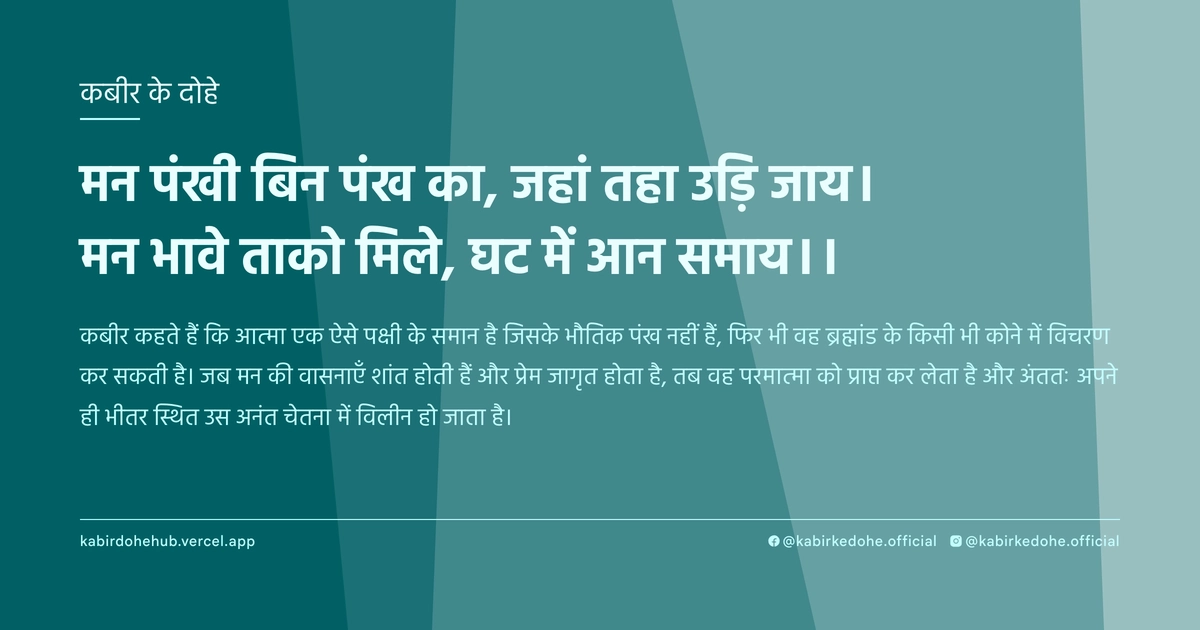
मन पंखी बिन पंख का, जहां तहा उड़ि जाय।
मन भावे ताको मिले, घट में आन समाय।।
Man pankhi bin pankh ka, jahan taha udi jaaye. Man bhave taako mile, ghat mein aan samaye.
इस पृष्ठ पर इस कबीर दोहे का अर्थ (meaning), हिंदी व्याख्या और अंग्रेज़ी अनुवाद, दार्शनिक विश्लेषण और व्यावहारिक जीवन सीख दी गई है। यह दोहा निर्गुण ब्रह्म (Nirguna Brahman) विषय से जुड़ा है — Kabir doha meaning and explanation in Hindi and English.
अर्थ (Meaning):
कबीर कहते हैं कि आत्मा एक ऐसे पक्षी के समान है जिसके भौतिक पंख नहीं हैं, फिर भी वह ब्रह्मांड के किसी भी कोने में विचरण कर सकती है। जब मन की वासनाएँ शांत होती हैं और प्रेम जागृत होता है, तब वह परमात्मा को प्राप्त कर लेता है और अंततः अपने ही भीतर स्थित उस अनंत चेतना में विलीन हो जाता है।
Kabir describes the soul as a wingless bird that possesses the innate ability to traverse any distance in the cosmos. When the mind transcends worldly desires and aligns with divine love, the seeker finds the Ultimate Truth, eventually merging into the vast consciousness residing within their own heart.
व्याख्या (Interpretation):
यहाँ 'पंखी' आत्मा का प्रतीक है और 'पंखों का अभाव' भौतिक शरीर की सीमाओं को दर्शाता है। शाब्दिक अर्थ यह है कि आत्मा को यात्रा के लिए शारीरिक अंगों की आवश्यकता नहीं है। रूपकात्मक रूप से, यह निर्गुण भक्ति का संकेत है जहाँ ईश्वर किसी विशेष स्थान या मूर्ति में नहीं, बल्कि सर्वव्यापी है। माया वह बंधन है जो हमें विश्वास दिलाता है कि हम सीमित हैं, जबकि अद्वैत वेदांत के अनुसार आत्मा और ब्रह्म एक ही हैं। जब 'मन भावे' यानी जब अहंकार का विसर्जन होता है और केवल शुद्ध प्रेम शेष रहता है, तब द्वैत समाप्त हो जाता है। अंततः, 'घट में समाय' का अर्थ है कि बाहरी खोज का अंत आंतरिक साक्षात्कार में होता है, जहाँ साधक यह अनुभव करता है कि जिसे वह बाहर ढूँढ रहा था, वह सदैव उसके भीतर ही था।
The 'bird' symbolizes the soul, and the 'absence of wings' represents the limitations of the physical body. Literally, it suggests the soul requires no material means for its journey. Metaphorically, this points toward Nirgun Bhakti, where the Divine is not confined to a form or location but is omnipresent. Maya is the illusion that convinces us of our limitation, whereas Advaita Vedanta posits the non-duality of Atman and Brahman. When 'man bhaave'—meaning when the ego dissolves and only pure love remains—the duality between the seeker and the sought vanishes. Ultimately, 'ghat mein samaay' signifies that the external quest ends in internal realization, where the seeker discovers that the Infinite was always residing within the infinitesimal space of the heart.
दार्शनिक विश्लेषण (Philosophical Analysis):
कबीर का यह दोहा उस युग की उपज है जहाँ धर्म बाहरी कर्मकांडों और मंदिर-मस्जिद के विवादों में उलझा था। कबीर ने पुरजोर तरीके से इस बात का खंडन किया कि ईश्वर तक पहुँचने के लिए किसी पुरोहित, विशेष तीर्थ या कठिन शारीरिक तपस्या की आवश्यकता है। उनका दर्शन 'सहज मार्ग' का है, जो बाहरी आडंबरों के बजाय आंतरिक शुद्धि पर बल देता है।
अद्वैत वेदांत के परिप्रेक्ष्य में, यह दोहा 'अहं ब्रह्मास्मि' की भावना को पुष्ट करता है। यदि आत्मा वास्तव में ब्रह्म का अंश है, तो वह पहले से ही पूर्ण है; उसे कहीं 'जाना' नहीं है, बल्कि केवल अपनी वास्तविक प्रकृति को 'पहचानना' है। पंखों का न होना इस बात का प्रमाण है कि आध्यात्मिक यात्रा शारीरिक नहीं, बल्कि चेतना का रूपांतरण है।
सूफी मत के 'फना' (अहंकार का विनाश) और 'बका' (परमात्मा में अस्तित्व) के सिद्धांतों से यहाँ गहरा साम्य है। जिस प्रकार एक बूंद समुद्र में गिरकर समुद्र बन जाती है, वैसे ही जब मन की इच्छाएं समाप्त होती हैं, तो आत्मा परमात्मा में विलीन हो जाती है। यह मनोवैज्ञानिक रूपांतरण है जहाँ 'मैं' का भाव मिटकर 'वह' में बदल जाता है।
कबीर यहाँ जाति और वर्ग के भेदों को भी निरस्त करते हैं। यदि आत्मा पंखहीन पक्षी है, तो वह किसी जाति, धर्म या सामाजिक स्थिति से बंधी नहीं है। यह सार्वभौमिक सत्य है कि मुक्ति केवल प्रेम और समर्पण से संभव है, न कि किसी विशेष जन्म या कुल के कारण।
अक्सर लोग इस दोहे को जादुई शक्तियों या सूक्ष्म शरीर की यात्रा के रूप में गलत समझते हैं। वास्तव में, कबीर यहाँ 'मानसिक यात्रा' की बात कर रहे हैं। यह यात्रा बाहर से भीतर की ओर है। जब साधक यह समझ जाता है कि संसार एक मायाजाल है, तब वह अपनी चेतना को अंतर्मुखी करता है और उस शून्य में प्रवेश करता है जहाँ केवल परमात्मा का वास है।
This couplet emerges from an era where religion was entangled in external rituals and conflicts between temples and mosques. Kabir vehemently rejected the notion that reaching God required priests, specific pilgrimages, or grueling physical penance. His philosophy is one of the 'Sahaj Marg' (the Natural Path), emphasizing internal purification over outward display.
From the perspective of Advaita Vedanta, this verse reinforces the sentiment of 'Aham Brahmasmi' (I am Brahman). If the soul is indeed a spark of the Divine, it is already complete; it does not need to 'travel' anywhere but simply 'recognize' its true nature. The lack of wings proves that the spiritual journey is not physical, but a transformation of consciousness.
There is a profound resonance here with the Sufi concepts of 'Fana' (annihilation of the ego) and 'Baqa' (subsistence in the Divine). Just as a drop merges into the ocean to become the ocean, when the desires of the mind cease, the soul dissolves into the Absolute. This is a psychological transmutation where the sense of 'I' is replaced by 'Thou'.
Kabir also dismantles caste and class distinctions through this imagery. If the soul is a wingless bird, it is not bound by caste, creed, or social status. It is a universal truth that liberation is achieved through love and surrender, not through the accident of birth or lineage.
Common literalist misconceptions often interpret this as a reference to astral projection or magical powers. In reality, Kabir is speaking of a 'mental journey.' This journey is from the periphery to the center. Once the seeker realizes that the world is a veil of Maya, they turn their consciousness inward to enter the void where only the Divine resides.
मूल संदेश (Core Message):
- बाहरी खोज एक भ्रम है; सत्य सदैव आंतरिक होता है।
- आत्मा की यात्रा भौतिक नहीं, बल्कि चेतना का विस्तार है।
- अहंकार का विसर्जन ही परमात्मा से मिलन का एकमात्र द्वार है।
- प्रेम वह एकमात्र शक्ति है जो द्वैत को मिटाकर अद्वैत करती है।
- पूर्णता कहीं बाहर नहीं, बल्कि स्वयं की पहचान में निहित है।
- External searching is an illusion; Truth is always internal.
- The soul's journey is not physical, but an expansion of consciousness.
- The dissolution of ego is the only gateway to the Divine.
- Love is the sole force that erases duality to establish non-duality.
- Completeness lies not elsewhere, but in the recognition of one's own Self.
व्यावहारिक उदाहरण (Practical Example):
वाराणसी के एक पुराने घाट पर रामदीन नाम का एक वृद्ध नाविक रहता था। उसका पूरा जीवन दूसरों को नदी पार कराने में बीता, लेकिन उसके अपने मन में एक गहरी बेचैनी थी। वह अक्सर बड़े-बड़े पंडितों को देखता जो कठिन मंत्रोच्चार करते और लंबी यात्राएं करते ताकि मोक्ष पा सकें। रामदीन को लगता था कि वह अनपढ़ और गरीब है, इसलिए वह कभी उस 'परम सत्य' तक नहीं पहुँच पाएगा।
वह अपनी नाव चलाता, लेकिन उसका मन हमेशा इस सवाल में उलझा रहता कि ईश्वर कहाँ रहता है? क्या वह कैलाश पर है? या किसी दूरस्थ गुफा में? वह अपनी गरीबी और अज्ञानता को अपनी बेड़ियों की तरह देखता था, यह सोचकर कि उसके पास ज्ञान के 'पंख' नहीं हैं।
एक दिन, एक फकीर उसकी नाव पर सवार हुआ। फकीर ने रामदीन की व्याकुलता को देखा और मुस्कुराते हुए पूछा, 'नाविक, तुम इस नदी के पानी को कहाँ ले जाना चाहते हो?' रामदीन हैरान हुआ और बोला, 'महाराज, पानी तो यहीं है, मैं तो बस नाव चला रहा हूँ।'
फकीर ने उत्तर दिया, 'ठीक वैसे ही, तुम जिसे बाहर ढूँढ रहे हो, वह तुम्हारे भीतर ही बह रहा है। तुम पंखों की तलाश कर रहे हो उड़ने के लिए, जबकि तुम स्वयं वह आकाश हो जिसमें सब कुछ समाया है। बस अपनी नाव के शोर को शांत करो और भीतर की गहराई में झाँको।'
रामदीन ने उस दिन पहली बार अपनी आँखें बंद कीं और नाव चलाने की मशीनरी को भूलकर केवल अपनी सांसों पर ध्यान केंद्रित किया। उसे महसूस हुआ कि वह नदी, वह नाव, और वह खुद—सब एक ही प्रवाह का हिस्सा हैं।
उसने महसूस किया कि उसकी गरीबी उसकी बाधा नहीं थी, बल्कि उसका 'अहंकार' कि वह 'अधूरा' है, असली बाधा थी। जैसे ही उसने यह स्वीकार किया कि वह जैसा है, वैसा ही पूर्ण है, उसके मन की बेचैनी शांत हो गई।
अब वह केवल नाव नहीं चलाता था, बल्कि हर यात्री में उसी एक चेतना को देखता था। उसने पाया कि जिस शांति की तलाश में लोग हजारों मील चलते हैं, वह उसके अपने हृदय के छोटे से कोने में बसी थी।
रामदीन का जीवन बदल गया। वह अब भी वही नाविक था, लेकिन उसका आंतरिक संसार अब अनंत था। उसने जान लिया था कि आत्मा को उड़ने के लिए पंखों की नहीं, बल्कि केवल समर्पण की आवश्यकता होती है।
On an ancient ghat in Varanasi lived an elderly boatman named Ramdin. His entire life was spent ferrying others across the river, yet a deep restlessness lingered in his heart. He often watched learned pundits chanting complex mantras and undertaking long pilgrimages to attain salvation. Ramdin felt that being illiterate and poor, he could never reach that 'Ultimate Truth.'
As he rowed his boat, his mind was constantly plagued by the question: Where does God reside? Is He on Mount Kailash? Or in some distant cave? He viewed his poverty and ignorance as shackles, believing he lacked the 'wings' of knowledge to fly toward the Divine.
One day, a wandering Sufi ascetic boarded his boat. The ascetic noticed Ramdin's turmoil and asked with a smile, 'Boatman, where do you intend to take the water of this river?' Ramdin was bewildered and replied, 'Maharaj, the water is right here; I am merely rowing the boat.'
The ascetic replied, 'Similarly, the one you seek outside is flowing within you. You search for wings to fly, while you yourself are the very sky in which everything is contained. Just silence the noise of your rowing and peer into the depths within.'
For the first time that day, Ramdin closed his eyes. Forgetting the mechanics of rowing, he focused solely on his breath. He felt that the river, the boat, and himself were all parts of a single, seamless flow.
He realized that his poverty was not the obstacle; rather, the egoistic belief that he was 'incomplete' was the true barrier. The moment he accepted that he was whole exactly as he was, the restlessness in his mind vanished.
From then on, he didn't just ferry passengers; he saw the same singular consciousness in every traveler. He discovered that the peace people traveled thousands of miles to find was nestled in a tiny corner of his own heart.
Ramdin's life was transformed. He remained the same boatman, but his internal world became infinite. He had learned that the soul does not need wings to fly; it only needs the courage of surrender.
अभ्यास मार्गदर्शन (Practice Guidance):
- प्रतिदिन 20 मिनट 'शून्य ध्यान' का अभ्यास करें, जहाँ आप किसी विचार या मंत्र के बिना केवल अपनी उपस्थिति को महसूस करें।
- एक डायरी लिखें जिसमें आप उन 'मानसिक पंखों' (अहंकार, पद, प्रतिष्ठा) की सूची बनाएं जिन्हें आप अपनी पहचान मानते हैं, और फिर विचार करें कि उनके बिना आप कौन हैं।
- दिन में तीन बार रुककर स्वयं से पूछें: 'क्या मैं इस क्षण में पूर्ण हूँ, या मैं किसी बाहरी चीज़ की तलाश में हूँ?'
- निदान चेकलिस्ट: यदि आप अभी भी दूसरों से अपनी तुलना कर रहे हैं या मोक्ष को भविष्य की घटना मान रहे हैं, तो आप अभी भी 'पंखों' की तलाश में हैं। यदि आप वर्तमान क्षण में असीम शांति महसूस करते हैं, तो आप 'घट' में समा चुके हैं।
- Practice 20 minutes of 'Shunya Meditation' daily, where you simply observe your presence without clinging to any thought or mantra.
- Maintain a journal listing the 'mental wings' (ego, status, titles) you identify with, and then contemplate who you are without them.
- Three times a day, pause and ask yourself: 'Am I complete in this moment, or am I searching for something external?'
- Diagnostic Checklist: If you are still comparing yourself to others or viewing liberation as a future event, you are still searching for 'wings.' If you feel an infinite peace in the present moment, you have merged into the 'ghat' (the heart).
चिंतन प्रश्न (Reflection Questions):
- आपकी वह कौन सी 'डिजिटल पहचान' या सामाजिक छवि है जिसे आप पंखों की तरह इस्तेमाल कर रहे हैं ताकि आप दूसरों से ऊपर दिख सकें?
- यदि आपसे आपकी सारी उपलब्धियाँ और संबंध छीन लिए जाएँ, तो जो बचेगा, क्या वह 'शून्य' होगा या 'अनंत'?
- क्या आप वास्तव में ईश्वर को खोज रहे हैं, या आप केवल अपनी इच्छाओं की पूर्ति के लिए एक दैवीय माध्यम चाहते हैं?
- आपके भीतर का वह कौन सा डर है जो आपको यह मानने से रोकता है कि आप पहले से ही पूर्ण हैं?
- क्या आपकी भक्ति आपको विनम्र बना रही है, या यह आपके आध्यात्मिक अहंकार को पोषण दे रही है?
- What digital identity or social image are you using as 'wings' to appear superior to others?
- If all your achievements and relationships were stripped away, would what remains be 'void' or 'infinite'?
- Are you truly seeking the Divine, or are you merely seeking a divine medium to fulfill your own desires?
- What is the fear within you that prevents you from believing you are already complete?
- Is your devotion making you humble, or is it feeding your spiritual ego?