
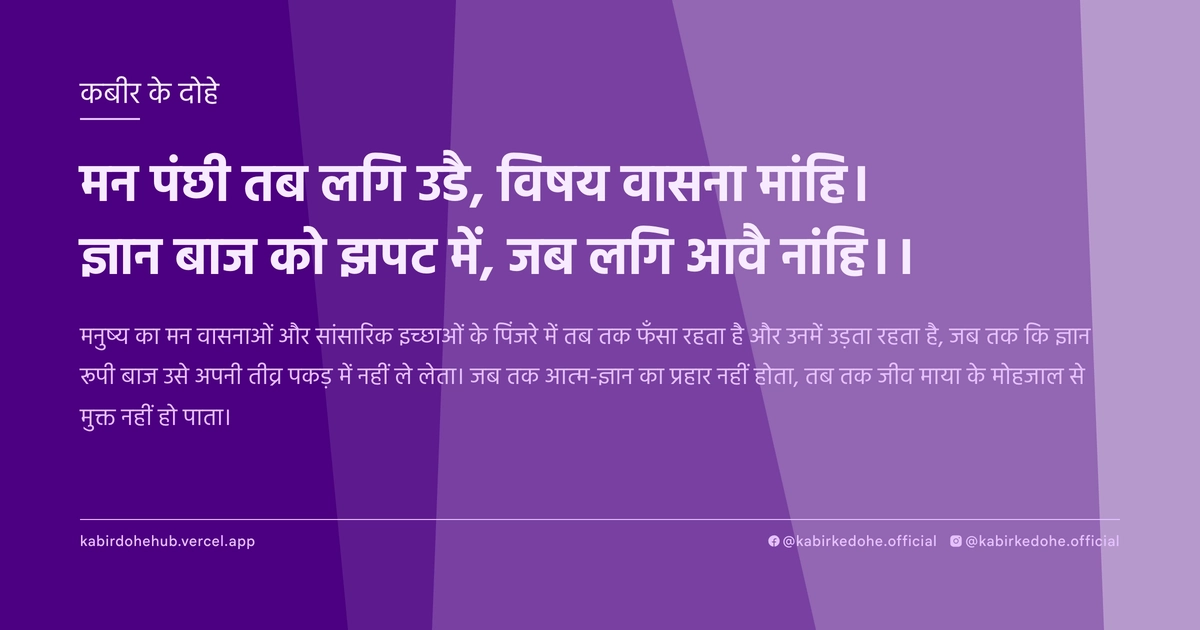
मन पंछी तब लगि उडै, विषय वासना मांहि।
ज्ञान बाज को झपट में, जब लगि आवै नांहि।।
Man panchhi tab lagi udai, vishay vaasna maahi. Gyaan baaj ko jhapat mein, jab lagi aavai naahin.
इस पृष्ठ पर इस कबीर दोहे का अर्थ (meaning), हिंदी व्याख्या और अंग्रेज़ी अनुवाद, दार्शनिक विश्लेषण और व्यावहारिक जीवन सीख दी गई है। यह दोहा मन नियंत्रण (Mind Control) विषय से जुड़ा है — Kabir doha meaning and explanation in Hindi and English.
अर्थ (Meaning):
मनुष्य का मन वासनाओं और सांसारिक इच्छाओं के पिंजरे में तब तक फँसा रहता है और उनमें उड़ता रहता है, जब तक कि ज्ञान रूपी बाज उसे अपनी तीव्र पकड़ में नहीं ले लेता। जब तक आत्म-ज्ञान का प्रहार नहीं होता, तब तक जीव माया के मोहजाल से मुक्त नहीं हो पाता।
The human mind continues to flutter and wander within the confines of sensory desires and worldly attachments as long as it remains ignorant. It cannot escape this cycle of craving until the hawk of spiritual knowledge swoops down with precision to seize it, liberating the soul from the grip of illusion.
व्याख्या (Interpretation):
यहाँ 'पंछी' जीवात्मा का प्रतीक है जो इंद्रिय सुखों (विषय वासना) के आकाश में भटक रहा है। यह उड़ान वास्तव में एक भ्रम है, क्योंकि यह मुक्ति नहीं बल्कि वासनाओं की गुलामी है। 'ज्ञान बाज' वह प्रखर बोध है जो अद्वैत वेदांत के 'तत्त्वमसि' के समान है, जो यह बताता है कि आत्मा और ब्रह्म एक ही हैं। जब तक यह बोध नहीं होता, जीव माया के जाल में उलझा रहता है। यह दोहा निरगुण भक्ति के उस मार्ग को दर्शाता है जहाँ बाहरी कर्मकांड नहीं, बल्कि आंतरिक जागरण ही मोक्ष का एकमात्र साधन है। यह विरोधाभास है कि जिसे हम स्वतंत्रता समझते हैं, वह वास्तव में वासनाओं का बंधन है, और जिसे हम ज्ञान का 'झपटना' या कठोर प्रहार समझते हैं, वही वास्तविक स्वतंत्रता है।
In this metaphor, the 'bird' represents the individual soul (Jivatma) fluttering aimlessly in the sky of sensory gratifications. This flight is an illusion; it is not true freedom but a recursive loop of craving. The 'Hawk of Knowledge' symbolizes the piercing insight of Advaita Vedanta—the realization of 'Thou Art That'—which shatters the ego. Until this sudden, sharp awakening occurs, the soul remains trapped in Maya. This aligns with Nirgun Bhakti, emphasizing that liberation comes not through ritual, but through the annihilation of the false self. The central paradox presented is that our perceived freedom in pursuing desires is actually a cage, and the 'attack' of spiritual knowledge is the only act of true liberation.
दार्शनिक विश्लेषण (Philosophical Analysis):
कबीर का यह दोहा मध्यकालीन भारत के उस सामाजिक-धार्मिक परिवेश में रचा गया जहाँ कर्मकांड और बाहरी आडंबर चरम पर थे। कबीर ने स्पष्ट किया कि मोक्ष किसी तीर्थ या मंदिर से नहीं, बल्कि आंतरिक रूपांतरण से मिलता है। यहाँ 'विषय वासना' का अर्थ केवल कामुकता नहीं, बल्कि वह सूक्ष्म अहंकार है जो हमें 'मैं' और 'मेरा' के भ्रम में रखता है।
दार्शनिक स्तर पर, यह अद्वैत वेदांत के उस सिद्धांत से जुड़ा है जहाँ अविद्या (अज्ञान) ही बंधन का कारण है। जब तक साधक यह नहीं समझता कि वह शरीर नहीं बल्कि शुद्ध चेतना है, वह वासनाओं के अधीन रहता है। सूफी मत के 'फना' (अहंकार का विनाश) की तरह, यहाँ भी ज्ञान के बाज द्वारा अहंकार का अंत आवश्यक है।
कबीर जाति और धर्म के भेदों को नकारते हुए यह संदेश देते हैं कि वासनाएँ सार्वभौमिक हैं और ज्ञान भी सार्वभौमिक है। वे बताते हैं कि मनुष्य अपनी इच्छाओं को पूरा करके शांति खोजता है, जो कि अग्नि को घी से बुझाने जैसा है। वास्तविक शांति केवल इच्छाओं के मूल कारण—अज्ञान—को समाप्त करने से आती है।
मनोवैज्ञानिक दृष्टि से, यह दोहा 'कंडीशनिंग' और 'तृष्णा' के चक्र को दर्शाता है। हमारा मन पुराने पैटर्न (संस्कारों) के कारण बार-बार उन्हीं इच्छाओं की ओर भागता है। ज्ञान का 'झपटना' एक संज्ञानात्मक बदलाव (Cognitive Shift) है, जहाँ व्यक्ति अचानक यह देख लेता है कि जिसे वह सुख समझ रहा था, वह वास्तव में दुख का स्रोत है।
अंततः, कबीर यह स्थापित करते हैं कि ज्ञान कोई किताबी जानकारी नहीं है, बल्कि एक जीवंत अनुभव है। यह एक ऐसा प्रहार है जो मनुष्य के झूठे अहंकार के खोल को तोड़ देता है, जिससे वह अपनी वास्तविक प्रकृति, जो कि ब्रह्म है, से साक्षात्कार कर पाता है।
Kabir's couplet emerged during a medieval Indian era dominated by rigid ritualism and caste hierarchies. He asserts that liberation is not found in pilgrimages or temples, but through internal transmutation. Here, 'sensory desires' refer not just to lust, but to the subtle ego that maintains the illusion of 'I' and 'Mine.'
Philosophically, this connects to Advaita Vedanta, where Avidya (ignorance) is the root of all bondage. Until the seeker realizes they are not the physical body but pure consciousness, they remain a slave to cravings. Similar to the Sufi concept of 'Fana' (annihilation of the self), the 'Hawk of Knowledge' must destroy the ego to reveal the Truth.
Kabir transcends caste and creed, suggesting that while desires are universal, so is the potential for awakening. He argues that seeking peace through the fulfillment of desires is like trying to extinguish a fire with gasoline. True peace arises only by eradicating the root cause: ignorance.
Psychologically, this describes the cycle of conditioning and 'Trishna' (craving). The mind habitually returns to old patterns of desire. The 'swoop' of knowledge represents a profound cognitive shift—a moment of satori—where the individual perceives that what they pursued as pleasure was actually the source of their suffering.
Ultimately, Kabir establishes that knowledge is not academic information but a lived experience. It is a violent rupture of the false ego, a necessary shock that breaks the shell of identity to reveal the underlying reality of the Brahman.
मूल संदेश (Core Message):
- इच्छाएं मुक्ति नहीं, बल्कि सूक्ष्म बंधन हैं।
- अहंकार का विनाश ही वास्तविक स्वतंत्रता का द्वार है।
- ज्ञान कोई सूचना नहीं, बल्कि एक प्रहारक अनुभव है।
- बाहरी उपलब्धियां आंतरिक रिक्तता को नहीं भर सकतीं।
- जब 'मैं' मिटता है, तब 'ब्रह्म' प्रकट होता है।
- Desires are not liberation, but subtle chains.
- The annihilation of ego is the only gateway to freedom.
- Knowledge is not information, but a piercing experience.
- External achievements cannot fill an internal void.
- When the 'I' vanishes, the 'Universal Truth' emerges.
व्यावहारिक उदाहरण (Practical Example):
एक समय की बात है, बनारस के घाटों पर रहने वाला एक वृद्ध बुनकर था, जिसका नाम माधव था। माधव अपनी कला में निपुण था, लेकिन उसका मन हमेशा इस बात की लालसा में रहता था कि वह शहर के सबसे अमीर सेठ के लिए सबसे कीमती रेशमी वस्त्र बनाए ताकि उसे प्रसिद्धि और धन मिले।
वह दिन-रात मेहनत करता, लेकिन जैसे ही एक इच्छा पूरी होती, दूसरी उसकी जगह ले लेती। वह कभी सोने के धागों की चाह करता, तो कभी राजमहल के आदेशों की। उसकी यह 'उड़ान' उसे मानसिक तनाव और अशांति की ओर ले जा रही थी।
एक दिन, माधव की मुलाकात एक मौन साधु से हुई। साधु ने माधव के चेहरे पर छाई बेचैनी को देखा और उससे पूछा, 'तुम इस रेशम के धागों में क्या बुन रहे हो—वस्त्र या अपनी बेड़ियाँ?'
माधव हँसा और बोला, 'मैं तो अपनी समृद्धि बुन रहा हूँ।' साधु ने शांति से उत्तर दिया, 'समृद्धि वह नहीं जो बाहर दिखे, बल्कि वह है जो भीतर शांत हो। तुम उस पंछी की तरह हो जो सोने के पिंजरे को ही अपना आकाश समझ बैठा है।'
इस बात ने माधव के भीतर एक हलचल पैदा कर दी। उसने महसूस किया कि उसकी सारी मेहनत केवल उसकी 'पहचान' और 'अहंकार' को संतुष्ट करने के लिए थी। वह जितना अधिक कमाता, उसकी वासनाएँ उतनी ही बढ़ती जातीं।
वह रात माधव सो नहीं सका। उसे लगा जैसे कोई बाज उसके भ्रम के पर्दे को चीर रहा हो। उसे अचानक बोध हुआ कि उसकी खुशी रेशम की चमक में नहीं, बल्कि बुनने की उस प्रक्रिया में थी जिसमें वह स्वयं को भूल जाता था।
अगले दिन, माधव ने सेठ के बड़े ऑर्डर को ठुकरा दिया। उसने तय किया कि वह अब केवल उन लोगों के लिए कपड़े बनाएगा जिन्हें वास्तव में उनकी आवश्यकता है, और बदले में केवल उतना ही लेगा जिससे उसका गुजारा हो सके।
उसने अपनी कला को लालच से हटाकर सेवा में बदल दिया। जैसे ही उसने 'प्रसिद्धि' की वासना को छोड़ा, उसका मन शांत हो गया। वह अब भी बुनता था, लेकिन अब वह वासनाओं के आकाश में नहीं उड़ रहा था, बल्कि शांति के धरातल पर स्थिर था।
माधव की यह रूपांतरण यात्रा दिखाती है कि कैसे ज्ञान का एक छोटा सा प्रहार (साधु के शब्द) जीवन भर की वासनाओं के चक्र को तोड़ सकता है।
उसने पाया कि जब 'मैं' मरता है, तभी 'सत्य' का जन्म होता है।
Once, on the ghats of Varanasi, lived an elderly weaver named Madhav. Madhav was a master of his craft, but his mind was perpetually consumed by a longing to create the most expensive silk garments for the city's wealthiest merchant to gain fame and fortune.
He worked day and night, but as soon as one desire was fulfilled, another took its place. He craved gold threads, then royal commissions. This 'flight' of ambition led him toward chronic stress and inner turmoil.
One day, Madhav encountered a silent monk. Observing the restlessness on Madhav's face, the monk asked, 'What are you weaving into these silk threads—a garment, or your own chains?'
Madhav laughed and replied, 'I am weaving my prosperity.' The monk answered calmly, 'Prosperity is not what is visible outside, but what is silent within. You are like a bird that has mistaken a golden cage for the open sky.'
These words triggered a storm within Madhav. He realized that all his toil was merely to satisfy his 'identity' and 'ego.' The more he earned, the more his cravings expanded.
That night, Madhav could not sleep. He felt as if a hawk was tearing through the veil of his delusions. He suddenly realized that his happiness lay not in the shimmer of the silk, but in the act of weaving where he used to lose himself.
The next day, Madhav rejected the merchant's massive order. He decided to weave only for those who truly needed clothing, accepting only enough to sustain his basic needs.
He shifted his art from greed to service. The moment he let go of the desire for 'fame,' his mind became still. He continued to weave, but he was no longer flying in the sky of cravings; he was grounded in peace.
Madhav's transformation illustrates how a single strike of knowledge (the monk's words) can break a lifelong cycle of desire.
He discovered that only when the 'I' dies, does the 'Truth' be born.
अभ्यास मार्गदर्शन (Practice Guidance):
- दैनिक साक्षी भाव: दिन में तीन बार 10 मिनट के लिए बैठें और अपने मन में उठने वाली इच्छाओं को एक बाहरी दर्शक की तरह देखें। यह विश्लेषण करें कि क्या यह इच्छा वास्तव में आवश्यक है या केवल अहंकार की तृप्ति है।
- आत्म-पूछताछ जर्नल: हर रात लिखें—'आज मैंने किस वासना के पीछे भागकर अपनी शांति खोई?' और 'यदि यह इच्छा पूरी नहीं होती, तो क्या मैं फिर भी पूर्ण होता?'
- मौन का अभ्यास: सप्ताह में एक दिन या दिन में कुछ घंटे पूर्ण मौन रहें। बाहरी शोर कम होने पर ही 'ज्ञान बाज' की आंतरिक पुकार सुनाई देती है।
- डायग्नोस्टिक चेकलिस्ट: यदि आप छोटी सी असफलता पर अत्यधिक क्रोधित होते हैं या किसी की प्रशंसा के बिना अधूरा महसूस करते हैं, तो समझ लें कि आप अभी भी 'विषय वासना' के आकाश में उड़ रहे हैं।
- Daily Witness Consciousness: Sit for 10 minutes three times a day and observe your desires as an external spectator. Analyze whether the craving is a genuine need or merely an ego-driven impulse.
- Self-Inquiry Journaling: Every night, write—'Which desire did I chase today that cost me my peace?' and 'Would I still be complete if this desire remained unfulfilled?'
- Practice of Silence: Maintain complete silence for one day a week or a few hours daily. The inner call of the 'Hawk of Knowledge' is only audible when external noise ceases.
- Diagnostic Checklist: If you feel extreme anger over a minor failure or feel incomplete without external validation, recognize that you are still fluttering in the sky of sensory cravings.
चिंतन प्रश्न (Reflection Questions):
- मेरी कौन सी ऐसी 'सभ्य' इच्छाएं हैं जो वास्तव में मेरे अहंकार को पाल रही हैं?
- यदि मेरी सारी सामाजिक पहचान (पद, प्रतिष्ठा, संपत्ति) छीन ली जाए, तो मेरे पास क्या बचेगा?
- क्या मैं वास्तव में स्वतंत्र हूँ, या मैं केवल अपनी पसंद के पिंजरे में उड़ रहा हूँ?
- मेरे जीवन में वह कौन सा 'ज्ञान बाज' था जिसने मेरी धारणाओं को तोड़ा, और मैंने उस समय कैसा महसूस किया?
- मैं अपनी डिजिटल पहचान (सोशल मीडिया) के माध्यम से किस प्रकार की वासनाओं को संतुष्ट कर रहा हूँ?
- Which of my 'civilized' desires are actually nourishing my ego?
- If all my social identities (rank, prestige, wealth) were stripped away, what would remain of me?
- Am I truly free, or am I simply fluttering within a cage of my own choosing?
- Who or what was the 'Hawk of Knowledge' in my life that shattered my delusions, and how did I react?
- Through my digital identity, what specific cravings am I attempting to satisfy?