
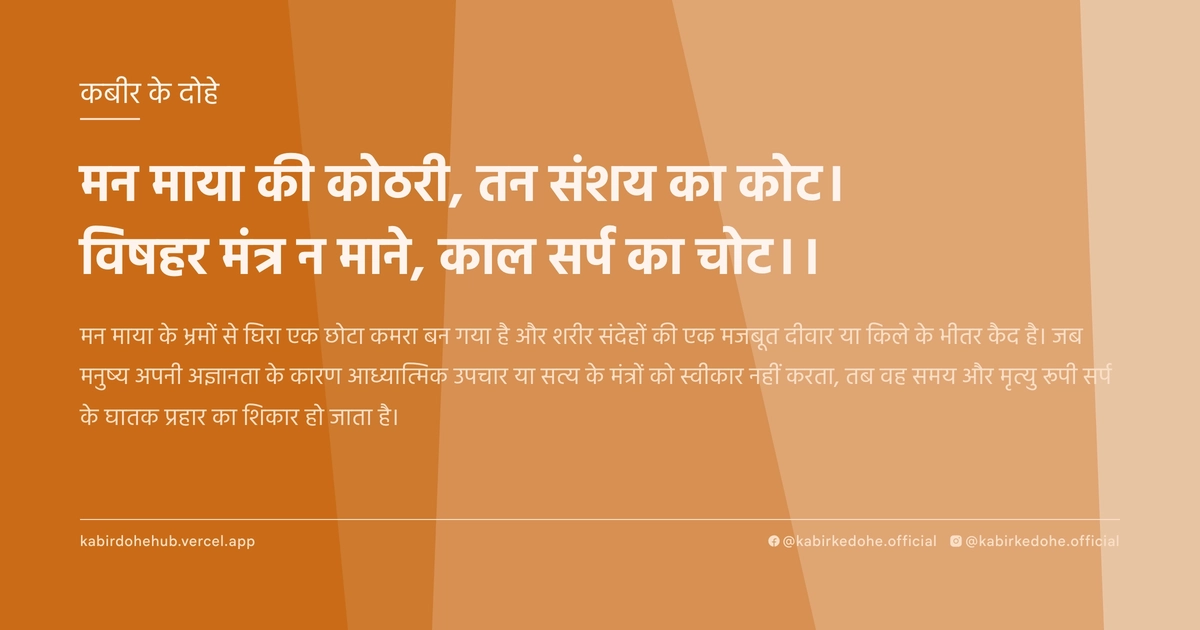
मन माया की कोठरी, तन संशय का कोट।
विषहर मंत्र न माने, काल सर्प का चोट।।
Man maya ki kothari, tan sanshay ka kot. Vishahar mantra na maane, kaal sarp ka chot.
इस पृष्ठ पर इस कबीर दोहे का अर्थ (meaning), हिंदी व्याख्या और अंग्रेज़ी अनुवाद, दार्शनिक विश्लेषण और व्यावहारिक जीवन सीख दी गई है। यह दोहा माया (Maya) विषय से जुड़ा है — Kabir doha meaning and explanation in Hindi and English.
अर्थ (Meaning):
मन माया के भ्रमों से घिरा एक छोटा कमरा बन गया है और शरीर संदेहों की एक मजबूत दीवार या किले के भीतर कैद है। जब मनुष्य अपनी अज्ञानता के कारण आध्यात्मिक उपचार या सत्य के मंत्रों को स्वीकार नहीं करता, तब वह समय और मृत्यु रूपी सर्प के घातक प्रहार का शिकार हो जाता है।
The mind has become a cramped chamber of illusions (Maya), and the body is enclosed within a fortress of doubt. When a person refuses to heed the antidotes of spiritual wisdom and truth, they inevitably fall prey to the lethal strike of the serpent of Time and Death.
व्याख्या (Interpretation):
यह दोहा मानवीय चेतना की वर्तमान स्थिति का एक गहरा रूपक है। 'माया की कोठरी' उस मानसिक संकीर्णता को दर्शाती है जहाँ हम भौतिक इच्छाओं को ही सत्य मान बैठते हैं। 'संशय का कोट' वह मानसिक अवरोध है जो हमें आत्म-साक्षात्कार से रोकता है। यहाँ कबीर निरगुण भक्ति के माध्यम से समझाते हैं कि जब तक अहंकार और संदेह का पर्दा नहीं हटता, तब तक ब्रह्म का ज्ञान संभव नहीं है। यह द्वैतवाद की स्थिति है जहाँ जीव स्वयं को ईश्वर से अलग मानता है। अंततः, 'काल सर्प' केवल भौतिक मृत्यु नहीं, बल्कि वह आध्यात्मिक पतन है जो अज्ञानता के कारण होता है।
This couplet serves as a profound metaphor for the current state of human consciousness. The 'chamber of Maya' represents the mental constriction where material desires are mistaken for ultimate reality. The 'fortress of doubt' signifies the psychological barriers that prevent self-realization. Through the lens of Nirgun Bhakti, Kabir explains that as long as the veil of ego and skepticism remains, the knowledge of the Formless Brahman is unattainable. This is the state of duality where the individual perceives themselves as separate from the Divine. Ultimately, the 'serpent of Time' refers not just to physical death, but to the spiritual decay resulting from persistent ignorance.
दार्शनिक विश्लेषण (Philosophical Analysis):
कबीर का यह दर्शन अद्वैत वेदांत और सूफी मत के संगम पर स्थित है। वे यहाँ 'माया' को एक ऐसी शक्ति के रूप में चित्रित करते हैं जो सत्य को ढक लेती है। ऐतिहासिक रूप से, कबीर ने अपने समय के कर्मकांडों और बाहरी दिखावे का विरोध किया क्योंकि वे जानते थे कि मोक्ष मंदिर या मस्जिद में नहीं, बल्कि मन की शुद्धि में है।
यहाँ 'संशय' (doubt) को एक किले के रूप में वर्णित करना अत्यंत महत्वपूर्ण है। यह वह बौद्धिक अहंकार है जो तर्क के नाम पर सत्य को नकारता है। सूफीवाद में इसे 'नफ्स' या अहंकार का नियंत्रण कहा गया है। जब तक साधक अपने तर्कसंगत अहंकार को नहीं त्यागता, वह उस 'विषहर मंत्र' (spiritual antidote) को ग्रहण नहीं कर सकता जो उसे मुक्ति दिलाए।
दार्शनिक रूप से, कबीर यह तर्क दे रहे हैं कि मनुष्य अपनी ही निर्मित मानसिक जेल में कैद है। यह जेल ईंट-पत्थर की नहीं, बल्कि धारणाओं और पूर्वाग्रहों की है। वे जाति और धर्म के भेदों को इसी 'माया की कोठरी' का हिस्सा मानते हैं, जो मनुष्य को उसकी वास्तविक पहचान—आत्मा—से दूर रखती है।
'काल सर्प' का प्रहार वास्तव में उस समय की बर्बादी का प्रतीक है जो मनुष्य अज्ञान में व्यतीत करता है। अद्वैत वेदांत के अनुसार, जब तक 'अहं' (I-ness) जीवित है, तब तक दुख और मृत्यु का भय बना रहता है। जैसे ही यह अहंकार विलीन होता है, जीव ब्रह्म में लीन हो जाता है और काल का प्रभाव समाप्त हो जाता है।
अंततः, यह दोहा एक चेतावनी है कि आध्यात्मिक उपचार (मंत्र) केवल उन्हीं के लिए कार्य करते हैं जो अपने संदेहों के किले को ढहाने का साहस रखते हैं। यह केवल धार्मिक विश्वास की बात नहीं है, बल्कि मनोवैज्ञानिक रूपांतरण की प्रक्रिया है जहाँ व्यक्ति अपनी सीमित पहचान को त्यागकर अनंतता को अपनाता है।
Kabir's philosophy here resides at the intersection of Advaita Vedanta and Sufism. He portrays 'Maya' as a cosmic force that obscures the Absolute Truth. Historically, Kabir opposed the rituals and external displays of his era, recognizing that liberation is found not in temples or mosques, but in the purification of the mind.
The description of 'doubt' as a fortress is critically significant. It represents the intellectual ego that rejects Truth in the name of logic. In Sufism, this relates to the struggle with the 'Nafs' or the lower self. Until the seeker relinquishes this rational ego, they cannot absorb the 'spiritual antidote' (Vishahar Mantra) necessary for liberation.
Philosophically, Kabir argues that humans are imprisoned in a mental jail of their own making. This prison is constructed not of brick and mortar, but of perceptions and prejudices. He views caste and religious divisions as extensions of this 'chamber of Maya,' which alienate the individual from their true identity—the Atman.
The 'strike of the serpent of Time' symbolizes the waste of precious human life spent in ignorance. According to Advaita Vedanta, as long as the 'Aham' (ego-sense) persists, the fear of death and suffering remains. Once this ego dissolves, the individual merges into Brahman, and the influence of Time ceases to exist.
Ultimately, this couplet is a warning that spiritual remedies only work for those courageous enough to demolish their fortresses of doubt. This is not merely a matter of religious faith, but a process of psychological transformation where one transcends a limited identity to embrace the Infinite.
मूल संदेश (Core Message):
- मानसिक संकीर्णता ही हमारी सबसे बड़ी जेल है।
- संदेह सत्य के मार्ग में सबसे बड़ी बाधा है।
- अहंकार का त्याग ही वास्तविक आध्यात्मिक उपचार है।
- समय का भय केवल अज्ञानता की उपज है।
- स्वयं को शरीर से परे आत्मा के रूप में पहचानें।
- Mental constriction is our greatest prison.
- Doubt is the primary obstacle on the path to Truth.
- Relinquishing the ego is the only true spiritual antidote.
- The fear of time is merely a product of ignorance.
- Identify yourself as the Soul beyond the physical body.
व्यावहारिक उदाहरण (Practical Example):
एक समय की बात है, बनारस के घाटों पर रहने वाला एक वृद्ध बुनकर था जिसका नाम माधव था। माधव अपने काम में निपुण था, लेकिन उसका मन हमेशा अशांत रहता था। वह अपनी गरीबी और सामाजिक स्थिति को लेकर गहरे संशय में रहता था।
वह मानता था कि उसका जन्म एक निम्न कुल में हुआ है, इसलिए वह कभी ईश्वर की कृपा प्राप्त नहीं कर पाएगा। यह विश्वास उसके लिए 'संशय का कोट' बन गया था, जिसने उसे बाहरी दुनिया और आंतरिक शांति से अलग कर दिया था।
वह घंटों तक इस बात पर विचार करता कि क्या उसकी प्रार्थनाएँ सुनी जा रही हैं या क्या वह केवल एक तुच्छ धागा है जिसे समय की मशीन कभी भी तोड़ सकती है। उसकी यह मानसिक स्थिति 'माया की कोठरी' थी, जहाँ वह केवल अपनी अभावों को देखता था।
एक दिन, एक घुमक्कड़ संत उसके पास आए और उसे एक साधारण सत्य बताया: "माधव, तू धागे को देख रहा है, लेकिन उस बुनकर को भूल गया है जिसने इस पूरे ब्रह्मांड को बुना है। तू खुद भी उसी महान बुनकर का एक हिस्सा है।"
शुरुआत में, माधव ने इस बात को नकार दिया। उसका तर्क था कि यदि वह ईश्वर का हिस्सा होता, तो वह इतना दुखी क्यों होता? उसका संदेह का किला बहुत मजबूत था।
लेकिन संत ने उसे एक प्रयोग दिया। उन्होंने कहा, "अगले सात दिनों तक, जब भी तू अपनी गरीबी के बारे में सोचे, बस यह सोच कि तू इस समय जिस सांस को ले रहा है, वह उसी परमात्मा की देन है।"
धीरे-धीरे, माधव ने महसूस किया कि उसकी सांसें और उसकी चेतना किसी जाति या कुल की मोहताज नहीं हैं। वह 'विषहर मंत्र'—अर्थात वर्तमान क्षण की जागरूकता—उसके भीतर काम करने लगी।
एक दिन, जब वह एक बहुत ही जटिल रेशमी कपड़ा बुन रहा था, उसे अचानक अहसास हुआ कि वह और वह कपड़ा, और वह बुनने की प्रक्रिया, सब एक ही ऊर्जा का हिस्सा हैं। उसका 'संशय का कोट' ढह गया।
उसने महसूस किया कि वह अब तक जिस डर और दुख में जी रहा था, वह केवल एक भ्रम था। उसने अपनी गरीबी को अपनी पहचान बनाना छोड़ दिया और स्वयं को उस अनंत चेतना का अंश माना।
माधव अब भी एक बुनकर था, लेकिन अब वह एक मुक्त बुनकर था। उसने जान लिया था कि काल सर्प का प्रहार केवल उन्हीं को लगता है जो खुद को शरीर और नाम तक सीमित रखते हैं।
Once, in the ghats of Varanasi, lived an elderly weaver named Madhav. Madhav was skilled in his craft, but his mind was perpetually restless. He lived in deep doubt regarding his poverty and social standing.
He believed that because he was born into a lower caste, he could never attain divine grace. This belief became his 'fortress of doubt,' isolating him from both the external world and internal peace.
He spent hours pondering whether his prayers were heard or if he was merely a fragile thread that the machine of time could snap at any moment. This mental state was his 'chamber of Maya,' where he saw only his deficiencies.
One day, a wandering saint visited him and shared a simple truth: "Madhav, you are looking at the thread, but you have forgotten the Weaver who wove this entire universe. You yourself are a part of that Great Weaver."
Initially, Madhav rejected this. His logic was that if he were a part of the Divine, why would he suffer so much? His fortress of doubt was formidable.
However, the saint gave him an exercise: "For the next seven days, whenever you think of your poverty, simply realize that the breath you are taking right now is a gift from the Eternal."
Slowly, Madhav realized that his breath and consciousness were not dependent on caste or lineage. The 'spiritual antidote'—the awareness of the present moment—began to work within him.
One day, while weaving a complex silk fabric, he suddenly felt that he, the cloth, and the act of weaving were all part of the same single energy. His 'fortress of doubt' collapsed.
He realized that the fear and sorrow he had lived in were merely illusions. He stopped making his poverty his identity and began to see himself as a fragment of the infinite consciousness.
Madhav remained a weaver, but he was now a liberated weaver. He understood that the serpent of time only strikes those who limit themselves to the body and a name.
अभ्यास मार्गदर्शन (Practice Guidance):
- दैनिक ध्यान: प्रतिदिन 20 मिनट मौन बैठें और अपने मन में उठने वाले संदेहों को एक 'किले' की तरह देखें। उन्हें रोकने की कोशिश न करें, बस यह देखें कि वे कैसे बनते और गिरते हैं।
- आत्म-पूछताछ जर्नल: प्रतिदिन एक ऐसी धारणा लिखें जिसे आप 'सत्य' मानते हैं (जैसे: 'मैं असफल हूँ' या 'मैं अकेला हूँ') और फिर पूछें, 'क्या यह वास्तव में सत्य है या यह माया की कोठरी का एक भ्रम है?'
- व्यवहार परिवर्तन: जब भी आप किसी के प्रति निर्णय (judgment) लें, रुकें और याद करें कि आप उस व्यक्ति को नहीं, बल्कि अपनी धारणाओं के चश्मे को देख रहे हैं।
- निदान चेकलिस्ट: यदि आप बार-बार भविष्य की चिंता कर रहे हैं या अतीत के पछतावे में हैं, तो समझ लें कि 'काल सर्प' का प्रभाव सक्रिय है। यदि आप वर्तमान क्षण में शांति महसूस करते हैं, तो आप 'विषहर मंत्र' के प्रभाव में हैं।
- Daily Meditation: Sit in silence for 20 minutes daily and observe the doubts arising in your mind as a 'fortress.' Do not try to stop them; simply observe how they are constructed and how they crumble.
- Self-Inquiry Journal: Write down one belief you hold as 'truth' (e.g., 'I am a failure' or 'I am alone') and then ask, 'Is this an absolute truth, or is it an illusion within the chamber of Maya?'
- Behavioral Shift: Whenever you judge someone, pause and realize that you are not seeing the person, but rather the lens of your own preconceived notions.
- Diagnostic Checklist: If you find yourself constantly worrying about the future or regretting the past, recognize that the 'serpent of time' is active. If you feel peace in the present moment, you are under the influence of the 'spiritual antidote.'
चिंतन प्रश्न (Reflection Questions):
- मेरे जीवन में 'संशय का कोट' किन क्षेत्रों में सबसे मजबूत है—मेरे रिश्तों में, मेरे करियर में, या मेरी आध्यात्मिकता में?
- मैं अपनी कौन सी सामाजिक पहचान (जाति, पद, प्रतिष्ठा) को इतनी मजबूती से पकड़े हुए हूँ कि वह मेरे लिए 'माया की कोठरी' बन गई है?
- क्या मेरा तर्क सत्य को खोजने का साधन है, या यह सत्य से बचने का एक बहाना है?
- यदि आज मेरा शरीर और मेरी सारी उपलब्धियाँ छीन ली जाएँ, तो मेरे भीतर क्या बचेगा?
- मैं अपनी डिजिटल पहचान (social media ego) को वास्तविक सत्य मानने की कितनी बड़ी गलती कर रहा हूँ?
- In which areas of my life is the 'fortress of doubt' strongest—my relationships, my career, or my spirituality?
- Which social identity (caste, position, status) am I clinging to so tightly that it has become my 'chamber of Maya'?
- Is my logic a tool for discovering Truth, or is it an excuse to avoid it?
- If my body and all my achievements were taken away today, what would remain within me?
- How much of a mistake am I making by treating my digital identity (social media ego) as my actual truth?