
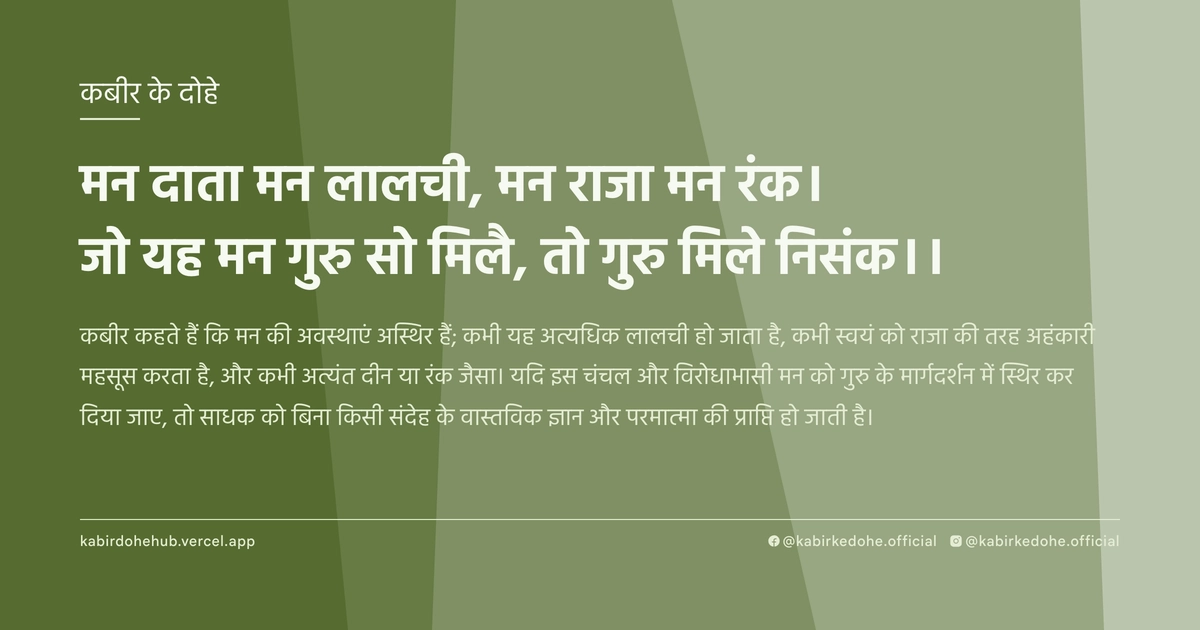
मन दाता मन लालची, मन राजा मन रंक।
जो यह मन गुरु सो मिलै, तो गुरु मिले निसंक।।
Man daata man laalchi, man raja man rank. Jo yeh man guru so milai, to guru mile nisank.
इस पृष्ठ पर इस कबीर दोहे का अर्थ (meaning), हिंदी व्याख्या और अंग्रेज़ी अनुवाद, दार्शनिक विश्लेषण और व्यावहारिक जीवन सीख दी गई है। यह दोहा गुरु महत्व (The Guru's Importance) विषय से जुड़ा है — Kabir doha meaning and explanation in Hindi and English.
अर्थ (Meaning):
कबीर कहते हैं कि मन की अवस्थाएं अस्थिर हैं; कभी यह अत्यधिक लालची हो जाता है, कभी स्वयं को राजा की तरह अहंकारी महसूस करता है, और कभी अत्यंत दीन या रंक जैसा। यदि इस चंचल और विरोधाभासी मन को गुरु के मार्गदर्शन में स्थिर कर दिया जाए, तो साधक को बिना किसी संदेह के वास्तविक ज्ञान और परमात्मा की प्राप्ति हो जाती है।
Kabir asserts that the mind is a whirlwind of contradictions; it fluctuates between insatiable greed, the arrogance of a king, and the desperation of a pauper. He suggests that if this volatile mind can be aligned and surrendered to the guidance of a true spiritual teacher, the seeker will attain absolute truth and divine union without a shred of doubt.
व्याख्या (Interpretation):
यह दोहा मन की त्रिविध अवस्थाओं—लोभ, अहंकार और अभाव—का विश्लेषण करता है। 'दाता' यहाँ उस मन को दर्शाता है जो देने का ढोंग करता है पर भीतर लालची है, 'राजा' उस अहंकार का प्रतीक है जो स्वयं को सर्वोपरि मानता है, और 'रंक' उस मानसिक दरिद्रता का जो हीन भावना से ग्रस्त है। कबीर के अनुसार, ये तीनों अवस्थाएं माया के विभिन्न मुखौटे हैं जो आत्मा को उसके वास्तविक स्वरूप से अलग रखते हैं। जब मन 'गुरु' (जो केवल बाहरी शिक्षक नहीं, बल्कि आंतरिक विवेक या शून्य है) में विलीन होता है, तो द्वैत समाप्त हो जाता है। यह निर्गुण भक्ति का सार है जहाँ व्यक्ति अपनी व्यक्तिगत पहचान को मिटाकर उस निराकार ब्रह्म में लीन हो जाता है। यहाँ 'निसंक' शब्द यह दर्शाता है कि जब मन शांत होता है, तब संदेह का अंत होता है और केवल शुद्ध अनुभव शेष रहता है।
This couplet analyzes the threefold states of the mind: greed, arrogance, and deprivation. The 'giver' represents the mind that pretends generosity while harboring greed, the 'king' symbolizes the ego that deems itself supreme, and the 'pauper' signifies the mental poverty of an inferiority complex. According to Kabir, these are various masks of Maya (illusion) that distance the soul from its true essence. When the mind merges with the 'Guru'—who is not merely an external teacher but the inner consciousness or the Void—duality vanishes. This is the core of Nirgun Bhakti, where the individual identity is annihilated to merge with the formless Brahman. The term 'nisank' implies that once the mind is stilled, all doubts evaporate, leaving behind only pure, unadulterated experience of the Absolute.
दार्शनिक विश्लेषण (Philosophical Analysis):
कबीर का यह दर्शन उनके समय के सामाजिक और धार्मिक पाखंडों पर एक गहरा प्रहार है। उन्होंने देखा कि लोग बाहरी कर्मकांडों, दान-पुण्य और सामाजिक पदवियों (राजा या रंक) के माध्यम से मोक्ष खोजने का प्रयास कर रहे थे, जबकि समस्या उनके आंतरिक मन की अस्थिरता थी। कबीर यहाँ 'मन' को ही सबसे बड़ा शत्रु और सबसे बड़ा मित्र बताते हैं। उनका दृष्टिकोण अद्वैत वेदांत से मेल खाता है, जहाँ जीव और ब्रह्म की एकता पर बल दिया गया है, लेकिन वे इसे सरल भाषा में 'मन की शुद्धि' के रूप में प्रस्तुत करते हैं।
सूफीवाद के प्रभाव में, कबीर 'फना' (अहंकार का विनाश) की बात करते हैं। जब मन राजा या रंक होने के भ्रम को त्याग देता है, तब वह 'शून्य' में प्रवेश करता है। यह मनोवैज्ञानिक रूपांतरण है जहाँ व्यक्ति अपनी सामाजिक पहचान (Social Identity) को छोड़कर अपनी आध्यात्मिक पहचान (Spiritual Identity) को पहचानता है। वे स्पष्ट करते हैं कि गुरु केवल वह नहीं जो मंत्र देता है, बल्कि वह है जो मन के इन भ्रामक उतार-चढ़ावों को शांत करने की कला सिखाता है।
ritualism (कर्मकांड) के प्रति उनकी अस्वीकृति यहाँ स्पष्ट है; न तो राजा का वैभव और न ही रंक की विलाप भक्ति का मार्ग है। मार्ग केवल 'मन का मिलन' है। वे तर्क देते हैं कि जब तक मन में द्वंद्व है, तब तक सत्य का अनुभव असंभव है। यह विश्लेषण हमें बताता है कि आध्यात्मिक प्रगति बाहरी परिस्थितियों के बदलने से नहीं, बल्कि आंतरिक धारणाओं के बदलने से होती है।
कबीर का 'गुरु' यहाँ एक उत्प्रेरक (Catalyst) है जो साधक को यह दिखाता है कि वह न तो दाता है, न राजा, और न ही रंक—वह केवल शुद्ध चेतना है। इस बोध के बाद ही 'निसंक' अवस्था आती है, जहाँ कोई प्रश्न नहीं बचता, केवल अनुभव होता है। यह अहंकार के पूर्ण विसर्जन की प्रक्रिया है।
अंततः, यह दोहा हमें सिखाता है कि मानसिक अस्थिरता ही संसार का मूल कारण है। जब हम स्वयं को किसी विशेष श्रेणी (अमीर, गरीब, महान, तुच्छ) में बांधते हैं, तो हम सत्य से दूर हो जाते हैं। मुक्ति उस श्रेणीबद्ध सोच से बाहर निकलने में है, जिसे कबीर 'मन का गुरु से मिलन' कहते हैं।
Kabir's philosophy here is a profound critique of the social and religious hypocrisies of his era. He observed people seeking liberation through external rituals, acts of charity, and social hierarchies (the king or the pauper), while the root cause of their suffering was the instability of the mind. Kabir identifies the 'mind' as both the greatest enemy and the greatest ally. His perspective aligns with Advaita Vedanta, emphasizing the oneness of the individual soul and the Universal Consciousness, yet he presents it through the accessible lens of 'purification of the mind.'
Influenced by Sufism, Kabir speaks of 'Fana'—the annihilation of the ego. When the mind ceases to identify as a king or a pauper, it enters the state of 'Shunya' (the Void). This is a psychological transformation where the seeker sheds their social identity to realize their spiritual essence. He clarifies that the Guru is not merely one who provides mantras, but one who teaches the art of stilling the mind's deceptive fluctuations.
His rejection of ritualism is evident; neither the splendor of a king nor the lamentations of a pauper lead to devotion. The only path is the 'union of the mind.' He argues that as long as duality exists within the mind, the experience of Truth is impossible. This analysis reveals that spiritual progress is not about changing external circumstances, but about shifting internal perceptions.
Kabir's 'Guru' acts as a catalyst, showing the seeker that they are neither the giver, nor the king, nor the pauper—they are pure consciousness. Only after this realization does the 'nisank' (doubtless) state arrive, where questions cease and only experience remains. This is the process of the total dissolution of the ego.
Ultimately, this couplet teaches us that mental instability is the root cause of worldly suffering. When we bind ourselves to specific categories—rich, poor, great, or insignificant—we distance ourselves from the Truth. Liberation lies in escaping this categorized thinking, which Kabir describes as the mind's union with the Guru.
मूल संदेश (Core Message):
- मानसिक अस्थिरता ही संसार का सबसे बड़ा बंधन है।
- अहंकार और हीन भावना एक ही सिक्के के दो पहलू हैं।
- सत्य की प्राप्ति बाहरी पदवी से नहीं, आंतरिक स्थिरता से होती है।
- गुरु वह है जो हमें हमारी झूठी पहचानों से मुक्त करता है।
- जब द्वंद्व समाप्त होता है, तब संदेह का अंत होता है और सत्य प्रकट होता है।
- Mental instability is the greatest bondage in the worldly existence.
- Arrogance and inferiority are merely two sides of the same coin.
- Truth is attained not through external status, but through internal stillness.
- The true Guru is the one who liberates us from our false identities.
- When duality ceases, doubt ends, and the Absolute Truth reveals itself.
व्यावहारिक उदाहरण (Practical Example):
वाराणसी के घाटों पर रहने वाले एक वृद्ध बुनकर, माधव, की कहानी है। माधव अपने काम में निपुण था, लेकिन उसका मन हमेशा अशांत रहता था। जब उसके पास अधिक धन आता, तो वह खुद को शहर का सबसे बड़ा व्यापारी समझने लगता और दूसरों को तुच्छ मानता (मन राजा)। फिर अचानक किसी पारिवारिक विवाद या घाटे के कारण वह गहरे अवसाद में चला जाता और खुद को दुनिया का सबसे बदकिस्मत इंसान मानने लगता (मन रंक)।
वह अक्सर मंदिरों में जाकर दान करता था ताकि लोग उसे 'दाता' कहें, लेकिन भीतर से वह हमेशा इस डर में रहता था कि कहीं उसका धन छिन न जाए (मन लालची)। उसकी पूरी जिंदगी इसी त्रिकोण—अहंकार, अभाव और दिखावे—के बीच झूलती रही। वह शांति की तलाश में कई पंडितों के पास गया, लेकिन उन्हें केवल कर्मकांड और दान की सलाह मिली।
एक दिन उसकी मुलाकात एक मौन साधु से हुई, जो घाट की सीढ़ियों पर चुपचाप बैठे रहते थे। माधव ने उनसे अपनी मानसिक पीड़ा साझा की। साधु ने उसे कोई मंत्र नहीं दिया, बल्कि केवल एक बात कही: 'माधव, तुम वह नहीं हो जो तुम सोचते हो कि तुम हो। तुम न तो वह अमीर हो जिसे तुम होने का दावा करते हो, न वह गरीब जिसे तुम महसूस करते हो। तुम बस एक साक्षी हो।'
माधव को यह बात समझ नहीं आई, लेकिन उसने साधु के सानिध्य में बैठना शुरू किया। धीरे-धीरे उसने गौर किया कि जब वह बुनकरी करता है, तो वह न राजा होता है न रंक, वह केवल 'बुनना' होता है। उसने महसूस किया कि उसका दुख तब शुरू होता है जब वह अपने आप को किसी लेबल से जोड़ता है।
एक समय ऐसा आया जब माधव के घर में आग लग गई और उसकी सारी जमापूंजी और करघे जल गए। पहले वाला माधव शायद टूट जाता या खुद को 'रंक' मानकर रोता। लेकिन अब, वह शांत था। उसने देखा कि आग ने उसके कपड़े और पैसे जलाए हैं, उसके 'होने' को नहीं।
उसने महसूस किया कि उसकी असली संपत्ति वह शांति थी जो उसे इस बोध से मिली थी कि वह इन बाहरी स्थितियों से ऊपर है। उसने अब दान देना शुरू किया, लेकिन 'दाता' बनने के अहंकार से नहीं, बल्कि इस भाव से कि जो कुछ भी है, वह उसी परमात्मा का है।
उसका मन अब राजा और रंक के बीच नहीं दौड़ता था। वह अब एक साधारण बुनकर था, लेकिन उसके भीतर एक सम्राट की शांति थी। उसने जान लिया था कि जब मन की चंचलता समाप्त होती है, तब गुरु (विवेक) का वास्तविक मिलन होता है।
माधव का जीवन अब एक उदाहरण बन गया कि कैसे आंतरिक स्थिरता बाहरी आपदाओं को भी एक खेल बना देती है। वह अब बिना किसी संदेह के (निसंक) जीवन के हर उतार-चढ़ाव को स्वीकार करता था।
Consider the story of Madhav, an elderly weaver living on the ghats of Varanasi. Madhav was skilled in his craft, but his mind was a storm of instability. When he earned more, he would imagine himself as the city's greatest merchant, looking down upon others (the mind as a king). Then, due to a family dispute or a business loss, he would spiral into deep depression, viewing himself as the most unfortunate man on earth (the mind as a pauper).
He often donated to temples so people would call him a 'giver,' yet internally, he lived in constant fear of losing his wealth (the greedy mind). His entire life swung like a pendulum between this triangle of ego, deprivation, and pretense.
In search of peace, he visited many priests, but they only advised him on rituals and more charity. One day, he encountered a silent monk who sat quietly on the steps of the ghat. Madhav shared his mental agony. The monk gave him no mantra but said one thing: 'Madhav, you are not who you think you are. You are neither the rich man you claim to be, nor the poor man you feel you are. You are simply the Witness.'
Madhav didn't understand at first, but he began spending time in the monk's presence. Gradually, he noticed that while he was weaving, he was neither a king nor a pauper; he was simply the act of 'weaving.' He realized his suffering began the moment he attached a label to himself.
Eventually, a fire broke out in Madhav's home, destroying all his savings and looms. The old Madhav would have been crushed, identifying as a 'pauper' and weeping. But now, he remained calm. He observed that the fire had burned his clothes and money, not his 'being.'
He realized his true wealth was the peace derived from the understanding that he was above these external conditions. He continued to give, but not with the ego of being a 'giver,' but with the feeling that everything belongs to the Divine.
His mind no longer raced between the extremes of king and pauper. He was now a simple weaver, yet he possessed the peace of an emperor. He understood that when the volatility of the mind ceases, the true union with the Guru (inner wisdom) occurs.
Madhav's life became a testament to how internal stability transforms external disasters into a mere play. He now accepted every ebb and flow of life without a shred of doubt (nisank).
अभ्यास मार्गदर्शन (Practice Guidance):
- दैनिक अवलोकन: दिन में तीन बार रुकें और स्वयं से पूछें—'इस क्षण में मेरा मन राजा (अहंकारी) है, रंक (पीड़ित) है, या लालची है?' केवल साक्षी भाव से देखें, निर्णय न लें।
- शून्य ध्यान: 15 मिनट के लिए मौन बैठें। जब भी कोई विचार आए कि 'मैं यह हूँ' या 'मेरे पास यह नहीं है', उसे एक बादल की तरह गुजरते हुए देखें और अपनी मूल चेतना में लौटें।
- अहंकार विसर्जन जर्नल: प्रतिदिन एक ऐसी घटना लिखें जहाँ आपने अपनी श्रेष्ठता (राजा) या अपनी कमी (रंक) को महसूस किया। विश्लेषण करें कि उस भावना ने आपकी शांति को कैसे प्रभावित किया।
- निदान चेकलिस्ट: यदि आप छोटी बातों पर अत्यधिक क्रोधित हो रहे हैं (राजा का अहंकार) या छोटी असफलताओं पर टूट रहे हैं (रंक की भावना), तो समझ लें कि आपका मन अभी भी अस्थिर है और गुरु-तत्व (विवेक) से दूर है।
- Daily Observation: Three times a day, pause and ask yourself—'In this moment, is my mind acting as a king (arrogant), a pauper (victim), or a greedy giver?' Observe as a witness without judgment.
- Void Meditation: Sit in silence for 15 minutes. Whenever a thought arises like 'I am this' or 'I lack that,' watch it pass like a cloud and return to your core consciousness.
- Ego-Dissolution Journal: Daily, record an instance where you felt superior (king) or inferior (pauper). Analyze how that specific emotion disrupted your inner peace.
- Diagnostic Checklist: If you find yourself reacting with excessive anger to small slights (king's ego) or collapsing under minor failures (pauper's mindset), recognize that your mind is still volatile and distant from the Guru-principle (wisdom).
चिंतन प्रश्न (Reflection Questions):
- आपकी वह कौन सी 'झूठी पहचान' है जिसे आप समाज के सामने सबसे अधिक सहेज कर रखते हैं?
- जब आप स्वयं को 'रंक' या पीड़ित महसूस करते हैं, तो क्या वह वास्तव में अभाव है या केवल एक मानसिक कहानी?
- क्या आपका दान वास्तव में निस्वार्थ है, या यह 'दाता' होने के अहंकार को पोषण दे रहा है?
- यदि आपकी सारी उपलब्धियां और आपकी सारी कमियां छीन ली जाएं, तो 'आप' वास्तव में कौन बचेंगे?
- आपके जीवन में 'संदेह' (Sanka) कहाँ से आता है—तथ्यों की कमी से या मन की चंचलता से?
- What is the 'false identity' you most carefully preserve in the eyes of society?
- When you feel like a 'pauper' or a victim, is it truly a lack of resources, or just a mental narrative?
- Is your generosity truly selfless, or is it feeding the ego of being a 'giver'?
- If all your achievements and all your flaws were stripped away, who would 'you' actually be?
- Where does 'doubt' originate in your life—from a lack of facts, or from the volatility of the mind?