
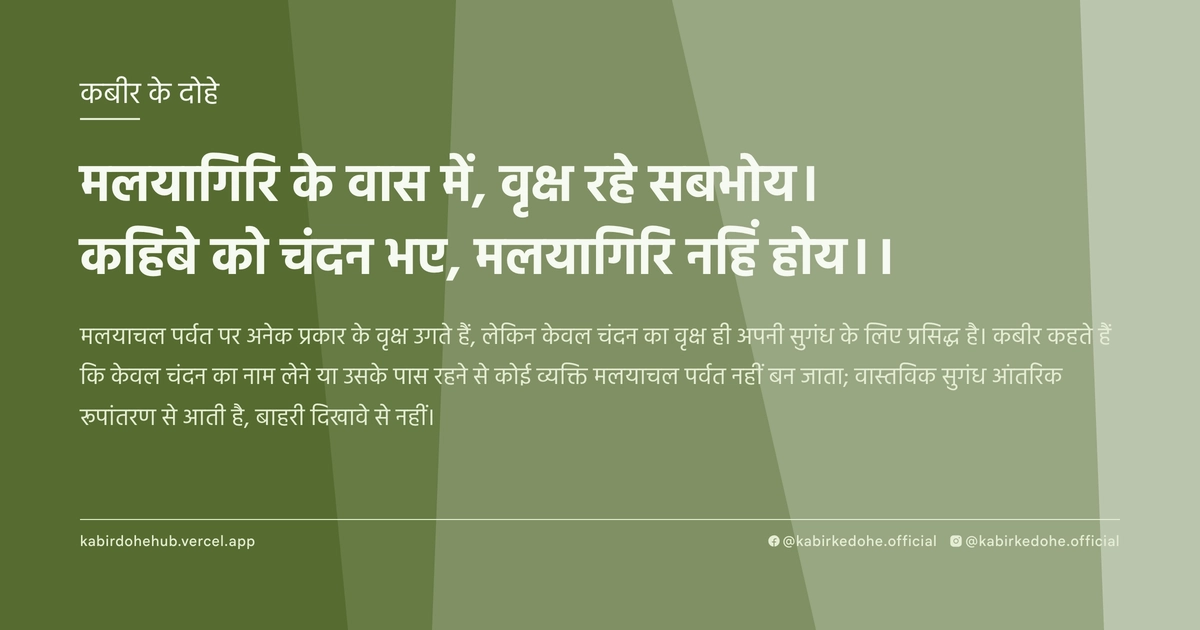
मलयागिरि के वास में, वृक्ष रहे सबभोय।
कहिबे को चंदन भए, मलयागिरि नहिं होय।।
Malayagiri ke vaas mein, vriksh rahe sabbhoye. Kahibe ko chandan bhaye, Malayagiri nahin hoye.
इस पृष्ठ पर इस कबीर दोहे का अर्थ (meaning), हिंदी व्याख्या और अंग्रेज़ी अनुवाद, दार्शनिक विश्लेषण और व्यावहारिक जीवन सीख दी गई है। यह दोहा अहंकार (The Ego) विषय से जुड़ा है — Kabir doha meaning and explanation in Hindi and English.
अर्थ (Meaning):
मलयाचल पर्वत पर अनेक प्रकार के वृक्ष उगते हैं, लेकिन केवल चंदन का वृक्ष ही अपनी सुगंध के लिए प्रसिद्ध है। कबीर कहते हैं कि केवल चंदन का नाम लेने या उसके पास रहने से कोई व्यक्ति मलयाचल पर्वत नहीं बन जाता; वास्तविक सुगंध आंतरिक रूपांतरण से आती है, बाहरी दिखावे से नहीं।
On the slopes of the Malayagiri mountains, countless varieties of trees grow in abundance. However, only the sandalwood tree is revered for its intrinsic fragrance. Kabir asserts that merely claiming to be like sandalwood or residing in a sacred place does not make one the mountain itself; true essence is born of internal transformation, not external association.
व्याख्या (Interpretation):
यह दोहा बाहरी प्रतीकों और आंतरिक वास्तविकता के बीच के अंतर को स्पष्ट करता है। यहाँ 'मलयागिरि' उस आध्यात्मिक वातावरण या संगति का प्रतीक है जहाँ ज्ञान उपलब्ध है, और 'चंदन' उस शुद्ध चेतना का जो अपनी सुगंध (गुणों) से पहचानी जाती है। कबीर चेतावनी देते हैं कि केवल एक आध्यात्मिक समूह का हिस्सा होने या धार्मिक शब्दावली का उपयोग करने से व्यक्ति आत्म-साक्षात्कार नहीं कर लेता। यह निर्गुण भक्ति का सार है, जहाँ ईश्वर किसी विशेष स्थान या मूर्ति में नहीं, बल्कि व्यक्ति के अपने शुद्ध स्वभाव में निहित है। माया हमें विश्वास दिलाती है कि बाहरी अनुष्ठान हमें पवित्र बना देंगे, जबकि अद्वैत वेदांत सिखाता है कि जब तक 'अहंकार' का विसर्जन नहीं होता, तब तक आत्मा का वास्तविक स्वरूप प्रकट नहीं होता। यह एक विरोधाभास है: हम सत्य की खोज बाहर करते हैं, जबकि सत्य वह है जो खोजकर्ता के भीतर ही सोया हुआ है।
This couplet elucidates the profound chasm between external symbolism and internal reality. Here, 'Malayagiri' symbolizes the spiritual environment or the company of the wise where knowledge is accessible, while 'Sandalwood' represents the pure consciousness recognized by its fragrance—its inherent virtues. Kabir warns that merely belonging to a spiritual collective or employing religious jargon does not grant one self-realization. This is the essence of Nirgun Bhakti, where the Divine is not confined to a specific location or idol but resides within the pure nature of the individual. Maya deceives us into believing that external rituals will purify us, whereas Advaita Vedanta teaches that until the 'ego' is dissolved, the true nature of the Atman remains veiled. It presents a central paradox: we seek truth in the external world, while the truth is the very essence of the seeker who remains asleep within.
दार्शनिक विश्लेषण (Philosophical Analysis):
कबीर का यह दृष्टिकोण उनके युग के कट्टरपंथी कर्मकांडों और पाखंडों पर एक तीखा प्रहार है। उन्होंने देखा कि लोग केवल तीर्थयात्राओं, विशेष वस्त्रों या मालाओं के माध्यम से मोक्ष प्राप्त करने का भ्रम पाल लेते थे। यह विश्लेषण हमें बताता है कि 'संगति' महत्वपूर्ण है, लेकिन केवल संगति पर्याप्त नहीं है; उस संगति का आंतरिक आत्मसात होना आवश्यक है।
दार्शनिक रूप से, यह सूफी मत के 'फना' (अहंकार का विनाश) और अद्वैत वेदांत के 'अहं ब्रह्मास्मि' के बीच एक सेतु है। यदि कोई व्यक्ति केवल यह कहता है कि वह ईश्वर का भक्त है, तो वह अभी भी 'मैं' और 'ईश्वर' के बीच एक द्वैत (duality) बनाए हुए है। वास्तविक सुगंध तब आती है जब 'मैं' पूरी तरह समाप्त हो जाता है और केवल वह सार्वभौमिक चेतना शेष रहती है।
कबीर यहाँ 'नाम' और 'रूप' के भ्रम को तोड़ते हैं। वे तर्क देते हैं कि जिस प्रकार चंदन की लकड़ी को काटने पर ही उसकी सुगंध बाहर आती है, उसी तरह मनुष्य को अपने अहंकार की परतों को काटकर ही अपनी आंतरिक दिव्यता को प्रकट करना पड़ता है। केवल बाहरी आवरण को चंदन जैसा दिखाने से कोई लाभ नहीं होता।
यह शिक्षण मनोवैज्ञानिक रूपांतरण पर जोर देता है। यह बताता है कि आध्यात्मिक प्रगति रैखिक नहीं है, बल्कि यह एक आंतरिक विखंडन की प्रक्रिया है। जब व्यक्ति यह समझ जाता है कि वह बाहरी दुनिया का हिस्सा नहीं बल्कि उस अनंत का अंश है, तब वह 'मलयागिरि' बनने की कोशिश छोड़ देता है और स्वयं 'सुगंध' बन जाता है।
अंततः, कबीर यह स्पष्ट करते हैं कि धर्म कोई बाहरी पोशाक नहीं है जिसे पहना जा सके, बल्कि यह एक आंतरिक स्थिति है। जो व्यक्ति केवल शब्दों से अपनी पवित्रता सिद्ध करता है, वह वास्तव में माया के जाल में और अधिक उलझ जाता है, क्योंकि वह अपनी झूठी छवि (False Ego) को ही सत्य मान बैठता है।
Kabir's perspective serves as a sharp critique of the rigid ritualism and hypocrisy prevalent during his era. He observed that people harbored the illusion of attaining salvation simply through pilgrimages, specific attire, or the chanting of beads. This analysis reveals that while 'Satsang' (company of truth) is vital, mere association is insufficient; the internal assimilation of that truth is mandatory.
Philosophically, this bridges the Sufi concept of 'Fana' (annihilation of the self) and the Advaita Vedanta realization of 'Aham Brahmasmi'. If a person merely claims to be a devotee of God, they maintain a duality between the 'I' and the 'Divine'. True fragrance emerges only when the 'I' is completely dissolved, leaving only the universal consciousness.
Kabir dismantles the illusion of 'Name' and 'Form'. He argues that just as the fragrance of sandalwood is released only when the wood is cut, a human must carve through the layers of ego to reveal their inner divinity. There is no utility in merely making the external shell appear like sandalwood.
This teaching emphasizes psychological transformation. It suggests that spiritual progress is not linear but a process of internal dismantling. When an individual realizes they are not a fragment of the material world but an extension of the Infinite, they cease trying to 'become' the mountain and instead become the fragrance itself.
Ultimately, Kabir clarifies that religion is not an external garment to be worn, but an internal state of being. One who attempts to prove their purity through words becomes further entangled in the web of Maya, as they mistake their fabricated image (False Ego) for the ultimate truth.
मूल संदेश (Core Message):
- बाहरी पहचान केवल एक भ्रम है, आंतरिक गुण ही वास्तविक सत्य हैं।
- शब्दों की पवित्रता से अधिक, आचरण की शुद्धता अनिवार्य है।
- अहंकार का विसर्जन ही वह प्रक्रिया है जिससे आत्मा सुगंधित होती है।
- संगति का लाभ तभी है जब वह आपके स्वभाव को बदल दे।
- सत्य को दावा करने की आवश्यकता नहीं, वह स्वयं प्रकट होता है।
- ईश्वर किसी स्थान में नहीं, बल्कि निस्वार्थ प्रेम में बसता है।
- External identity is a mere illusion; internal virtues are the only reality.
- Purity of conduct is far more essential than the sanctity of words.
- The dissolution of ego is the only process through which the soul becomes fragrant.
- The benefit of holy company exists only if it transforms your very nature.
- Truth requires no claim; it reveals itself through existence.
- The Divine dwells not in a place, but in the heart of selfless love.
व्यावहारिक उदाहरण (Practical Example):
एक समय की बात है, वाराणसी के घाटों पर रहने वाला एक वृद्ध बुनकर था जिसका नाम माधव था। माधव अपनी पूरी जिंदगी केवल धार्मिक ग्रंथों को पढ़ने और दूसरों को उपदेश देने में बिता चुका था। वह खुद को बहुत बड़ा ज्ञानी मानता था क्योंकि वह कठिन संस्कृत श्लोकों का उच्चारण कर सकता था और हमेशा माथे पर बड़ा तिलक लगाकर चलता था। वह शहर के हर व्यक्ति को बताता था कि वह 'मलयागिरि' के ज्ञान का स्वामी है।
उसी घाट पर एक युवा लड़का रहता था, जो चुपचाप मछुआरों की मदद करता था और रात में दीये जलाता था। वह अनपढ़ था और कभी किसी धर्मग्रंथ की बात नहीं करता था। माधव अक्सर उस लड़के का मजाक उड़ाता और कहता, "तुम क्या जानो मोक्ष क्या होता है? तुम तो केवल सांसारिक कार्यों में उलझे हो।"
एक दिन शहर में भीषण बाढ़ आई। घाटों पर हाहाकार मच गया। लोग अपनी जान बचाने के लिए इधर-उधर भाग रहे थे। माधव, जो अपनी विद्वत्ता का ढिंढोरा पीटता था, डर के मारे एक ऊंचे खंभे पर चढ़ गया और चिल्लाने लगा कि भगवान उसे बचाएं। उसने अपनी सारी किताबों और ज्ञान को भुला दिया; वह केवल अपने अस्तित्व को बचाने के लिए संघर्ष कर रहा था।
वहीं वह अनपढ़ लड़का, जिसे माधव तुच्छ समझता था, अपनी जान की परवाह किए बिना पानी में कूद गया। उसने एक-एक करके डूबते हुए बच्चों और बुजुर्गों को बाहर निकाला। उसने बिना किसी भेदभाव के सबकी मदद की, यहाँ तक कि उसने माधव को भी तब सहारा दिया जब वह खंभे से फिसलकर गिरने वाला था।
जब पानी उतरा, तो माधव की नजर उस लड़के के शांत चेहरे पर पड़ी। लड़के के चेहरे पर कोई अहंकार नहीं था, कोई दावा नहीं था कि उसने कुछ महान किया है। वह बस अपना काम कर रहा था। माधव को अचानक कबीर का वह दोहा याद आया कि केवल चंदन का नाम लेने से कोई मलयाचल नहीं बनता।
माधव को अहसास हुआ कि उसकी सारी विद्वत्ता केवल एक 'मुखौटा' थी। वह केवल चंदन की बात कर रहा था, लेकिन उसके जीवन में वह सुगंध नहीं थी। उस लड़के ने बिना किसी किताब के, केवल करुणा के माध्यम से वह सुगंध बिखेरी थी जिसे माधव सालों से शब्दों में खोज रहा था।
उस दिन माधव ने अपना बड़ा तिलक उतार फेंका और अपनी किताबों को केवल संदर्भ के लिए रखा, न कि अपनी पहचान के लिए। उसने सीखा कि सच्ची आध्यात्मिकता दूसरों की सेवा और अहंकार के विसर्जन में है, न कि स्वयं को श्रेष्ठ सिद्ध करने वाले शब्दों में।
माधव का जीवन बदल गया। अब वह उपदेश नहीं देता था, बल्कि चुपचाप दूसरों के दुखों को दूर करने में जुट गया। उसकी असली 'सुगंध' अब उसके व्यवहार में थी, न कि उसके भाषणों में। वह अब वास्तव में उस 'मलयागिरि' का हिस्सा बन गया था, क्योंकि उसने स्वयं को मिटाकर मानवता को अपना लिया था।
Once, in the ghats of Varanasi, lived an elderly weaver named Madhav. Madhav had spent his entire life reading religious texts and preaching to others. He considered himself a great scholar because he could recite complex Sanskrit shlokas and always wore a prominent tilak on his forehead. He told everyone in the city that he was a master of the wisdom of 'Malayagiri'.
On the same ghat lived a young boy who quietly helped the fishermen and lit lamps at night. He was illiterate and never spoke of scriptures. Madhav often mocked the boy, saying, "What do you know of salvation? You are merely entangled in worldly chores."
One day, a devastating flood hit the city. Chaos erupted on the ghats. People ran frantically to save their lives. Madhav, who boasted of his erudition, climbed a high pillar in terror and screamed for God to save him. He forgot all his books and knowledge; he was struggling only to preserve his own existence.
Meanwhile, the illiterate boy, whom Madhav deemed insignificant, dove into the water without a thought for his own life. One by one, he pulled drowning children and elders to safety. He helped everyone without discrimination, even extending a hand to Madhav when he was about to slip from the pillar.
When the waters receded, Madhav looked at the boy's calm face. There was no ego on the boy's face, no claim that he had done something great. He was simply performing his duty. Madhav suddenly recalled Kabir's couplet: merely claiming the name of sandalwood does not make one the mountain.
Madhav realized that all his scholarship was merely a 'mask'. He had been talking about sandalwood, but his life lacked that fragrance. The boy, without any books, had spread that fragrance through pure compassion—the very thing Madhav had spent years searching for in words.
That day, Madhav cast away his grand tilak and kept his books only for reference, not as his identity. He learned that true spirituality lies in the service of others and the dissolution of the ego, not in words used to prove one's superiority.
Madhav's life transformed. He no longer preached; instead, he quietly dedicated himself to alleviating the suffering of others. His true 'fragrance' was now in his behavior, not his speeches. He had finally become a part of 'Malayagiri' because he had erased himself to embrace humanity.
अभ्यास मार्गदर्शन (Practice Guidance):
- प्रतिदिन 20 मिनट मौन साधना करें, जहाँ आप अपने 'सामाजिक मुखौटे' (जैसे आपका पद, प्रतिष्ठा, या धार्मिक पहचान) को मानसिक रूप से उतार दें और केवल एक साक्षी के रूप में स्वयं को देखें।
- एक 'अहंकार डायरी' लिखें। दिन भर में उन क्षणों को दर्ज करें जब आपने अपनी श्रेष्ठता सिद्ध करने के लिए शब्दों का सहारा लिया, और फिर विचार करें कि उस समय आपके भीतर कौन सा डर या असुरक्षा काम कर रही थी।
- बिना किसी को बताए एक गुप्त सेवा कार्य करें। जब आप किसी की मदद करते हैं और उसे दुनिया से छिपाकर रखते हैं, तो आप अपनी 'छवि' के मोह को तोड़ते हैं और वास्तविक आंतरिक सुगंध विकसित करते हैं।
- निदान चेकलिस्ट: क्या मैं अपनी आध्यात्मिक पहचान का उपयोग दूसरों को छोटा महसूस कराने के लिए कर रहा हूँ? क्या मेरी शांति केवल तब तक रहती है जब तक कोई मेरी प्रशंसा करता है? यदि हाँ, तो मैं अभी भी 'नाम' में हूँ, 'सुगंध' में नहीं।
- Practice 20 minutes of daily silent meditation, mentally stripping away your 'social masks' (such as your rank, reputation, or religious identity) and observing yourself purely as a witness.
- Maintain an 'Ego Diary'. Record moments throughout the day when you used words to assert your superiority, and then reflect on the fear or insecurity that was driving that need for validation.
- Perform a secret act of service without informing anyone. By helping others and keeping it hidden from the world, you break the attachment to your 'image' and cultivate genuine internal fragrance.
- Diagnostic Checklist: Am I using my spiritual identity to make others feel inferior? Does my peace last only as long as I am being praised? If yes, I am still dwelling in the 'name', not the 'fragrance'.
चिंतन प्रश्न (Reflection Questions):
- यदि आपकी सभी उपाधियाँ, डिग्रियाँ और धार्मिक पहचान छीन ली जाएँ, तो आपके व्यक्तित्व में क्या शेष बचेगा?
- क्या आप वास्तव में सत्य की खोज कर रहे हैं, या आप केवल एक 'सत्य खोजने वाले' की छवि का आनंद ले रहे हैं?
- आपके जीवन का वह कौन सा हिस्सा है जिसे आप दुनिया से छिपाते हैं क्योंकि वह आपकी 'पवित्र' छवि के विपरीत है?
- जब आप दूसरों को उपदेश देते हैं, तो क्या आप उनकी मदद करना चाहते हैं या अपनी श्रेष्ठता की पुष्टि करना चाहते हैं?
- क्या आपकी शांति बाहरी परिस्थितियों और प्रशंसा पर निर्भर है, या वह आपके भीतर एक अटूट स्रोत की तरह बह रही है?
- डिजिटल युग में, आपकी ऑनलाइन प्रोफाइल आपकी वास्तविक आत्मा का प्रतिनिधित्व करती है या केवल एक निर्मित 'चंदन' का मुखौटा है?
- If all your titles, degrees, and religious identities were stripped away, what would remain of your personality?
- Are you truly seeking the truth, or are you merely enjoying the image of being a 'seeker of truth'?
- Which part of your life do you hide from the world because it contradicts your 'pure' public image?
- When you advise others, do you genuinely wish to help them, or are you seeking confirmation of your own superiority?
- Is your peace dependent on external circumstances and praise, or does it flow from an unbreakable internal source?
- In the digital age, does your online profile represent your actual soul, or is it merely a constructed mask of 'sandalwood'?