
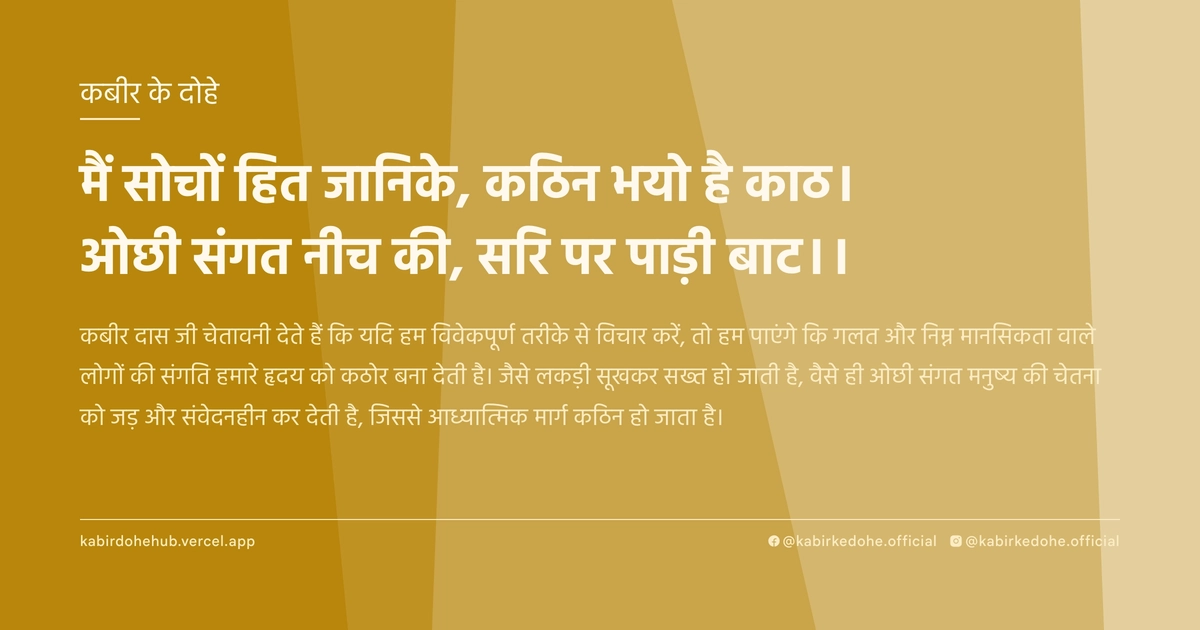
मैं सोचों हित जानिके, कठिन भयो है काठ।
ओछी संगत नीच की, सरि पर पाड़ी बाट।।
Main sochon hit jaanike, kathin bhayo hai kaath. Ochi sangat neech ki, sari par paadi baat.
इस पृष्ठ पर इस कबीर दोहे का अर्थ (meaning), हिंदी व्याख्या और अंग्रेज़ी अनुवाद, दार्शनिक विश्लेषण और व्यावहारिक जीवन सीख दी गई है। यह दोहा सत्संग (Satsang) विषय से जुड़ा है — Kabir doha meaning and explanation in Hindi and English.
अर्थ (Meaning):
कबीर दास जी चेतावनी देते हैं कि यदि हम विवेकपूर्ण तरीके से विचार करें, तो हम पाएंगे कि गलत और निम्न मानसिकता वाले लोगों की संगति हमारे हृदय को कठोर बना देती है। जैसे लकड़ी सूखकर सख्त हो जाती है, वैसे ही ओछी संगत मनुष्य की चेतना को जड़ और संवेदनहीन कर देती है, जिससे आध्यात्मिक मार्ग कठिन हो जाता है।
Kabir warns that if we reflect with true awareness, we realize that the company of those with narrow, petty, or malicious mindsets hardens the human heart. Just as wood becomes rigid and unyielding when dried, the influence of low-minded associations renders the consciousness inert and insensitive, making the path to spiritual liberation arduous and obstructed.
व्याख्या (Interpretation):
इस दोहे में 'काठ' (लकड़ी) एक शक्तिशाली रूपक है जो जड़ता और संवेदनहीनता का प्रतीक है। शाब्दिक अर्थ में, यह संगति के प्रभाव की बात करता है, लेकिन आध्यात्मिक स्तर पर यह 'माया' के उस जाल की ओर संकेत करता है जो आत्मा को उसके वास्तविक स्वरूप (ब्रह्म) से अलग करता है। निर्गुण भक्ति के संदर्भ में, जब साधक ऐसे लोगों के साथ रहता है जो केवल भौतिकता, ईर्ष्या और अहंकार में लीन हैं, तो उसकी अंतरात्मा की कोमलता समाप्त हो जाती है। यह स्थिति अद्वैत वेदांत के उस अवरोध के समान है जहाँ 'अविद्या' (अज्ञान) के कारण व्यक्ति स्वयं को शरीर और अहंकार मान बैठता है। यहाँ 'ओछी संगत' का अर्थ केवल बुरे लोगों से नहीं, बल्कि उन विचारों से है जो द्वैतवाद को बढ़ावा देते हैं और आत्मा की एकता को नकारते हैं।
In this couplet, 'Kaath' (wood) serves as a potent metaphor for spiritual inertia and emotional numbness. While the literal meaning addresses social associations, the metaphysical layer points toward the veil of 'Maya' that separates the Atman from its primordial essence (Brahman). Within the framework of Nirgun Bhakti, when a seeker aligns themselves with those immersed in materialism, jealousy, and ego, the innate tenderness of the soul is replaced by a rigid, calcified heart. This mirrors the obstacle of 'Avidya' (ignorance) in Advaita Vedanta, where the individual mistakenly identifies with the transient ego rather than the eternal consciousness. 'Low company' here refers not just to external persons, but to the internal resonance with thoughts that reinforce duality and fragmentation, thereby hardening the heart against the fluid grace of the Divine.
दार्शनिक विश्लेषण (Philosophical Analysis):
कबीर का यह विचार उनके युग के सामाजिक और धार्मिक पाखंड के विरुद्ध एक गहरा प्रहार है। उस समय धर्म के नाम पर बाहरी आडंबर और जातिगत श्रेष्ठता का बोलबाला था। कबीर ने देखा कि कैसे लोग केवल बाहरी अनुष्ठानों में विश्वास करते थे, जबकि उनका आंतरिक स्वभाव घृणा और अहंकार से भरा था। यह 'ओछी संगत' ही थी जिसने समाज को खंडित किया था।
दार्शनिक रूप से, यह दोहा सूफीवाद के 'नफ्स' (अहंकार) के विचार से मेल खाता है। सूफी मत के अनुसार, जब तक मनुष्य अपने निचले स्वभाव (नफ्स-ए-अम्मारा) के साथ जुड़ा रहता है, वह ईश्वर के नूर को महसूस नहीं कर सकता। कबीर यहाँ मनोवैज्ञानिक रूपांतरण की बात कर रहे हैं; वे समझाते हैं कि बाहरी वातावरण हमारे आंतरिक न्यूरल पाथवे और मानसिक प्रवृत्तियों को कैसे आकार देता है।
अद्वैत वेदांत के नजरिए से, यह जड़ता 'तमस' गुण की अधिकता है। जब हम निम्न प्रवृत्तियों के संपर्क में आते हैं, तो हमारी चेतना में तमस बढ़ता है, जिससे विवेक (Discernment) धुंधला हो जाता है। कबीर का उद्देश्य यह बताना है कि मोक्ष केवल मंत्रों से नहीं, बल्कि सचेत चयन (Conscious Selection) से मिलता है।
ritualism (कर्मकांड) का विरोध करते हुए कबीर कहते हैं कि यदि आपका हृदय 'काठ' जैसा कठोर है, तो हज़ारों तीर्थ यात्राएं भी आपको शुद्ध नहीं कर सकतीं। वास्तविक शुद्धि संगति के परिवर्तन और अहंकार के विसर्जन में है।
अंततः, यह दोहा इस सत्य को उद्घाटित करता है कि मनुष्य अपने परिवेश का प्रतिबिंब है। यदि वह सत्य की खोज करना चाहता है, तो उसे पहले उन मानसिक और सामाजिक बंधनों को तोड़ना होगा जो उसे संकुचित बनाते हैं। यह अहंकार के विलोपन (Annihilation of Ego) की प्रक्रिया है, जहाँ 'मैं' का अंत ही 'परमात्मा' का उदय है।
Kabir’s insight is a profound critique of the social and religious hypocrisy prevalent during his era. At a time when external rituals and caste-based superiority dominated the spiritual landscape, Kabir observed that people clung to outward forms while their inner nature remained steeped in hatred and arrogance. This 'low company' was the very catalyst for societal fragmentation.
Philosophically, this couplet resonates with the Sufi concept of the 'Nafs' (the lower self). According to Sufism, as long as an individual remains aligned with the commanding self (Nafs-al-Ammara), the divine light (Noor) remains obscured. Kabir is addressing a psychological transformation, explaining how the external environment shapes internal mental predispositions and spiritual receptivity.
From the lens of Advaita Vedanta, this rigidity represents an excess of 'Tamas' (inertia/darkness). When we immerse ourselves in low-minded associations, Tamas dominates the consciousness, clouding 'Viveka' (spiritual discernment). Kabir posits that liberation is achieved not through rote chanting, but through the conscious selection of one's influences.
Rejecting ritualism, Kabir suggests that if the heart has become as hard as 'Kaath' (wood), a thousand pilgrimages cannot purify it. True purification lies in the transformation of one's associations and the dissolution of the ego. The external ritual is a facade if the internal state is one of rigidity and prejudice.
Ultimately, the couplet reveals that a human being is a reflection of their environment. To seek the Truth, one must first dismantle the mental and social shackles that shrink the soul. This is the process of 'Fana' or the annihilation of the ego, where the death of the small 'i' allows the birth of the Universal Consciousness.
मूल संदेश (Core Message):
- नकारात्मक संगति आत्मा की संवेदनशीलता को नष्ट कर देती है।
- हृदय की कठोरता आध्यात्मिक प्रगति में सबसे बड़ी बाधा है।
- विवेकपूर्ण चयन ही मानसिक शांति का एकमात्र मार्ग है।
- बाहरी आडंबर व्यर्थ हैं यदि आंतरिक स्वभाव जड़ है।
- सत्य का अनुभव केवल एक कोमल और खुले हृदय में संभव है।
- Negative associations erode the soul's innate sensitivity.
- A hardened heart is the primary obstacle to spiritual evolution.
- Conscious selection of influence is the only path to peace.
- External rituals are futile if the inner nature remains inert.
- Truth can only be experienced within a tender and open heart.
व्यावहारिक उदाहरण (Practical Example):
वाराणसी के एक पुराने घाट पर माधव नाम का एक वृद्ध नाविक रहता था। माधव स्वभाव से अत्यंत सरल था, लेकिन उसकी अधिकांश संगति उन लोगों के साथ थी जो दिन भर दूसरों की बुराई करते, राजनीति की गंदी बातें करते और धर्म के नाम पर दूसरों को नीचा दिखाते थे। धीरे-धीरे माधव के भीतर भी एक कड़वाहट आने लगी। वह अब यात्रियों की मदद करने के बजाय उनसे बहस करने लगा और छोटी-छोटी बातों पर क्रोधित होने लगा। उसका हृदय, जो कभी करुणा से भरा था, अब 'काठ' की तरह कठोर हो गया था।
एक दिन उसकी नाव में एक मौन साधु सवार हुए। साधु ने देखा कि माधव एक यात्री पर चिल्ला रहा है। साधु ने कुछ नहीं कहा, बस अपनी शांत मुस्कान से माधव को देखा। उस शांति में एक ऐसा दर्पण था जिसने माधव को उसकी अपनी कुरूपता दिखा दी।
माधव ने महसूस किया कि वह जिन लोगों के साथ बैठता है, उनकी कड़वाहट उसके शब्दों में घुल गई है। उसने महसूस किया कि उसकी 'संगत' ने उसकी आत्मा की कोमलता को सोख लिया है।
उस रात माधव ने एक कठिन निर्णय लिया। उसने उन नकारात्मक लोगों से दूरी बनानी शुरू की। उसने अपना समय गंगा की लहरों को देखने और मौन रहने में बिताया।
शुरुआत में उसे अकेलापन महसूस हुआ, क्योंकि वह उस 'ओछी संगत' का आदी हो चुका था। लेकिन धीरे-धीरे उसका मन शांत होने लगा।
उसने देखा कि जब वह दूसरों की बुराई करना छोड़ता है, तो उसके भीतर एक अजीब सी शांति उतरने लगती है। उसकी वाणी में फिर से मिठास लौटने लगी।
वह अब यात्रियों के साथ केवल पैसे के लिए नहीं, बल्कि प्रेम के साथ व्यवहार करने लगा। उसकी नाव अब केवल शरीर को पार नहीं कराती थी, बल्कि उसकी करुणा लोगों के दिलों को छूने लगी।
माधव ने अनुभव किया कि जैसे ही उसने अपनी संगति बदली, उसके जीवन का 'काठ' पिघलकर जल बन गया।
उसने सीखा कि हम किसके साथ बैठते हैं, यह तय करता है कि हम क्या बनेंगे।
अंततः, माधव ने जाना कि वास्तविक तीर्थ किसी शहर में नहीं, बल्कि एक शुद्ध और कोमल हृदय में बसता है।
On an ancient ghat in Varanasi lived an elderly boatman named Madhav. Madhav was naturally simple, but he spent most of his time with a group of men who spent their days gossiping, criticizing others, and using religion to belittle those around them. Slowly, a subtle bitterness began to seep into Madhav’s own spirit. He stopped helping travelers with kindness and instead began arguing over trivialities, his temper flaring without cause. His heart, once a reservoir of compassion, had become as rigid as 'Kaath' (wood).
One day, a silent monk boarded his boat. The monk observed Madhav shouting at a passenger. The monk said nothing; he simply looked at Madhav with a profound, serene smile. In that silence, there was a mirror that forced Madhav to see his own internal ugliness.
Madhav suddenly realized that the bitterness of his companions had dissolved into his own words. He understood that his 'Sangat' (company) had sucked the tenderness out of his soul.
That night, Madhav made a difficult decision. He began to distance himself from those negative influences. He started spending his free time watching the ripples of the Ganges and embracing silence.
Initially, he felt a void, for he had become addicted to the drama of that 'low company.' However, gradually, his mind began to settle.
He noticed that as he stopped participating in the condemnation of others, a strange, luminous peace descended upon him. The sweetness returned to his speech.
He no longer treated passengers as mere transactions but as fellow souls. His boat no longer just crossed the river; his compassion began to touch the hearts of those he carried.
Madhav experienced that the moment he changed his associations, the 'wood' of his heart melted into flowing water.
He learned that who we sit with determines who we become.
Ultimately, Madhav realized that the true pilgrimage is not to a city, but to the sanctuary of a pure and tender heart.
अभ्यास मार्गदर्शन (Practice Guidance):
- सचेत अवलोकन: प्रतिदिन 15 मिनट इस बात पर विचार करें कि आपके आस-पास के लोगों के विचारों ने आपकी प्रतिक्रियाओं को कैसे प्रभावित किया।
- संगति ऑडिट: अपनी मित्र मंडली और सामाजिक संपर्कों की सूची बनाएं और पहचानें कि कौन आपको मानसिक रूप से संकुचित कर रहा है और कौन आपको विस्तार दे रहा है।
- मौन का अभ्यास: दिन में एक घंटा पूर्ण मौन रहें ताकि आप बाहरी शोर के बजाय अपने आंतरिक स्वर को सुन सकें।
- डायग्नोस्टिक चेकलिस्ट: क्या आप दूसरों की छोटी गलतियों पर तुरंत क्रोधित होते हैं? क्या आप दूसरों की सफलता से ईर्ष्या महसूस करते हैं? यदि हाँ, तो आपका हृदय 'काठ' की तरह कठोर हो रहा है।
- Conscious Observation: Spend 15 minutes daily reflecting on how the opinions and energies of people around you have influenced your emotional reactions.
- Association Audit: List your social circles and identify which relationships shrink your consciousness through negativity and which expand it through wisdom.
- Practice of Silence: Maintain one hour of absolute silence daily to decouple your mind from external noise and reconnect with the inner witness.
- Diagnostic Checklist: Do you react with immediate anger to others' minor mistakes? Do you feel a pinch of envy at another's success? If yes, your heart is becoming rigid like 'Kaath'.
चिंतन प्रश्न (Reflection Questions):
- मेरे जीवन में ऐसे कौन से लोग हैं जिनकी उपस्थिति मेरी करुणा को कम कर देती है?
- क्या मैं अपनी डिजिटल दुनिया (सोशल मीडिया) में ऐसी 'ओछी संगत' तो नहीं कर रहा जो मुझे निरंतर क्रोध और तुलना की ओर ले जाती है?
- मेरे भीतर का 'काठ' (कठोरता) किन पुराने घावों या अहंकार से उपजा है?
- क्या मैं वास्तव में स्वतंत्र हूँ, या मेरी सोच मेरे सामाजिक दायरे की एक प्रतिलिपि मात्र है?
- यदि मैं आज अपनी सभी बाहरी पहचान हटा दूँ, तो क्या मेरा हृदय अभी भी प्रेम के लिए खुला है?
- Who are the people in my life whose presence systematically diminishes my capacity for compassion?
- Am I engaging in 'low company' within my digital sphere, allowing social media to fuel constant anger and comparison?
- From which old wounds or ego-driven defenses does the 'Kaath' (rigidity) within me originate?
- Am I truly an independent thinker, or is my consciousness merely a photocopy of my social circle?
- If I stripped away all my external identities today, would my heart still be open to unconditional love?