
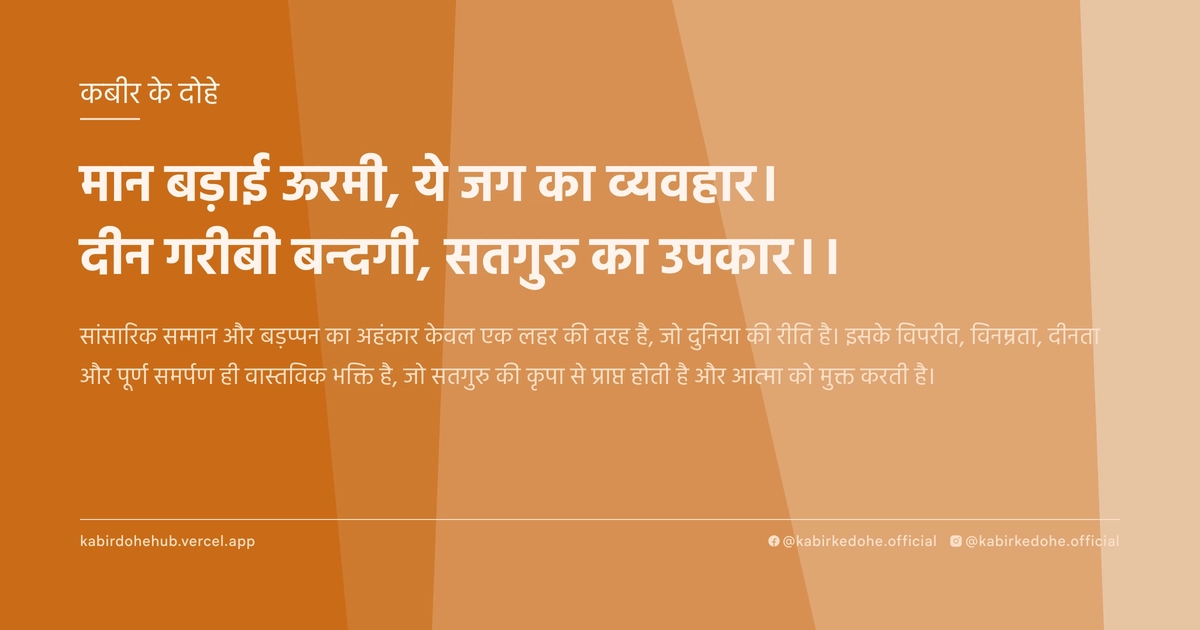
मान बड़ाई ऊरमी, ये जग का व्यवहार।
दीन गरीबी बन्दगी, सतगुरु का उपकार।।
Maan badai oormi, ye jag ka vyavhaar. Deen gareebi bandagi, satguru ka upkaar.
इस पृष्ठ पर इस कबीर दोहे का अर्थ (meaning), हिंदी व्याख्या और अंग्रेज़ी अनुवाद, दार्शनिक विश्लेषण और व्यावहारिक जीवन सीख दी गई है। यह दोहा विनम्रता (Humility) विषय से जुड़ा है — Kabir doha meaning and explanation in Hindi and English.
अर्थ (Meaning):
सांसारिक सम्मान और बड़प्पन का अहंकार केवल एक लहर की तरह है, जो दुनिया की रीति है। इसके विपरीत, विनम्रता, दीनता और पूर्ण समर्पण ही वास्तविक भक्ति है, जो सतगुरु की कृपा से प्राप्त होती है और आत्मा को मुक्त करती है।
Worldly honor and the pride of status are merely transient waves, characteristic of social interaction. In contrast, true devotion lies in humility and a sense of spiritual poverty, which is a divine gift bestowed by the True Guru to liberate the soul.
व्याख्या (Interpretation):
इस दोहे में कबीर 'मान' और 'बड़ाई' को एक 'ऊरमी' यानी लहर के समान बताते हैं, जो क्षणिक है। सांसारिक प्रतिष्ठा माया का एक जाल है जो अहंकार को पुष्ट करता है। जब साधक स्वयं को 'दीन' या विनम्र मानता है, तब वह वास्तव में उस निर्गुण ब्रह्म के करीब पहुँचता है। यहाँ 'गरीबी' भौतिक अभाव नहीं, बल्कि अहंकार का अभाव है। यह अद्वैत वेदांत के उस सिद्धांत को दर्शाता है जहाँ 'मैं' का विसर्जन ही 'वह' (ब्रह्म) से मिलन का एकमात्र मार्ग है। सतगुरु का उपकार वह प्रकाश है जो इस भ्रम को तोड़कर साधक को शून्य की स्थिति में ले जाता है।
Kabir likens 'honor' and 'grandeur' to an 'urmi' or a wave—inherently transient and unstable. Worldly prestige is a snare of Maya that reinforces the ego's illusion of separation. When a seeker embraces 'deen' or humility, they align themselves with the Nirgun Brahman. Here, 'poverty' does not signify material lack, but the absolute absence of ego. This mirrors the Advaita Vedanta principle where the dissolution of the 'I' is the only gateway to the 'One'. The Guru's grace is the catalyst that shatters the mirage of status, guiding the soul toward the state of Shunya (emptiness) and ultimate non-duality.
दार्शनिक विश्लेषण (Philosophical Analysis):
कबीर का यह संदेश उस समय के सामाजिक ढांचे पर प्रहार है जहाँ जाति, पद और प्रतिष्ठा को आध्यात्मिक श्रेष्ठता का पैमाना माना जाता था। वे स्पष्ट करते हैं कि बाहरी आडंबर और सामाजिक सम्मान आध्यात्मिक प्रगति के मार्ग में सबसे बड़ी बाधाएँ हैं। यह विचार सूफीवाद के 'फना' (अहंकार का विनाश) के सिद्धांत से मेल खाता है, जहाँ खुदा को पाने के लिए स्वयं को मिटाना आवश्यक है।
निर्गुण भक्ति के परिप्रेक्ष्य में, ईश्वर किसी विशेष रूप या पद में नहीं, बल्कि सरलता और सत्य में बसता है। कबीर ritualism (कर्मकांड) का विरोध करते हुए कहते हैं कि मंदिर या मस्जिद में बड़प्पन दिखाने से बेहतर है कि व्यक्ति अपने भीतर की विनम्रता को खोजे। यह मनोवैज्ञानिक रूपांतरण की प्रक्रिया है जहाँ व्यक्ति अपनी सामाजिक पहचान (Social Identity) को त्यागकर अपनी वास्तविक पहचान (Universal Identity) को पहचानता है।
अद्वैत वेदांत के अनुसार, जब तक 'अहंकार' है, तब तक द्वैत है। 'मान-बड़ाई' इस द्वैत को और गहरा करती है। जब साधक स्वयं को तुच्छ और ईश्वर को सर्वोपरि मानता है, तो वह वास्तव में अपने भीतर के उस छोटे 'अहं' को मार रहा होता है जो उसे अनंत ब्रह्म से अलग करता है।
ऐतिहासिक रूप से, कबीर ने बुनकर समुदाय से होते हुए भी सत्ता और धर्म के केंद्रों को चुनौती दी। उन्होंने यह सिद्ध किया कि ज्ञान किसी विशेष वर्ग की बपौती नहीं है, बल्कि वह विनम्रता और अनुभव से आता है।
अंततः, यह दोहा हमें सिखाता है कि आध्यात्मिक उत्थान का मार्ग ऊपर चढ़ने में नहीं, बल्कि नीचे उतरने (विनम्र होने) में है। जो स्वयं को शून्य कर लेता है, वही पूर्णता को प्राप्त करता है।
Kabir’s message is a direct critique of the social hierarchies of his era, where caste, rank, and prestige were erroneously viewed as markers of spiritual superiority. He asserts that external pomp and social validation are the primary obstacles to genuine spiritual evolution. This philosophy resonates deeply with the Sufi concept of 'Fana' (annihilation of the self), where the ego must be extinguished to achieve union with the Divine.
From the lens of Nirgun Bhakti, the Formless Divine does not reside in titles or rituals but in simplicity and truth. Kabir rejects ritualism, suggesting that seeking grandeur in temples or mosques is futile compared to discovering the humility within. This is a psychological shift from a 'Social Identity'—defined by others—to a 'Universal Identity'—defined by the Atman.
According to Advaita Vedanta, as long as the 'ego' exists, duality persists. 'Maan-Badayi' (pride and honor) deepens this duality. When a seeker views themselves as 'deen' (humble/poor in spirit), they are effectively dismantling the narrow 'I' that separates the individual soul from the infinite Brahman.
Historically, Kabir, emerging from the weaving community, challenged the monopoly of the priestly and ruling classes over spiritual knowledge. He demonstrated that wisdom is not the birthright of a specific caste but is accessible to anyone who possesses the courage to be humble.
Ultimately, this Doha teaches that the path to spiritual ascent is not an upward climb toward status, but a downward descent into humility. Only those who render themselves as 'zero' can be filled with the 'infinite'.
मूल संदेश (Core Message):
- सामाजिक प्रतिष्ठा एक भ्रम है, जो आत्मा को बंधन में डालती है।
- विनम्रता वह द्वार है जिससे ईश्वर का प्रवेश संभव होता है।
- अहंकार का विसर्जन ही वास्तविक आध्यात्मिक उपलब्धि है।
- सच्चा गुरु वह है जो हमें हमारी लघुता का बोध कराकर अनंत से मिलाए।
- बाहरी बड़प्पन आंतरिक रिक्तता का संकेत है।
- Social prestige is a mirage that shackles the soul in duality.
- Humility is the only portal through which the Divine enters.
- The dissolution of ego is the ultimate spiritual achievement.
- A True Guru reveals our insignificance to connect us with the Infinite.
- External grandeur is often a mask for internal emptiness.
व्यावहारिक उदाहरण (Practical Example):
वाराणसी के घाटों पर रहने वाले एक वृद्ध विधवा, जानकी, का जीवन इस दोहे का जीवंत उदाहरण है। जानकी के पास न तो धन था और न ही समाज में कोई सम्मान। शहर के संपन्न लोग उन्हें अक्सर अनदेखा कर देते थे और कभी-कभी उपहास भी उड़ाते थे।
उसी घाट पर एक प्रसिद्ध विद्वान पंडित रहते थे, जिन्हें उनकी शास्त्र-निपुणता के कारण पूरा शहर पूजता था। पंडित जी को अपनी विद्वत्ता और सामाजिक प्रतिष्ठा का बहुत गर्व था। वे अक्सर जानकी जैसे लोगों को आध्यात्मिक रूप से निम्न मानते थे।
एक दिन, पंडित जी एक कठिन आध्यात्मिक दुविधा में फँस गए। उन्होंने कई ग्रंथों को पढ़ा, लेकिन उन्हें शांति नहीं मिली। उनका अहंकार उन्हें यह मानने नहीं दे रहा था कि वे कुछ नहीं जानते।
एक शाम, उन्होंने जानकी को गंगा किनारे शांत भाव से बैठे देखा। उनके चेहरे पर एक ऐसी असीम शांति और संतोष था जिसे पंडित जी अपनी सारी प्रतिष्ठा के बावजूद प्राप्त नहीं कर पाए थे।
जिज्ञासावश, पंडित जी ने उनसे पूछा, 'माँ, आपके पास न ज्ञान है, न धन, फिर भी आप इतनी शांत कैसे हैं?'
जानकी ने मंद मुस्कान के साथ उत्तर दिया, 'बेटा, मेरे पास खोने के लिए कोई 'बड़प्पन' नहीं है। मैं तो बस इस गंगा की एक छोटी सी बूंद हूँ। जब मैंने यह मान लिया कि मैं कुछ भी नहीं हूँ, तो मुझे पता चला कि मैं सब कुछ हूँ।'
यह शब्द पंडित जी के लिए एक बिजली के झटके की तरह थे। उन्हें एहसास हुआ कि उनकी 'मान-बड़ाई' वास्तव में एक दीवार थी जिसने उन्हें सत्य से दूर रखा था।
पंडित जी का अहंकार टूट गया। उन्होंने अपनी प्रतिष्ठा का मुखौटा उतारा और जानकी के चरणों में बैठकर सरलता का पाठ सीखा।
इस 'कबीर ट्विस्ट' ने पंडित जी को एक अहंकारी विद्वान से एक सच्चे साधक में बदल दिया। उन्होंने समझा कि वास्तविक ज्ञान शास्त्रों के रटने में नहीं, बल्कि अहंकार के विसर्जन में है।
अब वे समाज में सम्मान की खोज नहीं करते थे, बल्कि हर दीन-दुखी में ईश्वर को देखने लगे थे।
The life of Janaki, an elderly widow living on the ghats of Varanasi, serves as a living embodiment of this Doha. Janaki possessed neither wealth nor social standing. The affluent citizens of the city often ignored her, and some even mocked her simplicity.
On the same ghat lived a renowned scholar-priest, revered by the entire city for his mastery of the scriptures. This priest was deeply proud of his erudition and the social prestige that accompanied his title. He viewed people like Janaki as spiritually inferior.
One day, the priest found himself trapped in a profound spiritual crisis. Despite reading countless texts, he could not find inner peace. His ego prevented him from admitting that there were things he did not understand.
One evening, he observed Janaki sitting by the Ganges. Her face radiated a boundless peace and contentment that the priest, despite all his accolades, had never achieved.
Driven by curiosity, he asked, 'Mother, you have neither knowledge nor wealth, yet how are you so peaceful?'
Janaki replied with a gentle smile, 'My son, I have no 'grandeur' to protect or lose. I am but a tiny drop in this Ganges. When I accepted that I am nothing, I discovered that I am everything.'
These words struck the priest like a bolt of lightning. He realized that his 'Maan-Badayi' (honor and pride) was actually a wall separating him from the Truth.
The priest's ego shattered. He cast aside the mask of prestige and sat at Janaki's feet to learn the art of simplicity.
This 'Kabir Twist' transformed the arrogant scholar into a genuine seeker. He understood that true wisdom does not lie in the rote memorization of scriptures, but in the dissolution of the ego.
He stopped seeking validation from society and began seeing the Divine in every humble and suffering soul.
अभ्यास मार्गदर्शन (Practice Guidance):
- प्रतिदिन 15 मिनट 'शून्य ध्यान' का अभ्यास करें, जहाँ आप अपनी सभी उपाधियों (पिता, पुत्र, अधिकारी, विद्वान) को मानसिक रूप से त्याग दें और केवल एक शुद्ध चेतना के रूप में रहें।
- एक 'अहंकार डायरी' लिखें: दिन भर में उन क्षणों को नोट करें जब आपको अपनी श्रेष्ठता का अनुभव हुआ या जब किसी की प्रशंसा ने आपके भीतर अहंकार जगाया। विश्लेषण करें कि यह भावना आपको सत्य से कैसे दूर ले जा रही है।
- सचेत सेवा (Conscious Service): सप्ताह में एक बार किसी ऐसे व्यक्ति की सहायता करें जिससे समाज आमतौर पर उपेक्षा करता है, और इस प्रक्रिया में यह महसूस करें कि आप उनकी मदद नहीं कर रहे, बल्कि वे आपको विनम्रता सिखा रहे हैं।
- नैदानिक चेकलिस्ट: क्या मैं दूसरों की प्रशंसा पर उत्साहित होता हूँ? क्या मैं उपेक्षा होने पर क्रोधित या दुखी होता हूँ? क्या मैं अपनी उपलब्धियों का उपयोग दूसरों को छोटा महसूस कराने के लिए करता हूँ? यदि हाँ, तो आप अभी भी 'मान-बड़ाई' की लहरों में फंसे हैं।
- Practice 15 minutes of 'Shunya Meditation' daily, mentally stripping away all your titles (parent, professional, scholar, citizen) and resting simply as pure consciousness.
- Maintain an 'Ego Journal': Note moments throughout the day when you felt superior or when praise triggered a sense of pride. Analyze how this feeling creates a barrier between you and the Truth.
- Conscious Service: Once a week, serve someone whom society typically overlooks. During this act, consciously shift your perspective: you are not 'helping' them, but they are teaching you the art of humility.
- Diagnostic Checklist: Do I feel an emotional high from praise? Do I feel resentment or sadness when ignored? Do I use my achievements to subtly diminish others? If yes, you are still caught in the waves of 'Maan-Badayi'.
चिंतन प्रश्न (Reflection Questions):
- यदि आज आपकी सारी डिग्रियाँ, पद और सामाजिक सम्मान छीन लिए जाएँ, तो आपके भीतर क्या बचेगा?
- आपकी 'पब्लिक इमेज' (Public Image) को बनाए रखने के लिए आप अपने वास्तविक स्वरूप का कितना गला घोंटते हैं?
- क्या आपकी विनम्रता वास्तविक है, या यह केवल दूसरों से अधिक प्रशंसा पाने की एक रणनीतिक चाल है?
- आप किन लोगों को 'दीन' मानते हैं, और क्या वह निर्णय आपके अपने पूर्वाग्रहों पर आधारित है?
- वह कौन सा डर है जो आपको पूरी तरह से 'शून्य' होने से रोकता है?
- If all your degrees, titles, and social honors were stripped away today, what would remain of you?
- How much of your authentic self do you sacrifice to maintain your curated 'public image'?
- Is your humility genuine, or is it a strategic tool used to garner more admiration from others?
- Whom do you categorize as 'lowly' or 'poor', and is that judgment based on your own internal biases?
- What is the specific fear that prevents you from becoming completely 'empty' or 'zero'?