
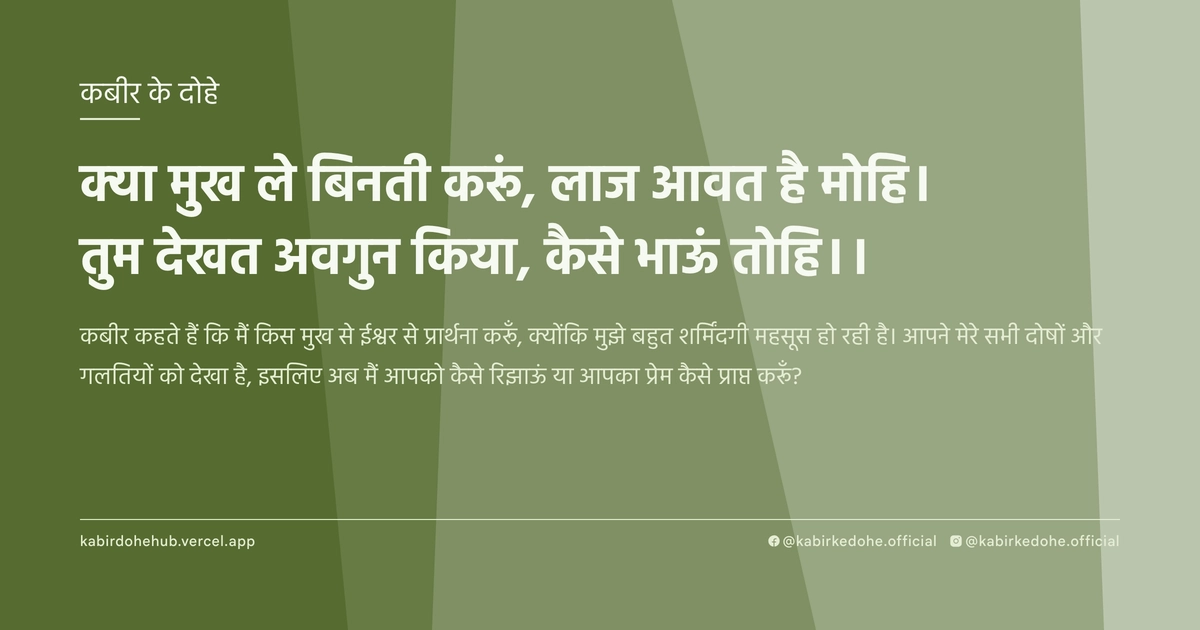
क्या मुख ले बिनती करूं, लाज आवत है मोहि।
तुम देखत अवगुन किया, कैसे भाऊं तोहि।।
Kya mukh le beenati karun, laaj aavat hai mohi. Tum dekhat avgun kiya, kaise bhaun tohi.
इस पृष्ठ पर इस कबीर दोहे का अर्थ (meaning), हिंदी व्याख्या और अंग्रेज़ी अनुवाद, दार्शनिक विश्लेषण और व्यावहारिक जीवन सीख दी गई है। यह दोहा विनम्रता (Humility) विषय से जुड़ा है — Kabir doha meaning and explanation in Hindi and English.
अर्थ (Meaning):
कबीर कहते हैं कि मैं किस मुख से ईश्वर से प्रार्थना करूँ, क्योंकि मुझे बहुत शर्मिंदगी महसूस हो रही है। आपने मेरे सभी दोषों और गलतियों को देखा है, इसलिए अब मैं आपको कैसे रिझाऊं या आपका प्रेम कैसे प्राप्त करूँ?
Kabir expresses a profound sense of spiritual shame, questioning how he can possibly approach the Divine with a plea for mercy. Since the Almighty has witnessed every flaw and transgression of his soul, he feels unworthy and bewildered about how to evoke Divine love or grace.
व्याख्या (Interpretation):
इस दोहे का शाब्दिक अर्थ एक भक्त की अपनी त्रुटियों के प्रति जागरूकता है। आध्यात्मिक स्तर पर, यह 'अहंकार के विसर्जन' की प्रक्रिया है। यहाँ 'लाज' केवल सामाजिक शर्म नहीं, बल्कि आत्मा की वह अवस्था है जब उसे अपनी सीमितता और अज्ञानता का बोध होता है। यह निर्गुण भक्ति का वह मोड़ है जहाँ साधक समझता है कि बाहरी अनुष्ठान नहीं, बल्कि आंतरिक ईमानदारी ही ईश्वर तक पहुँचने का मार्ग है। यह अद्वैत वेदांत के उस सत्य की ओर इशारा करता है जहाँ 'मैं' (अहंकार) जब तक जीवित है, तब तक 'वह' (परमात्मा) दूर लगता है। जैसे ही यह शर्मिंदगी पूर्ण समर्पण में बदलती है, द्वैत समाप्त हो जाता है और आत्मा ब्रह्म में विलीन होने लगती है।
Literally, the verse depicts a devotee's acute awareness of their shortcomings. Metaphorically, it represents the critical stage of 'ego dissolution.' The 'shame' mentioned is not social embarrassment but a spiritual realization of one's own limitations and ignorance. In the context of Nirgun Bhakti, it signifies that external rituals are useless; only raw, internal honesty can bridge the gap to the Divine. This aligns with Advaita Vedanta, where the perceived separation between the self and the Absolute is maintained by the ego. The paradox is that this very feeling of unworthiness—when stripped of pride—becomes the ultimate qualification for grace. Once the 'I' is annihilated through humility, the duality vanishes, and the Atman recognizes its non-duality with Brahman.
दार्शनिक विश्लेषण (Philosophical Analysis):
कबीर का यह दोहा उस युग की उपज है जहाँ धर्म केवल कर्मकांडों और बाहरी दिखावे तक सीमित था। कबीर ने पुरोहितवाद और जातिगत श्रेष्ठता को नकारते हुए यह स्थापित किया कि ईश्वर के सामने केवल हृदय की पवित्रता मायने रखती है। यहाँ 'अवगुन' (दोष) का उल्लेख केवल पापों की सूची नहीं है, बल्कि उस 'माया' का वर्णन है जिसने आत्मा को सत्य से दूर रखा है।
सूफी मत के 'फना' (स्वयं का विनाश) के सिद्धांत के समान, कबीर यहाँ अपनी पहचान को मिटाने की बात कर रहे हैं। जब साधक यह स्वीकार करता है कि वह पूरी तरह से दोषपूर्ण है, तो वह वास्तव में अपने उस मुखौटे को उतार रहा होता है जिसे उसने दुनिया के सामने पहन रखा है। यह मनोवैज्ञानिक रूपांतरण है जहाँ 'अपराधबोध' (Guilt) 'पछतावे' (Remorse) में और फिर 'समर्पण' (Surrender) में बदल जाता है।
अद्वैत वेदांत के अनुसार, हम सभी मूलतः शुद्ध हैं, लेकिन अविद्या (अज्ञान) के कारण हम स्वयं को शरीर और मन समझ लेते हैं। कबीर की यह 'लाज' वास्तव में उस अविद्या के फटने की प्रक्रिया है। वह यह समझा रहे हैं कि जब तक हम अपनी श्रेष्ठता का भ्रम पालते हैं, हम परमात्मा से दूर रहते हैं।
यह दोहा इस बात पर प्रहार करता है कि ईश्वर को 'रिझाने' के लिए किसी विशेष विधि की आवश्यकता नहीं है। जो व्यक्ति अपनी कमियों को स्वीकार कर लेता है, वह वास्तव में सबसे अधिक योग्य हो जाता है क्योंकि उसने सत्य को स्वीकार कर लिया है। यहाँ 'भाऊं' (रिझाना) का अर्थ चापलूसी नहीं, बल्कि प्रेमपूर्ण मिलन है।
अंततः, कबीर यह संदेश देते हैं कि आध्यात्मिक यात्रा का प्रारंभ 'मैं कुछ नहीं हूँ' के बोध से होता है। यह शून्य की अवस्था ही वह उर्वर भूमि है जहाँ ईश्वरीय कृपा का बीज अंकुरित होता है। बिना इस विनम्रता के, कोई भी ज्ञान केवल बौद्धिक अहंकार बन जाता है।
This verse emerges from an era where religion was largely reduced to mechanical rituals and outward displays of piety. Kabir vehemently rejected the priestly hegemony and caste hierarchies, asserting that only the purity of the heart holds currency in the Divine court. The 'avgun' (flaws) mentioned here are not merely a list of sins, but a description of 'Maya'—the cosmic illusion that veils the soul's true nature.
Parallel to the Sufi concept of 'Fana' (annihilation of the self), Kabir describes the process of erasing the individual identity. When the seeker admits their total imperfection, they are stripping away the social and psychological masks they wear. This is a profound psychological shift where guilt evolves into remorse, and finally into total surrender (Prapatti).
According to Advaita Vedanta, the soul is inherently pure, but 'Avidya' (ignorance) creates the illusion of a separate, flawed ego. Kabir's 'shame' is actually the cracking of this ignorance. He suggests that as long as we cling to the illusion of our own righteousness or superiority, we remain alienated from the Absolute.
The poem critiques the notion that the Divine can be 'manipulated' or 'bought' through specific rituals. The person who accepts their flaws is the most qualified for grace because they have ceased pretending. The term 'bhaoon' (to please/attract) does not imply flattery, but a longing for a love-based union.
Ultimately, Kabir posits that the spiritual journey begins with the realization: "I am nothing." This state of void is the only fertile ground where divine grace can take root. Without this humility, all spiritual knowledge remains mere intellectual vanity, failing to transform the practitioner's core.
मूल संदेश (Core Message):
- अहंकार की दीवार ही ईश्वर और आत्मा के बीच का एकमात्र पर्दा है।
- सच्ची प्रार्थना शब्दों में नहीं, बल्कि पूर्ण आत्म-समर्पण और ईमानदारी में है।
- अपनी कमियों को स्वीकार करना ही आध्यात्मिक उन्नति का पहला और सबसे कठिन कदम है।
- बाहरी कर्मकांड तब तक व्यर्थ हैं जब तक आंतरिक ग्लानि प्रेम में नहीं बदलती।
- जब 'मैं' मिटता है, तभी 'वह' (परमात्मा) प्रकट होता है।
- The wall of ego is the only veil separating the soul from the Divine.
- True prayer resides not in words, but in absolute surrender and honesty.
- Accepting one's flaws is the first and most challenging step toward spiritual evolution.
- External rituals remain futile until inner guilt is transformed into divine love.
- Only when the 'I' is annihilated does the 'Absolute' manifest.
व्यावहारिक उदाहरण (Practical Example):
एक समय की बात है, बनारस के घाटों पर रहने वाला एक वृद्ध विधवा, जिसे लोग 'काकी' कहते थे, अपनी पूरी जिंदगी दूसरों की सेवा और छोटे-मोटे कामों में बिता चुकी थी। वह बहुत धार्मिक थी, लेकिन उसके मन में हमेशा एक टीस रहती थी कि उसने जीवन में बहुत सी गलतियाँ कीं, कई बार क्रोध किया और अपनों का दिल दुखाया।
काकी हर दिन मंदिर जाती, घंटों पूजा करती और लंबी मालाएँ जपती। लेकिन जब भी वह आँखें बंद करती, उसे अपने अतीत के वे पल याद आते जब उसने अहंकार में आकर किसी गरीब को झिड़का था या अपनी बहू के प्रति कठोरता दिखाई थी। उसे लगता था कि उसकी पूजा केवल एक दिखावा है क्योंकि उसका मन अंदर से अशांत और ग्लानि से भरा था।
एक दिन उसकी मुलाकात एक घुमक्कड़ फकीर से हुई जो घाट की सीढ़ियों पर बैठा था। काकी ने अपनी व्यथा बताई कि वह ईश्वर से क्षमा माँगना चाहती है, लेकिन उसे लगता है कि वह इतनी अयोग्य है कि ईश्वर उसकी प्रार्थना सुनेंगे ही नहीं। उसने कहा, "मेरे पाप इतने हैं कि मैं उनके सामने मुख खोलने की हिम्मत नहीं करती।"
फकीर ने मुस्कुराते हुए कहा, "माँ, तुम अपनी कमियों को छिपाने के लिए पूजा का पर्दा इस्तेमाल कर रही हो। तुम ईश्वर से क्षमा नहीं माँग रही, बल्कि तुम अपनी छवि को बचाने की कोशिश कर रही हो। असली प्रार्थना वह है जहाँ तुम अपनी पूरी नग्नता और कमजोरी के साथ उसके सामने खड़े हो जाओ, बिना किसी ढोंग के।"
काकी को यह बात चुभ गई। उसने महसूस किया कि उसकी लंबी मालाएँ और घंटों की पूजा वास्तव में उसके अहंकार का एक नया रूप था—'एक धार्मिक व्यक्ति होने का अहंकार'। वह पहली बार फूट-फूट कर रोई, लेकिन इस बार वह अपनी गलतियों के लिए दुखी नहीं थी, बल्कि इस बात के लिए दुखी थी कि उसने अब तक खुद को धोखे में रखा था।
उसने मंदिर जाना कम कर दिया और अपना पूरा ध्यान उन लोगों की मदद करने में लगा दिया जिन्हें उसने कभी नीचा दिखाया था। उसने अपनी बहू से माफी माँगी और अपने पड़ोसियों के साथ प्रेम से रहना शुरू किया। उसने पाया कि जब उसने अपनी 'लाज' (शर्म) को स्वीकार कर लिया और उसे कर्म में बदला, तो उसका मन हल्का हो गया।
अब वह पूजा इसलिए नहीं करती थी कि उसे स्वर्ग मिलना था या पाप धुलने थे, बल्कि इसलिए करती थी क्योंकि वह उस अनंत प्रेम का अनुभव करना चाहती थी जो हर दोष को समाहित कर लेता है। उसका जीवन अब एक प्रदर्शन नहीं, बल्कि एक प्रार्थना बन गया था।
काकी ने सीखा कि ईश्वर को रिझाने के लिए किसी विशेष मंत्र की नहीं, बल्कि एक टूटे हुए और ईमानदार हृदय की आवश्यकता होती है। उसकी विनम्रता ही उसका सबसे बड़ा गहना बन गई और उसके चेहरे पर एक ऐसी शांति आई जो पहले कभी नहीं थी।
Once, in the sacred lanes of Varanasi, lived an elderly widow known as 'Kaki.' She had spent her life in service and small chores, maintaining a facade of deep piety. However, a persistent ache resided in her heart—the memory of her past mistakes, her flashes of anger, and the times she had hurt those closest to her.
Kaki visited the temple daily, spending hours in prayer and chanting long rosaries. Yet, every time she closed her eyes, images of her past arrogance surfaced—the moments she had snapped at a poor soul or been overly harsh with her daughter-in-law. She felt her rituals were a mere charade because her inner world was clouded by guilt.
One afternoon, she encountered a wandering fakir sitting on the stone steps of the ghats. Kaki confessed her agony, explaining that she wished to seek forgiveness but felt too unworthy. She lamented, "My flaws are so many that I lack the courage to even speak before the Divine."
The fakir smiled and replied, "Mother, you are using your prayers as a veil to hide your flaws. You are not seeking forgiveness; you are trying to protect your image. True prayer happens when you stand before the Absolute in your complete nakedness and vulnerability, without any pretense."
These words pierced Kaki's heart. She realized that her endless chanting was actually a new form of ego—the 'ego of being a religious person.' For the first time, she wept uncontrollably, not out of guilt for her sins, but out of grief for the deception she had practiced upon herself.
She reduced her ritualistic temple visits and shifted her focus toward serving those she had once belittled. She sought genuine forgiveness from her daughter-in-law and began treating her neighbors with authentic kindness. She discovered that once she accepted her 'shame' and transformed it into action, her heart became light.
She no longer prayed to earn heaven or wash away sins, but to experience the infinite love that absorbs all imperfections. Her life ceased to be a performance and became a living prayer.
Kaki learned that to 'please' the Divine, one does not need a specific mantra, but a broken and honest heart. Her humility became her greatest ornament, and a serene peace settled upon her face that no ritual had ever provided.
अभ्यास मार्गदर्शन (Practice Guidance):
- दैनिक आत्म-निरीक्षण: प्रतिदिन 15 मिनट मौन बैठें और उन क्षणों को याद करें जब आपने अहंकारवश किसी का अपमान किया। बिना खुद को कोसें, बस उस भावना को देखें।
- ईमानदार जर्नल लेखन: एक डायरी लिखें जिसमें आप अपनी उन कमियों को लिखें जिन्हें आप दुनिया से छिपाते हैं। इसे 'छाया कार्य' (Shadow Work) कहें।
- अहंकार-त्याग अभ्यास: दिन में कम से कम एक बार किसी ऐसे व्यक्ति की मदद करें जिससे आप घृणा करते हैं, और यह महसूस करें कि आप दोनों की मूल प्रकृति एक ही है।
- निदान चेकलिस्ट: क्या आप अपनी गलतियों पर रक्षात्मक (defensive) हो जाते हैं? क्या आप अपनी धार्मिकता का उपयोग दूसरों को छोटा दिखाने के लिए करते हैं? यदि हाँ, तो आप अभी भी 'माया' के प्रभाव में हैं।
- Daily Self-Inquiry: Sit in silence for 15 minutes daily. Recall moments where ego led you to belittle others. Observe the feeling without self-judgment.
- Honest Journaling: Maintain a diary of the flaws you hide from the world. Treat this as 'Shadow Work' to integrate your hidden self.
- Ego-Dissolution Practice: Once a day, perform an act of kindness for someone you dislike, consciously realizing that your fundamental essence is identical.
- Diagnostic Checklist: Do you become defensive when your flaws are pointed out? Do you use your spirituality to feel superior to others? If yes, you are still operating under the illusion of the ego.
चिंतन प्रश्न (Reflection Questions):
- क्या मेरी धार्मिकता वास्तव में मुझे विनम्र बना रही है, या यह मेरे अहंकार को एक नया 'पवित्र' रूप दे रही है?
- मैं दुनिया को जो चेहरा दिखाता हूँ और जो मैं वास्तव में भीतर से हूँ, उनके बीच का अंतर कितना गहरा है?
- क्या मैं अपनी गलतियों को स्वीकार करने से इसलिए डरता हूँ क्योंकि मुझे लगता है कि इससे मेरी सामाजिक प्रतिष्ठा कम हो जाएगी?
- यदि ईश्वर मेरे जीवन के हर गुप्त विचार को देख रहा है, तो क्या मैं अभी भी वही प्रार्थना करूँगा जो मैं सार्वजनिक रूप से करता हूँ?
- क्या मेरी 'शर्म' वास्तव में पश्चाताप है, या यह केवल मेरी अपनी छवि के खोने का डर है?
- Is my spirituality truly making me humble, or is it merely giving my ego a 'sacred' new form?
- How wide is the chasm between the persona I project to the world and the reality of my inner self?
- Do I fear admitting my flaws because I believe it will diminish my social standing or digital image?
- If the Divine witnesses every secret thought, would I still offer the same prayers I recite in public?
- Is my 'shame' genuine repentance, or is it simply the fear of losing my curated self-image?