
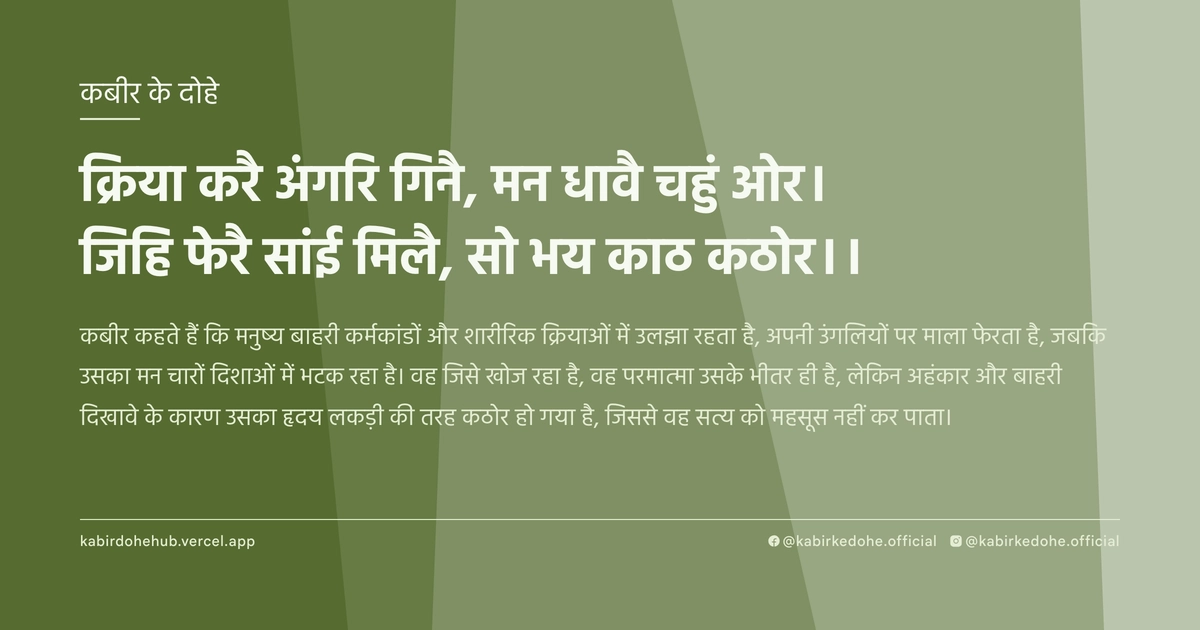
क्रिया करै अंगरि गिनै, मन धावै चहुं ओर।
जिहि फेरै सांई मिलै, सो भय काठ कठोर।।
Kriya karai angari ginai, man dhaavai chahun or. Jih pherai sai milai, so bhay kaath kathor.
इस पृष्ठ पर इस कबीर दोहे का अर्थ (meaning), हिंदी व्याख्या और अंग्रेज़ी अनुवाद, दार्शनिक विश्लेषण और व्यावहारिक जीवन सीख दी गई है। यह दोहा मन नियंत्रण (Mind Control) विषय से जुड़ा है — Kabir doha meaning and explanation in Hindi and English.
अर्थ (Meaning):
कबीर कहते हैं कि मनुष्य बाहरी कर्मकांडों और शारीरिक क्रियाओं में उलझा रहता है, अपनी उंगलियों पर माला फेरता है, जबकि उसका मन चारों दिशाओं में भटक रहा है। वह जिसे खोज रहा है, वह परमात्मा उसके भीतर ही है, लेकिन अहंकार और बाहरी दिखावे के कारण उसका हृदय लकड़ी की तरह कठोर हो गया है, जिससे वह सत्य को महसूस नहीं कर पाता।
Kabir observes that humans immerse themselves in external rituals and physical acts of devotion, counting beads on their fingers while the mind wanders aimlessly in all directions. The Divine, whom they seek externally, resides within, but because the heart has become as rigid and insensitive as a piece of wood due to ego and hypocrisy, the seeker remains blind to the internal truth.
व्याख्या (Interpretation):
इस दोहे का शाब्दिक अर्थ बाहरी आडंबरों की व्यर्थता को दर्शाता है। कबीर यहाँ 'अंगरि गिनै' (उंगलियों से गिनने) के माध्यम से यांत्रिक भक्ति पर प्रहार करते हैं। आध्यात्मिक स्तर पर, यह मन की चंचलता और आत्मा की जड़ता के बीच के द्वंद्व को दर्शाता है। निर्गुण भक्ति के अनुसार, ईश्वर किसी मूर्ति या माला में नहीं, बल्कि शुद्ध चेतना में है। जब तक मन 'माया' के वश में है और चारों ओर भटक रहा है, तब तक आंतरिक शांति असंभव है। 'काठ कठोर' होना उस आध्यात्मिक शून्यता और संवेदनहीनता का प्रतीक है जो तब आती है जब व्यक्ति ज्ञान को केवल बौद्धिक या औपचारिक मानता है, न कि अनुभवजन्य। यह अद्वैत वेदांत के उस सिद्धांत को पुष्ट करता है कि अज्ञान (Avidya) ही वह पर्दा है जो आत्मा को ब्रह्म से अलग करता है।
The literal meaning of this couplet highlights the futility of external ostentation. Through the phrase 'angari ginai' (counting with fingers), Kabir critiques mechanical devotion. On a spiritual level, it depicts the conflict between the restlessness of the mind and the rigidity of the soul. According to Nirgun Bhakti, the Divine is not found in idols or beads but within pure consciousness. As long as the mind is enslaved by 'Maya' and wanders in all directions, inner peace remains elusive. The metaphor 'kaath kathor' (hard as wood) symbolizes the spiritual numbness and insensitivity that arise when a person treats knowledge as a formal exercise rather than a lived experience. This reinforces the Advaita Vedanta principle that ignorance (Avidya) is the only veil separating the Atman from Brahman, turning a living heart into a dead piece of timber.
दार्शनिक विश्लेषण (Philosophical Analysis):
कबीर का यह दोहा उनके युग के धार्मिक पाखंड और कर्मकांडीय कट्टरता के विरुद्ध एक सशक्त विद्रोह है। उन्होंने देखा कि लोग धर्म को केवल बाहरी क्रियाओं—जैसे तीर्थयात्रा, माला फेरना या विशेष वस्त्र पहनना—तक सीमित कर चुके थे। कबीर इस 'क्रिया' को एक भ्रम मानते हैं जो साधक को वास्तव में ईश्वर से दूर ले जाता है क्योंकि यह अहंकार को पुष्ट करता है कि 'मैं पूजा कर रहा हूँ'।
दार्शनिक रूप से, यह सूफी मत के 'फना' और अद्वैत वेदांत के 'अहं ब्रह्मास्मि' का संगम है। सूफीवाद में, जब तक 'नफ्स' (अहंकार) जीवित रहता है, खुदा का दीदार असंभव है। इसी तरह, कबीर तर्क देते हैं कि जब तक मन बाहरी दुनिया की वासनाओं में 'धावै' (दौड़ता) रहेगा, तब तक वह आंतरिक केंद्र को नहीं पा सकेगा।
यहाँ 'काठ कठोर' होना मनोवैज्ञानिक जड़ता की स्थिति है। जब मनुष्य सत्य को केवल शब्दों में पढ़ता है और उसे अपने आचरण में नहीं उतारता, तो उसकी संवेदनाएं मर जाती हैं। वह धार्मिक तो हो जाता है, लेकिन आध्यात्मिक नहीं। कबीर का प्रहार उस व्यक्ति पर है जो स्वयं को धार्मिक मानकर दूसरों को तुच्छ समझता है, जो कि भक्ति मार्ग की सबसे बड़ी बाधा है।
यह विश्लेषण हमें बताता है कि वास्तविक भक्ति 'क्रिया' में नहीं, बल्कि 'भाव' और 'जागरूकता' में है। निर्गुण परंपरा यह मानती है कि ईश्वर निराकार है, इसलिए उसे पाने के लिए किसी भौतिक उपकरण की आवश्यकता नहीं है, केवल मन की एकाग्रता और अहंकार का विसर्जन आवश्यक है।
अंततः, कबीर यह संदेश देते हैं कि परमात्मा कहीं बाहर नहीं, बल्कि उसी हृदय में है जिसे हमने अपनी कठोरता और पूर्वाग्रहों से ढंक दिया है। जब यह 'काठ' जैसा हृदय पिघलकर प्रेम और करुणा में बदलता है, तभी साधक को अपने भीतर के 'सांई' का साक्षात्कार होता है।
This couplet is a powerful rebellion against the religious hypocrisy and ritualistic bigotry of Kabir's era. He observed that people had reduced religion to mere external acts—such as pilgrimages, counting beads, or wearing specific attire. Kabir views this 'kriya' (ritual action) as a delusion that actually distances the seeker from the Divine because it reinforces the ego's belief that 'I am performing worship.'
Philosophically, this is a convergence of the Sufi concept of 'Fana' (annihilation of self) and the Advaita Vedanta realization of 'Aham Brahmasmi' (I am Brahman). In Sufism, as long as the 'Nafs' (ego) remains alive, the vision of God is impossible. Similarly, Kabir argues that as long as the mind 'dhavai' (runs) after the desires of the external world, it can never find the internal center.
The state of being 'kaath kathor' (hard as wood) represents a psychological rigidity. When a person reads truth only in words and fails to embody it in their conduct, their sensibilities atrophy. They become religious, but not spiritual. Kabir attacks the individual who, believing themselves to be pious, looks down upon others—the greatest obstacle on the path of Bhakti.
This analysis reveals that true devotion lies not in 'action' but in 'intent' and 'awareness.' The Nirgun tradition posits that since the Divine is formless, no physical tool is required to reach Him; only the concentration of the mind and the dissolution of the ego are necessary.
Ultimately, Kabir conveys that the Divine is not elsewhere but resides within the very heart that we have covered with our rigidity and prejudices. Only when this wood-like heart melts into love and compassion does the seeker encounter the 'Saai' (Lord) within.
मूल संदेश (Core Message):
- बाहरी कर्मकांड केवल मानसिक शोर हैं यदि हृदय जागृत नहीं है।
- मन की चंचलता ही आध्यात्मिक प्रगति की सबसे बड़ी बाधा है।
- ईश्वर को खोजने के लिए बाहर जाने की नहीं, भीतर मुड़ने की आवश्यकता है।
- अहंकार से प्रेरित भक्ति वास्तव में भक्ति नहीं, बल्कि आत्म-मोह है।
- सच्ची आध्यात्मिकता हृदय की कठोरता को करुणा में बदलने का नाम है।
- External rituals are mere mental noise if the heart is not awakened.
- The restlessness of the mind is the greatest obstacle to spiritual progress.
- Finding God requires not going outward, but turning inward.
- Devotion driven by ego is not true devotion, but self-infatuation.
- True spirituality is the process of transforming the heart's rigidity into compassion.
व्यावहारिक उदाहरण (Practical Example):
एक समय की बात है, वाराणसी के घाटों पर रहने वाला एक वृद्ध बुनकर था जिसका नाम माधव था। माधव दिन भर कपड़े बुनता और रात भर मंदिर में बैठकर घंटों माला फेरता था। वह पूरे शहर में अपनी धार्मिकता के लिए प्रसिद्ध था। वह हर नियम का पालन करता, हर मंत्र का जाप करता, लेकिन उसका मन हमेशा इस बात में लगा रहता कि लोग उसकी कितनी प्रशंसा करते हैं और वह अन्य बुनकरों से कितना श्रेष्ठ है।
एक दिन, माधव की मुलाकात एक फकीर से हुई जो घाट की सीढ़ियों पर चुपचाप बैठा था। फकीर के पास न कोई माला थी, न वह कोई मंत्र पढ़ रहा था, फिर भी उसके चेहरे पर एक असीम शांति थी। माधव ने अहंकारवश उससे पूछा, 'हे फकीर, तुम बिना किसी क्रिया के ईश्वर को कैसे पा सकते हो? देखो मैं कितनी मेहनत से माला फेरता हूँ।'
फकीर ने मुस्कुराकर माधव की ओर देखा और कहा, 'माधव, तुम्हारी उंगलियाँ तो माला फेर रही हैं, लेकिन तुम्हारा मन तो प्रशंसा की गलियों में घूम रहा है। तुम पत्थर की मूर्ति को पूज रहे हो, लेकिन अपने भीतर के जीवित ईश्वर को अनदेखा कर रहे हो। तुम्हारी भक्ति एक ऐसी लकड़ी की तरह है जिसमें कोई रस नहीं, केवल कठोरता है।'
माधव को पहले तो यह बात चुभी, लेकिन उस रात उसे नींद नहीं आई। उसने महसूस किया कि जब वह माला फेरता था, तब भी वह मन ही मन यह सोचता था कि कल मंदिर का पुजारी उसे सबसे आगे बैठने देगा या नहीं। उसे एहसास हुआ कि उसकी 'क्रिया' केवल एक दिखावा थी, एक मानसिक व्यायाम था, न कि आत्म-समर्पण।
अगले कुछ दिनों तक माधव ने माला फेरना छोड़ दिया। उसने तय किया कि वह अब केवल अपने काम और अपने व्यवहार पर ध्यान देगा। उसने देखा कि उसके पड़ोस में एक गरीब विधवा रहती थी जिसे अक्सर लोग दुत्कारते थे। माधव ने चुपचाप उसकी मदद करना शुरू किया, बिना किसी को बताए, बिना किसी प्रशंसा की इच्छा के।
जैसे-जैसे उसने दूसरों के दुख को महसूस करना शुरू किया, उसके भीतर की वह 'कठोरता' पिघलने लगी। उसे महसूस हुआ कि जब वह उस विधवा के चेहरे पर मुस्कान देखता था, तो उसे वही शांति मिलती थी जो वह हजारों मालाओं के जाप में नहीं पा सका था।
एक दिन, कपड़े बुनते समय, माधव को अचानक एक गहरा अनुभव हुआ। उसे लगा कि वह, उसका करघा, और वह कपड़ा—सब एक ही चेतना का हिस्सा हैं। उसे अब किसी बाहरी क्रिया की आवश्यकता नहीं थी।
उसने महसूस किया कि जब मन की चंचलता शांत हुई और हृदय की कठोरता करुणा में बदली, तब 'सांई' स्वयं उसके भीतर प्रकट हो गए। माधव अब केवल एक धार्मिक व्यक्ति नहीं, बल्कि एक जागृत आत्मा बन चुका था।
Once, in the ghats of Varanasi, lived an elderly weaver named Madhav. Madhav spent his days weaving cloth and his nights in the temple, spending hours counting beads on a rosary. He was renowned throughout the city for his piety. He followed every rule and chanted every mantra, yet his mind was always preoccupied with how much people praised him and how superior he was to other weavers.
One day, Madhav encountered a fakir sitting silently on the steps of the ghat. The fakir had no beads, nor was he chanting any mantra, yet his face radiated an infinite peace. Out of ego, Madhav asked him, 'O Fakir, how can you find God without any ritual action? Look at the effort I put into my rosary.'
The fakir smiled and looked at Madhav, saying, 'Madhav, your fingers are moving the beads, but your mind is wandering through the streets of praise. You worship a stone idol but ignore the living God within you. Your devotion is like a piece of wood—devoid of sap, possessing only rigidity.'
At first, Madhav felt stung by these words, but he could not sleep that night. He realized that while he was counting beads, he was actually wondering whether the temple priest would let him sit in the front row the next day. He understood that his 'kriya' was merely a facade, a mental exercise, not a surrender.
For the next few days, Madhav stopped using the rosary. He decided to focus only on his work and his behavior. He noticed a poor widow in his neighborhood whom people often shunned. Madhav began helping her quietly, without telling anyone and without any desire for praise.
As he began to feel the pain of others, the 'rigidity' within him started to melt. He discovered that seeing a smile on that widow's face gave him a peace that thousands of rosary repetitions never could.
One day, while weaving cloth, Madhav had a profound experience. He felt that he, his loom, and the fabric were all part of one single consciousness. He no longer felt the need for any external ritual.
He realized that when the restlessness of the mind ceased and the hardness of the heart turned into compassion, the 'Saai' (Lord) manifested within him. Madhav was no longer just a religious man; he had become an awakened soul.
अभ्यास मार्गदर्शन (Practice Guidance):
- दैनिक अवलोकन: दिन में तीन बार रुकें और स्वयं से पूछें, 'क्या मेरा शरीर एक कार्य कर रहा है जबकि मेरा मन कहीं और है?' इस विखंडन को पहचानें।
- मौन चिंतन: प्रतिदिन 20 मिनट बिना किसी माला या मंत्र के केवल अपनी सांसों के प्रति जागरूक रहें। बाहरी उपकरणों को त्यागकर आंतरिक शून्य में उतरने का प्रयास करें।
- करुणा अभ्यास: सप्ताह में एक बार किसी ऐसे व्यक्ति की निस्वार्थ मदद करें जिससे आपको कोई लाभ न मिले और इस बात को गुप्त रखें ताकि अहंकार को पोषण न मिले।
- डायग्नोस्टिक चेकलिस्ट: यदि आप पूजा के बाद भी क्रोधित महसूस करते हैं, या दूसरों की तुलना में स्वयं को अधिक 'पवित्र' मानते हैं, तो समझें कि आपका हृदय अभी भी 'काठ कठोर' है।
- Daily Observation: Three times a day, pause and ask yourself, 'Is my body performing one action while my mind is elsewhere?' Recognize this fragmentation.
- Silent Contemplation: Spend 20 minutes daily being aware of your breath without any beads or mantras. Attempt to descend into the inner void by discarding external tools.
- Compassion Practice: Once a week, help someone selflessly from whom you gain nothing, and keep it secret so that the ego is not nourished.
- Diagnostic Checklist: If you still feel anger after prayer, or consider yourself more 'pure' than others, recognize that your heart is still 'kaath kathor' (hard as wood).
चिंतन प्रश्न (Reflection Questions):
- मेरे जीवन में वे कौन सी 'मालाएं' हैं जिन्हें मैं केवल दुनिया को दिखाने के लिए फेर रहा हूँ?
- जब मैं धर्म या नैतिकता की बात करता हूँ, तो क्या मैं वास्तव में दूसरों के प्रति संवेदनशील हूँ या केवल अपनी श्रेष्ठता सिद्ध कर रहा हूँ?
- मेरे व्यक्तित्व का वह कौन सा हिस्सा है जो 'काठ' की तरह कठोर हो गया है और प्रेम को स्वीकार नहीं कर पा रहा?
- क्या मेरी प्रार्थनाएं मुझे शांत करती हैं, या वे मेरे भीतर के 'धार्मिक अहंकार' को और अधिक बढ़ा रही हैं?
- यदि मुझसे मेरे सभी धार्मिक लेबल (जाति, धर्म, पद) छीन लिए जाएं, तो मेरे भीतर क्या बचेगा?
- What are the 'beads' in my life that I am counting only to show the world?
- When I speak of religion or morality, am I truly sensitive to others or merely proving my superiority?
- Which part of my personality has become 'hard as wood' and is unable to accept love?
- Do my prayers actually calm me, or do they amplify the 'religious ego' within me?
- If all my religious labels (caste, faith, title) were stripped away, what would remain within me?