
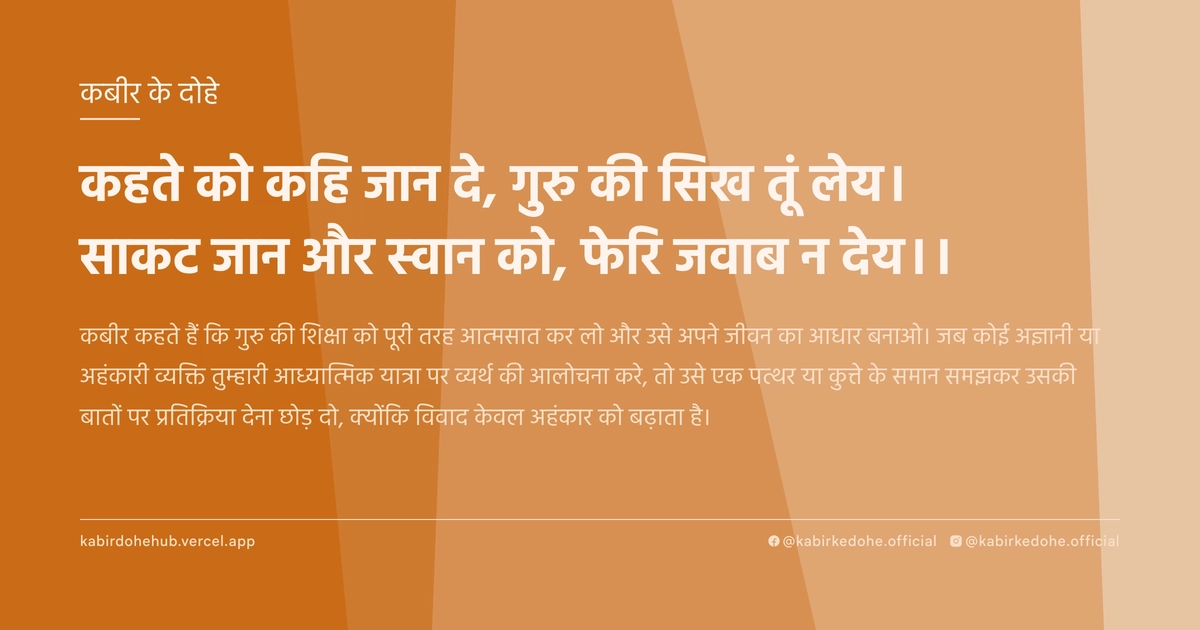
कहते को कहि जान दे, गुरु की सिख तूं लेय।
साकट जान और स्वान को, फेरि जवाब न देय।।
Kehte ko kahi jaan de, guru ki sikh tun ley. Sakat jaan aur swan ko, pher jawab na dey.
इस पृष्ठ पर इस कबीर दोहे का अर्थ (meaning), हिंदी व्याख्या और अंग्रेज़ी अनुवाद, दार्शनिक विश्लेषण और व्यावहारिक जीवन सीख दी गई है। यह दोहा गुरु महत्व (The Guru's Importance) विषय से जुड़ा है — Kabir doha meaning and explanation in Hindi and English.
अर्थ (Meaning):
कबीर कहते हैं कि गुरु की शिक्षा को पूरी तरह आत्मसात कर लो और उसे अपने जीवन का आधार बनाओ। जब कोई अज्ञानी या अहंकारी व्यक्ति तुम्हारी आध्यात्मिक यात्रा पर व्यर्थ की आलोचना करे, तो उसे एक पत्थर या कुत्ते के समान समझकर उसकी बातों पर प्रतिक्रिया देना छोड़ दो, क्योंकि विवाद केवल अहंकार को बढ़ाता है।
Kabir advises the seeker to fully internalize the teachings of the Guru and make them the foundation of existence. When an ignorant or ego-driven person offers futile criticism of your spiritual path, treat such noise as the barking of a dog or the silence of a stone; do not engage in rebuttal, for conflict only nourishes the ego.
व्याख्या (Interpretation):
यह दोहा मौन की शक्ति और आध्यात्मिक अनुशासन पर केंद्रित है। 'साकट' (पत्थर) और 'स्वान' (कुत्ता) यहाँ उन लोगों के प्रतीक हैं जो सत्य से अनभिज्ञ हैं और केवल प्रतिक्रिया उत्पन्न करने के लिए बोलते हैं। गुरु की शिक्षा यहाँ केवल शब्दों का ज्ञान नहीं, बल्कि एक आंतरिक रूपांतरण है जो साधक को बाहरी शोर से ऊपर उठाता है। यह निरगुण भक्ति का वह स्तर है जहाँ साधक यह समझ जाता है कि सत्य को तर्क से सिद्ध नहीं किया जा सकता। माया का प्रभाव तब तक रहता है जब तक हम दूसरों की धारणाओं में अपनी पहचान खोजते हैं। जब आत्मा स्वयं को ब्रह्म के साथ एकाकार महसूस करती है, तो बाहरी निंदा और प्रशंसा दोनों अर्थहीन हो जाते हैं। यह विरोधाभास है कि शांति पाने के लिए सबसे पहले बाहरी दुनिया के साथ मानसिक युद्ध को समाप्त करना पड़ता है।
This couplet focuses on the power of silence and spiritual discipline. 'Saakat' (stone) and 'Swaan' (dog) symbolize those devoid of spiritual awakening who speak only to provoke. The Guru's teaching here is not mere intellectual knowledge but an internal alchemy that elevates the seeker above external noise. This reflects the state of Nirgun Bhakti where the seeker realizes that Truth cannot be proven through logic or debate. The influence of Maya persists as long as we seek our identity in the perceptions of others. When the Atman recognizes its non-duality with Brahman, both praise and condemnation become meaningless. It is the central paradox of the human condition: to achieve ultimate peace, one must first cease the mental war with the external world.
दार्शनिक विश्लेषण (Philosophical Analysis):
कबीर का यह दृष्टिकोण उनके समय के कट्टरपंथी धार्मिक वातावरण की प्रतिक्रिया है, जहाँ शास्त्रार्थ और वाद-विवाद को ज्ञान का पैमाना माना जाता था। वे कर्मकांडीय विद्वता के बजाय अनुभवजन्य सत्य पर जोर देते हैं। यहाँ गुरु की शिक्षा का अर्थ है 'सहज मार्ग' का अनुसरण करना, जो बाहरी आडंबरों से मुक्त है।
अद्वैत वेदांत के परिप्रेक्ष्य में, यह दोहा 'साक्षी भाव' की शिक्षा देता है। जब साधक स्वयं को शरीर और मन से अलग एक दृष्टा के रूप में देखता है, तो उसे बाहरी अपमान स्पर्श नहीं करता। यह सूफी मत के 'फना' (अहंकार का विनाश) के समान है, जहाँ व्यक्ति अपनी व्यक्तिगत पहचान को मिटाकर परमात्मा में लीन हो जाता है।
कबीर जाति और धर्म के नाम पर होने वाले संघर्षों को व्यर्थ मानते थे। उनके लिए, किसी अज्ञानी से तर्क करना अपनी ऊर्जा को नष्ट करना है। वे समझाते हैं कि अहंकार (Ego) एक ऐसा दर्पण है जो केवल अपनी ही छवि देखना चाहता है; यदि आप किसी अहंकारी को जवाब देते हैं, तो आप वास्तव में अपने स्वयं के अहंकार को सक्रिय कर रहे होते हैं।
मनोवैज्ञानिक स्तर पर, यह 'प्रतिक्रियात्मकता' (reactivity) को समाप्त करने का मार्ग है। जब हम किसी की आलोचना पर प्रतिक्रिया देते हैं, तो हम अपनी मानसिक शांति की चाबी दूसरे के हाथ में सौंप देते हैं। कबीर हमें उस चाबी को वापस लेने और आंतरिक स्थिरता प्राप्त करने का निर्देश देते हैं।
अंततः, यह शिक्षण हमें सिखाता है कि सत्य मौन में निवास करता है। शब्दों का जाल केवल भ्रम पैदा करता है। वास्तविक ज्ञान वह है जो शब्दों से परे है और जिसे केवल अनुभव के माध्यम से प्राप्त किया जा सकता है, न कि तर्क-वितर्क के माध्यम से।
Kabir's perspective is a direct reaction to the dogmatic religious environment of his era, where scholastic debates and ritualistic arguments were considered the benchmarks of wisdom. He emphasizes experiential truth over scriptural erudition. The 'Guru's teaching' here refers to the 'Sahaj Marg' (the natural path), which is liberated from external pretenses.
From the lens of Advaita Vedanta, this doha teaches the state of 'Sakshi' (the Witness). When the seeker views themselves as a detached observer rather than the body or mind, external insults fail to penetrate the consciousness. This mirrors the Sufi concept of 'Fana' (annihilation of the self), where the individual ego is dissolved into the Divine Presence.
Kabir viewed conflicts arising from caste and creed as futile. To argue with the ignorant is to squander spiritual energy. He explains that the ego is a mirror that only wishes to see its own reflection; by responding to an egoist, you are merely activating your own latent ego.
Psychologically, this is a path toward ending reactivity. When we react to criticism, we surrender the key to our mental peace to another. Kabir instructs us to reclaim that key and establish an unshakable internal equilibrium.
Ultimately, this teaching posits that Truth resides in silence. The web of words only creates illusion (Maya). Real knowledge is that which transcends language and can only be accessed through direct realization, not through the friction of debate.
मूल संदेश (Core Message):
- बाहरी शोर केवल तब तक परेशान करता है जब तक भीतर शोर होता है।
- मौन सबसे शक्तिशाली उत्तर है जो अहंकार को नष्ट करता है।
- गुरु की शिक्षा को तर्क से नहीं, अनुभव से जिएं।
- अज्ञानी से विवाद करना स्वयं की शांति का त्याग करना है।
- सत्य का प्रमाण शब्दों में नहीं, व्यवहार की स्थिरता में है।
- External noise only disturbs when there is noise within.
- Silence is the most potent answer that annihilates the ego.
- Live the Guru's teaching through experience, not through logic.
- Arguing with the ignorant is an act of sacrificing one's own peace.
- The proof of Truth lies not in words, but in the stability of conduct.
व्यावहारिक उदाहरण (Practical Example):
वाराणसी के एक पुराने घाट पर माधव नाम का एक वृद्ध बुनकर रहता था। वह कबीर के सिद्धांतों का अनुयायी था और अत्यंत शांत स्वभाव का था।
उसी मोहल्ले में एक अहंकारी व्यक्ति था जो खुद को बहुत बड़ा विद्वान मानता था और अक्सर माधव के साधारण जीवन और उसकी सादगी का मजाक उड़ाता था।
वह व्यक्ति अक्सर माधव के पास आकर उसे नीचा दिखाने की कोशिश करता, उसे अनपढ़ कहता और उसकी आध्यात्मिक मान्यताओं पर व्यंग्य करता।
माधव कभी पलटकर जवाब नहीं देता था। वह बस मंद मुस्कान के साथ अपना काम करता रहता और उस व्यक्ति की बातों को ऐसे सुनता जैसे हवा चल रही हो।
मोहल्ले के लोग माधव से पूछते, 'वह तुम्हें इतना अपमानित करता है, तुम चुप क्यों रहते हो? क्या तुम्हें अपनी गरिमा की चिंता नहीं?'
माधव ने शांति से उत्तर दिया, 'यदि कोई कुत्ता भौंकता है, तो क्या मैं भी भौंकने लगूँ? या यदि कोई पत्थर मेरे रास्ते में पड़ा है, तो क्या मैं उससे लड़ूँ?'
एक दिन वह विद्वान व्यक्ति एक गहरे मानसिक संकट में फँसा और उसे महसूस हुआ कि उसकी सारी किताबी बातें उसे शांति नहीं दे पा रही हैं।
वह माधव के पास आया और पूछा, 'तुम्हारी इस चुप्पी का रहस्य क्या है? तुम मुझे जवाब क्यों नहीं देते थे?'
माधव ने कहा, 'मैंने गुरु से सीखा था कि सत्य को शब्दों की आवश्यकता नहीं होती। जब मैंने तुम्हारे शब्दों को सुनना बंद कर दिया, तब मैंने तुम्हारे भीतर के दर्द को देखना शुरू किया।'
वह व्यक्ति माधव के चरणों में गिर पड़ा। उसे समझ आया कि असली ज्ञान तर्क जीतने में नहीं, बल्कि अहंकार को जीतने में है।
On an ancient ghat in Varanasi lived an elderly weaver named Madhav. He was a follower of Kabir's principles and possessed a profoundly serene nature.
In the same neighborhood lived an arrogant man who considered himself a great scholar and frequently mocked Madhav's simple life and humility.
This man would often approach Madhav to belittle him, calling him uneducated and casting sneers upon his spiritual beliefs.
Madhav never responded in kind. He would continue his weaving with a gentle smile, listening to the man's words as if they were merely passing wind.
The villagers asked Madhav, 'He insults you so deeply; why do you remain silent? Do you not care for your dignity?'
Madhav replied calmly, 'If a dog barks, shall I also begin to bark? Or if a stone lies in my path, shall I fight with it?'
One day, the scholar fell into a deep psychological crisis and realized that all his bookish knowledge could not grant him peace.
He approached Madhav and asked, 'What is the secret of your silence? Why did you never answer my provocations?'
Madhav said, 'I learned from my Guru that Truth requires no words. When I stopped listening to your words, I began to see the pain within you.'
The man fell at Madhav's feet, realizing that true wisdom lies not in winning arguments, but in conquering the ego.
अभ्यास मार्गदर्शन (Practice Guidance):
- प्रतिदिन 20 मिनट मौन अभ्यास करें, जहाँ आप बाहरी आवाजों को बिना किसी निर्णय के केवल सुनें और उन्हें जाने दें।
- जब कोई आपकी आलोचना करे, तो तुरंत प्रतिक्रिया देने के बजाय 10 सेकंड का मौन रखें और स्वयं से पूछें: 'क्या यह मेरी आत्मा को प्रभावित करता है या केवल मेरे अहंकार को?'
- एक डायरी लिखें जिसमें उन स्थितियों का विवरण हो जहाँ आपने प्रतिक्रिया देने के बजाय मौन चुना और उसके बाद आपको कैसा महसूस हुआ।
- निदानात्मक चेकलिस्ट: क्या मैं दूसरों की राय से विचलित होता हूँ? क्या मैं खुद को सही साबित करने की तीव्र इच्छा रखता हूँ? यदि हाँ, तो आप अभी भी 'स्वान' और 'साकट' के जाल में हैं।
- Practice 20 minutes of conscious silence daily, where you listen to external noises without judgment and let them pass through you.
- When criticized, implement a 10-second pause before reacting. Ask yourself: 'Is this affecting my soul, or merely bruising my ego?'
- Maintain a journal documenting instances where you chose silence over reaction and the subsequent shift in your internal state.
- Diagnostic Checklist: Do I feel disturbed by others' opinions? Do I have an intense urge to prove myself right? If yes, you are still entangled in the web of the 'dog' and the 'stone'.
चिंतन प्रश्न (Reflection Questions):
- मेरी वह कौन सी पहचान है जिसे मैं बचाने के लिए दूसरों से लड़ता हूँ?
- क्या मेरी चुप्पी वास्तव में शांति है, या यह केवल दबी हुई नाराजगी है?
- मैं अपनी डिजिटल पहचान (सोशल मीडिया) पर दूसरों को सही साबित करने के लिए कितनी ऊर्जा नष्ट करता हूँ?
- यदि दुनिया मुझे पूरी तरह गलत मान ले, तो क्या मैं फिर भी आंतरिक रूप से स्थिर रह पाऊँगा?
- मेरे जीवन में 'गुरु' कौन है—एक व्यक्ति, या वह आंतरिक मौन जो मुझे सत्य की ओर ले जाता है?
- मैं किन लोगों को 'पत्थर' या 'कुत्ता' मानकर उनसे घृणा करता हूँ, और क्या यह घृणा मेरे अपने अहंकार का हिस्सा है?
- Which part of my identity am I fighting so hard to protect from others?
- Is my silence truly peace, or is it merely suppressed resentment?
- How much energy do I waste trying to prove myself right in my digital persona?
- If the entire world perceived me as wrong, could I still remain internally stable?
- Who is the 'Guru' in my life—a person, or the internal silence that leads me to Truth?
- Whom do I categorize as 'stones' or 'dogs' with contempt, and is this contempt a fragment of my own ego?