
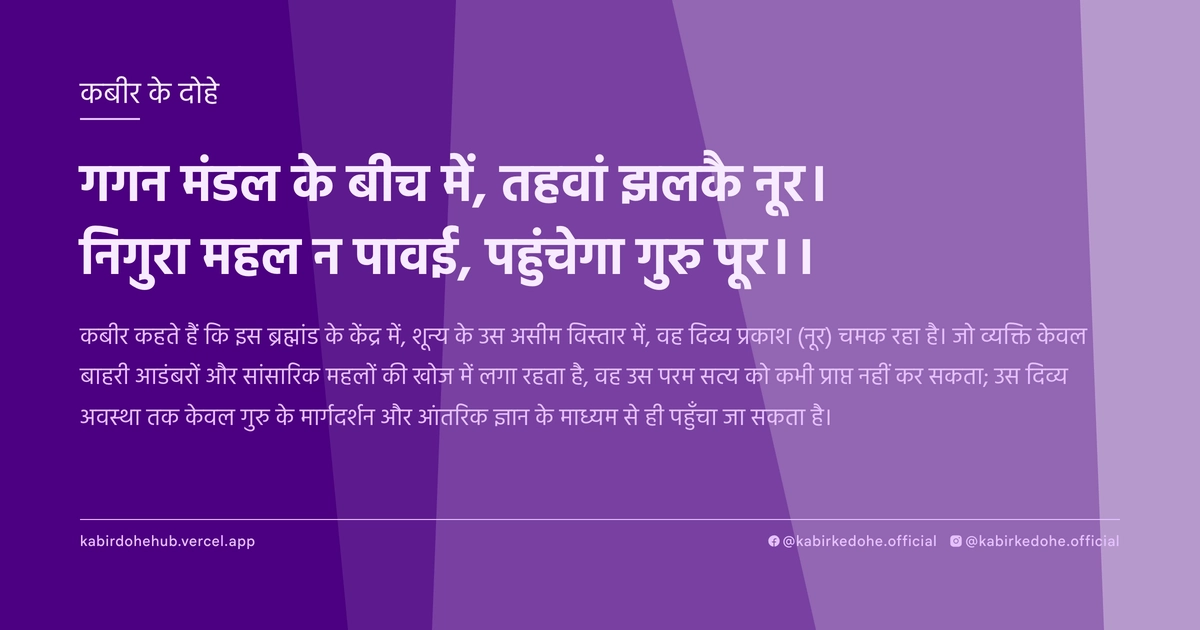
गगन मंडल के बीच में, तहवां झलकै नूर।
निगुरा महल न पावई, पहुंचेगा गुरु पूर।।
Gagan mandal ke beech mein, tahvan jhalkai noor. Nigura mahal na paavai, pahunchega guru poor.
इस पृष्ठ पर इस कबीर दोहे का अर्थ (meaning), हिंदी व्याख्या और अंग्रेज़ी अनुवाद, दार्शनिक विश्लेषण और व्यावहारिक जीवन सीख दी गई है। यह दोहा गुरु महत्व (The Guru's Importance) विषय से जुड़ा है — Kabir doha meaning and explanation in Hindi and English.
अर्थ (Meaning):
कबीर कहते हैं कि इस ब्रह्मांड के केंद्र में, शून्य के उस असीम विस्तार में, वह दिव्य प्रकाश (नूर) चमक रहा है। जो व्यक्ति केवल बाहरी आडंबरों और सांसारिक महलों की खोज में लगा रहता है, वह उस परम सत्य को कभी प्राप्त नहीं कर सकता; उस दिव्य अवस्था तक केवल गुरु के मार्गदर्शन और आंतरिक ज्ञान के माध्यम से ही पहुँचा जा सकता है।
Kabir asserts that in the center of the celestial sphere, within the vastness of the void, the Divine Light (Noor) radiates. One who seeks only the material palaces of the world or clings to external rituals will never find this sanctuary; the realization of this supreme state is attainable only through the grace of a true Guru and the awakening of inner consciousness.
व्याख्या (Interpretation):
यह दोहा भौतिक जगत और आध्यात्मिक शून्य के बीच के विरोधाभास को दर्शाता है। 'गगन मंडल' यहाँ केवल आकाश नहीं, बल्कि 'शून्य' या 'सहज' अवस्था का प्रतीक है, जहाँ आत्मा का परमात्मा से मिलन होता है। 'नूर' वह निराकार प्रकाश है जो निर्गुण भक्ति का आधार है, जो किसी एक रूप या आकार में सीमित नहीं है। 'निगुरा महल' उन मानसिक और भौतिक संरचनाओं को दर्शाता है जिन्हें मनुष्य अपनी अहंकार-वृत्ति के कारण सत्य मान बैठता है। अद्वैत वेदांत के अनुसार, यह माया का पर्दा है जो आत्मा को उसकी वास्तविक प्रकृति से अलग करता है। कबीर स्पष्ट करते हैं कि जब तक साधक बाहरी दुनिया के 'महलों' (अहंकार और प्रतिष्ठा) में उलझा है, वह उस आंतरिक प्रकाश को नहीं देख सकता। गुरु यहाँ केवल एक व्यक्ति नहीं, बल्कि वह ज्ञान-शक्ति है जो शिष्य के भीतर के अंधकार को मिटाकर उसे 'गुरु पूर' यानी उस पूर्णता की स्थिति में ले जाती है जहाँ द्वैत समाप्त हो जाता है।
This couplet illustrates the paradox between the material realm and the spiritual void. 'Gagan Mandal' does not merely refer to the sky, but symbolizes the 'Shunya' or the state of 'Sahaja'—the void where the individual soul merges with the Universal Consciousness. The 'Noor' is the formless light, the cornerstone of Nirgun Bhakti, which remains unbound by shape or attribute. 'Nigura Mahal' represents the mental and physical constructs that humans mistake for reality due to their egoic tendencies. In the context of Advaita Vedanta, this is the veil of Maya that obscures the Atman's true nature. Kabir clarifies that as long as the seeker is entangled in the 'palaces' of external prestige and ego, the internal light remains invisible. The Guru here is not merely a physical instructor but the catalyst of gnosis, the spiritual force that dissolves the seeker's darkness and leads them to 'Guru Poor'—the state of absolute wholeness where duality ceases to exist.
दार्शनिक विश्लेषण (Philosophical Analysis):
कबीर का यह दर्शन उनके समय के धार्मिक कट्टरवाद और कर्मकांडों के विरुद्ध एक सशक्त प्रहार है। उन्होंने देखा कि लोग मंदिरों, मस्जिदों और बाहरी तीर्थों में ईश्वर को खोज रहे थे, जबकि ईश्वर उनके अपने भीतर 'शून्य' में विद्यमान था। यह दृष्टिकोण सूफी मत के 'नूर' (दिव्य प्रकाश) और हिंदू धर्म के 'ब्रह्म' के विचार का एक सुंदर समन्वय है, जहाँ ईश्वर को किसी विशेष धर्म या संप्रदाय की जागीर नहीं माना गया है।
दार्शनिक स्तर पर, यह दोहा 'अहंकार के विसर्जन' की बात करता है। 'महल' का अर्थ है वह पहचान जो हमने समाज में बनाई है—हमारी जाति, पद और संपत्ति। जब तक यह 'महल' खड़ा है, वह सत्य के प्रकाश को रोक देता है। कबीर का तर्क है कि सत्य को पाने के लिए कुछ जोड़ना नहीं, बल्कि सब कुछ छोड़ना (unlearning) पड़ता है। यह शून्य की अवस्था है, जहाँ 'मैं' का अस्तित्व समाप्त हो जाता है और केवल 'वह' शेष रहता है।
यहाँ निर्गुण भक्ति की प्रधानता है। कबीर किसी मूर्ति या साकार रूप की पूजा के बजाय उस निराकार तत्व की बात करते हैं जो सर्वव्यापी है। यह अद्वैत वेदांत के उस सिद्धांत के करीब है जहाँ जीव और ब्रह्म एक ही हैं, बस अज्ञानता के कारण वे अलग प्रतीत होते हैं। गुरु का महत्व यहाँ इसलिए है क्योंकि वह साधक को यह अहसास कराता है कि जिसे वह बाहर खोज रहा है, वह वास्तव में उसके भीतर ही है।
मनोवैज्ञानिक रूप से, यह दोहा बाहरी उत्तेजनाओं से हटकर अंतर्मुखी होने का आह्वान है। आधुनिक युग में, जहाँ मनुष्य डिजिटल और भौतिक 'महलों' में कैद है, कबीर का यह संदेश और भी प्रासंगिक हो जाता है। वे सिखाते हैं कि वास्तविक शांति और प्रकाश बाहरी उपलब्धियों में नहीं, बल्कि मौन और आत्म-साक्षात्कार में निहित है।
अंततः, कबीर का संदेश यह है कि आध्यात्मिक यात्रा एक 'वापसी' की यात्रा है। हम उस नूर से ही आए हैं और उसी में विलीन होना है। जो व्यक्ति बाहरी आडंबरों के मोहजाल से मुक्त होकर गुरु (ज्ञान) के मार्ग पर चलता है, वह उस परम शून्य में प्रवेश कर जाता है जहाँ न कोई दुख है, न कोई द्वैत, केवल अनंत प्रकाश है।
Kabir's philosophy here serves as a potent critique of the religious dogmatism and ritualism prevalent during his era. He observed people searching for the Divine in temples, mosques, and external pilgrimages, while the Truth resided within the 'Shunya' (void) of their own being. This perspective is a sublime synthesis of the Sufi concept of 'Noor' (Divine Light) and the Vedantic notion of 'Brahman,' asserting that the Divine is not the property of any specific religion or sect.
On a philosophical level, this couplet emphasizes the 'annihilation of the ego.' The 'palace' symbolizes the identity constructed within society—one's caste, status, and wealth. As long as this mental palace stands, it obstructs the light of Truth. Kabir argues that attaining Truth is not about adding more knowledge or possessions, but about 'unlearning' and shedding the false self. This is the state of Shunya, where the 'I' vanishes, and only the 'Absolute' remains.
There is a strong emphasis on Nirgun Bhakti. Instead of worshipping an idol or a form, Kabir speaks of a formless element that is omnipresent. This aligns closely with Advaita Vedanta, which posits that the Jiva (individual soul) and Brahman (Universal Soul) are identical, separated only by the illusion of ignorance. The Guru's role is pivotal because the Guru acts as the mirror, reflecting to the seeker that the object of their search is already within them.
Psychologically, this couplet is a call for introversion—shifting focus from external stimuli to internal stillness. In the modern age, where humans are imprisoned in digital and material 'palaces,' Kabir's message becomes even more relevant. He teaches that genuine peace and illumination are not found in external achievements but in silence and self-realization.
Ultimately, Kabir suggests that the spiritual journey is a journey of 'return.' We emerged from that Light, and to it, we must return. He posits that the one who liberates themselves from the web of external pretenses and follows the path of the Guru (Knowledge) enters that supreme void where suffering and duality vanish, leaving only infinite radiance.
मूल संदेश (Core Message):
- बाहरी आडंबर सत्य की प्राप्ति में सबसे बड़ी बाधा हैं।
- ईश्वर किसी इमारत में नहीं, बल्कि चेतना के शून्य में है।
- अहंकार का महल ढहने पर ही दिव्य प्रकाश प्रकट होता है।
- सच्चा गुरु वह है जो आपको आपके अपने भीतर ले जाए।
- आत्मा और परमात्मा का मिलन द्वैत के अंत में निहित है।
- External rituals are the greatest obstacles to realizing the Truth.
- The Divine resides not in buildings, but in the void of consciousness.
- Divine light emerges only when the palace of ego collapses.
- A true Guru is one who guides you back to your own center.
- The union of Atman and Brahman lies in the end of duality.
व्यावहारिक उदाहरण (Practical Example):
एक समय की बात है, राजस्थान के एक छोटे से गाँव में रामू नाम का एक किसान रहता था। रामू बहुत मेहनती था, लेकिन उसके मन में एक गहरी बेचैनी थी। उसने सुना था कि मोक्ष पाने के लिए बड़े-बड़े तीर्थों पर जाना और भव्य मंदिरों में दान देना आवश्यक है। उसने अपनी जीवन भर की जमा पूँजी एक बड़े शहर के सबसे भव्य मंदिर के निर्माण में दान कर दी, यह सोचकर कि इस 'पुण्य' से उसे ईश्वर की प्राप्ति होगी।
रामू अब गरीब हो चुका था, लेकिन उसे लगा कि उसने एक आध्यात्मिक 'महल' बना लिया है। वह घंटों उस मंदिर की सीढ़ियों पर बैठकर प्रार्थना करता, लेकिन उसके मन की अशांति कम नहीं हुई। उसे लगा कि शायद उसकी प्रार्थनाएँ पर्याप्त नहीं हैं, या वह सही विधि का पालन नहीं कर रहा है। वह और अधिक कर्मकांडों में डूब गया, यह सोचकर कि बाहरी शुद्धता ही उसे ईश्वर के करीब ले जाएगी।
एक दिन, गाँव के किनारे एक फकीर आया। वह फकीर किसी मंदिर या मस्जिद में नहीं रहता था, बल्कि एक पुराने बरगद के पेड़ के नीचे मौन बैठा रहता था। रामू उसके पास गया और अपनी व्यथा सुनाई। उसने बताया कि कैसे उसने अपना सब कुछ उस भव्य मंदिर को दे दिया, फिर भी वह उस 'नूर' या शांति को महसूस नहीं कर पा रहा है जिसकी उसने कल्पना की थी।
फकीर ने मुस्कुराते हुए रामू से कहा, 'बेटा, तूने पत्थर का महल तो बना लिया, लेकिन अपने भीतर के अंधेरे को नहीं देखा। तू उस प्रकाश को बाहर खोज रहा है जो तेरे ही हृदय के शून्य में चमक रहा है। मंदिर की दीवारें तुझे ईश्वर तक पहुँचा सकती हैं, लेकिन वे तुझे तेरे अपने अहंकार से नहीं छुड़ा सकतीं।'
रामू को पहले तो यह बात समझ नहीं आई। उसने पूछा, 'तो मैं क्या करूँ?' फकीर ने उसे निर्देश दिया कि वह प्रतिदिन केवल दस मिनट के लिए अपनी आँखें बंद करे और अपने भीतर के उस स्थान पर ध्यान केंद्रित करे जहाँ कोई विचार न हो, कोई इच्छा न हो, और कोई पहचान न हो। उसने कहा, 'जब तू खुद को मिटा देगा, तब वह नूर खुद-ब-खुद झलकेगा।'
रामू ने इस अभ्यास को शुरू किया। धीरे-धीरे, उसका ध्यान मंदिर की भव्यता से हटकर अपने भीतर की शांति पर केंद्रित होने लगा। उसने महसूस किया कि जिस ईश्वर को वह मीलों दूर और सोने की दीवारों के पीछे खोज रहा था, वह वास्तव में उसके हर सांस में, उसके मौन में मौजूद था।
एक दिन, जब वह अपने खेतों में काम कर रहा था, उसे अचानक एक गहरा अनुभव हुआ। उसे लगा कि वह और उसका खेत, वह मिट्टी और वह आकाश, सब एक ही प्रकाश का हिस्सा हैं। उसके भीतर का 'किसान' होने का अहंकार, 'दानी' होने का गर्व, सब विलीन हो गया।
रामू अब उस भव्य मंदिर में नहीं जाता था, लेकिन वह हर इंसान में उस नूर को देखने लगा। उसने सीखा कि असली 'गुरु पूर' वह अवस्था है जहाँ मनुष्य अपनी सीमाओं को तोड़कर अनंत से जुड़ जाता है। उसकी गरीबी अब उसके लिए बाधा नहीं, बल्कि एक मुक्ति बन गई थी क्योंकि उसने भौतिक महलों का मोह त्याग दिया था।
Once upon a time, in a small village in Rajasthan, lived a farmer named Ramu. Ramu was hardworking, but he carried a deep restlessness within him. He had been told that to attain salvation, one must visit great pilgrimages and donate generously to magnificent temples. Believing this, he donated his entire life's savings to the construction of the grandest temple in a distant city, thinking this 'merit' would bring him closer to God.
Ramu was now poor, but he felt he had built a spiritual 'palace' for himself. He spent hours sitting on the temple steps in prayer, yet his inner turmoil persisted. He began to believe that perhaps his prayers were insufficient or his methods were flawed. He immersed himself further in rituals, convinced that external purity was the only gateway to the Divine.
One day, a wandering dervish arrived at the edge of the village. This dervish did not reside in any temple or mosque; he sat in silence beneath an ancient banyan tree. Ramu approached him and shared his grief, explaining how he had given everything to the grand temple yet failed to feel the 'Noor' or the peace he had envisioned.
The dervish smiled and said, 'My son, you have built a palace of stone, but you have ignored the darkness within. You seek the light outside, while it radiates from the void within your own heart. The temple walls may point you toward God, but they cannot liberate you from your own ego.'
Ramu was initially confused. He asked, 'Then what must I do?' The dervish instructed him to close his eyes for just ten minutes every day and focus on that space within where there are no thoughts, no desires, and no identity. He added, 'When you erase yourself, the Noor will shine forth of its own accord.'
Ramu began this practice. Gradually, his focus shifted from the grandeur of the temple to the stillness within. He realized that the God he had been searching for miles away, behind golden walls, was actually present in every breath and every moment of silence.
One day, while working in his fields, he had a profound realization. He felt that he, the field, the soil, and the sky were all parts of the same singular light. His ego as a 'farmer' and his pride as a 'donor' vanished completely.
Ramu no longer visited the grand temple, but he began to see that Noor in every human being. He learned that the true 'Guru Poor' is the state where a human breaks their limitations to merge with the Infinite. His poverty was no longer a burden but a liberation, for he had relinquished the attachment to material palaces.
अभ्यास मार्गदर्शन (Practice Guidance):
- प्रतिदिन 20 मिनट 'शून्य ध्यान' का अभ्यास करें: अपनी चेतना को शरीर और विचारों से ऊपर उठाकर उस अनंत आकाश (गगन मंडल) की कल्पना करें जहाँ केवल मौन है।
- आत्म-पूछताछ जर्नल: प्रतिदिन लिखें कि आज आपने किन 'मानसिक महलों' (अहंकार, पद, प्रतिष्ठा) को सत्य मानकर अपनी आंतरिक शांति का त्याग किया।
- मौन व्रत: सप्ताह में एक बार कुछ घंटों के लिए पूर्ण मौन रहें, ताकि बाहरी शोर कम हो और आंतरिक 'नूर' सुनाई दे सके।
- निदान चेकलिस्ट: यदि आप अभी भी दूसरों की प्रशंसा से खुश और आलोचना से दुखी होते हैं, तो इसका अर्थ है कि आप अभी भी 'निगुरा महल' (अहंकार) में कैद हैं।
- Practice 'Shunya Meditation' for 20 minutes daily: Elevate your consciousness above the body and thoughts, visualizing the infinite celestial void (Gagan Mandal) where only silence exists.
- Self-Inquiry Journaling: Daily record the 'mental palaces' (ego, status, prestige) you mistook for truth, which caused you to sacrifice your inner peace.
- Vow of Silence: Observe complete silence for a few hours once a week to diminish external noise and allow the internal 'Noor' to become audible.
- Diagnostic Checklist: If you still derive happiness from praise and distress from criticism, it is a sign that you are still imprisoned within the 'Nigura Mahal' (ego).
चिंतन प्रश्न (Reflection Questions):
- मेरे जीवन का वह कौन सा 'महल' (पद, छवि, संपत्ति) है जिसे मैं अपनी असली पहचान मानता हूँ?
- क्या मेरी आध्यात्मिकता वास्तव में आंतरिक शांति के लिए है, या यह केवल मेरी सामाजिक छवि को बेहतर बनाने का एक साधन है?
- जब मैं पूरी तरह अकेला और मौन होता हूँ, तो मुझे अपने भीतर किस तरह का डर या खालीपन महसूस होता है?
- क्या मैं सत्य को खोजने के लिए अपने उन विश्वासों को छोड़ने के लिए तैयार हूँ जो मुझे 'सुरक्षित' महसूस कराते हैं?
- मेरे भीतर का 'नूर' उन लोगों में भी चमकता है जिन्हें मैं नापसंद करता हूँ; मैं इसे देखने में असमर्थ क्यों हूँ?
- Which 'palace' (status, image, wealth) in my life do I mistake for my true identity?
- Is my spirituality truly for inner peace, or is it merely a tool to enhance my social image?
- When I am completely alone and silent, what kind of fear or emptiness do I encounter within?
- Am I prepared to let go of the beliefs that make me feel 'safe' in order to find the Truth?
- The internal 'Noor' shines even in those I dislike; why am I unable to perceive it?