
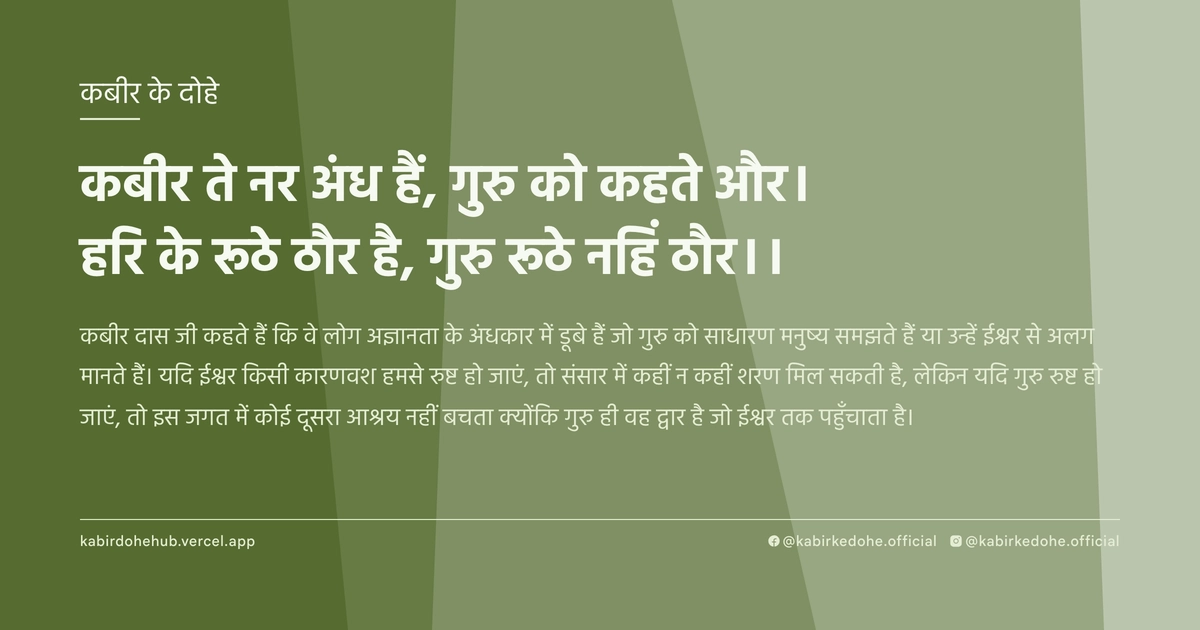
कबीर ते नर अंध हैं, गुरु को कहते और।
हरि के रूठे ठौर है, गुरु रूठे नहिं ठौर।।
Kabir te nar andh hain, guru ko kahte aur. Hari ke roothe thaur hai, guru roothe nahin thaur.
इस पृष्ठ पर इस कबीर दोहे का अर्थ (meaning), हिंदी व्याख्या और अंग्रेज़ी अनुवाद, दार्शनिक विश्लेषण और व्यावहारिक जीवन सीख दी गई है। यह दोहा गुरु महत्व (The Guru's Importance) विषय से जुड़ा है — Kabir doha meaning and explanation in Hindi and English.
अर्थ (Meaning):
कबीर दास जी कहते हैं कि वे लोग अज्ञानता के अंधकार में डूबे हैं जो गुरु को साधारण मनुष्य समझते हैं या उन्हें ईश्वर से अलग मानते हैं। यदि ईश्वर किसी कारणवश हमसे रुष्ट हो जाएं, तो संसार में कहीं न कहीं शरण मिल सकती है, लेकिन यदि गुरु रुष्ट हो जाएं, तो इस जगत में कोई दूसरा आश्रय नहीं बचता क्योंकि गुरु ही वह द्वार है जो ईश्वर तक पहुँचाता है।
Kabir asserts that those who perceive the Guru as a mere mortal or distinct from the Divine are blinded by ignorance. He posits a profound spiritual hierarchy: while one might find solace or a sanctuary elsewhere if the Divine is displeased, there is no refuge in the entire universe if the Guru is displeased, for the Guru is the indispensable bridge to ultimate liberation.
व्याख्या (Interpretation):
यह दोहा गुरु की सर्वोच्चता और आध्यात्मिक मार्गदर्शन की अनिवार्यता को रेखांकित करता है। यहाँ 'अंध' शब्द केवल शारीरिक दृष्टि के अभाव को नहीं, बल्कि 'माया' के प्रभाव में होने वाली आध्यात्मिक चेतना की शून्यता को दर्शाता है। गुरु को 'और' कहना अर्थात उन्हें केवल एक शिक्षक या व्यक्ति मानना, अज्ञानता की पराकाष्ठा है। Nirgun Bhakti के संदर्भ में, गुरु वह तत्व है जो साधक को रूप और नाम के बंधन से मुक्त कर निराकार ब्रह्म से मिलाता है। यहाँ एक विरोधाभास प्रस्तुत है: ईश्वर (हरि) और गुरु के बीच का संबंध। कबीर का तर्क है कि हरि तक पहुँचने का मार्ग गुरु के माध्यम से ही जाता है, अतः गुरु की नाराजगी का अर्थ है मार्ग का अवरुद्ध हो जाना। यह अद्वैत वेदांत के उस सिद्धांत को पुष्ट करता है जहाँ गुरु केवल एक व्यक्ति नहीं, बल्कि वह 'बोध' है जो आत्मा और परमात्मा के बीच के भ्रम को मिटाता है।
This couplet underscores the absolute supremacy of the Guru and the necessity of spiritual guidance. The term 'blind' refers not to physical sight, but to the spiritual void caused by 'Maya' (illusion). To call the Guru 'another' is to mistake a divine conduit for a mere human instructor, representing the peak of ignorance. In the context of Nirgun Bhakti, the Guru is the catalyst who liberates the seeker from the shackles of form and name to realize the Formless Brahman. A striking paradox is presented regarding the Divine (Hari) and the Guru. Kabir argues that since the path to the Divine is paved by the Guru, the Guru's displeasure signifies the closure of the only available gateway. This aligns with Advaita Vedanta, where the Guru is not merely a person but the embodiment of 'Jnana' (knowledge) that dissolves the illusion of duality between the Atman and Brahman.
दार्शनिक विश्लेषण (Philosophical Analysis):
कबीर का यह दृष्टिकोण उनके समय के कट्टरपंथी धार्मिक ढांचे के विरुद्ध एक विद्रोह था। उन्होंने ब्राह्मणवादी कर्मकांडों और बाहरी आडंबरों को नकारते हुए 'आंतरिक गुरु' और 'जीवंत मार्गदर्शन' पर बल दिया। उनके लिए गुरु कोई ऐसा व्यक्ति नहीं था जिसने केवल शास्त्र पढ़े हों, बल्कि वह था जिसने स्वयं को जाना हो। यह विचार सूफी मत के 'पीर' या 'मुर्शिद' की अवधारणा से गहराई से मेल खाता है, जहाँ बिना मार्गदर्शक के सत्य की प्राप्ति असंभव मानी जाती है।
दार्शनिक स्तर पर, कबीर यहाँ 'अहंकार' के विसर्जन की बात कर रहे हैं। जब शिष्य गुरु को 'और' (अलग) समझता है, तो वह वास्तव में अपने अहंकार को बनाए रखता है। गुरु के प्रति पूर्ण समर्पण का अर्थ है स्वयं के सीमित व्यक्तित्व का विनाश, ताकि सार्वभौमिक चेतना का उदय हो सके। यह अद्वैत वेदांत के उस सत्य को उजागर करता है कि गुरु, शिष्य और ईश्वर अंततः एक ही चैतन्य के विभिन्न आयाम हैं।
कबीर ने जाति और धर्म की सीमाओं को तोड़कर यह स्थापित किया कि गुरु की पात्रता उसके ज्ञान और अनुभव से तय होती है, न कि उसकी जन्मगत पहचान से। यह सामाजिक क्रांति का एक सूक्ष्म रूप था, जहाँ आध्यात्मिक योग्यता को सामाजिक पदानुक्रम से ऊपर रखा गया।
मनोवैज्ञानिक रूप से, यह दोहा 'विश्वास' और 'समर्पण' की शक्ति का विश्लेषण करता है। जब एक साधक पूरी तरह से गुरु में लीन हो जाता है, तो वह मानसिक द्वंद्वों से मुक्त हो जाता है। यह समर्पण ही उसे उस मानसिक स्थिरता की ओर ले जाता है जहाँ वह संसार के उतार-चढ़ाव से अप्रभावित रहकर सत्य का साक्षात्कार कर सके।
अंततः, कबीर यह स्पष्ट करते हैं कि ईश्वर की कृपा प्राप्त करने के लिए भी गुरु की कृपा अनिवार्य है। यह एक आध्यात्मिक पदानुक्रम नहीं, बल्कि एक कार्यात्मक आवश्यकता है। जैसे बिना चाबी के ताला नहीं खुलता, वैसे ही बिना गुरु के बोध के, आत्मा का परमात्मा से मिलन संभव नहीं है।
Kabir's perspective was a deliberate rebellion against the rigid religious structures of his era. By rejecting Brahmanical rituals and external pomposity, he emphasized the 'Inner Guru' and 'Living Guidance.' To Kabir, a Guru was not someone who had merely memorized scriptures, but one who had realized the Self. This mirrors the Sufi concept of the 'Pir' or 'Murshid,' where the guidance of a spiritual master is deemed essential for the journey toward Truth.
On a philosophical plane, Kabir addresses the annihilation of the 'Ego.' When a disciple perceives the Guru as 'another' (separate), they are clinging to their limited individual identity. Total surrender to the Guru signifies the dissolution of the ego, allowing the universal consciousness to emerge. This echoes Advaita Vedanta, suggesting that the Guru, the disciple, and the Divine are ultimately different dimensions of the same singular Consciousness.
By dismantling the barriers of caste and creed, Kabir established that a Guru's eligibility is determined by their realization and experience, not by their birth or social standing. This was a subtle yet powerful social revolution, placing spiritual merit above hereditary hierarchy.
Psychologically, the couplet analyzes the power of 'Faith' and 'Surrender.' When a seeker fully merges with the Guru's guidance, they are liberated from mental conflicts. This surrender provides the psychological stability necessary to remain unaffected by the fluctuations of the material world and witness the Truth.
Ultimately, Kabir clarifies that even to receive Divine grace, the grace of the Guru is a prerequisite. This is not a spiritual hierarchy but a functional necessity. Just as a lock cannot be opened without the correct key, the union of the Atman with Brahman is impossible without the awakening provided by the Guru.
मूल संदेश (Core Message):
- अहंकार वह पर्दा है जो गुरु को साधारण मनुष्य बना देता है।
- बाहरी कर्मकांड ईश्वर तक पहुँचा सकते हैं, लेकिन गुरु ही मुक्ति का द्वार है।
- सच्चा मार्गदर्शन व्यक्ति में नहीं, बल्कि उस बोध में है जो व्यक्ति के माध्यम से आता है।
- गुरु के प्रति समर्पण वास्तव में स्वयं के सीमित अहंकार का विसर्जन है।
- बिना गुरु के ज्ञान के, आध्यात्मिक यात्रा केवल एक भ्रम है।
- Ego is the veil that reduces the Guru to a mere mortal.
- External rituals may reach the Divine, but only the Guru is the gateway to liberation.
- True guidance lies not in the person, but in the awakening that flows through them.
- Surrender to the Guru is, in reality, the dissolution of the limited ego.
- Without the Guru's awakening, the spiritual journey remains a sophisticated illusion.
व्यावहारिक उदाहरण (Practical Example):
वाराणसी के एक पुराने घाट पर माधव नाम का एक वृद्ध बुनकर रहता था। वह अपनी कला में निपुण था, लेकिन उसका मन हमेशा अशांत रहता था। वह घंटों मंदिरों में समय बिताता, लंबी पूजा करता और कठिन उपवास रखता, फिर भी उसे वह शांति नहीं मिली जिसकी उसे तलाश थी। वह मानता था कि ईश्वर केवल कर्मकांडों और कठिन तपस्या से प्रसन्न होते हैं।
एक दिन उसकी मुलाकात एक फकीर से हुई, जिसने उसे एक साधारण सा सत्य बताया: 'तू बाहर जिसे खोज रहा है, वह तेरे भीतर ही है, बस तूने अपनी आँखों पर अहंकार का पर्दा डाला हुआ है।' माधव ने पहले तो इस बात को अनसुना कर दिया, क्योंकि वह फकीर न तो किसी बड़े मंदिर का पुजारी था और न ही कोई शास्त्र-विद्वान। उसने फकीर को 'एक साधारण आदमी' समझा।
समय बीतने के साथ, माधव ने महसूस किया कि उसकी सारी पूजा केवल एक दिखावा थी। उसने फकीर के पास जाकर अपनी गलती मानी और उनसे मार्गदर्शन माँगा। फकीर ने उसे कोई मंत्र नहीं दिया, बल्कि उसे केवल अपने भीतर की सांसों और मौन पर ध्यान केंद्रित करने को कहा।
शुरुआत में माधव को यह बहुत सरल लगा। उसे लगा कि इतनी बड़ी आध्यात्मिक यात्रा इतनी आसान कैसे हो सकती है? उसने फिर से अपनी पुरानी आदतों की ओर रुख किया और फकीर की बातों को कमतर आंकने लगा। उसने सोचा कि वह स्वयं ही सत्य को पा सकता है।
कुछ दिनों बाद, माधव एक गहरे मानसिक संकट में घिर गया। उसे लगा कि वह ईश्वर से पूरी तरह कट चुका है। उसने हर मंदिर का दरवाजा खटखटाया, लेकिन उसे कहीं शांति नहीं मिली। उसे एहसास हुआ कि उसने उस मार्गदर्शक का अपमान किया था जिसने उसे सही दिशा दिखाई थी।
वह रोते हुए फकीर के पास गया और उनके चरणों में गिर पड़ा। उसने महसूस किया कि वह फकीर कोई साधारण मनुष्य नहीं, बल्कि उसके लिए साक्षात ईश्वर का रूप था। उसने समझा कि ईश्वर तो सर्वव्यापी है, लेकिन उस तक पहुँचने का रास्ता केवल गुरु की कृपा से ही खुलता है।
फकीर ने उसे गले लगाया और कहा, 'जब तूने मुझे केवल एक मनुष्य समझा, तब तू अंधा था। जब तूने मुझे अपना मार्गदर्शक माना, तब तेरी आँखें खुलीं।'
माधव का जीवन पूरी तरह बदल गया। अब वह केवल कपड़े नहीं बुनता था, बल्कि अपने जीवन के हर धागे को प्रेम और जागरूकता से बुनने लगा। उसने बाहरी आडंबरों को त्याग दिया और अपने भीतर के मौन में ईश्वर को खोजने लगा।
उसकी इस आंतरिक शांति का प्रभाव उसके काम पर भी पड़ा। उसके द्वारा बनाए गए वस्त्रों में अब एक अलग ही चमक थी, जिसे लोग 'दिव्य शांति' कहने लगे।
माधव ने अब समझ लिया था कि गुरु की नाराजगी का अर्थ है स्वयं के सत्य से दूर हो जाना, और गुरु की कृपा ही वह एकमात्र सेतु है जो जीव को शिव से मिलाता है।
On an ancient ghat in Varanasi lived an elderly weaver named Madhav. He was a master of his craft, yet his mind was perpetually restless. He spent hours in temples, performing elaborate rituals and rigorous fasts, yet the peace he sought remained elusive. He believed that the Divine could only be pleased through strict adherence to orthopraxy and asceticism.
One day, he encountered a wandering fakir who shared a simple truth: 'That which you seek outside is already within you; you have merely veiled your eyes with the curtain of ego.' Madhav initially dismissed this, for the fakir was neither a high priest of a grand temple nor a scholar of the scriptures. He perceived the fakir as 'just an ordinary man.'
As time passed, Madhav realized his rituals were mere performances. He returned to the fakir, admitted his error, and sought guidance. The fakir gave him no complex mantras, but simply asked him to focus on his breath and the silence within.
Initially, Madhav found this too simple. He wondered how a profound spiritual journey could be so effortless. He drifted back to his old habits, underestimating the fakir's words and believing he could find the Truth independently.
Soon, Madhav fell into a deep psychological crisis. He felt completely severed from the Divine. He knocked on every temple door in the city, but found no solace. He realized he had insulted the very guide who had pointed him toward the light.
Broken, he returned to the fakir and collapsed at his feet. He understood that the fakir was not a mere mortal, but the living embodiment of the Divine for him. He realized that while God is omnipresent, the path to that realization is unlocked only through the Guru's grace.
The fakir embraced him and said, 'When you saw me as only a man, you were blind. When you accepted me as your guide, your eyes opened.'
Madhav's life underwent a total transformation. He no longer just wove cloth; he began weaving every thread of his existence with love and awareness. He abandoned external pomposity and sought the Divine in the silence of his own heart.
This inner peace reflected in his work. The fabrics he created now possessed a unique radiance, which people began to call 'divine tranquility.'
Madhav now understood that the Guru's displeasure is equivalent to being estranged from one's own Truth, and that the Guru's grace is the only bridge connecting the individual soul to the Universal Soul.
अभ्यास मार्गदर्शन (Practice Guidance):
- दैनिक चिंतन: प्रतिदिन 15 मिनट मौन बैठें और विचार करें कि आपके जीवन में 'गुरु' की भूमिका क्या है—क्या आप उन्हें केवल एक व्यक्ति मानते हैं या एक चेतना के रूप में?
- आत्म-पूछताछ जर्नल: लिखें कि आपके जीवन में किन क्षणों में आपके अहंकार ने आपको सही मार्गदर्शन को अनदेखा करने पर मजबूर किया।
- व्यवहार परिवर्तन: किसी ऐसे व्यक्ति के प्रति सम्मान व्यक्त करें जिसने आपको जीवन का एक छोटा लेकिन महत्वपूर्ण सत्य सिखाया हो, चाहे वह व्यक्ति सामाजिक रूप से छोटा ही क्यों न हो।
- निदान चेकलिस्ट: यदि आप अभी भी बाहरी अनुष्ठानों में शांति खोज रहे हैं और आंतरिक मौन से डर रहे हैं, तो आप अभी भी 'अंध' (अज्ञानी) अवस्था में हैं।
- Daily Contemplation: Spend 15 minutes in silence daily, reflecting on the role of the 'Guru' in your life—do you perceive them as a mere person or as a manifestation of consciousness?
- Self-Inquiry Journal: Document instances where your ego compelled you to ignore genuine guidance or wisdom from unexpected sources.
- Behavioral Shift: Express genuine gratitude toward someone who taught you a small but pivotal life truth, regardless of their social status or credentials.
- Diagnostic Checklist: If you are still seeking peace exclusively through external rituals and feel a fear of internal silence, you are likely still in the state of 'blindness' (ignorance).
चिंतन प्रश्न (Reflection Questions):
- क्या मैं केवल उन लोगों से ज्ञान स्वीकार करता हूँ जिनके पास बड़ी डिग्रियाँ या पद हैं? मेरा यह पूर्वाग्रह मुझे सत्य से कैसे दूर रख रहा है?
- मेरे जीवन में 'गुरु' कौन है—एक व्यक्ति, एक पुस्तक, या मेरा अपना अंतर्मन? क्या मैं उनके प्रति वास्तव में समर्पित हूँ या केवल अपनी सुविधा के अनुसार चलता हूँ?
- जब मुझे मेरी गलतियाँ बताई जाती हैं, तो क्या मैं उसे 'गुरु की कृपा' मानता हूँ या अपने अहंकार को चोट पहुँचते हुए महसूस करता हूँ?
- क्या मेरा आध्यात्मिक अभ्यास केवल एक सामाजिक पहचान (Digital Ego) बनाने का साधन है, या वास्तव में यह मेरे भीतर के अंधकार को मिटा रहा है?
- यदि आज मेरे जीवन से सभी बाहरी सहारे और मान्यताएँ छीन ली जाएँ, तो क्या मेरे पास वह आंतरिक बोध बचेगा जो मुझे स्थिर रख सके?
- Do I only accept wisdom from those with prestigious degrees or titles? How is this bias distancing me from the Truth?
- Who is the 'Guru' in my life—a person, a book, or my own inner voice? Am I truly surrendered, or do I only follow guidance when it is convenient?
- When my flaws are pointed out, do I perceive it as the 'Guru's grace' or do I feel my ego being wounded?
- Is my spiritual practice merely a tool for constructing a social identity (Digital Ego), or is it genuinely eroding the darkness within me?
- If all external supports and validations were stripped away today, would I possess the internal awakening necessary to remain steady?