
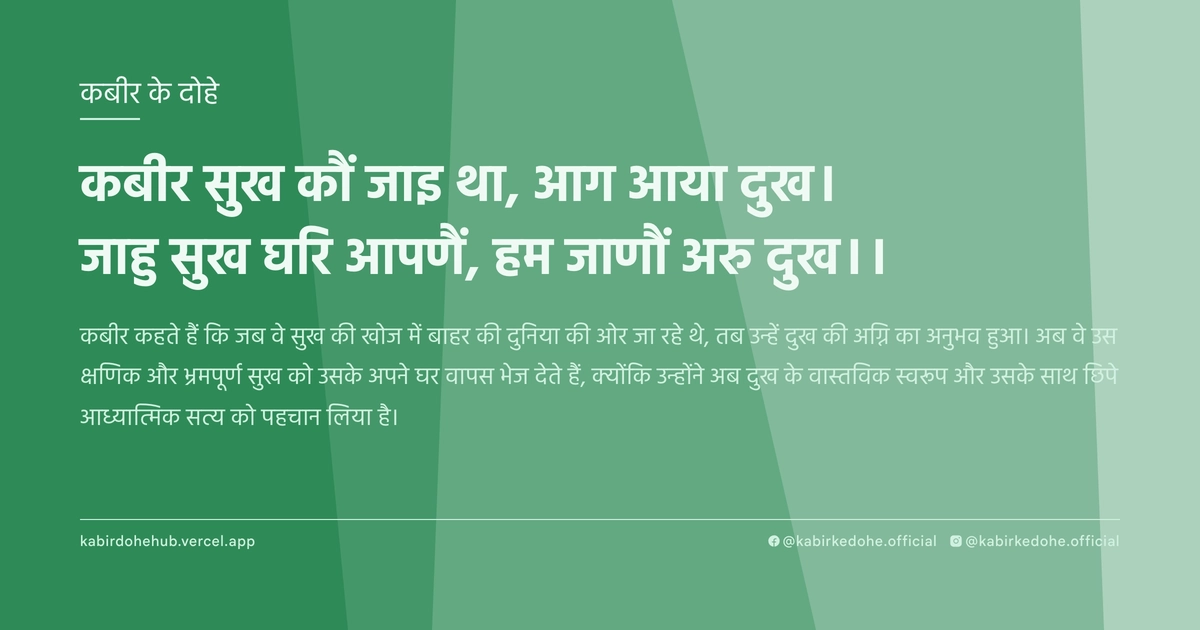
कबीर सुख कौं जाइ था, आग आया दुख।
जाहु सुख घरि आपणैं, हम जाणौं अरु दुख।।
Kabir sukh kaun jaai tha, aag aaya dukh. Jahu sukh ghari aapnai, hum jaanoun aru dukh.
इस पृष्ठ पर इस कबीर दोहे का अर्थ (meaning), हिंदी व्याख्या और अंग्रेज़ी अनुवाद, दार्शनिक विश्लेषण और व्यावहारिक जीवन सीख दी गई है। यह दोहा दुख और सुख (Sorrow and Joy) विषय से जुड़ा है — Kabir doha meaning and explanation in Hindi and English.
अर्थ (Meaning):
कबीर कहते हैं कि जब वे सुख की खोज में बाहर की दुनिया की ओर जा रहे थे, तब उन्हें दुख की अग्नि का अनुभव हुआ। अब वे उस क्षणिक और भ्रमपूर्ण सुख को उसके अपने घर वापस भेज देते हैं, क्योंकि उन्होंने अब दुख के वास्तविक स्वरूप और उसके साथ छिपे आध्यात्मिक सत्य को पहचान लिया है।
Kabir explains that while he was venturing outward in pursuit of worldly pleasure, he was instead met by the fire of suffering. He now dismisses that illusory happiness to its own abode, for he has come to deeply understand the nature of pain and the profound spiritual truth that resides within it.
व्याख्या (Interpretation):
इस दोहे का शाब्दिक अर्थ है कि सुख की तलाश में दुख मिला। लेकिन गहरा आध्यात्मिक अर्थ यह है कि 'सुख' जिसे हम बाहरी दुनिया, वस्तुओं या रिश्तों में खोजते हैं, वह वास्तव में माया का एक जाल है। जब साधक इस बाहरी सुख के पीछे भागता है, तो वह अनिवार्य रूप से दुख की अग्नि में जलता है क्योंकि वह नश्वरता से जुड़ रहा है। यहाँ 'दुख' केवल पीड़ा नहीं है, बल्कि वह जागृति है जो हमें बताती है कि हम गलत दिशा में जा रहे हैं। यह निर्गुण भक्ति का सार है: जब तक अहंकार (I) सुख खोजता है, वह दुख पाता है; लेकिन जब वह दुख को स्वीकार कर उसके पार जाता है, तो वह उस आनंद (Bliss) को पाता है जो सुख-दुख के द्वंद्व से परे है। यह अद्वैत वेदांत के उस सत्य को दर्शाता है जहाँ आत्मा को यह बोध होता है कि बाहरी जगत केवल एक प्रतिबिंब है और वास्तविक शांति केवल अंतर्मुखी होने पर मिलती है।
Literally, the verse speaks of finding pain while seeking pleasure. Metaphorically, it addresses the fundamental human error of seeking 'Sukh' (happiness) in the external realm, which is the domain of Maya (illusion). The 'fire of suffering' is not a punishment, but a divine catalyst that incinerates the ego's delusions. In the framework of Nirgun Bhakti, the pursuit of pleasure is a movement away from the Self, whereas the embrace of suffering—when viewed as a teacher—leads the seeker back to the formless Absolute. The paradox here is that by welcoming the 'fire' of sorrow, the seeker burns away the false identity, eventually realizing the non-duality of Atman and Brahman. The 'happiness' Kabir dismisses is the transient, conditional pleasure of the world, replacing it with an unconditional, eternal state of being that transcends the binary of joy and grief.
दार्शनिक विश्लेषण (Philosophical Analysis):
कबीर का यह दोहा उस कालखंड का प्रतिनिधित्व करता है जब भारतीय समाज कर्मकांडों और बाहरी आडंबरों में उलझा हुआ था। कबीर ने स्पष्ट किया कि मोक्ष किसी तीर्थ या मंदिर में नहीं, बल्कि चेतना के रूपांतरण में है। वे यहाँ 'सुख' को एक भ्रम के रूप में प्रस्तुत करते हैं, जो सूफी मत के 'नफ्स' (अहंकार) के विनाश जैसा है। जब तक मनुष्य अपनी इच्छाओं के अधीन है, वह दुख के चक्र में घूमता रहेगा।
अद्वैत वेदांत के दृष्टिकोण से, यह दोहा 'विवेक' (discrimination) की प्रक्रिया है। साधक यह पहचानता है कि जिसे वह सुख समझ रहा था, वह वास्तव में बंधन था। दुख यहाँ एक मार्गदर्शक की भूमिका निभाता है, जो साधक को बाहरी जगत से हटाकर आंतरिक शून्य की ओर ले जाता है। यह प्रक्रिया 'निवृत्ति मार्ग' का हिस्सा है, जहाँ संसार का त्याग भौतिक नहीं, बल्कि मानसिक होता है।
कबीर का विरोध केवल धर्मगुरुओं से नहीं था, बल्कि उस मानसिक संरचना से था जो सुख को 'प्राप्ति' मानती है। उनके अनुसार, सुख कोई वस्तु नहीं जिसे पाया जाए, बल्कि वह एक अवस्था है जो तब प्रकट होती है जब हम पाने की इच्छा को त्याग देते हैं। यह सूफीवाद के 'फना' (annihilation) के सिद्धांत से मिलता-जुलता है, जहाँ स्वयं का मिटना ही परमात्मा से मिलन का एकमात्र रास्ता है।
मनोवैज्ञानिक स्तर पर, यह दोहा संज्ञानात्मक विसंगति (cognitive dissonance) को संबोधित करता है। हम सुख चाहते हैं लेकिन हमें दुख मिलता है। कबीर इस विसंगति को स्वीकार करने और उसे आध्यात्मिक ईंधन में बदलने का सुझाव देते हैं। जब हम दुख को शत्रु के बजाय शिक्षक मानते हैं, तो हमारा प्रतिरोध समाप्त हो जाता है और हम शांति की ओर बढ़ते हैं।
अंततः, यह दोहा हमें सिखाता है कि जीवन का उद्देश्य सुख की खोज नहीं, बल्कि सत्य का साक्षात्कार है। सत्य अक्सर दुख की राख के नीचे दबा होता है। जब हम बाहरी सुख के मोह को 'उसके घर' यानी माया के साम्राज्य में वापस भेज देते हैं, तब हम उस अद्वैत स्थिति में पहुँचते हैं जहाँ न कुछ पाने की लालसा रहती है और न कुछ खोने का भय।
Kabir's verse emerges from a historical milieu characterized by rigid ritualism and caste hierarchies. By redefining 'happiness' and 'suffering,' Kabir dismantles the traditional religious promise that specific rituals or pilgrimages lead to paradise. He asserts that the pursuit of external pleasure is a diversion from the internal realization of the Divine. This aligns with the Sufi concept of 'Nafs,' where the lower self's desires must be subdued to experience the presence of the Beloved.
From the lens of Advaita Vedanta, this Doha illustrates the process of 'Viveka' or spiritual discrimination. The seeker realizes that the perceived happiness of the material world is merely a projection of Maya. The 'fire of suffering' acts as a purifying agent, stripping away the layers of ignorance (Avidya) that obscure the Atman. The movement is from the 'Pravritti' (outward-moving) path to the 'Nivritti' (inward-turning) path, where liberation is found not in the acquisition of pleasure, but in the cessation of craving.
Kabir's rejection of ritualism is evident in his dismissal of the 'home of happiness.' He suggests that the societal definition of a successful, happy life is actually a gilded cage. By inviting the 'fire' of sorrow, the seeker undergoes a psychological alchemy, transforming pain into power and longing into liberation. This mirrors the Sufi state of 'Fana,' the annihilation of the ego, which is the prerequisite for 'Baqa' or eternal subsistence in God.
Psychologically, the verse addresses the human tendency to avoid pain. Kabir suggests that avoidance is the primary obstacle to growth. By consciously acknowledging the presence of suffering and refusing to flee from it, the individual transcends the duality of pleasure and pain. This is a radical shift from the hedonistic pursuit of happiness to the stoic and mystical pursuit of Truth.
Ultimately, the philosophical core of this teaching is the realization that the Absolute is not found in the absence of pain, but in the presence of Awareness. When the seeker stops chasing the mirage of external joy and accepts the reality of their condition, the boundary between the individual soul and the Universal Consciousness dissolves, leading to a state of Sahaja (natural) enlightenment.
मूल संदेश (Core Message):
- बाहरी सुख की खोज वास्तव में दुख का निमंत्रण है।
- दुख वह अग्नि है जो अहंकार के मुखौटों को जलाती है।
- सच्चा आनंद पाने की इच्छा के विसर्जन में निहित है।
- माया के सुख को विदा करना ही आत्म-साक्षात्कार का मार्ग है।
- जब हम द्वंद्व से ऊपर उठते हैं, तब हम अनंत शांति पाते हैं।
- Seeking external happiness is an invitation to suffering.
- Pain is the fire that incinerates the masks of the ego.
- True bliss resides in the dissolution of the desire to possess.
- Dismissing the illusions of Maya is the path to Self-realization.
- When we transcend duality, we discover infinite peace.
व्यावहारिक उदाहरण (Practical Example):
एक समय की बात है, वाराणसी के घाटों पर रहने वाला एक वृद्ध बुनकर था जिसका नाम माधव था। माधव ने अपना पूरा जीवन बेहतरीन रेशमी वस्त्र बनाने में लगा दिया। उसका मानना था कि यदि वह शहर का सबसे समृद्ध बुनकर बन जाएगा, तो उसे वह परम सुख मिलेगा जिसकी वह तलाश कर रहा है। उसने दिन-रात मेहनत की, अपनी नींद त्यागी और केवल धन संचय के लक्ष्य में डूब गया।
जैसे-जैसे उसका धन बढ़ा, उसे लगा कि वह सुख के करीब है। उसने एक बड़ा घर बनाया और महंगे वस्त्र पहने। लेकिन एक समय ऐसा आया जब उसके परिवार में कलह बढ़ गई, उसके स्वास्थ्य ने साथ छोड़ दिया और उसके करीबी मित्र उससे दूर हो गए। वह जिस सुख की खोज में था, वह अब एक गहरे अकेलेपन और मानसिक पीड़ा में बदल चुका था। वह पूरी तरह टूट चुका था और खुद को दुख की अग्नि में जलता हुआ महसूस कर रहा था।
एक शाम, माधव एक पुराने संत के पास गया और रोते हुए बोला, "मैंने सुख पाने के लिए सब कुछ किया, लेकिन मुझे केवल दुख मिला। क्या सुख एक झूठ है?"
संत ने मुस्कुराते हुए माधव के हाथ में एक कच्चा सूत का टुकड़ा दिया और पूछा, "इस धागे में तुम्हें क्या दिखता है?"
माधव ने कहा, "यह केवल एक साधारण धागा है।"
संत ने जवाब दिया, "ठीक इसी तरह, तुम्हारा सुख भी इस धागे की तरह था—एक साधारण भ्रम। तुम सुख को बाहर खोज रहे थे, इसलिए तुम्हें दुख मिला। क्योंकि तुमने सुख को अपनी पहचान बना लिया था, और जब वह गया, तो तुम भी मिट गए। अब इस दुख को अपनाओ, क्योंकि यही वह आग है जो तुम्हारे अहंकार को जलाकर तुम्हें असली शांति की ओर ले जाएगी।"
माधव को कबीर की इस बात का बोध हुआ कि वह अब तक गलत दिशा में जा रहा था। उसने अपने धन और प्रतिष्ठा के मोह को 'उसके घर' वापस भेज दिया। उसने महसूस किया कि उसकी असली खुशी उस रेशम में नहीं थी, बल्कि उस शांति में थी जो उसे तब मिली जब उसने पाने की इच्छा छोड़ दी।
उसने अपनी कला का उपयोग अब धन कमाने के लिए नहीं, बल्कि दूसरों की सेवा के लिए करना शुरू किया। वह अब गरीब बच्चों को बुनाई सिखाता था।
उसकी आँखों में अब वह पुरानी लालसा नहीं थी, बल्कि एक गहरी स्थिरता थी। उसने जान लिया था कि दुख वास्तव में वह द्वार था जिसने उसे स्वयं से मिलवाया।
माधव अब वास्तव में सुखी था, लेकिन यह वह सुख नहीं था जिसे वह पहले खोज रहा था। यह एक ऐसा आनंद था जो किसी बाहरी परिस्थिति पर निर्भर नहीं था।
Once, in the ghats of Varanasi, lived an elderly weaver named Madhav. Madhav spent his entire life crafting the finest silk garments. He believed that if he could become the wealthiest weaver in the city, he would attain the ultimate happiness he had always craved. He worked tirelessly, sacrificing sleep and peace, consumed by the singular goal of accumulating wealth.
As his riches grew, he felt he was closing in on happiness. He built a grand house and wore opulent clothes. However, a time came when conflict tore through his family, his health deteriorated, and his closest friends drifted away. The happiness he had chased had transformed into a profound loneliness and mental agony. He felt as though he were being consumed by a fire of suffering.
One evening, Madhav approached an old saint, weeping, and asked, "I did everything to find happiness, yet I found only pain. Is happiness a lie?"
The saint smiled, handed Madhav a piece of raw cotton thread, and asked, "What do you see in this thread?"
Madhav replied, "It is just a simple thread."
The saint answered, "Exactly. Your happiness was like this thread—a simple illusion. You sought happiness externally, and thus you encountered suffering. Because you made happiness your identity, when it vanished, you felt you were vanishing too. Now, embrace this pain, for it is the very fire that will burn away your ego and lead you to true peace."
Madhav suddenly understood the essence of Kabir's wisdom: he had been walking in the wrong direction. He consciously decided to send his attachment to wealth and prestige back to 'its own home.' He realized that his true fulfillment did not lie in the silk, but in the stillness that arrived once he ceased the act of grasping.
He began using his craft not for profit, but for service, teaching weaving to orphaned children in the neighborhood.
There was no longer a restless longing in his eyes, but a deep, unshakable stability. He recognized that suffering was actually the gateway that had introduced him to his own Soul.
Madhav was now truly happy, but it was not the happiness he had initially sought. It was a state of bliss that depended on no external circumstance.
अभ्यास मार्गदर्शन (Practice Guidance):
- प्रतिदिन 20 मिनट मौन बैठें और अपने भीतर उठने वाले 'दुख' या 'असंतोष' को बिना किसी निर्णय के केवल देखें। इसे रोकने की कोशिश न करें, बल्कि इसे एक शिक्षक की तरह महसूस करें।
- एक डायरी लिखें जिसमें आप उन क्षणों को दर्ज करें जब आपने किसी बाहरी वस्तु या व्यक्ति से सुख की उम्मीद की और अंततः निराश हुए। विश्लेषण करें कि वह निराशा आपको स्वयं के करीब कैसे ले आई।
- व्यवहार परिवर्तन: जब भी आप किसी चीज़ को पाने की तीव्र इच्छा (लालसा) महसूस करें, तो रुकें और स्वयं से पूछें, "क्या मैं सुख खोज रहा हूँ या केवल एक भ्रम?" इस जागरूकता के साथ उस इच्छा को धीरे से विदा करें।
- निदानात्मक चेकलिस्ट (Diagnostic Checklist): क्या मैं अभी भी अपनी खुशी को दूसरों की प्रशंसा या भौतिक उपलब्धियों से जोड़ रहा हूँ? क्या मैं दुख आने पर घबराता हूँ या उसे आत्म-मंथन के अवसर के रूप में देखता हूँ? क्या मेरी शांति बाहरी परिस्थितियों की गुलाम है?
- Sit in silence for 20 minutes daily, observing any 'suffering' or 'dissatisfaction' that arises within without judgment. Do not try to suppress it; instead, perceive it as a spiritual teacher.
- Maintain a journal recording moments where you expected happiness from an external object or person and were ultimately disappointed. Analyze how that disappointment actually brought you closer to your inner self.
- Behavioral Shift: Whenever you feel an intense craving or longing for something, pause and ask yourself, "Am I seeking true bliss, or merely a mirage?" With this awareness, gently release the attachment.
- Diagnostic Checklist: Am I still linking my happiness to external praise or material achievements? Do I panic when suffering arrives, or do I view it as an opportunity for self-inquiry? Is my peace a slave to external circumstances?
चिंतन प्रश्न (Reflection Questions):
- मेरी वह कौन सी 'सुख' की परिभाषा है जिसे मैं दुनिया के सामने प्रदर्शित करता हूँ, लेकिन अंदर से वह मुझे खाली महसूस कराती है?
- यदि मेरा सारा सामाजिक दर्जा और भौतिक सुख आज छीन लिया जाए, तो मेरे भीतर क्या बचेगा?
- मैं अपने जीवन के दुखों को मिटाने की कोशिश करता हूँ या उनके माध्यम से सत्य को जानने का प्रयास करता हूँ?
- क्या मेरा 'डिजिटल व्यक्तित्व' (Social Media Ego) वास्तव में सुख का अनुभव कर रहा है, या यह केवल एक अंतहीन दौड़ है?
- वह कौन सा डर है जो मुझे दुख को स्वीकार करने से रोकता है, और वह डर मुझे किस भ्रम से बांधे हुए है?
- What is the definition of 'happiness' that I project to the world, yet leaves me feeling empty inside?
- If all my social status and material comforts were stripped away today, what would remain of me?
- Do I spend my energy trying to erase my suffering, or do I attempt to discover the truth through it?
- Is my 'digital persona' actually experiencing joy, or is it merely participating in an endless race of comparison?
- What is the specific fear that prevents me from embracing my pain, and what illusion is that fear anchoring me to?