
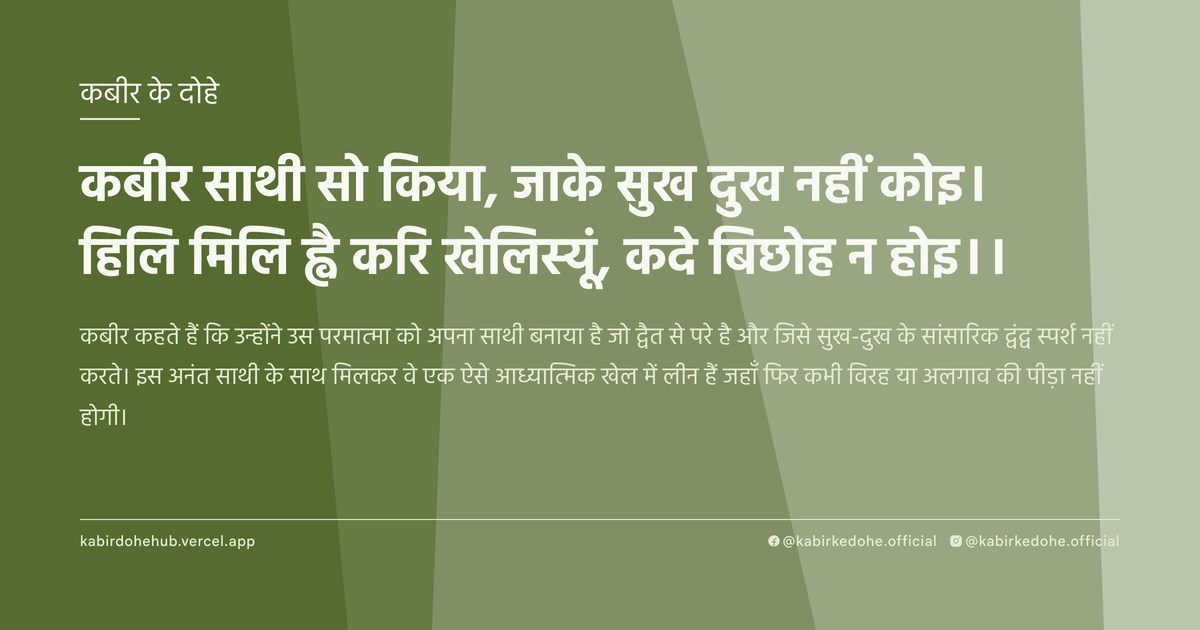
कबीर साथी सो किया, जाके सुख दुख नहीं कोइ।
हिलि मिलि ह्वै करि खेलिस्यूं, कदे बिछोह न होइ।।
Kabir saathi so kiya, jaake sukh dukh nahi koi. Hili mili hvai kari khelisyun, kade bichoh na hoye.
इस पृष्ठ पर इस कबीर दोहे का अर्थ (meaning), हिंदी व्याख्या और अंग्रेज़ी अनुवाद, दार्शनिक विश्लेषण और व्यावहारिक जीवन सीख दी गई है। यह दोहा निर्गुण ब्रह्म (Nirguna Brahman) विषय से जुड़ा है — Kabir doha meaning and explanation in Hindi and English.
अर्थ (Meaning):
कबीर कहते हैं कि उन्होंने उस परमात्मा को अपना साथी बनाया है जो द्वैत से परे है और जिसे सुख-दुख के सांसारिक द्वंद्व स्पर्श नहीं करते। इस अनंत साथी के साथ मिलकर वे एक ऐसे आध्यात्मिक खेल में लीन हैं जहाँ फिर कभी विरह या अलगाव की पीड़ा नहीं होगी।
Kabir declares that he has chosen the Divine as his sole companion, a Being who exists beyond the dualities of pleasure and pain. By merging with this eternal presence, he engages in a cosmic play of consciousness where the agony of separation is forever extinguished.
व्याख्या (Interpretation):
यहाँ 'साथी' शब्द केवल एक मित्र नहीं, बल्कि अंतरात्मा के साथ एकात्मता का प्रतीक है। कबीर उस अवस्था की बात कर रहे हैं जहाँ व्यक्ति अपनी सीमित पहचान (अहंकार) को त्यागकर उस निराकार ब्रह्म में विलीन हो जाता है। सुख और दुख माया के दो पहलू हैं जो केवल शरीर और मन के स्तर पर कार्य करते हैं; आत्मा इनसे अप्रभावित है। 'खेलिस्यूं' शब्द यहाँ जीवन की लीला को दर्शाता है, जहाँ साधक अब जीवन के संघर्षों को बोझ नहीं, बल्कि एक दिव्य क्रीड़ा मानता है। यह अद्वैत वेदांत की उस स्थिति को दर्शाता है जहाँ ज्ञाता, ज्ञान और ज्ञेय एक हो जाते हैं, जिससे विछोह या दूरी की संभावना समाप्त हो जाती है।
The term 'companion' here transcends human friendship, symbolizing the union of the individual soul with the Universal Consciousness. Kabir refers to a state where the practitioner sheds the limited ego to merge with the formless Brahman. Pleasure and pain are mere fluctuations of Maya, operating only at the levels of body and mind; the Atman remains untouched. The word 'play' (khel) signifies the transformation of life's struggles into a divine dance of consciousness. This aligns with Advaita Vedanta, where the observer, the observed, and the process of observation become one, rendering the concept of separation or 'birha' logically impossible.
दार्शनिक विश्लेषण (Philosophical Analysis):
कबीर का यह दोहा उनके 'निर्गुण भक्ति' मार्ग का सार है, जहाँ ईश्वर किसी मूर्ति या मंदिर में नहीं, बल्कि स्वयं के भीतर स्थित है। ऐतिहासिक रूप से, कबीर ने उस समय के कट्टरपंथ और कर्मकांडों का विरोध किया जो ईश्वर को बाहरी दुनिया में खोजते थे। वे सिखाते हैं कि जब तक हम सुख-दुख के द्वंद्व में फंसे हैं, हम वास्तव में अलग हैं।
यह दर्शन सूफी मत के 'फना' (अहंकार का विनाश) से गहराई से जुड़ा है। जब 'मैं' मिट जाता है, तो केवल 'वह' बचता है। यहाँ सुख और दुख का अभाव शून्यता नहीं है, बल्कि एक ऐसी पूर्णता है जिसे शब्दों में नहीं बांधा जा सकता। यह अवस्था 'समरसता' की है, जहाँ विपरीत भावनाएं एक ही बिंदु पर विलीन हो जाती हैं।
अद्वैत वेदांत के अनुसार, विछोह केवल एक भ्रम है। हम कभी अलग थे ही नहीं, बस अज्ञानता के कारण स्वयं को अलग महसूस करते हैं। कबीर इस भ्रम को तोड़कर उस शाश्वत सत्य की ओर इशारा करते हैं जहाँ आत्मा और परमात्मा का मिलन स्थायी है।
कबीर का दृष्टिकोण मनोवैज्ञानिक रूप से भी क्रांतिकारी है। वे हमें सिखाते हैं कि भावनात्मक स्थिरता बाहरी परिस्थितियों पर नहीं, बल्कि आंतरिक जुड़ाव पर निर्भर करती है। जब साथी स्वयं परमात्मा है, तो दुनिया का कोई भी तूफ़ान विचलित नहीं कर सकता।
अंततः, यह दोहा हमें ritualism (कर्मकांड) से हटाकर real-ization (साक्षात्कार) की ओर ले जाता है। यह बताता है कि सच्ची भक्ति मंदिर जाने में नहीं, बल्कि उस मौन उपस्थिति को महसूस करने में है जो हर सांस में मौजूद है।
This couplet encapsulates the essence of Kabir's 'Nirgun Bhakti', where the Divine is not found in idols or temples but within the self. Historically, Kabir challenged the orthodoxy of his era, which sought God through external rituals and rigid caste hierarchies. He posits that as long as we are tethered to the duality of pleasure and pain, we remain in a state of perceived separation.
This philosophy resonates deeply with the Sufi concept of 'Fana'—the annihilation of the ego. When the 'I' is extinguished, only the 'He' remains. The absence of pleasure and pain here is not a void or numbness, but a state of transcendental wholeness that defies linguistic description. It is the state of 'Samrasata' (equanimity), where opposites merge into a single point of truth.
According to Advaita Vedanta, separation is a cosmic illusion (Maya). We were never truly separate; we only perceived distance due to ignorance (Avidya). Kabir points toward the eternal truth where the union of Atman and Brahman is permanent and irrevocable.
Psychologically, Kabir’s approach is revolutionary. He suggests that emotional stability is not dependent on external circumstances but on internal alignment. When the Divine is the companion, no worldly storm can shake the practitioner's inner peace.
Ultimately, this Doha shifts the focus from ritualism to realization. It asserts that true devotion is not found in the performance of rites, but in the conscious experience of the silent presence that permeates every breath.
मूल संदेश (Core Message):
- बाहरी रिश्तों की अस्थिरता को पहचानें और आंतरिक स्थिरता खोजें।
- सुख और दुख को सिक्के के दो पहलुओं की तरह देखें, दोनों अस्थायी हैं।
- अहंकार का विसर्जन ही उस शाश्वत साथी से मिलन का एकमात्र मार्ग है।
- जीवन को एक बोझ नहीं, बल्कि एक दिव्य खेल (लीला) की तरह जिएं।
- सच्चा मिलन तब होता है जब 'मैं' और 'तू' का भेद समाप्त हो जाता है।
- Recognize the instability of external bonds and seek the anchor within.
- View pleasure and pain as two sides of the same coin; both are transient.
- The dissolution of the ego is the only gateway to the Eternal Companion.
- Experience life not as a burden, but as a divine play of consciousness.
- True union occurs only when the distinction between 'I' and 'Thou' vanishes.
व्यावहारिक उदाहरण (Practical Example):
वाराणसी के घाटों पर रहने वाले एक वृद्ध बुनकर, माधव की कहानी है। माधव ने जीवन भर रेशमी साड़ियाँ बुनीं, लेकिन उसका मन हमेशा इस बात से परेशान रहता था कि उसके बेटे उसे छोड़कर शहर चले गए हैं। वह अकेलेपन और दुख के गहरे सागर में डूबा रहता था।
एक दिन वह एक फकीर के पास गया और अपनी व्यथा सुनाई। फकीर ने उसे कबीर का यह दोहा सुनाया और कहा, 'माधव, तुम इंसानों में साथी ढूंढ रहे हो, इसलिए दुख है। उस साथी को ढूंढो जो कभी नहीं बदलता।'
माधव ने अपनी बुनाई को ही ध्यान बना लिया। जब वह धागों को जोड़ता, तो वह यह महसूस करता कि वह केवल धागे नहीं, बल्कि अपनी आत्मा को परमात्मा से जोड़ रहा है। उसने अपने अकेलेपन को 'एकांत' में बदल दिया।
शुरुआत में उसे डर लगा, लेकिन धीरे-धीरे उसने महसूस किया कि जब वह पूरी तरह से अपने काम में लीन होता है, तो उसके भीतर एक असीम शांति का अनुभव होता है। उसे अब बेटों की याद सताती तो थी, पर वह दुख उसे तोड़ता नहीं था।
उसने पाया कि वह अब अकेला नहीं है। हर सांस में, हर धागे की गूंज में, उसे एक ऐसा साथी महसूस होने लगा जो उससे कभी अलग नहीं हो सकता।
एक समय ऐसा आया जब माधव के चेहरे पर एक स्थायी मुस्कान रहने लगी। लोग उससे पूछने लगे कि उसके दुख का राज क्या है। वह बस मुस्कुराकर कहता, 'मेरा साथी अब कभी नहीं जाता।'
उसकी बुनाई में अब एक अलग ही चमक थी, क्योंकि वह अब केवल कपड़ा नहीं, बल्कि प्रेम बुन रहा था। उसने बाहरी दुनिया की अपेक्षाओं को त्याग दिया था।
अंततः, माधव ने जाना कि विछोह केवल मन का एक खेल था। जब उसने स्वयं को उस निराकार साथी के हवाले कर दिया, तो वह दुनिया में रहते हुए भी दुनिया से परे हो गया।
Consider the story of Madhav, an elderly weaver living on the ghats of Varanasi. For decades, Madhav wove exquisite silk sarees, but his heart was heavy with the grief of his sons, who had abandoned him for the city. He lived in a profound ocean of loneliness and sorrow.
One day, he approached a wandering mystic and shared his agony. The mystic recited this Doha of Kabir and told him, 'Madhav, you seek companionship in humans, and thus you find pain. Seek the Companion who never changes.'
Madhav began to treat his weaving as a form of meditation. As he interlaced the threads, he visualized himself connecting his own soul to the Divine. He consciously transformed his 'loneliness' into 'solitude'.
Initially, he felt fear and doubt, but gradually, he noticed that when he was fully immersed in his craft, an infinite peace descended upon him. He still remembered his sons, but the grief no longer had the power to shatter him.
He discovered that he was no longer alone. In every breath, in the rhythmic hum of the loom, he felt a presence that could never depart from him.
Eventually, a permanent smile graced Madhav's face. People began to ask him the secret of his sudden contentment. He would simply smile and say, 'My Companion has finally arrived and will never leave.'
There was now a celestial glow in his weaving, for he was no longer weaving mere fabric, but weaving love itself. He had relinquished all expectations from the external world.
In the end, Madhav realized that separation was merely a game played by the mind. By surrendering himself to the Formless Companion, he lived in the world, yet remained untouched by it.
अभ्यास मार्गदर्शन (Practice Guidance):
- प्रतिदिन 20 मिनट मौन ध्यान करें, जहाँ आप किसी विचार को पकड़ने के बजाय केवल अपनी उपस्थिति को महसूस करें।
- एक जर्नल लिखें जिसमें आप उन क्षणों को दर्ज करें जब आपने 'अकेलेपन' को 'दिव्य एकांत' में बदला।
- जब भी दुख या सुख की तीव्र लहर आए, स्वयं से पूछें: 'क्या यह लहर मेरी आत्मा को छू सकती है, या यह केवल मन का एक विचार है?'
- डायग्नोस्टिक चेकलिस्ट: क्या मैं अभी भी बाहरी लोगों से अपनी खुशी की उम्मीद कर रहा हूँ? क्या मैं विछोह के डर से रिश्तों को पकड़ कर बैठा हूँ? यदि हाँ, तो मैं अभी भी द्वैत में हूँ।
- Practice 20 minutes of silent meditation daily, focusing not on thoughts, but on the sheer sense of 'being' and presence.
- Maintain a journal to record moments where you successfully transformed 'loneliness' into 'divine solitude'.
- Whenever a strong wave of joy or sorrow arises, ask yourself: 'Does this wave touch my essence, or is it merely a flicker of the mind?'
- Diagnostic Checklist: Am I still projecting my happiness onto others? Am I clinging to relationships out of fear of separation? If yes, I am still operating within the illusion of duality.
चिंतन प्रश्न (Reflection Questions):
- मेरा वह कौन सा हिस्सा है जो अभी भी विछोह से डरता है, और वह डर मुझे किस पहचान से बांधे हुए है?
- यदि मैं अपनी सामाजिक और पारिवारिक पहचान खो दूँ, तो मेरे भीतर क्या शेष बचेगा?
- क्या मेरी भक्ति वास्तव में निराकार है, या मैंने ईश्वर को भी अपनी इच्छाओं के अनुसार एक रूप दे दिया है?
- मैं अपनी डिजिटल पहचान (सोशल मीडिया ईगो) के माध्यम से किस तरह के 'नकली साथ' की तलाश कर रहा हूँ?
- क्या मैं वास्तव में सुख और दुख से ऊपर उठना चाहता हूँ, या मैं केवल दुख से बचना चाहता हूँ?
- Which part of me still fears separation, and what identity is that fear tethering me to?
- If I were to strip away my social and familial identities, what would remain at my core?
- Is my devotion truly to the Formless, or have I merely projected my own desires onto a conceptual God?
- In what ways am I seeking 'artificial companionship' through my digital ego and social media presence?
- Do I genuinely desire to transcend pleasure and pain, or am I simply trying to avoid pain?