
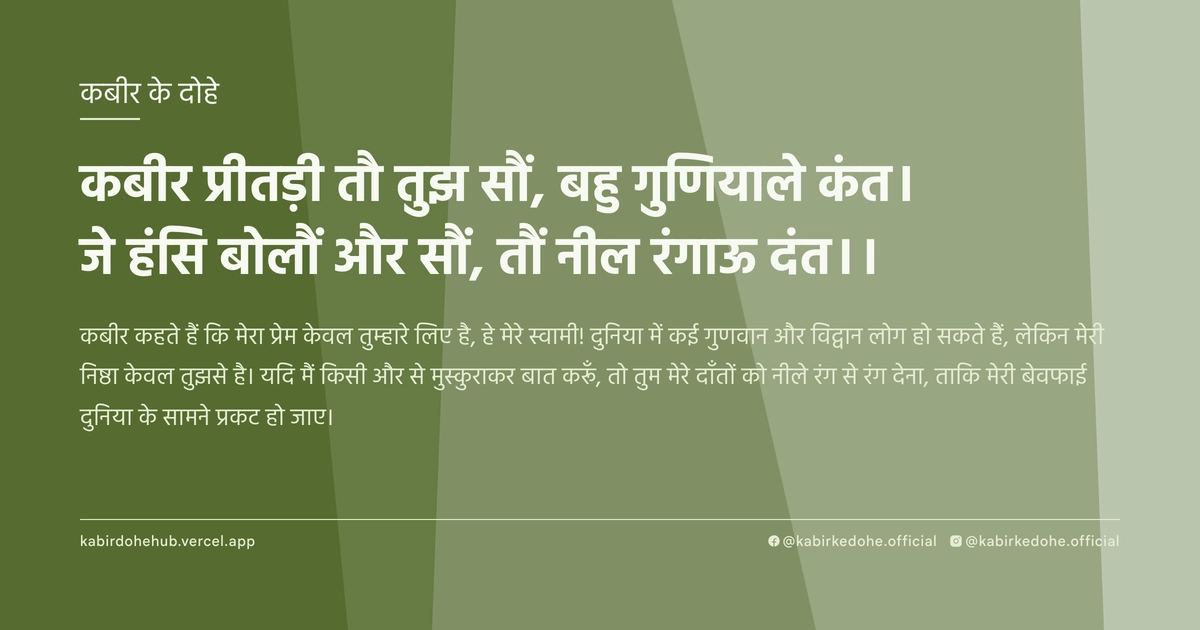
कबीर प्रीतड़ी तौ तुझ सौं, बहु गुणियाले कंत।
जे हंसि बोलौं और सौं, तौं नील रंगाऊ दंत।।
Kabir preetadi tau tujh saun, bahu guniyale kant. Je hansi bolun aur saun, taun neel rangau dant.
इस पृष्ठ पर इस कबीर दोहे का अर्थ (meaning), हिंदी व्याख्या और अंग्रेज़ी अनुवाद, दार्शनिक विश्लेषण और व्यावहारिक जीवन सीख दी गई है। यह दोहा भक्ति (Bhakti) विषय से जुड़ा है — Kabir doha meaning and explanation in Hindi and English.
अर्थ (Meaning):
कबीर कहते हैं कि मेरा प्रेम केवल तुम्हारे लिए है, हे मेरे स्वामी! दुनिया में कई गुणवान और विद्वान लोग हो सकते हैं, लेकिन मेरी निष्ठा केवल तुझसे है। यदि मैं किसी और से मुस्कुराकर बात करूँ, तो तुम मेरे दाँतों को नीले रंग से रंग देना, ताकि मेरी बेवफाई दुनिया के सामने प्रकट हो जाए।
Kabir declares that his love is reserved solely for the Divine Beloved. While there may be many virtuous or learned individuals in the world, his devotion is singular. He asserts that if he should ever smile or converse with another in a way that betrays this sacred bond, may his teeth be dyed blue as a mark of his infidelity.
व्याख्या (Interpretation):
यह दोहा आत्मा और परमात्मा के बीच के अनन्य प्रेम को दर्शाता है। यहाँ 'कंत' शब्द ईश्वर के लिए प्रयुक्त हुआ है, जो एक प्रेमी की भूमिका में है। शाब्दिक अर्थ में यह ईर्ष्या जैसा लग सकता है, लेकिन आध्यात्मिक स्तर पर यह 'एकनिष्ठ भक्ति' का प्रतीक है। यह निर्गुण भक्ति की उस अवस्था को दर्शाता है जहाँ साधक के लिए संसार की समस्त आकर्षण शक्तियाँ शून्य हो जाती हैं। 'नीले दाँत' का रूपक सामाजिक कलंक और आंतरिक ग्लानि का प्रतीक है, जो यह बताता है कि परमात्मा से विमुख होना आत्मा के लिए सबसे बड़ा पतन है। यह अद्वैत वेदांत के उस सत्य की ओर संकेत करता है जहाँ केवल एक ही सत्ता सत्य है, और उसके अलावा सब माया है।
This couplet illustrates the exclusive, singular love between the Atman (soul) and the Paramatman (Supreme Soul). The term 'Kant' refers to the Divine as the Beloved, framing the spiritual journey as a romantic longing. While it may superficially appear as jealousy, it is actually a metaphor for 'Ek-Nishtha' or unwavering devotion. It represents the state of Nirgun Bhakti where all worldly attractions vanish in the presence of the Formless. The image of 'blue-dyed teeth' serves as a symbol of spiritual infidelity and the resulting shame, suggesting that any diversion from the Divine is a betrayal of one's own essence. It aligns with Advaita Vedanta, emphasizing that since only the Brahman is real, any attachment to the illusory world (Maya) is a deviation from Truth.
दार्शनिक विश्लेषण (Philosophical Analysis):
कबीर का यह दोहा मध्यकालीन भारत के उस सामाजिक परिवेश में लिखा गया था जहाँ धर्म बाहरी कर्मकांडों और सामाजिक श्रेणियों में बँटा हुआ था। कबीर ने इन सभी को नकारते हुए 'प्रेम मार्ग' को सर्वोच्च माना। यहाँ उनका विरोध केवल मनुष्यों से नहीं, बल्कि उस 'अहंकार' से है जो साधक को यह विश्वास दिलाता है कि वह ईश्वर के साथ-साथ संसार के सुखों का भी उपभोग कर सकता है।
दार्शनिक रूप से, यह सूफीवाद के 'इश्क-ए-हकीकी' (ईश्वरीय प्रेम) और 'इश्क-ए-मजाजी' (सांसारिक प्रेम) के अंतर को स्पष्ट करता है। कबीर यह स्थापित कर रहे हैं कि जब तक हृदय में संसार के प्रति मोह बना रहता है, तब तक परमात्मा का पूर्ण साक्षात्कार संभव नहीं है। यह एक प्रकार का आध्यात्मिक 'विनाश' है—पुराने व्यक्तित्व का विनाश ताकि नया, दैवीय व्यक्तित्व जन्म ले सके।
अद्वैत वेदांत के परिप्रेक्ष्य में, यह दोहा द्वैत (दो होने का भाव) को समाप्त करने की पुकार है। जब भक्त कहता है कि वह किसी और से बात नहीं करेगा, तो वह वास्तव में अपनी चेतना को बाहरी जगत से हटाकर आंतरिक केंद्र की ओर मोड़ रहा है। यह 'चित्त' की एकाग्रता की पराकाष्ठा है।
कबीर यहाँ ritualism (कर्मकांड) के बजाय internal transformation (आंतरिक रूपांतरण) पर जोर देते हैं। उनके लिए भक्ति कोई मंदिर या मस्जिद जाने की क्रिया नहीं है, बल्कि एक ऐसी मानसिक स्थिति है जहाँ प्रेमी और प्रियतम के बीच का अंतर मिट जाए।
अंततः, यह दोहा अहंकार के विसर्जन की बात करता है। 'नीले दाँत' का डर वास्तव में उस पवित्रता की रक्षा है जो एक साधक ने कठिन तपस्या से अर्जित की होती है। यह चेतावनी है कि माया का एक छोटा सा स्पर्श भी आध्यात्मिक उपलब्धि को दूषित कर सकता है।
This couplet was composed during a period of intense religious fragmentation in medieval India, where faith was often reduced to rituals and caste hierarchies. Kabir rejects these externalities, championing the 'Path of Love' as the only authentic route to the Divine. His opposition is not directed at people, but at the 'ego' that lures the seeker into believing they can simultaneously possess worldly pleasures and spiritual liberation.
Philosophically, this aligns with the Sufi distinction between 'Ishq-e-Majazi' (metaphorical/worldly love) and 'Ishq-e-Haqiqi' (Divine love). Kabir asserts that as long as the heart harbors attachments to the transient world, the full realization of the Eternal is impossible. It is a call for the annihilation of the lower self (Fana) to make room for the Divine presence.
From the lens of Advaita Vedanta, this is a plea to dissolve duality. When the devotee vows not to 'speak' to another, they are consciously withdrawing their awareness from the fragmented external world and centering it within the singular Truth. It is the pinnacle of 'Ekagrata' or one-pointed concentration.
Kabir emphasizes internal transformation over ritualism. For him, devotion is not an act of visiting a temple or mosque, but a psychological state where the boundary between the lover and the Beloved evaporates. The focus is on the purity of intent rather than the performance of piety.
Ultimately, the poem addresses the dissolution of the ego. The fear of 'blue teeth' is a metaphor for protecting the sanctity of a hard-won spiritual state. It serves as a warning that even a momentary lapse into the illusions of Maya can contaminate the purity of a soul's alignment with the Infinite.
मूल संदेश (Core Message):
- आध्यात्मिक मार्ग पर भटकाव ही सबसे बड़ी बाधा है।
- पूर्ण समर्पण के बिना परमात्मा की प्राप्ति असंभव है।
- बाहरी आकर्षण केवल आत्मा के भ्रम (माया) हैं।
- एकनिष्ठ प्रेम ही अहंकार को नष्ट करने का एकमात्र साधन है।
- सत्य एक है; अनेकता केवल दृष्टि का भ्रम है।
- Diversion is the greatest obstacle on the spiritual path.
- Realization of the Divine is impossible without total surrender.
- External attractions are merely illusions (Maya) of the soul.
- Singular love is the only means to annihilate the ego.
- Truth is One; multiplicity is but an illusion of perception.
व्यावहारिक उदाहरण (Practical Example):
एक समय की बात है, बनारस के घाटों पर रहने वाला एक वृद्ध बुनकर था जिसका नाम माधव था। माधव अपनी पूरी जिंदगी सूत कातने और कपड़े बुनने में बिता चुका था, लेकिन उसका मन हमेशा एक अनजानी तड़प से भरा रहता था। वह शहर के बड़े पंडितों और मौलवियों की बातें सुनता, पर उसे संतोष नहीं मिलता था।
एक दिन उसने कबीर के इस दोहे को सुना और उसे महसूस हुआ कि वह अब तक 'बहुत से' लोगों को खुश करने की कोशिश कर रहा था—पड़ोसियों को, समाज को, और अपनी झूठी प्रतिष्ठा को। उसने महसूस किया कि उसकी भक्ति केवल एक दिखावा थी, जबकि उसका हृदय वास्तव में खाली था।
माधव ने एक कठिन संकल्प लिया। उसने तय किया कि वह अपनी बाहरी दुनिया की सारी व्यर्थ चर्चाओं को छोड़ देगा। उसने अपने काम को ही अपनी प्रार्थना बना लिया। जब वह करघे पर धागे पिरोता, तो वह केवल उस एक परमात्मा का स्मरण करता।
शुरुआत में लोगों ने उसका मजाक उड़ाया। उसके मित्र कहते, "माधव पागल हो गया है, अब वह हमसे हंसकर बात नहीं करता।" लेकिन माधव के भीतर एक अद्भुत शांति छाने लगी थी। उसने पाया कि जब वह दुनिया की प्रशंसा की इच्छा छोड़ देता है, तो उसका काम और भी निखरा हुआ होने लगा।
एक दिन एक धनी व्यापारी उसके पास आया और उसे बहुत बड़ा लालच दिया कि वह उसके लिए विशेष शाही वस्त्र बनाए और बदले में उसे सोने की मोहरें देगा। व्यापारी ने माधव को बहुत फुसलाया और उसकी प्रशंसा की।
माधव के मन में एक पल के लिए लालच आया। उसे लगा कि इस धन से वह अपने परिवार की गरीबी दूर कर सकता है। वह मुस्कुराकर व्यापारी की बातों में आने ही वाला था कि उसे कबीर के 'नीले दाँत' की चेतावनी याद आई।
उसे अहसास हुआ कि यह लालच उस 'दूसरे' से बात करने जैसा है, जो उसे उसके प्रियतम (परमात्मा) से दूर ले जाएगा। उसने विनम्रतापूर्वक उस प्रस्ताव को ठुकरा दिया और अपनी साधारण सी कुटिया में वापस लौट गया।
उस क्षण माधव को एक ऐसी आंतरिक खुशी मिली जो सोने की मोहरों से कहीं अधिक मूल्यवान थी। उसने अनुभव किया कि जब हम अपनी पूरी निष्ठा एक ही सत्य को समर्पित कर देते हैं, तो संसार की सारी कृत्रिमता फीकी पड़ जाती है।
उसकी आँखों में आँसू थे, लेकिन चेहरे पर एक दिव्य मुस्कान थी। उसने जान लिया था कि सच्चा प्रेम वह नहीं जो सब कुछ पाने की कोशिश करे, बल्कि वह है जो केवल एक को पाने के लिए सब कुछ छोड़ने का साहस रखे।
माधव अब केवल एक बुनकर नहीं था, वह एक जीवित उदाहरण बन गया था कि कैसे एक साधारण मनुष्य अपनी एकाग्रता और प्रेम के बल पर ईश्वरत्व को प्राप्त कर सकता है।
Once, in the ghats of Varanasi, lived an elderly weaver named Madhav. Madhav had spent his entire life spinning yarn and weaving cloth, yet his heart was always filled with an unknown longing. He listened to the discourses of great pundits and maulvis, but found no lasting peace.
One day, he encountered this specific doha of Kabir and realized that he had spent his life trying to please 'too many'—his neighbors, the society, and his own false image. He saw that his devotion was merely a performance, while his inner self remained empty.
Madhav took a rigorous vow. He decided to cease all futile worldly conversations. He transformed his labor into his prayer. As he threaded the loom, he focused his entire consciousness on the one Divine Presence.
Initially, people mocked him. His friends would say, "Madhav has gone mad; he no longer speaks to us with a smile." However, a profound silence and peace began to bloom within him. He discovered that by abandoning the desire for social validation, the quality of his work actually improved.
One day, a wealthy merchant approached him with a tempting offer to weave royal garments in exchange for gold coins. The merchant flattered Madhav extensively, praising his skill to lure him into a lucrative contract.
For a fleeting moment, greed flickered in Madhav's heart. He thought of how this wealth could erase his family's poverty. He was on the verge of smiling and agreeing to the merchant's terms when Kabir's warning of 'blue teeth' flashed across his mind.
He realized that this greed was like 'conversing with another'—a diversion that would pull him away from his Beloved. He politely declined the offer and returned to the simplicity of his humble hut.
In that moment, Madhav experienced an inner joy far more valuable than gold coins. He understood that when one dedicates total loyalty to a single Truth, all the artificialities of the world fade away.
Tears streamed down his face, but a divine smile lingered on his lips. He learned that true love is not about acquiring everything, but about having the courage to let go of everything for the sake of the One.
Madhav was no longer just a weaver; he became a living testament to how an ordinary human can attain divinity through unwavering focus and singular love.
अभ्यास मार्गदर्शन (Practice Guidance):
- प्रतिदिन 20 मिनट का मौन अभ्यास करें, जहाँ आप किसी भी बाहरी विचार या व्यक्ति के प्रति प्रतिक्रिया न दें, केवल अपने आंतरिक केंद्र पर ध्यान केंद्रित करें।
- एक 'निष्ठा डायरी' (Loyalty Journal) बनाएँ। दिन भर में उन क्षणों को लिखें जब आपका ध्यान अपने लक्ष्य या आध्यात्मिक सत्य से भटककर बाहरी प्रशंसा या लालच की ओर गया।
- व्यवहार परिवर्तन: जब भी आप किसी की प्रशंसा या चापलूसी के कारण अपनी मान्यताओं से समझौता करने लगें, तो रुकें और स्वयं से पूछें, "क्या यह मुस्कान मुझे मेरे सत्य से दूर ले जा रही है?"
- निदान चेकलिस्ट: क्या मैं अपनी पहचान दूसरों की नजरों से तय कर रहा हूँ? क्या मेरी शांति बाहरी परिस्थितियों पर निर्भर है? क्या मैं एक साथ कई विरोधाभासी रास्तों पर चलने की कोशिश कर रहा हूँ? यदि हाँ, तो आप 'नीले दाँतों' के जोखिम में हैं।
- Practice 20 minutes of absolute silence daily, where you refrain from reacting to external thoughts or people, focusing solely on your inner center.
- Maintain a 'Loyalty Journal.' Record moments throughout the day when your attention drifted from your spiritual goal toward external validation or greed.
- Behavioral Shift: Whenever you find yourself compromising your values due to flattery or social pressure, pause and ask, "Is this smile leading me away from my Truth?"
- Diagnostic Checklist: Am I defining my identity through others' eyes? Is my peace dependent on external circumstances? Am I trying to walk multiple contradictory paths simultaneously? If yes, you are risking the 'blue teeth' of spiritual infidelity.
चिंतन प्रश्न (Reflection Questions):
- मेरे जीवन में वह 'दूसरा' कौन है, जिसके प्रति मेरा आकर्षण मुझे मेरे वास्तविक उद्देश्य से दूर रखता है?
- मैं अपनी सार्वजनिक छवि (Public Image) को बनाए रखने के लिए अपने आंतरिक सत्य का कितना बलिदान करता हूँ?
- क्या मेरी मुस्कुराहटें अक्सर सत्य को छिपाने का मुखौटा होती हैं?
- यदि आज मेरी सारी सामाजिक प्रतिष्ठा छीन ली जाए, तो क्या मेरा ईश्वर के प्रति प्रेम शेष रहेगा?
- मैं किन सूक्ष्म इच्छाओं के कारण अपनी आध्यात्मिक निष्ठा से समझौता करता हूँ?
- क्या मैं वास्तव में एक ही सत्य की खोज कर रहा हूँ, या मैं केवल अपनी इच्छाओं की पुष्टि करने वाले सत्यों को चुनता हूँ?
- Who is the 'other' in my life whose attraction keeps me distant from my true purpose?
- How much of my inner truth do I sacrifice to maintain my public image?
- Are my smiles often masks used to conceal the truth?
- If all my social status were stripped away today, would my love for the Divine remain?
- What subtle desires lead me to compromise my spiritual loyalty?
- Am I truly seeking the One Truth, or am I merely selecting truths that confirm my own desires?