
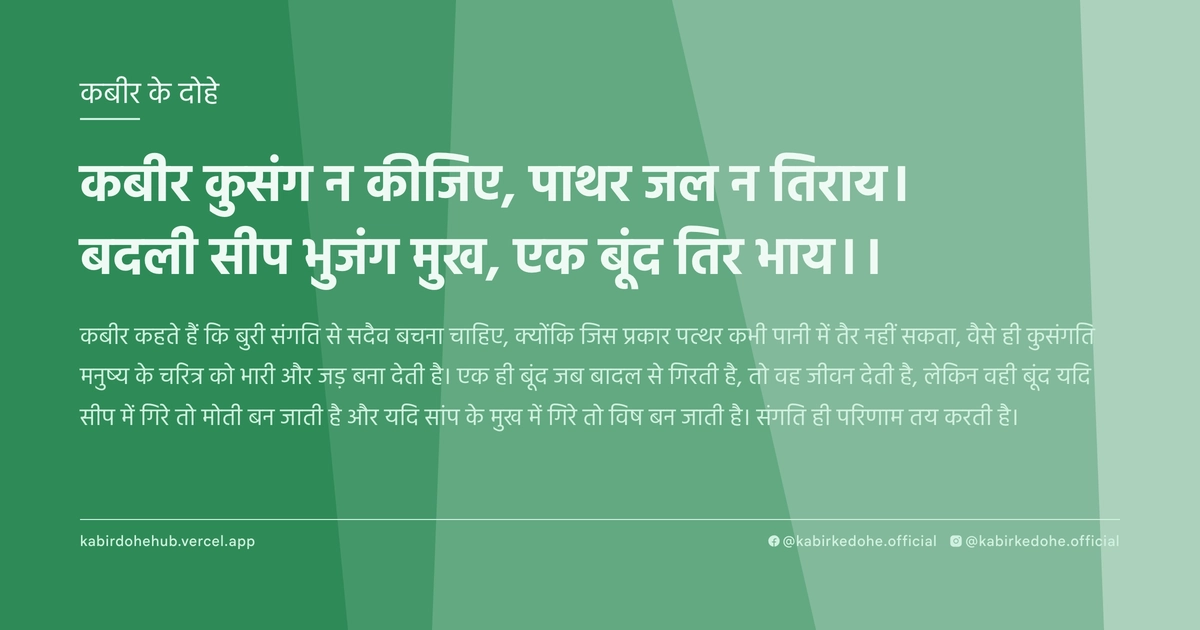
कबीर कुसंग न कीजिए, पाथर जल न तिराय।
बदली सीप भुजंग मुख, एक बूंद तिर भाय।।
Kabir kusang na kijiye, pathar jal na tiray. Badli seep bhujang mukh, ek boond tir bhay.
इस पृष्ठ पर इस कबीर दोहे का अर्थ (meaning), हिंदी व्याख्या और अंग्रेज़ी अनुवाद, दार्शनिक विश्लेषण और व्यावहारिक जीवन सीख दी गई है। यह दोहा सत्संग (Satsang) विषय से जुड़ा है — Kabir doha meaning and explanation in Hindi and English.
अर्थ (Meaning):
कबीर कहते हैं कि बुरी संगति से सदैव बचना चाहिए, क्योंकि जिस प्रकार पत्थर कभी पानी में तैर नहीं सकता, वैसे ही कुसंगति मनुष्य के चरित्र को भारी और जड़ बना देती है। एक ही बूंद जब बादल से गिरती है, तो वह जीवन देती है, लेकिन वही बूंद यदि सीप में गिरे तो मोती बन जाती है और यदि सांप के मुख में गिरे तो विष बन जाती है। संगति ही परिणाम तय करती है।
Kabir warns against the perils of bad company, asserting that just as a stone cannot float on water, a soul immersed in negative company becomes spiritually heavy and stagnant. He illustrates this with a profound metaphor: a single drop of water, depending on where it lands, can become a life-giving rain, a precious pearl within an oyster, or a lethal poison in the mouth of a serpent. The environment determines the essence.
व्याख्या (Interpretation):
इस दोहे का शाब्दिक अर्थ संगति के प्रभाव से शुरू होता है, लेकिन इसका गहरा आध्यात्मिक अर्थ 'माया' और 'चेतना' के रूपांतरण में निहित है। पत्थर का न तैरना जड़ता और अहंकार का प्रतीक है, जो आत्मा को परमात्मा से अलग कर देता है। यहाँ 'बूंद' जीवात्मा का प्रतीक है, जो अपनी मूल प्रकृति में शुद्ध है, परंतु बाहरी प्रभावों के कारण अपना स्वरूप बदल लेती है। निर्गुण भक्ति के संदर्भ में, यह दर्शाता है कि बिना सही मार्गदर्शन (सत्संग) के, साधक अपनी मूल दिव्यता को भूलकर सांसारिक विकारों में डूब सकता है। यह अद्वैत वेदांत के उस सिद्धांत को पुष्ट करता है जहाँ चेतना का स्तर इस बात पर निर्भर करता है कि वह किन विचारों और ऊर्जाओं के संपर्क में है। अंततः, यह दोहा हमें सचेत करता है कि हमारी बाहरी दुनिया हमारे आंतरिक रूपांतरण का दर्पण है।
The literal meaning focuses on social association, but the deeper metaphorical layer addresses the transformation of 'Maya' and consciousness. The stone's inability to float symbolizes spiritual inertia and the ego, which weighs down the soul, preventing it from ascending toward the Divine. Here, the 'drop' represents the Jivatma (individual soul), which is inherently pure but malleable. In the context of Nirgun Bhakti, this suggests that without the guidance of a true teacher or 'Satsang,' a seeker may lose their divine spark to worldly distortions. It aligns with Advaita Vedanta, suggesting that while the essence is one, the perceived quality of existence is shaped by the 'vessel' or environment it inhabits. The central paradox is that the soul is eternal and unchanging, yet its experience of reality is entirely dependent on the company it keeps.
दार्शनिक विश्लेषण (Philosophical Analysis):
कबीर का यह विचार उनके युग के सामाजिक और धार्मिक पाखंडों के विरुद्ध एक सशक्त प्रहार है। उन्होंने देखा कि कैसे लोग केवल बाहरी कर्मकांडों और जातिगत श्रेष्ठता के अहंकार में डूबे थे, जबकि वास्तविक आध्यात्मिक उन्नति आंतरिक शुद्धता और सही संगति से आती है। कबीर यहाँ 'कुसंग' को केवल बुरे लोगों से नहीं, बल्कि उन विचारों से जोड़ते हैं जो मनुष्य को सत्य से दूर ले जाते हैं।
दार्शनिक स्तर पर, यह सूफी मत के 'इश्क' और 'साहब' की अवधारणा से मिलता है, जहाँ साधक को अपनी आत्मा को परिष्कृत करने के लिए एक पवित्र वातावरण की आवश्यकता होती है। यदि मन वासनाओं और द्वेष की संगति में है, तो वह विषैला हो जाता है। कबीर का तर्क है कि मनुष्य का स्वभाव स्थिर नहीं है; वह अत्यंत संवेदनशील है और अपने परिवेश को अवशोषित करता है।
अद्वैत वेदांत के अनुसार, ब्रह्म ही सत्य है, लेकिन अज्ञान (Avidya) के कारण हम स्वयं को शरीर और मन समझते हैं। कुसंगति इस अज्ञान को और गहरा करती है, जिससे आत्मा स्वयं को पत्थर की तरह भारी महसूस करती है और मोक्ष की धारा में तैरने में असमर्थ हो जाती है।
कबीर यहाँ कर्म और संस्कार के मनोविज्ञान की व्याख्या कर रहे हैं। वे बताते हैं कि जैसे एक ही तत्व (पानी) अलग-अलग परिस्थितियों में अलग-अलग गुण ग्रहण करता है, वैसे ही एक मनुष्य अपनी बुद्धि और संगति के आधार पर संत या पापी बन सकता है। यह जाति या जन्म की श्रेष्ठता को पूरी तरह नकार कर 'आचरण' की श्रेष्ठता को स्थापित करता है।
अंततः, यह विश्लेषण अहंकार के विनाश (Fana) की ओर ले जाता है। जब व्यक्ति कुसंगति का त्याग कर स्वयं के भीतर के 'निर्गुण' रूप से जुड़ता है, तब वह उस बूंद की तरह बन जाता है जो सीप में गिरकर मोती बन गई—अर्थात, वह संसार में रहते हुए भी उससे अछूता और मूल्यवान बन जाता है।
Kabir's insight is a powerful critique of the social and religious hypocrisies of his era. He observed how people were immersed in external rituals and the ego of caste superiority, while true spiritual evolution stems from internal purity and the company of the wise. Kabir defines 'Kusang' (bad company) not merely as associating with 'bad people,' but as aligning with thoughts and ideologies that alienate the soul from Truth.
Philosophically, this resonates with the Sufi concepts of 'Ishq' (divine love) and the need for a spiritual guide to refine the heart. If the mind dwells in the company of lust and hatred, it becomes poisonous. Kabir argues that human nature is not static; it is highly permeable and absorbs the energies of its surroundings.
According to Advaita Vedanta, Brahman is the only reality, but due to 'Avidya' (ignorance), we identify with the ego. Bad company deepens this ignorance, making the soul feel as heavy as a stone, unable to float in the current of liberation (Moksha).
Kabir is explaining the psychology of 'Samskaras' (impressions). He demonstrates that just as a single element (water) acquires different properties based on its vessel, a human being can become a saint or a sinner based on their associations. This completely dismantles the notion of innate superiority by birth or caste, replacing it with the superiority of conduct.
Ultimately, this analysis leads to the annihilation of the ego. When an individual renounces negative associations and connects with the 'Nirgun' (formless) aspect of existence, they become like the drop that falls into the oyster and becomes a pearl—remaining in the world but becoming priceless and untainted by it.
मूल संदेश (Core Message):
- संगति केवल बाहरी नहीं, बल्कि मानसिक और ऊर्जावान होती है।
- अहंकार और नकारात्मकता आत्मा को पत्थर की तरह भारी बना देते हैं।
- एक ही जीवन-तत्व परिवेश के अनुसार विष या अमृत बन सकता है।
- सत्य की खोज के लिए सबसे पहले अशुद्ध प्रभावों का त्याग आवश्यक है।
- आंतरिक रूपांतरण ही वास्तविक मोक्ष का एकमात्र मार्ग है।
- Company is not just physical; it is mental and energetic.
- Ego and negativity make the soul heavy and stagnant like a stone.
- The same life-force can become poison or nectar based on its environment.
- Renouncing impure influences is the first step toward discovering Truth.
- Internal transformation is the only authentic path to liberation.
व्यावहारिक उदाहरण (Practical Example):
एक समय की बात है, वाराणसी के घाटों पर माधव नाम का एक वृद्ध बुनकर रहता था। माधव स्वभाव से सरल था, लेकिन उसके मोहल्ले में कुछ ऐसे लोग थे जो दिन भर राजा की बुराई करते, दूसरों के दोष निकालते और शराब पीकर शोर मचाते थे। माधव धीरे-धीरे उनके प्रभाव में आने लगा। वह जो कभी अपनी बुनाई में मग्न रहता था, अब दूसरों की निंदा करने में समय बिताने लगा। उसका मन अशांत रहने लगा और उसकी कला में वह बारीकी खत्म होने लगी जो कभी उसकी पहचान थी।
एक दिन माधव एक पुराने संत के पास गया और अपनी बेचैनी का कारण पूछा। संत ने उसे एक कटोरा पानी दिया और कहा, 'इसमें एक बूंद शहद डालो और फिर एक बूंद जहर।' संत ने समझाया कि पानी वही है, लेकिन शहद ने उसे मीठा कर दिया और जहर ने उसे घातक।
माधव को अपनी गलती का अहसास हुआ। उसने महसूस किया कि वह उन लोगों के साथ रहकर अपने भीतर 'जहर' घोल रहा था। उसने तुरंत उन नकारात्मक लोगों का साथ छोड़ दिया और उन शिल्पकारों के साथ समय बिताना शुरू किया जो कला और आध्यात्मिकता की चर्चा करते थे।
शुरुआत में उसे अकेलापन महसूस हुआ, क्योंकि वह पुराने 'साथियों' के शोर का आदी था। लेकिन धीरे-धीरे उसका मन शांत होने लगा। उसने फिर से अपनी बुनाई शुरू की, लेकिन इस बार वह धागों में केवल कपड़े नहीं, बल्कि अपनी शांति और ध्यान बुनने लगा।
उसकी कला इतनी निखर गई कि दूर-दूर से लोग उसके कपड़े देखने आने लगे। लेकिन माधव अब प्रसिद्ध होने की लालसा नहीं रखता था। वह जान चुका था कि संगति का प्रभाव केवल बाहरी नहीं, बल्कि आंतरिक होता है।
उसने देखा कि उसके पुराने साथी अभी भी उसी कड़वाहट में जी रहे थे, जबकि वह एक शांत झील की तरह बन गया था। उसने अपने जीवन के 'पत्थर' को हटाकर 'मोती' बनने की प्रक्रिया शुरू कर दी थी।
अब माधव केवल कपड़े नहीं बुनता था, बल्कि वह नए आने वाले युवाओं को यह सिखाता था कि कैसे सही विचारों का चुनाव करके जीवन को सुंदर बनाया जा सकता है।
उसका रूपांतरण इस बात का प्रमाण था कि जब हम कुसंगति का त्याग करते हैं, तो हमारी आत्मा का वह हिस्सा जागृत हो जाता है जो हमें जीवन की धारा में तैरने के योग्य बनाता है।
Once, in the ghats of Varanasi, lived an elderly weaver named Madhav. Madhav was simple by nature, but his neighborhood was filled with men who spent their days criticizing the king, mocking others, and creating chaos while intoxicated. Slowly, Madhav fell under their influence. He, who once found solace in the rhythm of his loom, began spending his hours in gossip and negativity. His mind became restless, and the intricate precision of his weaving—once his hallmark—began to fade.
One day, Madhav visited an old sage and asked why he felt such inner turmoil. The sage handed him a bowl of water and said, 'Add a drop of honey to this, and then a drop of poison.' The sage explained that the water remained the same, but the honey made it sweet, while the poison made it lethal.
Madhav realized his mistake. He understood that by associating with those negative people, he was pouring poison into his own soul. He immediately distanced himself from that company and began spending time with artisans who discussed art, philosophy, and spirituality.
Initially, he felt a void, as he was addicted to the noise of his old companions. However, gradually, his mind grew still. He returned to his loom, but this time, he didn't just weave fabric; he wove his peace and meditation into every thread.
His art flourished to such an extent that people from far lands came to see his work. Yet, Madhav no longer craved fame. He had realized that the influence of company is not just social, but cellular and spiritual.
He observed that his old companions were still trapped in their bitterness, while he had become like a serene lake. He had removed the 'stone' of negativity and begun the process of becoming a 'pearl.'
Madhav no longer just wove clothes; he began mentoring young men, teaching them how to curate their thoughts and associations to create a beautiful life.
His transformation served as a testament that when we renounce bad company, the part of our soul that allows us to float in the current of life is awakened.
अभ्यास मार्गदर्शन (Practice Guidance):
- दैनिक आत्म-निरीक्षण: हर रात सोने से पहले विचार करें कि आज आपने किन लोगों के साथ समय बिताया और उनके प्रभाव से आपके मन की स्थिति (खुश, क्रोधित, या ईर्ष्यालु) में क्या बदलाव आया।
- विचारों का छनन (Mental Filtering): जब भी कोई नकारात्मक विचार या गपशप आपके मन में आए, तो स्वयं से पूछें—'क्या यह विचार मुझे मोती बना रहा है या जहर?'
- सत्संग का अभ्यास: प्रतिदिन कम से कम 30 मिनट ऐसे साहित्य का अध्ययन करें या ऐसे लोगों के साथ रहें जो आपको उच्चतर सत्य और करुणा की याद दिलाएं।
- डायग्नोस्टिक चेकलिस्ट: यदि आप दूसरों की आलोचना करने में आनंद महसूस कर रहे हैं, छोटी बातों पर चिड़चिड़े हो रहे हैं, या आपकी रचनात्मकता घट रही है, तो यह संकेत है कि आप 'कुसंग' के प्रभाव में हैं।
- Daily Self-Audit: Before sleep, reflect on the people you interacted with today and observe how their energy shifted your internal state (e.g., did you become more anxious, angry, or peaceful?).
- Mental Filtering: Whenever a negative thought or a piece of gossip enters your mind, ask yourself—'Is this thought turning me into a pearl or into poison?'
- Satsang Practice: Spend at least 30 minutes daily reading spiritual texts or associating with individuals who remind you of higher truths and compassion.
- Diagnostic Checklist: If you find pleasure in criticizing others, feel irritable over trivialities, or notice a decline in your creative drive, recognize these as symptoms of 'Kusang' (negative influence).
चिंतन प्रश्न (Reflection Questions):
- मेरे जीवन के वे कौन से 'अदृश्य मित्र' (डिजिटल प्रभाव या विचार) हैं जो मुझे भीतर से भारी बना रहे हैं?
- क्या मैं अपनी पहचान उन लोगों से बना रहा हूँ जिन्हें मैं वास्तव में पसंद नहीं करता, केवल सामाजिक स्वीकृति के लिए?
- मेरे भीतर का 'जहर' कहाँ से आ रहा है—मेरे अपने अनुभवों से या उन लोगों से जिन्हें मैं अपना आदर्श मानता हूँ?
- यदि मेरा मन एक सीप है, तो मैं उसमें किस तरह के विचारों के मोती पिरोना चाहता हूँ?
- क्या मैं अपनी बुराइयों को 'ईमानदारी' का नाम देकर उन्हें सही ठहरा रहा हूँ?
- Who are the 'invisible companions' (digital influences or recurring thoughts) that are making my soul feel heavy?
- Am I constructing my identity based on people I don't actually respect, simply for social validation?
- Where does the 'poison' within me originate—from my own experiences or from those I perceive as role models?
- If my mind is an oyster, what kind of pearls of thought do I wish to cultivate within it?
- Am I labeling my toxic traits as 'honesty' to justify my behavior?