
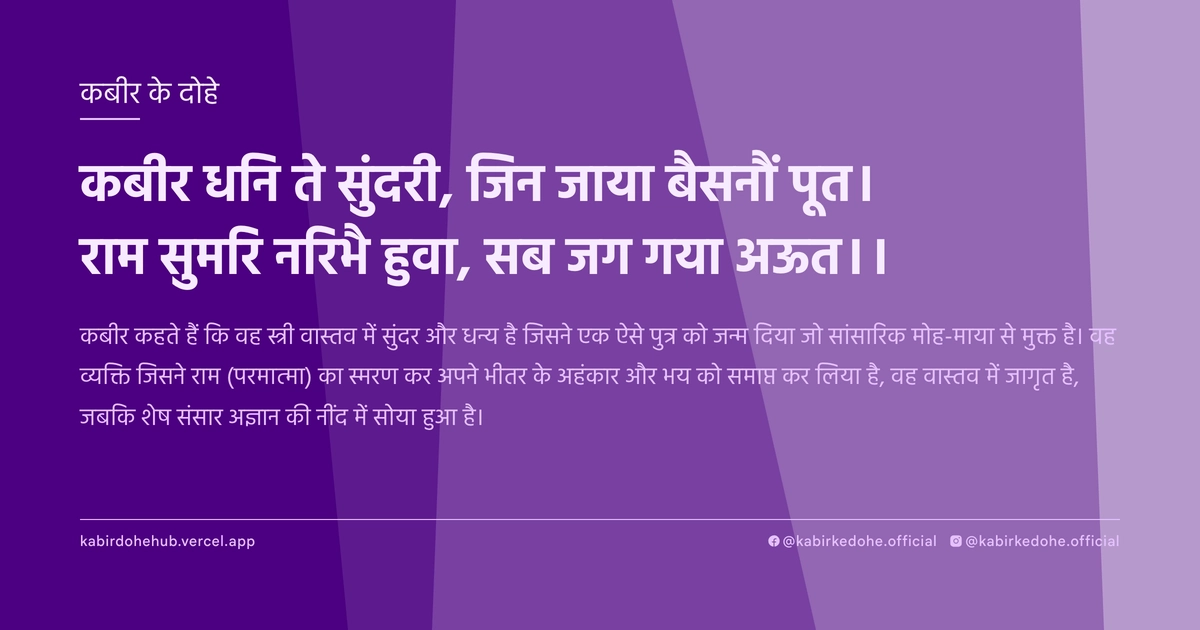
कबीर धनि ते सुंदरी, जिन जाया बैसनौं पूत।
राम सुमरि नरिभै हुवा, सब जग गया अऊत।।
Kabir dhani te sundari, jin jaya vaisanun put. Ram sumari naribhai huva, sab jag gaya aut.
इस पृष्ठ पर इस कबीर दोहे का अर्थ (meaning), हिंदी व्याख्या और अंग्रेज़ी अनुवाद, दार्शनिक विश्लेषण और व्यावहारिक जीवन सीख दी गई है। यह दोहा भक्ति (Bhakti) विषय से जुड़ा है — Kabir doha meaning and explanation in Hindi and English.
अर्थ (Meaning):
कबीर कहते हैं कि वह स्त्री वास्तव में सुंदर और धन्य है जिसने एक ऐसे पुत्र को जन्म दिया जो सांसारिक मोह-माया से मुक्त है। वह व्यक्ति जिसने राम (परमात्मा) का स्मरण कर अपने भीतर के अहंकार और भय को समाप्त कर लिया है, वह वास्तव में जागृत है, जबकि शेष संसार अज्ञान की नींद में सोया हुआ है।
Kabir declares that the truly beautiful and blessed woman is she who gives birth to a soul liberated from worldly attachments. The one who, through the remembrance of the Divine (Ram), has dissolved fear and ego, has awakened to the truth, while the rest of the world remains adrift in the slumber of ignorance.
व्याख्या (Interpretation):
यहाँ 'सुंदरता' का अर्थ शारीरिक आकर्षण नहीं, बल्कि आध्यात्मिक उपलब्धि है। कबीर एक विरोधाभास प्रस्तुत करते हैं जहाँ मातृत्व की सार्थकता केवल संतानोत्पत्ति में नहीं, बल्कि ऐसी चेतना को जन्म देने में है जो मुक्ति की ओर अग्रसर हो। 'बैसनौं पूत' वह है जो संसार की झूठी चमक से विरक्त है। यह निरगुण भक्ति का सार है, जहाँ राम किसी व्यक्ति विशेष नहीं, बल्कि वह सर्वव्यापी चेतना है। जब साधक इस चेतना में लीन होता है, तो वह 'नरिभै' (निर्भय) हो जाता है क्योंकि वह जान जाता है कि आत्मा और परमात्मा एक ही हैं। यह अद्वैत वेदांत की उस स्थिति को दर्शाता है जहाँ द्वैत समाप्त हो जाता है और केवल शुद्ध अस्तित्व शेष रहता है।
Here, 'beauty' does not refer to physical allure but to spiritual attainment. Kabir presents a paradox where the fulfillment of motherhood lies not in mere procreation, but in bringing forth a consciousness geared toward liberation. The 'son' mentioned is one detached from the illusory glitter of the world. This is the essence of Nirgun Bhakti, where 'Ram' is not a mythological figure but the all-pervading consciousness. When the seeker merges with this consciousness, they become 'fearless' (naribhai), realizing the non-duality of Atman and Brahman. It mirrors the Advaita Vedanta state where duality dissolves, leaving only pure, undifferentiated existence.
दार्शनिक विश्लेषण (Philosophical Analysis):
कबीर का यह दोहा तत्कालीन समाज की रूढ़ियों और बाहरी आडंबरों पर एक गहरा प्रहार है। उनके समय में सुंदरता को केवल रूप-रंग से जोड़ा जाता था, लेकिन कबीर ने सौंदर्य की परिभाषा को आंतरिक पवित्रता और वैराग्य से जोड़ दिया। यह दृष्टिकोण सूफी मत के 'फना' (अहंकार का विनाश) और वेदांत के 'माया' के सिद्धांत से मेल खाता है। कबीर तर्क देते हैं कि जन्म लेना मात्र एक जैविक प्रक्रिया है, लेकिन उस जन्म को सार्थक बनाना एक आध्यात्मिक यात्रा है।
वे जाति, वर्ण और बाहरी रीति-रिवाजों को नकारते हुए यह स्पष्ट करते हैं कि ईश्वर की प्राप्ति के लिए किसी विशेष कुल या कर्मकांड की आवश्यकता नहीं है। उनके लिए 'राम' का स्मरण कोई रटंत प्रक्रिया नहीं, बल्कि एक गहन आंतरिक मौन है। यह विश्लेषण दर्शाता है कि कैसे मनुष्य अपनी पहचान को शरीर और रिश्तों (पुत्र, माता) में खोजता है, जबकि वास्तविक पहचान उस निराकार तत्व में है जो जन्म-मृत्यु के चक्र से परे है।
दार्शनिक स्तर पर, यह दोहा 'अविद्या' (ignorance) और 'विद्या' (knowledge) के बीच के संघर्ष को चित्रित करता है। 'सब जग गया अऊत' का अर्थ है कि पूरी मानवता एक सामूहिक सम्मोहन में है, जहाँ वे नश्वर वस्तुओं को स्थायी मानकर उनमें लिप्त हैं। कबीर इस सम्मोहन को तोड़ने का आह्वान करते हैं।
यह शिक्षण मनोवैज्ञानिक रूपांतरण पर केंद्रित है। जब व्यक्ति यह समझ लेता है कि बाहरी दुनिया एक दर्पण है और वास्तविक सत्य भीतर है, तो उसका भय समाप्त हो जाता है। यह भय केवल मृत्यु का नहीं, बल्कि खोने का, अपमानित होने का और अकेले रह जाने का भय है।
अंततः, कबीर यह संदेश देते हैं कि वास्तविक धन वह नहीं जो संचित किया जाए, बल्कि वह है जो त्याग दिया जाए। जो व्यक्ति अपनी वासनाओं और अहंकार का त्याग कर देता है, वही वास्तव में 'धनि' या धन्य है। यह मार्ग कठिन है क्योंकि यह समाज की मान्यताओं के विपरीत है, लेकिन यही एकमात्र मार्ग है जो पूर्ण स्वतंत्रता की ओर ले जाता है।
This couplet is a profound critique of the societal norms and external ostentations of Kabir's era. In his time, beauty was strictly tied to physical appearance, but Kabir redefines beauty as internal purity and detachment. This perspective aligns with the Sufi concept of 'Fana' (annihilation of the ego) and the Vedantic doctrine of 'Maya' (illusion). Kabir argues that birth is merely a biological event, but making that birth meaningful is a spiritual journey.
By rejecting caste, creed, and ritualism, he clarifies that attaining the Divine requires no specific lineage or ceremony. For him, the 'remembrance of Ram' is not a repetitive chant but a deep internal silence. This analysis reveals how humans seek identity in the body and relationships, whereas the true identity resides in the formless element beyond the cycle of birth and death.
Philosophically, the verse depicts the struggle between 'Avidya' (ignorance) and 'Vidya' (knowledge). The phrase 'sab jag gaya aut' implies that humanity is in a state of collective hypnosis, clinging to transient objects as if they were permanent. Kabir calls for a rupture in this hypnotic state.
This teaching focuses on psychological transformation. When an individual realizes that the external world is a mirror and the ultimate truth is within, fear vanishes. This is not just the fear of death, but the fear of loss, humiliation, and existential loneliness.
Ultimately, Kabir conveys that true wealth is not what is accumulated, but what is renounced. He who discards desires and ego is truly 'dhani' or blessed. This path is arduous as it contradicts social validation, yet it is the only path leading to absolute liberation.
मूल संदेश (Core Message):
- बाहरी रूप केवल भ्रम है, आंतरिक जागृति ही वास्तविक सौंदर्य है।
- अहंकार का विसर्जन ही भय से मुक्ति का एकमात्र मार्ग है।
- परमात्मा किसी मंदिर में नहीं, बल्कि स्वयं के भीतर के मौन में है।
- संसार की भीड़ में होना जागृत होना नहीं, बल्कि स्वयं को जानना जागृति है।
- प्रेम और करुणा ही वह सेतु हैं जो व्यक्ति को ब्रह्म से जोड़ते हैं।
- External form is a mere illusion; internal awakening is the only true beauty.
- The dissolution of ego is the sole path to liberation from fear.
- The Divine resides not in temples, but in the silence within oneself.
- Being in the crowd is not awakening; knowing oneself is the true awakening.
- Love and compassion are the bridges that connect the individual to the Universal Truth.
व्यावहारिक उदाहरण (Practical Example):
एक समय की बात है, वाराणसी के घाटों पर रहने वाली एक वृद्ध विधवा, जानकी, अपनी पूरी ज़िंदगी दूसरों की सेवा और धार्मिक अनुष्ठानों में बिता चुकी थी। वह मानती थी कि मोक्ष केवल कठिन तपस्या और बाहरी नियमों के पालन से मिलता है। वह अपने आस-पास के लोगों को उनकी 'अशुद्धता' के लिए टोकती रहती थी।
उसी घाट पर एक युवा लड़का, माधव, रहता था जो केवल एक छोटी सी नाव चलाता था। माधव न तो मंदिर जाता था और न ही कोई लंबा जाप करता था, लेकिन उसके चेहरे पर एक ऐसी शांति थी जो जानकी ने बड़े-बड़े विद्वानों में भी नहीं देखी थी।
एक दिन जानकी ने माधव से पूछा, "तुम इतनी कम उम्र में इतने शांत कैसे हो? क्या तुम कोई गुप्त साधना करते हो?"
माधव ने मुस्कुराते हुए उत्तर दिया, "माँ, मैं बस यह याद रखता हूँ कि यह नाव, यह नदी और यहाँ तक कि मैं भी, उस एक ही परमात्मा की लहरें हैं। जब मैं खुद को अलग नहीं मानता, तो डर कैसा? और जब डर नहीं, तो बेचैनी कैसी?"
जानकी को लगा जैसे किसी ने उसके सामने एक दर्पण रख दिया हो। उसने महसूस किया कि उसकी पूरी ज़िंदगी 'नियमों' के बोझ तले दबी थी, जबकि माधव 'प्रेम' और 'एकता' के भाव में जी रहा था।
उस रात जानकी को नींद नहीं आई। उसने सोचा कि वह अब तक जिसे 'सुंदरता' और 'धर्म' मानती आई थी, वह केवल एक बाहरी खोल था। उसने अपनी सारी धार्मिक श्रेष्ठता के अहंकार को नदी में प्रवाहित कर दिया।
अगले दिन से जानकी ने लोगों को टोकना बंद कर दिया। उसने महसूस किया कि असली पूजा मंदिर की सीढ़ियों पर नहीं, बल्कि दूसरे के दुख को अपना समझने में है।
उसने अपनी शेष आयु माधव जैसे सरल लोगों के साथ बिताई, यह समझते हुए कि ज्ञान शब्दों में नहीं, बल्कि व्यवहार में होता है।
जानकी का यह रूपांतरण एक 'कबीर ट्विस्ट' था—जहाँ उसने बाहरी अनुष्ठानों की मृत परंपरा को छोड़कर आंतरिक जीवंतता को अपनाया।
अंततः, वह विधवा जो कभी दूसरों को नीचा दिखाती थी, अब सबकी सेवा में सबसे आगे रहने लगी, क्योंकि उसने जान लिया था कि जब 'मैं' मरता है, तभी 'राम' जागते हैं।
Once, in the ghats of Varanasi, lived an elderly widow named Janaki, who had spent her entire life in the service of others and performing rigorous religious rituals. She believed that salvation was only possible through harsh penance and strict adherence to external rules. She often criticized those around her for their 'impurity'.
On the same ghat lived a young boy named Madhav, who operated a small boat. Madhav neither visited temples nor performed long chants, yet his face radiated a peace that Janaki had never seen even in the most learned scholars.
One day, Janaki asked Madhav, "How are you so peaceful at such a young age? Do you practice some secret discipline?"
Madhav smiled and replied, "Mother, I simply remember that this boat, this river, and even I are but waves of that one Divine. When I do not see myself as separate, where is the fear? And when there is no fear, where is the restlessness?"
Janaki felt as if a mirror had been placed before her. She realized that her entire life had been crushed under the weight of 'rules,' while Madhav was living in the essence of 'love' and 'unity'.
That night, Janaki could not sleep. She reflected that what she had considered 'beauty' and 'religion' was merely an external shell.
She decided to cast away her ego of religious superiority into the river. The next day, Janaki stopped judging others.
She realized that true worship does not happen on the steps of a temple, but in recognizing another's pain as one's own.
She spent the remainder of her days with simple souls like Madhav, understanding that knowledge resides not in words, but in conduct.
Janaki's transformation was a 'Kabir Twist'—where she abandoned the dead tradition of external rituals for internal vitality.
Ultimately, the widow who once looked down upon others became the first to serve, for she had learned that when the 'I' dies, the 'Divine' awakens.
अभ्यास मार्गदर्शन (Practice Guidance):
- प्रतिदिन 20 मिनट मौन बैठें और विचार करें कि आपकी कौन सी पहचान (नाम, पद, रिश्ता) आपको दूसरों से अलग करती है, फिर उसे मानसिक रूप से विसर्जित करें।
- एक डायरी लिखें जिसमें आप उन क्षणों को दर्ज करें जब आपने डर या असुरक्षा महसूस की, और विश्लेषण करें कि वह डर किस 'अहंकार' के कारण था।
- व्यवहार परिवर्तन: दिन में कम से कम एक बार किसी ऐसे व्यक्ति की मदद करें जिसे समाज 'अयोग्य' या 'निम्न' मानता हो, बिना किसी श्रेष्ठता के भाव के।
- निदान चेकलिस्ट: क्या आप अभी भी अपनी उपलब्धियों पर गर्व करते हैं? क्या आप दूसरों को सुधारने की कोशिश करते हैं? यदि हाँ, तो आप अभी भी 'अऊत' (अज्ञान की नींद) में हैं।
- Sit in silence for 20 minutes daily and contemplate which identity (name, position, relationship) separates you from others, then mentally dissolve it.
- Maintain a journal recording moments of fear or insecurity, analyzing which specific 'ego' was being threatened in those moments.
- Behavioral Change: At least once a day, help someone whom society deems 'unworthy' or 'low,' doing so without any sense of superiority.
- Diagnostic Checklist: Do you still take pride in your achievements? Do you feel the need to 'correct' others? If yes, you are still in the state of 'aut' (the sleep of ignorance).
चिंतन प्रश्न (Reflection Questions):
- यदि आपसे आपकी सारी सामाजिक पहचान (डिग्री, पद, संपत्ति) छीन ली जाए, तो आपके पास क्या बचेगा?
- आप अपनी 'सुंदरता' को किस पैमाने पर मापते हैं—दूसरों की प्रशंसा पर या अपनी आंतरिक शांति पर?
- वह कौन सा डर है जो आपको पूरी तरह से स्वतंत्र होने से रोकता है?
- क्या आपका धर्म दूसरों को जोड़ने का माध्यम है या उन्हें छोटा महसूस कराने का हथियार?
- आपकी डिजिटल पहचान (सोशल मीडिया) आपके वास्तविक स्वरूप को कितना ढक रही है?
- क्या आप वास्तव में जागृत हैं, या आप केवल समाज द्वारा निर्धारित 'सफल' जीवन की नींद में सो रहे हैं?
- If all your social identities (degrees, titles, wealth) were stripped away, what would remain of you?
- By what scale do you measure your 'beauty'—by the praise of others or by your internal peace?
- What is the specific fear that prevents you from being completely free?
- Is your faith a bridge to connect with others, or a weapon to make them feel inferior?
- To what extent does your digital identity (social media) mask your authentic self?
- Are you truly awake, or are you merely sleeping in the 'successful' life prescribed by society?