
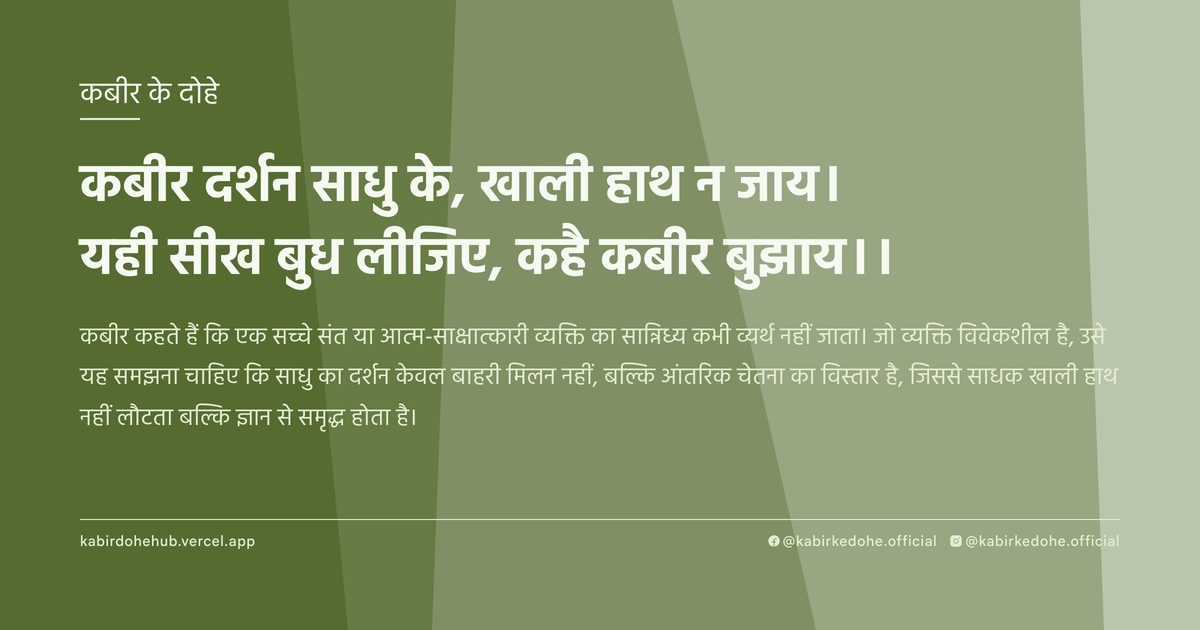
कबीर दर्शन साधु के, खाली हाथ न जाय।
यही सीख बुध लीजिए, कहै कबीर बुझाय।।
Kabir darshan sadhu ke, khaali haath na jaaye. Yahi seekh budh leeje, kahe kabir bujhaye.
इस पृष्ठ पर इस कबीर दोहे का अर्थ (meaning), हिंदी व्याख्या और अंग्रेज़ी अनुवाद, दार्शनिक विश्लेषण और व्यावहारिक जीवन सीख दी गई है। यह दोहा सत्संग (Satsang) विषय से जुड़ा है — Kabir doha meaning and explanation in Hindi and English.
अर्थ (Meaning):
कबीर कहते हैं कि एक सच्चे संत या आत्म-साक्षात्कारी व्यक्ति का सान्निध्य कभी व्यर्थ नहीं जाता। जो व्यक्ति विवेकशील है, उसे यह समझना चाहिए कि साधु का दर्शन केवल बाहरी मिलन नहीं, बल्कि आंतरिक चेतना का विस्तार है, जिससे साधक खाली हाथ नहीं लौटता बल्कि ज्ञान से समृद्ध होता है।
Kabir asserts that an encounter with a true saint or an enlightened soul is never fruitless. He urges the wise to realize that 'darshan' is not merely a physical meeting, but a spiritual transmission where the seeker does not return empty-handed, but enriched with the seed of awakening.
व्याख्या (Interpretation):
शाब्दिक रूप से यह दोहा एक संत के दर्शन के महत्व को बताता है, परंतु आध्यात्मिक स्तर पर यह 'सत्संग' की शक्ति का वर्णन है। यहाँ 'साधु' केवल वह नहीं जो गेरुआ वस्त्र पहने, बल्कि वह है जिसने अपनी वासनाओं को जीत लिया है और ब्रह्म के साथ एकाकार हो गया है। 'खाली हाथ न जाना' का अर्थ भौतिक लाभ नहीं, बल्कि उस सूक्ष्म ऊर्जा और बोध का संचार है जो एक जागृत आत्मा से अज्ञानी की ओर प्रवाहित होता है। यह निर्गुण भक्ति का सार है, जहाँ गुरु का सान्निध्य माया के पर्दे को हटाकर आत्मा को उसके वास्तविक स्वरूप (अद्वैत) से परिचित कराता है। यह विरोधाभास है कि बिना कुछ मांगे भी साधक वह सब पा लेता है जिसकी उसे वास्तव में आवश्यकता थी—आत्म-ज्ञान।
Literally, the couplet emphasizes the value of visiting a saint, but metaphorically, it describes the alchemy of 'Satsang' (holy company). The 'Sadhu' here is not defined by saffron robes, but by the mastery over ego and union with the Absolute. 'Not returning empty-handed' refers not to material gain, but to the subtle transmission of consciousness from an awakened soul to a seeker. In the context of Nirgun Bhakti, the presence of a realized being acts as a catalyst that pierces the veil of Maya, revealing the non-duality of Atman and Brahman. It presents a spiritual paradox: by seeking nothing material, the seeker receives the ultimate wealth—self-realization—which is the only true possession in the transient world.
दार्शनिक विश्लेषण (Philosophical Analysis):
कबीर का यह विचार उस युग की प्रतिक्रिया है जहाँ धर्म केवल कर्मकांडों और बाहरी आडंबरों में सिमट गया था। उन्होंने मंदिर-मस्जिद के बजाय 'जीवंत सत्य' यानी एक जागृत मनुष्य की खोज पर बल दिया। यह दर्शन अद्वैत वेदांत के करीब है, जहाँ माना जाता है कि ज्ञान केवल शास्त्रों से नहीं, बल्कि एक अनुभवी गुरु के सान्निध्य से आता है।
सूफीवाद के 'पीर-मुरीद' संबंध की तरह, कबीर यहाँ आध्यात्मिक संचरण (transmission) की बात कर रहे हैं। जब एक व्यक्ति अपनी अहंकार-सीमाओं को तोड़कर किसी साधु के सामने झुकता है, तो वह वास्तव में अपने अहंकार का विसर्जन कर रहा होता है। यही वह क्षण है जब 'खाली हाथ' होने का अर्थ बदल जाता है; रिक्तता ही वह स्थान है जहाँ परमात्मा का वास होता है।
कबीर जाति और वर्ग के भेदों को नकारते हुए कहते हैं कि साधुत्व किसी कुल में नहीं, बल्कि आचरण में है। उनके लिए साधु वह है जिसने 'सहज' अवस्था को प्राप्त कर लिया है। यह विश्लेषण स्पष्ट करता है कि कबीर केवल सामाजिक सुधारक नहीं थे, बल्कि एक गहन मनोवैज्ञानिक थे जो जानते थे कि बाहरी वातावरण और संगति मनुष्य के अवचेतन को कैसे बदल सकती है।
यहाँ 'बुध' शब्द का प्रयोग केवल बुद्धिमान के लिए नहीं, बल्कि उस जागृत चेतना के लिए किया गया है जो सत्य और असत्य के बीच भेद कर सके। यह बौद्ध धर्म के 'बोधि' और वेदांत के 'विवेक' का संगम है।
अंततः, यह दोहा यह संदेश देता है कि आध्यात्मिक प्रगति के लिए केवल व्यक्तिगत प्रयास पर्याप्त नहीं हैं; कभी-कभी एक बाहरी चिंगारी (साधु का दर्शन) की आवश्यकता होती है जो भीतर सुलग रही श्रद्धा को प्रज्वलित कर दे।
Kabir’s insight is a direct critique of an era where religion had devolved into sterile rituals and outward displays of piety. He shifts the focus from the architecture of temples and mosques to the 'living truth' embodied in an awakened human being. This aligns with Advaita Vedanta, suggesting that liberation is not achieved through scriptural rote learning but through the grace and guidance of a realized master.
Mirroring the Sufi tradition of the Pir-Murid relationship, Kabir speaks of spiritual transmission. When a seeker bows before a Sadhu, they are not performing an act of subservience but are practicing the annihilation of the ego. It is in this state of emptiness—the 'empty hand'—that the Divine can finally enter and reside.
Kabir vehemently rejects caste and class hierarchies, asserting that sanctity is found in conduct, not lineage. For him, a Sadhu is one who has attained the state of 'Sahaja' (natural spontaneity). This reveals Kabir as a profound psychologist who understood how the external environment and the company of the enlightened can rewire a person's subconscious mind.
The use of the word 'Budh' refers not merely to an intellectual person, but to one who possesses 'Viveka' (discernment)—the ability to distinguish the eternal from the ephemeral. It is a synthesis of Buddhist awakening and Vedantic wisdom.
Ultimately, the couplet posits that while individual effort is necessary, a spiritual catalyst—a spark from a realized soul—is often required to ignite the dormant flame of devotion and awareness within the seeker.
मूल संदेश (Core Message):
- बाहरी आडंबरों का त्याग करें, जीवित सत्य को खोजें।
- सच्चा ज्ञान पुस्तकों में नहीं, अनुभवसिद्ध आत्माओं में है।
- अहंकार का विसर्जन ही वास्तविक प्राप्ति का द्वार है।
- आंतरिक शांति ही जीवन की सबसे बड़ी संपत्ति है।
- गुरु का सान्निध्य अज्ञान के अंधकार को मिटाने वाली ज्योति है।
- Discard ritualistic masks; seek the living truth.
- True wisdom resides in experienced souls, not just texts.
- The dissolution of ego is the only gateway to attainment.
- Inner stillness is the only wealth that survives the end.
- The presence of a master is the light that dissolves ignorance.
व्यावहारिक उदाहरण (Practical Example):
वाराणसी के घाटों पर रहने वाली एक वृद्ध विधवा, जानकी, का जीवन केवल शोक और परंपराओं के बोझ तले दबा था। वह प्रतिदिन घंटों पूजा करती, लेकिन मन में गहरे दुख और अकेलेपन की टीस थी। उसे लगता था कि ईश्वर केवल नियमों के पालन से प्रसन्न होते हैं।
एक दिन, घाट की सीढ़ियों पर एक फकीर बैठा था, जिसकी आँखों में एक अजीब सी शांति थी। जानकी ने उसे देखा और उसके पास जाकर अपनी व्यथा सुनाई। फकीर ने कोई उपदेश नहीं दिया, बस मुस्कुराकर कहा, 'माँ, तुम पत्थर की मूर्ति में जिसे खोज रही हो, वह तुम्हारे भीतर की सांसों में नाच रहा है।'
जानकी को पहले यह बात अजीब लगी, लेकिन उस फकीर के सान्निध्य में बिताए कुछ मिनटों ने उसके भीतर कुछ बदल दिया। उसे महसूस हुआ कि उसकी सारी पूजा केवल एक सामाजिक ढोंग थी, जबकि वास्तविक भक्ति स्वयं के भीतर की शांति थी।
उस दिन के बाद, जानकी ने बाहरी आडंबरों को कम कर दिया। उसने अपने घर के दरवाजे उन अनाथ बच्चों के लिए खोल दिए जिन्हें समाज ने ठुकरा दिया था।
उसने पाया कि जब वह दूसरों की सेवा करती है, तो उसे वही शांति महसूस होती है जो उसने उस फकीर की आँखों में देखी थी।
उसका दुख अब बोझ नहीं, बल्कि करुणा बन गया था।
वह अब मंदिर जाने के बजाय, अपने भीतर के मंदिर में मौन बैठने लगी।
उसने समझा कि फकीर का दर्शन उसे खाली हाथ नहीं लौटाया, बल्कि उसे 'स्वयं' से मिला दिया।
जानकी का जीवन अब शोक का नहीं, बल्कि उत्सव का पर्याय बन गया था।
यह कबीर का वह 'ट्विस्ट' था जहाँ एक बाहरी मुलाकात ने आंतरिक क्रांति ला दी।
Janaki, an elderly widow living on the ghats of Varanasi, spent her days burdened by grief and the rigid expectations of tradition. She spent hours in ritualistic prayer, yet her heart remained heavy with loneliness, believing that God was only pleased by strict adherence to rules.
One afternoon, she encountered a wandering fakir sitting on the stone steps, whose eyes radiated an inexplicable peace. Drawn to him, Janaki shared her lifelong sorrow. The fakir offered no sermon; he simply smiled and said, 'Mother, the one you seek in the stone idol is dancing within your own breath.'
Initially, Janaki found the statement baffling, but the few minutes spent in the fakir's presence triggered a shift in her consciousness. She realized that her rituals had become a social mask, while true devotion was the stillness within.
Following this encounter, Janaki gradually stepped away from outward displays of piety. She opened her small home to orphaned children whom society had discarded.
She discovered that in serving others, she felt the same profound peace she had witnessed in the fakir's eyes.
Her grief, once a crushing weight, transformed into a reservoir of compassion.
Instead of seeking solace in distant temples, she began practicing silence within the temple of her own heart.
She understood that the 'darshan' of the fakir had not left her empty-handed; it had returned her to herself.
Janaki's life shifted from a narrative of mourning to one of celebration.
This was the 'Kabir Twist'—where a brief encounter with a realized soul ignited an internal revolution.
अभ्यास मार्गदर्शन (Practice Guidance):
- प्रतिदिन 20 मिनट मौन का अभ्यास करें, यह महसूस करते हुए कि आपके भीतर का 'साधु' (शुद्ध चेतना) आपसे बात कर रहा है।
- एक डायरी लिखें जिसमें आप उन क्षणों को दर्ज करें जब किसी अजनबी या गुरु की एक छोटी सी बात ने आपकी सोच बदल दी।
- व्यवहार परिवर्तन: दिन में कम से कम एक बार किसी ऐसे व्यक्ति की निस्वार्थ मदद करें जो आपको 'अयोग्य' लगता हो, ताकि आपका अहंकार मिट सके।
- निदान चेकलिस्ट: क्या आप अभी भी केवल बाहरी प्रतीकों (माला, तिलक, कपड़े) में शांति खोज रहे हैं? यदि हाँ, तो आप अभी भी 'खाली हाथ' हैं।
- Practice 20 minutes of daily silence, consciously feeling that the 'Sadhu' (pure consciousness) within you is communicating with your ego.
- Maintain a journal recording moments when a brief interaction with a stranger or mentor shifted your entire perspective on a problem.
- Behavioral Shift: Once a day, perform a selfless act for someone you instinctively judge as 'unworthy,' specifically to dismantle your internal hierarchies.
- Diagnostic Checklist: Are you still seeking peace exclusively through external symbols (beads, robes, rituals)? If yes, you are still returning 'empty-handed' from the spiritual journey.
चिंतन प्रश्न (Reflection Questions):
- क्या मैं वास्तव में ज्ञान चाहता हूँ, या मैं केवल अपनी धार्मिक पहचान को पुष्ट करने के लिए 'साधु' के पास जाता हूँ?
- मेरे जीवन में वह कौन सा 'खाली हाथ' (अभाव) है जिसे कोई भी भौतिक वस्तु नहीं भर सकती?
- क्या मैं अपनी डिजिटल पहचान (सोशल मीडिया इमेज) को ही अपना वास्तविक स्वरूप मान बैठा हूँ?
- यदि मेरे पास कोई पद, पैसा या प्रतिष्ठा न हो, तो क्या मेरे भीतर कोई ऐसा 'साधु' शेष रहेगा जो शांत हो?
- मैं दूसरों में जो कमियाँ देखता हूँ, क्या वे वास्तव में मेरे अपने आंतरिक अंधकार का प्रतिबिंब हैं?
- Do I truly seek enlightenment, or do I visit 'saints' merely to validate my religious identity?
- What is the specific 'emptiness' in my life that no material acquisition can ever fill?
- Have I mistaken my digital persona and curated image for my actual spiritual identity?
- If all my titles, wealth, and status were stripped away, would there be a 'silent witness' left within me?
- Are the flaws I perceive in others actually reflections of my own hidden internal shadows?