
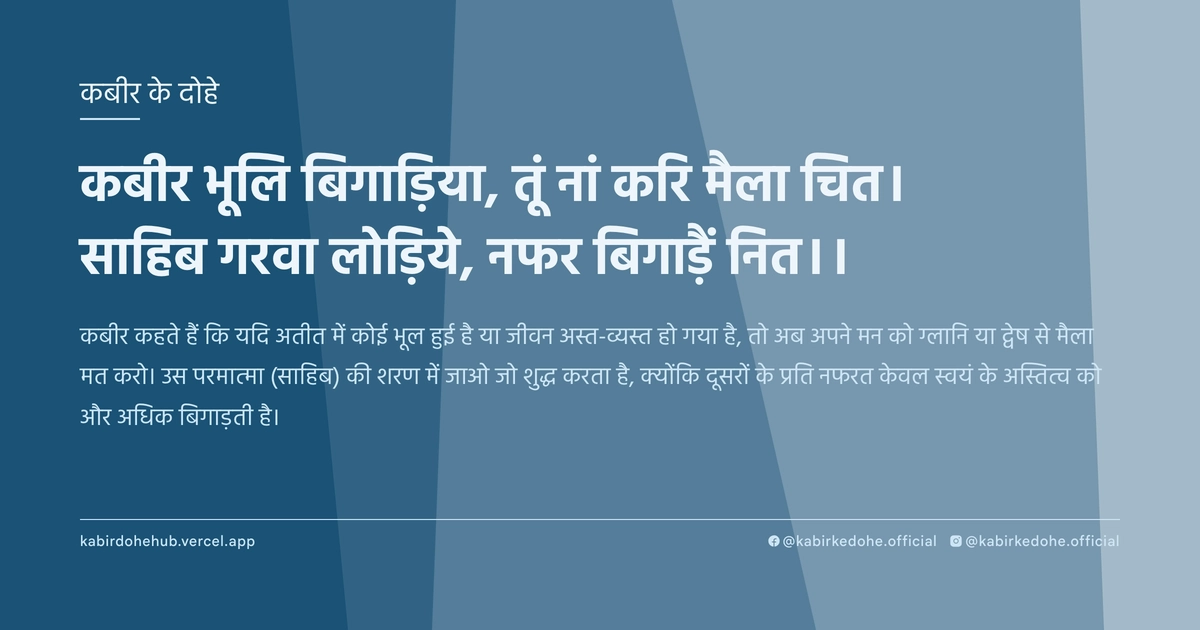
कबीर भूलि बिगाड़िया, तूं नां करि मैला चित।
साहिब गरवा लोड़िये, नफर बिगाड़ैं नित।।
Kabir bhooli bigadya, toon naan kari maila chit. Sahib garva lodiye, nafar bigadain nit.
इस पृष्ठ पर इस कबीर दोहे का अर्थ (meaning), हिंदी व्याख्या और अंग्रेज़ी अनुवाद, दार्शनिक विश्लेषण और व्यावहारिक जीवन सीख दी गई है। यह दोहा आत्मनिरीक्षण (Self-introspection) विषय से जुड़ा है — Kabir doha meaning and explanation in Hindi and English.
अर्थ (Meaning):
कबीर कहते हैं कि यदि अतीत में कोई भूल हुई है या जीवन अस्त-व्यस्त हो गया है, तो अब अपने मन को ग्लानि या द्वेष से मैला मत करो। उस परमात्मा (साहिब) की शरण में जाओ जो शुद्ध करता है, क्योंकि दूसरों के प्रति नफरत केवल स्वयं के अस्तित्व को और अधिक बिगाड़ती है।
Kabir asserts that even if past mistakes have derailed your life, do not further pollute your consciousness with guilt or malice. Seek refuge in the Divine Master who purifies the soul, for harboring hatred toward others only serves to further degrade one's own spiritual essence.
व्याख्या (Interpretation):
यह दोहा मानवीय त्रुटि और आध्यात्मिक शुद्धि के बीच के द्वंद्व को दर्शाता है। 'भूलि बिगाड़िया' का अर्थ है कि मनुष्य माया के प्रभाव में आकर मार्ग से भटक गया है। कबीर चेतावनी देते हैं कि पश्चाताप का अर्थ स्वयं को कोसना या दूसरों पर दोष मढ़ना नहीं है, क्योंकि इससे 'चित' (चेतना) और अधिक मैला हो जाता है। यहाँ 'साहिब' निर्गुण ब्रह्म का प्रतीक है, जो किसी बाहरी कर्मकांड से नहीं बल्कि आंतरिक समर्पण से प्राप्त होता है। यह अद्वैत वेदांत के उस सिद्धांत की ओर संकेत करता है जहाँ आत्मा का परमात्मा से मिलन केवल तब संभव है जब अहंकार और द्वेष की परतें हट जाएं। अंततः, नफरत एक ऐसा विष है जो पीने वाला स्वयं नष्ट होता है, जबकि प्रेम और क्षमा ही वास्तविक मुक्ति के द्वार हैं।
This couplet explores the tension between human error and spiritual purification. 'Bhuli bigadiya' refers to the soul's deviation from its true nature due to the influence of Maya (illusion). Kabir warns that repentance should not manifest as self-loathing or resentment, as this further pollutes the 'Chit' (consciousness). The 'Sahib' represents the Nirgun Brahman—the formless Absolute—attainable not through ritual but through internal surrender. It aligns with Advaita Vedanta, suggesting that the realization of Atman-Brahman non-duality is blocked by the debris of ego and hatred. The central paradox is that while we seek to 'fix' our lives, the act of hating those who wronged us only deepens our spiritual decay, whereas unconditional love acts as the ultimate solvent for the ego.
दार्शनिक विश्लेषण (Philosophical Analysis):
कबीर का यह संदेश उस समय के सामाजिक और धार्मिक परिवेश में अत्यंत क्रांतिकारी था, जहाँ पाप और पुण्य की अवधारणाएं कठोर कर्मकांडों और जातिगत श्रेष्ठता से जुड़ी थीं। कबीर ने बाहरी शुद्धि (जैसे स्नान या तीर्थ) के बजाय आंतरिक शुद्धि पर बल दिया। वे बताते हैं कि मन की मैलापन किसी बाहरी गंदगी से नहीं, बल्कि ईर्ष्या, क्रोध और अहंकार से आता है।
दार्शनिक स्तर पर, यह सूफी मत के 'फना' (अहंकार का विनाश) और वेदांत के 'माया' विलोपन के करीब है। जब व्यक्ति यह समझ जाता है कि जिसे वह 'दूसरा' मानकर नफरत कर रहा है, वह वास्तव में उसी एक सार्वभौमिक चेतना का हिस्सा है, तब नफरत स्वतः समाप्त हो जाती है। यह द्वैत (Duality) से अद्वैत (Non-duality) की ओर संक्रमण है।
कबीर यहाँ 'साहिब' शब्द का प्रयोग करते हैं, जो ईश्वर को एक गुरु या मार्गदर्शक के रूप में प्रस्तुत करता है। यह दर्शाता है कि मुक्ति के लिए केवल ज्ञान पर्याप्त नहीं है, बल्कि एक ऐसी करुणा की आवश्यकता है जो स्वयं को और दूसरों को क्षमा कर सके। ritualism का विरोध करते हुए वे कहते हैं कि कोई भी मंत्र या जाप तब तक व्यर्थ है जब तक हृदय में प्रेम न हो।
मनोवैज्ञानिक रूप से, यह दोहा 'गिल्ट' (अपराधबोध) और 'रेज' (क्रोध) के चक्र को तोड़ने की बात करता है। जब हम अपनी गलतियों के लिए दूसरों को जिम्मेदार ठहराते हैं, तो हम अपनी आध्यात्मिक प्रगति को रोक देते हैं। कबीर हमें सिखाते हैं कि क्षमा केवल दूसरे के लिए नहीं, बल्कि स्वयं की मानसिक शांति और आध्यात्मिक उत्थान के लिए आवश्यक है।
अंततः, यह शिक्षण हमें यह समझाता है कि जीवन की विसंगतियों को सुधारने का एकमात्र तरीका 'प्रेम' है। नफरत केवल विनाश का मार्ग है, जबकि समर्पण और आंतरिक स्वच्छता ही वह सेतु है जो जीव को शिव से जोड़ता है। यह एक आह्वान है कि हम अपने भीतर के उस शुद्ध स्रोत को खोजें जो समय और त्रुटियों से परे है।
Kabir's message was profoundly revolutionary within the socio-religious landscape of his era, where notions of sin and merit were rigidly tied to ritualistic purity and caste hierarchies. He shifted the focus from external purification—such as ritual bathing or pilgrimages—to the internal cleansing of the heart. He posits that the 'impurity' of the mind is not caused by physical filth but by the toxins of jealousy, anger, and ego.
Philosophically, this aligns with the Sufi concept of 'Fana' (the annihilation of the self) and the Vedantic dissolution of 'Maya'. When an individual realizes that the 'other' they despise is merely another manifestation of the same universal consciousness, hatred becomes illogical. This is the transition from Duality to Non-duality (Advaita), where the boundary between the self and the universe vanishes.
By using the term 'Sahib', Kabir presents the Divine as a Master or Guide. This suggests that intellectual knowledge is insufficient for liberation; one requires a compassionate heart capable of forgiving both the self and others. In his rejection of ritualism, he implies that no mantra or prayer is effective if the heart remains a battlefield of hatred.
Psychologically, the Doha addresses the destructive cycle of guilt and rage. When we project our failures onto others or cling to past traumas, we arrest our own spiritual evolution. Kabir teaches that forgiveness is not a favor granted to the offender, but a necessity for the victim's own mental liberation and spiritual ascent.
Ultimately, this teaching asserts that the only remedy for life's distortions is 'Prem' (Divine Love). Hatred is a path of self-destruction, while surrender and internal purity are the bridges connecting the individual soul (Jiva) to the Absolute (Shiva). It is a call to rediscover the primordial purity within that remains untouched by temporal errors.
मूल संदेश (Core Message):
- अतीत की गलतियाँ स्थायी नहीं हैं, लेकिन उनसे उपजी नफरत एक बंधन है।
- आंतरिक शुद्धि किसी बाहरी अनुष्ठान से नहीं, बल्कि हृदय की करुणा से आती है।
- नफरत स्वयं को नष्ट करने वाला धीमा विष है; क्षमा ही एकमात्र औषधि है।
- परमात्मा (साहिब) की प्राप्ति के लिए अहंकार और द्वेष का विसर्जन अनिवार्य है।
- सच्ची आध्यात्मिक प्रगति स्वयं को और दूसरों को बिना शर्त स्वीकार करने में है।
- Past errors are not permanent, but the hatred born from them is a shackle.
- Internal purity is achieved through the heart's compassion, not external rituals.
- Hatred is a slow-acting poison to the self; forgiveness is the only antidote.
- The realization of the Divine (Sahib) requires the dissolution of ego and malice.
- True spiritual evolution lies in the unconditional acceptance of self and others.
व्यावहारिक उदाहरण (Practical Example):
वाराणसी के घाटों पर रहने वाले एक वृद्ध विधवा, जानकी, का जीवन दुखों और कड़वाहट से भरा था। दशकों पहले, उनके परिवार के एक सदस्य ने उन्हें धोखा दिया था, जिसके कारण उन्होंने अपना सब कुछ खो दिया। तब से, जानकी ने अपने हृदय में उस व्यक्ति के प्रति एक गहरी नफरत पाल रखी थी। वह हर दिन गंगा स्नान करती थीं, लेकिन उनका मन क्रोध की अग्नि में जलता रहता था।
वह शहर के हर उस व्यक्ति को संदेह की दृष्टि से देखती थीं जो उनके परिवार जैसा दिखता था। उनकी यह नफरत उनके स्वास्थ्य और नींद को निगल रही थी। वह मानती थीं कि उनकी नफरत उन्हें उस धोखेबाज से 'न्याय' दिलाएगी, लेकिन वास्तव में वह स्वयं को एक मानसिक जेल में कैद कर चुकी थीं।
एक दिन, घाट पर एक फकीर ने उन्हें यह दोहा सुनाया। फकीर ने कहा, "माँ, तुम गंगा में शरीर धोती हो, लेकिन मन की मैल को नफरत के पानी से नहीं धोया जा सकता।" जानकी ने पूछा, "जब उसने मेरा जीवन बर्बाद किया, तो मैं उसे माफ कैसे करूँ?"
फकीर ने मुस्कुराते हुए कहा, "तुम उसे माफ नहीं कर रही हो, तुम स्वयं को उस बोझ से मुक्त कर रही हो जिसे तुम सालों से ढो रही हो। तुम्हारा 'साहिब' तुम्हारे भीतर है, उसे नफरत की गंदगी से मत ढको।"
जानकी को पहली बार अहसास हुआ कि उनकी नफरत ने उस धोखेबाज को कोई नुकसान नहीं पहुँचाया, बल्कि उनके अपने जीवन के बचे हुए वर्षों को जहरीला बना दिया था। उन्होंने महसूस किया कि उनकी 'भूल' यह नहीं थी कि उन्होंने भरोसा किया, बल्कि यह थी कि उन्होंने नफरत को अपना साथी बना लिया।
उस रात, जानकी ने अपनी आँखें बंद कीं और उस व्यक्ति का मानसिक रूप देखा। उन्होंने उसे नफरत से नहीं, बल्कि एक अभागे जीव के रूप में देखा जिसने अपनी आत्मा को खो दिया था। उन्होंने धीरे से कहा, "मैं तुम्हें मुक्त करती हूँ, ताकि मैं स्वयं मुक्त हो सकूँ।"
अगले कुछ हफ्तों में, जानकी के व्यवहार में एक अद्भुत परिवर्तन आया। उनकी आँखों की कड़वाहट गायब हो गई और उन्होंने घाट पर आने वाले अजनबियों को मुस्कुराकर देखना शुरू किया। उन्होंने छोटे बच्चों को कहानियाँ सुनाना शुरू किया और दूसरों की मदद करने लगीं।
उनका शरीर अब भी कमजोर था, लेकिन उनका चित्त (मन) हल्का हो गया था। उन्होंने पाया कि जब उन्होंने नफरत का त्याग किया, तो उन्हें वह शांति मिली जो हजारों गंगा स्नानों से नहीं मिली थी।
यह 'कबीर ट्विस्ट' था—यह समझना कि क्षमा शत्रु के लिए नहीं, बल्कि स्वयं की मुक्ति के लिए है। जानकी अब केवल एक विधवा नहीं थीं, बल्कि एक ऐसी आत्मा थीं जिसने अपने भीतर के 'साहिब' को पहचान लिया था।
अंततः, उनकी मृत्यु शांतिपूर्ण थी, और उनके चेहरे पर एक ऐसी मुस्कान थी जो केवल उन लोगों के पास होती है जिन्होंने अपने जीवन के अंत में अपने मन की सारी मैल धो डाली हो।
Janaki, an elderly widow living on the ghats of Varanasi, carried a heart heavy with bitterness. Decades ago, a close family member had betrayed her, leading to the loss of her ancestral home and savings. Since then, Janaki had nurtured a searing hatred for that person, a flame that refused to die.
She performed daily ritual baths in the Ganges, but her mind remained a storm of anger. She viewed every stranger with suspicion, fearing another betrayal. This hatred consumed her health and robbed her of sleep; she believed her resentment was a form of 'justice' against the betrayer, unaware that she was the only prisoner in this emotional jail.
One afternoon, a wandering Sufi mystic recited this specific Doha to her. The mystic remarked, "Mother, you wash your body in the river, but the filth of the mind cannot be cleansed with the water of hatred." Janaki retorted, "How can I forgive someone who destroyed my life?"
The mystic smiled and replied, "You are not forgiving him for his sake; you are releasing yourself from the burden you have carried for forty years. Your 'Sahib' resides within; do not shroud Him in the grime of malice."
For the first time, Janaki realized that her hatred had not harmed her enemy in any significant way, but it had poisoned every waking moment of her own existence. She understood that her true 'error' was not the initial trust she gave, but the lifelong commitment she made to hatred.
That night, Janaki closed her eyes and visualized the man. Instead of seeing a monster, she chose to see a broken, misguided soul who had lost his own way. She whispered, "I release you, so that I may finally be free."
Over the following weeks, a profound transformation occurred. The bitterness in her gaze vanished, replaced by a gentle warmth. She began sharing stories with the children on the ghats and offering kindness to strangers.
Though her body remained frail, her 'Chit' (consciousness) became light. She discovered a peace that thousands of ritual baths had failed to provide.
This was the 'Kabir Twist'—the realization that forgiveness is an act of self-liberation, not a concession to the offender. Janaki was no longer just a grieving widow; she became a soul who had recognized the 'Sahib' within.
Ultimately, she passed away in profound serenity, with a smile that only belongs to those who have scrubbed the stains of ego and hate from their souls before the final journey.
अभ्यास मार्गदर्शन (Practice Guidance):
- दैनिक आत्म-निरीक्षण: प्रतिदिन 15 मिनट मौन बैठें और उन भावनाओं को पहचानें जो 'चित' को मैला कर रही हैं (जैसे क्रोध, ईर्ष्या या ग्लानि)।
- क्षमा जर्नल: एक डायरी लिखें जिसमें उन लोगों के नाम लिखें जिनसे आप नफरत करते हैं, और उनके प्रति 'मुक्ति' का भाव लिखते हुए उन्हें मानसिक रूप से विदा करें।
- व्यवहार परिवर्तन: जब भी किसी के प्रति क्रोध आए, तो रुककर सोचें—'क्या यह क्रोध मुझे शुद्ध कर रहा है या मैला?' और सचेत रूप से करुणा का चुनाव करें।
- डायग्नोस्टिक चेकलिस्ट: क्या मैं पुरानी बातों को बार-बार याद कर दुखी होता हूँ? क्या मेरी खुशी दूसरों की विफलता पर निर्भर है? यदि हाँ, तो समझें कि चित्त अभी मैला है।
- Daily Self-Observation: Spend 15 minutes in silence identifying emotions that pollute the 'Chit' (consciousness), such as lingering anger, jealousy, or guilt.
- Forgiveness Journaling: Maintain a journal listing individuals you harbor resentment toward; write a conscious 'release' statement for each, emotionally detaching yourself from the trauma.
- Behavioral Shift: Whenever anger arises, pause and ask, 'Is this emotion purifying me or polluting me?' Consciously pivot toward a state of compassion.
- Diagnostic Checklist: Do I replay past grievances repeatedly? Is my sense of satisfaction tied to others' failures? If yes, recognize that the consciousness is still clouded by 'mail' (impurity).
चिंतन प्रश्न (Reflection Questions):
- मेरे जीवन का वह कौन सा 'मैला' हिस्सा है जिसे मैं दुनिया से छिपाता हूँ, लेकिन वह मुझे अंदर ही अंदर जला रहा है?
- क्या मेरी नैतिकता वास्तव में करुणा पर आधारित है, या मैं केवल दूसरों को छोटा दिखाकर अपनी श्रेष्ठता सिद्ध करना चाहता हूँ?
- यदि मैं आज अपने सबसे बड़े शत्रु को क्षमा कर दूँ, तो मेरे व्यक्तित्व में क्या बचेगा? क्या मेरी पहचान मेरी नफरत से जुड़ी है?
- डिजिटल युग में, क्या मैं दूसरों के प्रति 'नफरत' (hate-speech/judgment) फैलाकर अपनी आंतरिक शांति का सौदा कर रहा हूँ?
- क्या मैं अपनी गलतियों के लिए वास्तव में पश्चाताप करता हूँ, या मैं केवल 'पाप' के डर से डरा हुआ हूँ?
- What is the 'polluted' part of my life that I hide from the world, yet continues to burn me from within?
- Is my morality truly based on compassion, or do I seek superiority by judging the flaws of others?
- If I were to forgive my greatest enemy today, what would remain of my identity? Is my ego anchored in my grievances?
- In the digital age, am I trading my inner peace for the temporary rush of projecting hatred or judgment toward others?
- Do I truly repent for my mistakes, or am I merely operating out of a fear of 'sin' and punishment?