
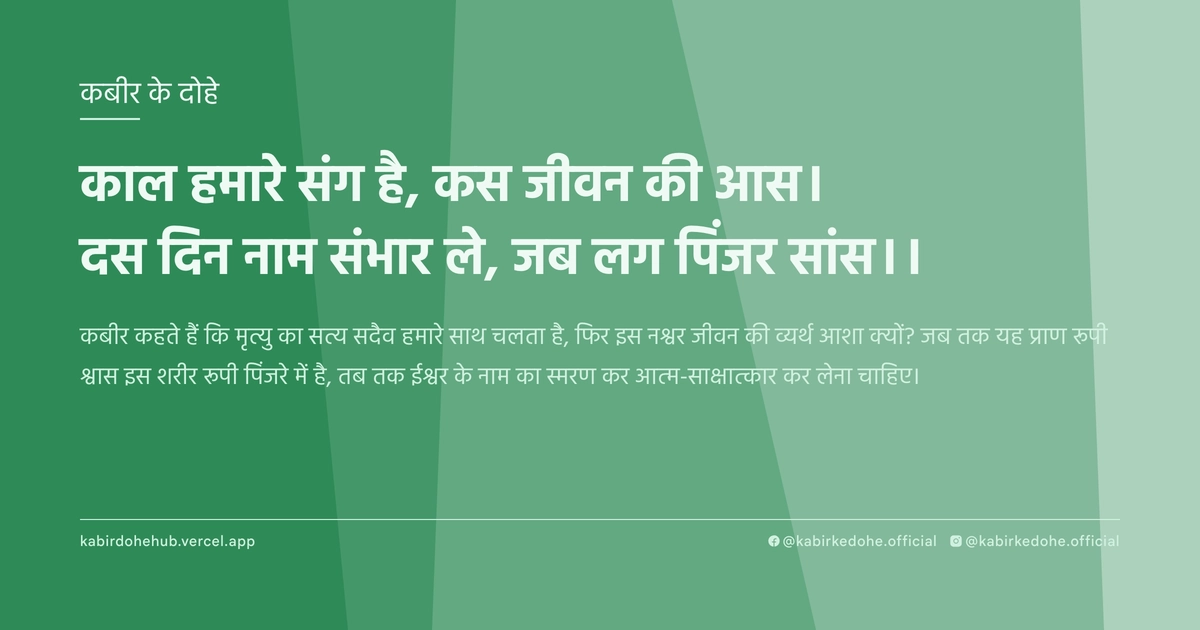
काल हमारे संग है, कस जीवन की आस।
दस दिन नाम संभार ले, जब लग पिंजर सांस।।
Kaal hamare sang hai, kas jeevan ki aas. Das din naam sambhaar le, jab lag pinjar saans.
इस पृष्ठ पर इस कबीर दोहे का अर्थ (meaning), हिंदी व्याख्या और अंग्रेज़ी अनुवाद, दार्शनिक विश्लेषण और व्यावहारिक जीवन सीख दी गई है। यह दोहा जागृति (The Wake-up Call) विषय से जुड़ा है — Kabir doha meaning and explanation in Hindi and English.
अर्थ (Meaning):
कबीर कहते हैं कि मृत्यु का सत्य सदैव हमारे साथ चलता है, फिर इस नश्वर जीवन की व्यर्थ आशा क्यों? जब तक यह प्राण रूपी श्वास इस शरीर रूपी पिंजरे में है, तब तक ईश्वर के नाम का स्मरण कर आत्म-साक्षात्कार कर लेना चाहिए।
Kabir asserts that the certainty of death accompanies us at every moment, questioning the futility of clinging to worldly hopes. He urges the seeker to embrace the Divine Name and spiritual mindfulness while the breath still lingers within the cage of the physical body.
व्याख्या (Interpretation):
यह दोहा जीवन की क्षणभंगुरता और आध्यात्मिक तत्परता पर केंद्रित है। 'पिंजर' शब्द शरीर को एक कारागार के रूप में दर्शाता है जहाँ आत्मा कैद है। निरगुण भक्ति के परिप्रेक्ष्य में, 'नाम' केवल शब्द नहीं बल्कि उस निराकार ब्रह्म की चेतना है जो माया के पर्दे को हटाती है। यहाँ अद्वैत वेदांत का प्रभाव दिखता है जहाँ जीव को यह बोध कराया जा रहा है कि वह शरीर नहीं, बल्कि वह अविनाशी तत्व है। मृत्यु का स्मरण यहाँ भय पैदा करने के लिए नहीं, बल्कि जाग्रति लाने के लिए किया गया है। यह विरोधाभास है कि मृत्यु का बोध ही वास्तव में जीवन को सार्थक बनाता है। अंततः, यह संदेश देता है कि मुक्ति बाहरी कर्मकांडों में नहीं, बल्कि वर्तमान क्षण में ईश्वर के साथ एकाकार होने में है।
This couplet focuses on the transience of existence and the urgency of spiritual awakening. The metaphor of the 'cage' (pinjar) depicts the physical body as a prison confining the eternal soul. In the context of Nirgun Bhakti, the 'Name' is not a mere linguistic label but the vibration of the Formless Brahman that pierces through the veil of Maya. It reflects Advaita Vedanta by reminding the seeker that they are not the perishable body, but the imperishable consciousness. The invocation of death is not intended to incite fear, but to catalyze a state of heightened awareness. It presents a profound paradox: only by acknowledging the inevitability of death can one truly begin to live. Ultimately, it suggests that liberation lies not in ritualistic piety, but in the immediate realization of oneness with the Divine.
दार्शनिक विश्लेषण (Philosophical Analysis):
कबीर का यह दोहा उस युग की उपज है जहाँ धर्म केवल बाहरी आडंबरों और जातिगत श्रेष्ठता तक सीमित था। कबीर ने इस व्यवस्था को चुनौती देते हुए 'नाम' की आंतरिक साधना पर बल दिया। उनका दर्शन सूफी मत के 'फना' (अहंकार का विनाश) और वेदांत के 'अहं ब्रह्मास्मि' का एक अनूठा संगम है। वे तर्क देते हैं कि जब मृत्यु निश्चित है, तो सामाजिक प्रतिष्ठा, धन और संचय का मोह केवल एक भ्रम है।
यहाँ 'नाम संभार' का अर्थ केवल जप नहीं, बल्कि सजगता है। यह मनोवैज्ञानिक रूपांतरण की प्रक्रिया है जहाँ साधक अपने 'अहं' को विसर्जित कर देता है। कबीर के अनुसार, अधिकांश लोग जीवन भर माया के जाल में उलझे रहते हैं और मृत्यु के द्वार पर पहुँचकर जागते हैं, जो कि बहुत देर हो चुकी होती है।
यह शिक्षण ritualism (कर्मकांड) के विरुद्ध एक कड़ा प्रहार है। कबीर का मानना था कि तीर्थयात्रा या उपवास से अधिक महत्वपूर्ण है अपने भीतर के मंदिर को खोजना। वे शरीर को एक अस्थायी निवास मानते हैं, जिसे उन्होंने 'पिंजर' कहा है, ताकि मनुष्य अपनी पहचान को भौतिकता से हटाकर आध्यात्मिकता की ओर ले जाए।
दार्शनिक स्तर पर, यह दोहा समय की अवधारणा (Kaal) पर प्रहार करता है। हम अक्सर 'कल' की प्रतीक्षा करते हैं, लेकिन कबीर 'अभी' (Present Moment) की अनिवार्यता को स्थापित करते हैं। यह सूफी संतों की उस शिक्षा के समान है जहाँ ईश्वर को खोजने के लिए कहीं जाने की आवश्यकता नहीं, वह हृदय की धड़कन में मौजूद है।
अंततः, यह विश्लेषण स्पष्ट करता है कि कबीर का मार्ग मध्यम मार्ग नहीं, बल्कि एक क्रांतिकारी मार्ग है। वे मनुष्य को उसकी नींद से जगाकर उसे यह याद दिलाते हैं कि आत्मा का वास्तविक घर यह संसार नहीं है। जब अहंकार मिटता है, तभी वह 'नाम' सार्थक होता है और जीव ब्रह्म में विलीन हो जाता है।
Kabir’s couplet emerges from an era where religion was largely reduced to external rituals and caste-based hierarchies. By emphasizing the internal practice of the 'Name,' Kabir challenged the prevailing orthodoxy. His philosophy represents a unique synthesis of the Sufi concept of 'Fana' (annihilation of the ego) and the Vedantic realization of 'Aham Brahmasmi' (I am Brahman). He argues that since death is an absolute certainty, the pursuit of social status, wealth, and accumulation is a mere illusion.
In this context, 'remembering the Name' is not merely repetitive chanting but a state of conscious awareness. It is a process of psychological transformation where the seeker dissolves the ego. Kabir observes that most individuals remain entangled in the web of Maya throughout their lives, awakening only at the threshold of death, by which time the opportunity for liberation has diminished.
This teaching is a sharp critique of ritualism. Kabir believed that searching for the Divine in pilgrimages or through fasting was futile compared to discovering the temple within. By describing the body as a 'cage' (pinjar), he urges the human consciousness to detach its identity from the material form and align with the spiritual essence.
Philosophically, the verse attacks the human tendency to procrastinate spiritual growth. We often wait for a 'better time' or a 'future' to seek truth, but Kabir establishes the absolute necessity of the 'Now.' This mirrors the Sufi teaching that the Divine is not found in distant lands but within the very beat of one's heart.
Ultimately, this analysis reveals that Kabir’s path is not one of moderation, but of revolution. He awakens the sleeper to the fact that the soul's true home is not this transient world. Only when the ego is annihilated does the 'Name' become meaningful, allowing the individual soul to merge back into the Universal Consciousness.
मूल संदेश (Core Message):
- मृत्यु भय नहीं, बल्कि एक महान जागृति का निमंत्रण है।
- शरीर एक पिंजरा है; चेतना ही एकमात्र मुक्त पक्षी है।
- भविष्य की आशाएं आध्यात्मिक प्रगति में सबसे बड़ी बाधा हैं।
- ईश्वर का नाम बाहरी जप नहीं, आंतरिक उपस्थिति है।
- वर्तमान क्षण ही वह एकमात्र द्वार है जहाँ मुक्ति संभव है।
- अहंकार का विसर्जन ही आत्मा का वास्तविक मिलन है।
- Death is not a terror, but an invitation to a great awakening.
- The body is a cage; consciousness is the only free bird.
- Hopes for the future are the greatest obstacles to spiritual growth.
- The Divine Name is not external chanting, but internal presence.
- The present moment is the only gateway where liberation is possible.
- The dissolution of ego is the true union of the soul.
व्यावहारिक उदाहरण (Practical Example):
वाराणसी के एक पुराने घाट पर रहने वाले रामदीन नाम के एक वृद्ध बुनकर थे। उनका पूरा जीवन केवल बेहतरीन रेशमी कपड़े बुनने और अधिक धन कमाने की होड़ में बीता। वे हमेशा सोचते थे कि जब उनके पास पर्याप्त संपत्ति होगी, तब वे शांति से ईश्वर की भक्ति करेंगे।
रामदीन का स्वभाव चिड़चिड़ा था और वे अपने परिवार तथा पड़ोसियों को हमेशा अपनी सफलता का बखान करते थे। उनके लिए जीवन का अर्थ था—अधिकतम उत्पादन और सामाजिक प्रतिष्ठा। वे अक्सर कहते, 'अभी समय नहीं है, पहले व्यापार बढ़ा लूँ, फिर शांति खोजूँगा।'
एक दिन रामदीन ने देखा कि उनके सबसे करीबी मित्र, जो उनसे अधिक समृद्ध थे, का अचानक निधन हो गया। अंतिम संस्कार के समय, जब वे चिता की अग्नि को देख रहे थे, उन्हें अचानक कबीर का यह दोहा याद आया कि मृत्यु सदैव हमारे संग है।
उन्हें अहसास हुआ कि जिस 'कल' की प्रतीक्षा में वे अपनी वर्तमान शांति की बलि दे रहे थे, वह कल कभी आता ही नहीं। उन्होंने देखा कि उनकी रेशमी साड़ियाँ और सोने के सिक्के उनके मित्र के काम नहीं आए, और न ही वे उनके अपने दुख को कम कर पा रहे थे।
रामदीन के भीतर एक गहरा बदलाव आया। उन्होंने अपनी कार्यशाला को बंद नहीं किया, लेकिन अब वे काम को केवल जीविका का साधन मानते थे, न कि जीवन का उद्देश्य। उन्होंने हर दिन सुबह एक घंटा मौन में बिताना शुरू किया।
वे अब कपड़े बुनते समय भी मन ही मन उस निराकार सत्ता का स्मरण करते थे। उनकी चिड़चिड़ाहट गायब हो गई और वे दूसरों की मदद करने लगे। उन्होंने महसूस किया कि असली 'नाम संभार' काम को छोड़कर भागना नहीं, बल्कि काम करते हुए भी भीतर से विरक्त रहना है।
एक समय ऐसा आया जब रामदीन ने अपनी संपत्ति का एक बड़ा हिस्सा गरीबों के लिए खोल दिया। उन्हें अब इस बात का डर नहीं था कि वे क्या खो रहे हैं, क्योंकि उन्होंने वह पा लिया था जो कभी खोता नहीं—आंतरिक संतोष।
जब रामदीन का अंतिम समय आया, तो उनके चेहरे पर कोई भय नहीं था। उन्होंने मुस्कुराते हुए अपनी अंतिम सांस ली, क्योंकि उन्होंने अपने 'पिंजरे' के भीतर उस अनंत संगीत को सुन लिया था। उनके जीवन का रूपांतरण यह सिखाता है कि जागरूकता ही वास्तविक मुक्ति है।
In the ancient ghats of Varanasi lived an elderly weaver named Ramdeen. His entire life had been spent in a relentless pursuit of weaving the finest silk fabrics and accumulating wealth. He always believed that once he possessed enough assets, he would finally find the time to devote himself to God.
Ramdeen was irritable and constantly boasted of his success to his family and neighbors. For him, life was defined by maximum production and social prestige. He would often say, 'There is no time now; let me expand my business first, then I shall seek peace.'
One day, Ramdeen witnessed the sudden passing of his closest friend, a man even wealthier than himself. While watching the funeral pyre, Kabir’s words echoed in his mind: death is a constant companion, always walking beside us.
He suddenly realized that the 'tomorrow' he was waiting for—the one for which he sacrificed his present peace—never actually arrives. He saw that the exquisite silks and gold coins did not serve his friend in the end, nor did they alleviate his own grief.
A profound shift occurred within Ramdeen. He did not abandon his loom, but he stopped viewing his work as the purpose of his life, treating it instead as a mere means of survival. He began spending an hour every morning in deep, meditative silence.
Now, while weaving, he maintained a constant internal connection with the Formless Divine. His irritability vanished, and he began helping others selflessly. He discovered that true 'remembrance of the Name' is not about fleeing from work, but remaining detached while engaged in it.
Eventually, Ramdeen donated a significant portion of his wealth to the poor. He no longer feared loss because he had attained that which is eternal—inner contentment.
When Ramdeen’s own final hour arrived, there was no fear on his face. He breathed his last with a smile, for he had heard the infinite music within his 'cage.' His transformation teaches us that awareness is the only true liberation.
अभ्यास मार्गदर्शन (Practice Guidance):
- दैनिक मरण-चिंतन: प्रतिदिन 10 मिनट शांत बैठकर यह विचार करें कि यह शरीर नश्वर है और केवल चेतना शाश्वत है।
- सजग श्वास अभ्यास: दिन में तीन बार, अपनी सांसों पर ध्यान केंद्रित करें और महसूस करें कि हर सांस एक उपहार है जो अंततः वापस लौट जाएगी।
- अहंकार डायरी: उन क्षणों को लिखें जब आपने अपनी सामाजिक पहचान (पद, प्रतिष्ठा) को अपनी वास्तविक पहचान माना, और फिर उसे मानसिक रूप से विसर्जित करें।
- निदान चेकलिस्ट: क्या आप भविष्य की चिंता में वर्तमान को खो रहे हैं? क्या आप मृत्यु के विचार से डरते हैं? यदि हाँ, तो आप अभी भी माया के प्रभाव में हैं।
- Daily Contemplation of Mortality: Spend 10 minutes in silence reflecting on the transience of the body and the eternity of pure consciousness.
- Mindful Breath Awareness: Three times a day, focus on your breath, recognizing that each inhalation is a borrowed gift that must eventually be returned.
- Ego Journaling: Document moments where you clung to your social identity (status, title) as your true self, then consciously dissolve that attachment.
- Diagnostic Checklist: Are you sacrificing the present for a hypothetical future? Does the thought of death trigger fear rather than liberation? If so, you are still under the influence of Maya.
चिंतन प्रश्न (Reflection Questions):
- यदि आज आपकी अंतिम सांस हो, तो आपकी कौन सी उपलब्धियां वास्तव में मायने रखेंगी?
- आप अपनी सार्वजनिक छवि (Digital/Social Ego) को बनाए रखने के लिए अपनी आंतरिक शांति का कितना त्याग करते हैं?
- क्या आपका 'भक्ति मार्ग' वास्तव में समर्पण है, या यह केवल एक और तरीका है खुद को श्रेष्ठ महसूस कराने का?
- आप किस डर के कारण मृत्यु के विचार से बचते हैं—अधूरे कामों का डर या स्वयं को न जानने का डर?
- यदि शरीर एक पिंजरा है, तो वह कौन सी मानसिक जंजीरें हैं जिन्होंने आपको वास्तव में कैद कर रखा है?
- If today were your final breath, which of your achievements would truly hold meaning?
- How much of your inner peace do you sacrifice to maintain your public image (Digital/Social Ego)?
- Is your 'spiritual path' truly a surrender, or is it just another way to feel superior to others?
- What is the root of your avoidance of death—the fear of unfinished tasks or the fear of not knowing yourself?
- If the body is a cage, what are the specific mental chains that keep you truly imprisoned?