
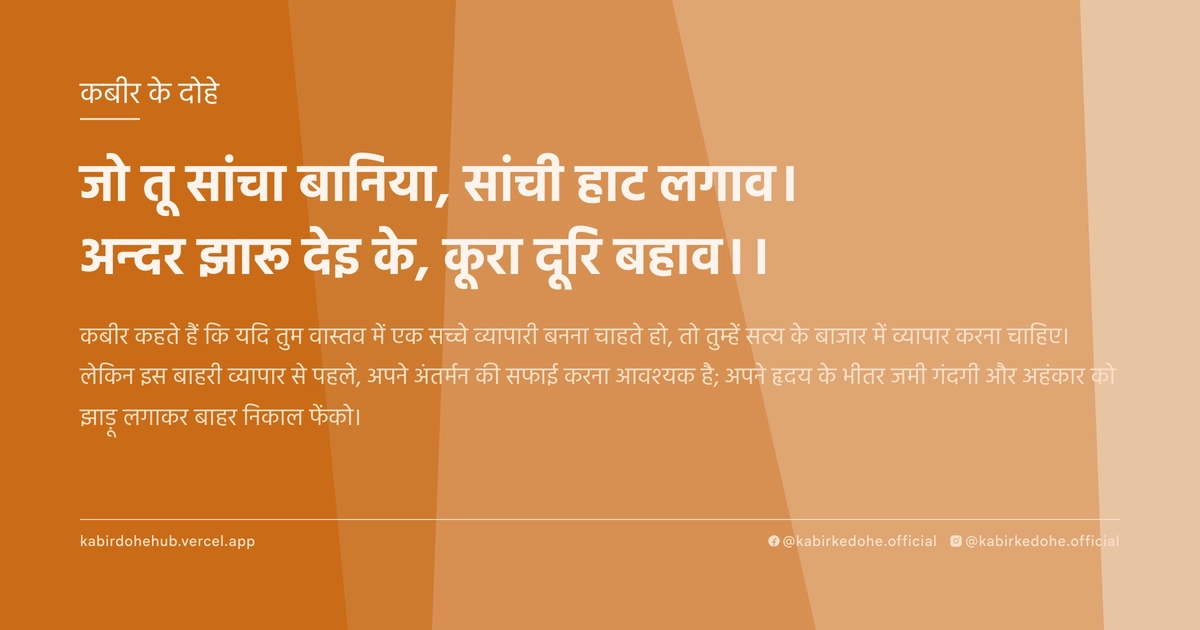
जो तू सांचा बानिया, सांची हाट लगाव।
अन्दर झारू देइ के, कूरा दूरि बहाव।।
Jo tu saancha baaniya, saanchi haat lagaav. Andar jhaaru dei ke, koora doori bahaav.
इस पृष्ठ पर इस कबीर दोहे का अर्थ (meaning), हिंदी व्याख्या और अंग्रेज़ी अनुवाद, दार्शनिक विश्लेषण और व्यावहारिक जीवन सीख दी गई है। यह दोहा आत्मनिरीक्षण (Self-introspection) विषय से जुड़ा है — Kabir doha meaning and explanation in Hindi and English.
अर्थ (Meaning):
कबीर कहते हैं कि यदि तुम वास्तव में एक सच्चे व्यापारी बनना चाहते हो, तो तुम्हें सत्य के बाजार में व्यापार करना चाहिए। लेकिन इस बाहरी व्यापार से पहले, अपने अंतर्मन की सफाई करना आवश्यक है; अपने हृदय के भीतर जमी गंदगी और अहंकार को झाड़ू लगाकर बाहर निकाल फेंको।
Kabir asserts that if you truly wish to be an honest merchant, you must engage in the marketplace of Truth. However, before venturing into this external trade, it is imperative to cleanse your inner being; use the broom of awareness to sweep away the accumulated filth and ego from within your heart.
व्याख्या (Interpretation):
यह दोहा एक गहरे आध्यात्मिक रूपक का उपयोग करता है जहाँ 'बानिया' (व्यापारी) और 'हाट' (बाजार) का अर्थ सांसारिक लेन-देन नहीं, बल्कि आत्मा का परमात्मा के साथ संबंध है। शाब्दिक अर्थ यह है कि सत्य की खोज के लिए आंतरिक पवित्रता अनिवार्य है। रूपकात्मक रूप से, 'कूड़ा' उन मानसिक विकारों, पूर्वाग्रहों और अहंकार का प्रतीक है जो आत्मा और ब्रह्म के बीच की दूरी पैदा करते हैं। निर्गुण भक्ति के संदर्भ में, यह संदेश देता है कि ईश्वर किसी बाहरी मंदिर या मस्जिद में नहीं, बल्कि एक शुद्ध हृदय में निवास करता है। माया वह धूल है जो सत्य के दर्पण को धुंधला कर देती है। जब साधक अपने भीतर के 'मैं' को मिटा देता है, तब वह अद्वैत की स्थिति में पहुँचता है जहाँ वह स्वयं को ब्रह्मांडीय चेतना के साथ एक पाता है। यह विरोधाभास है कि सबसे बड़ी उपलब्धि बाहरी प्राप्ति नहीं, बल्कि आंतरिक रिक्तता और शुद्धि है।
This couplet employs a profound spiritual metaphor where the 'merchant' and the 'marketplace' do not refer to worldly commerce, but to the soul's relationship with the Divine. Literally, it suggests that inner purity is a prerequisite for the pursuit of Truth. Metaphorically, the 'trash' symbolizes the mental impurities, prejudices, and ego that create a perceived separation between the Atman and Brahman. In the context of Nirgun Bhakti, it posits that the Formless Divine resides not in external temples or mosques, but within a purified heart. Maya is the dust that obscures the mirror of truth. When the seeker eradicates the 'I-ness' or ego, they attain the state of Advaita, realizing their non-duality with universal consciousness. The central paradox is that the greatest spiritual achievement is not an external acquisition, but an internal emptying and purification.
दार्शनिक विश्लेषण (Philosophical Analysis):
कबीर का यह दोहा उस युग की प्रतिक्रिया है जहाँ धर्म केवल कर्मकांडों और बाहरी दिखावे तक सीमित हो गया था। उन्होंने स्पष्ट किया कि मोक्ष किसी विशेष जाति में जन्म लेने या कठिन अनुष्ठान करने से नहीं, बल्कि आत्म-साक्षात्कार से मिलता है। यह दृष्टिकोण अद्वैत वेदांत के करीब है, जो मानता है कि जीव और ईश्वर मूलतः एक ही हैं, बस अज्ञान की परतें उन्हें अलग करती हैं।
सूफीवाद के 'फना' (अहंकार का विनाश) के सिद्धांत के साथ इसका गहरा संबंध है। जैसे एक सूफी अपनी पहचान को ईश्वर में विलीन कर देता है, वैसे ही कबीर 'अंदर झारू' देने की बात करते हैं, जिसका अर्थ है अपनी व्यक्तिगत पहचान और अहंकार का पूर्ण विलोपन। बिना इस विलोपन के, सत्य का अनुभव असंभव है क्योंकि अहंकार सत्य का सबसे बड़ा अवरोध है।
कबीर ने जाति व्यवस्था और धार्मिक कट्टरता को चुनौती दी। उनके लिए 'सच्चा बानिया' वह नहीं है जो धन कमाता है, बल्कि वह है जो सत्य के मूल्यों को जीवन में उतारता है। उन्होंने यह सिखाया कि बाहरी पवित्रता (जैसे स्नान या तिलक) व्यर्थ है यदि मन के भीतर ईर्ष्या, क्रोध और लोभ का कूड़ा जमा है।
मनोवैज्ञानिक स्तर पर, यह दोहा 'शैडो वर्क' की बात करता है। अपने भीतर के अंधेरे और गंदगी को स्वीकार करना और उसे साफ करना ही वास्तविक आध्यात्मिक प्रगति है। अधिकांश लोग अपनी कमियों को छिपाते हैं, लेकिन कबीर उन्हें बाहर बहाने का आह्वान करते हैं ताकि वास्तविक प्रकाश प्रकट हो सके।
अंततः, यह शिक्षण हमें यह समझाता है कि आध्यात्मिक यात्रा 'जोड़ने' की नहीं, बल्कि 'हटाने' की प्रक्रिया है। हम सत्य को खोजते नहीं हैं, बल्कि हम उन बाधाओं को हटाते हैं जो हमें सत्य को देखने से रोक रही हैं। जब कूड़ा साफ हो जाता है, तो जो बचता है वही शुद्ध चेतना या ब्रह्म है।
Kabir's couplet is a reaction to an era where religion had become confined to mere rituals and external displays. He clarifies that liberation is not achieved by being born into a specific caste or performing rigorous rituals, but through self-realization. This perspective aligns closely with Advaita Vedanta, which posits that the individual soul (Jiva) and the Universal Soul (Ishvara) are fundamentally one, separated only by layers of ignorance.
There is a deep connection here to the Sufi concept of 'Fana' (the annihilation of the ego). Just as a Sufi dissolves their identity into the Divine, Kabir speaks of 'sweeping the inside,' meaning the total dissolution of personal identity and ego. Without this annihilation, the experience of Truth is impossible because the ego is the primary obstacle to realization.
Kabir challenged the caste system and religious bigotry. For him, a 'true merchant' is not one who accumulates wealth, but one who embodies the values of Truth. He taught that external purity—such as ritual bathing or wearing sacred marks—is futile if the heart remains cluttered with the trash of jealousy, anger, and greed.
On a psychological level, this verse advocates for what modern therapy calls 'shadow work.' Acknowledging and cleansing the internal darkness and filth is the only true path to spiritual progress. While most people hide their flaws, Kabir calls for them to be swept away so that the innate light can shine through.
Ultimately, this teaching suggests that the spiritual journey is not a process of 'adding' or acquiring, but a process of 'subtraction.' We do not find Truth; rather, we remove the obstructions that prevent us from seeing it. Once the debris is cleared, what remains is pure consciousness or Brahman.
मूल संदेश (Core Message):
- बाहरी आडंबर आध्यात्मिक प्रगति के मार्ग में सबसे बड़ी बाधा हैं।
- सत्य की प्राप्ति के लिए पहले अहंकार का विसर्जन अनिवार्य है।
- शुद्ध हृदय ही वह एकमात्र स्थान है जहाँ परमात्मा का वास होता है।
- आध्यात्मिक यात्रा जोड़ने की नहीं, बल्कि अनावश्यक को हटाने की प्रक्रिया है।
- वास्तविक धर्म कर्मकांडों में नहीं, बल्कि आंतरिक रूपांतरण में निहित है।
- External pretenses are the greatest obstacles on the path to spiritual progress.
- The dissolution of ego is an absolute prerequisite for realizing the Truth.
- A purified heart is the only sanctuary where the Divine truly resides.
- The spiritual journey is not about adding, but about removing the unnecessary.
- True religion lies not in rituals, but in profound internal transformation.
व्यावहारिक उदाहरण (Practical Example):
वाराणसी के एक पुराने घाट पर रामदीन नाम का एक वृद्ध नाविक रहता था। वह अपनी नाव चलाने में निपुण था, लेकिन स्वभाव से अत्यंत क्रोधी और अहंकारी था। वह खुद को शहर का सबसे अनुभवी नाविक मानता था और नए लड़कों को नीचा दिखाता था।
रामदीन का मानना था कि वह बहुत धार्मिक है क्योंकि वह प्रतिदिन गंगा स्नान करता था और मंदिर में दान देता था। लेकिन उसके मन में दूसरों के प्रति घृणा और श्रेष्ठता का भाव हमेशा बना रहता था।
एक दिन, उसकी नाव में एक शांत साधु सवार हुए। साधु ने देखा कि रामदीन नाव को बहुत सफाई से चला रहा है, लेकिन उसकी वाणी में कड़वाहट है। साधु ने मुस्कुराते हुए पूछा, "रामदीन, तुम्हारी नाव इतनी चमक रही है, पर क्या तुमने अपने हृदय की नाव की सफाई की है?"
रामदीन हँसा और बोला, "महाराज, मैं रोज़ गंगा में नहाता हूँ, इससे पवित्र क्या होगा?"
साधु ने उत्तर दिया, "गंगा शरीर की धूल धोती है, लेकिन मन का कूड़ा केवल सत्य और विनम्रता की झाड़ू से साफ होता है। तुम बाहर से तो व्यापारी हो, पर भीतर से अहंकार के बोझ तले दबे हो।"
यह बात रामदीन के दिल पर लगी। उसने महसूस किया कि उसकी बाहरी धार्मिकता केवल एक मुखौटा थी। उसने देखा कि कैसे उसका अहंकार उसके और अन्य लोगों के बीच एक दीवार बन गया था।
अगले कुछ महीनों तक, रामदीन ने अपनी वाणी पर नियंत्रण करना शुरू किया। जब भी उसे किसी पर क्रोध आता, वह याद करता कि वह अपने भीतर का 'कूड़ा' बाहर बहा रहा है।
उसने नए नाविकों की मदद करना शुरू किया और अपनी श्रेष्ठता के भाव को त्याग दिया। उसने पाया कि जैसे-जैसे उसका अहंकार कम हुआ, उसके जीवन में शांति और वास्तविक प्रेम बढ़ने लगा।
अब वह केवल नाव नहीं चलाता था, बल्कि लोगों के दुखों को समझने का प्रयास करता था। उसकी नाव अब केवल शरीर को पार नहीं कराती थी, बल्कि उसकी करुणा लोगों के दिलों को छूती थी।
रामदीन अब एक 'सच्चा बानिया' बन चुका था, जिसने बाहरी दिखावे के बजाय आंतरिक शुद्धि को चुना और जीवन के वास्तविक सत्य को पाया।
On an ancient ghat in Varanasi lived an elderly boatman named Ramdeen. He was masterful at rowing his boat, but by nature, he was extremely angry and arrogant. He considered himself the most experienced boatman in the city and frequently belittled the younger men.
Ramdeen believed he was deeply religious because he bathed in the Ganges daily and made donations to the temple. However, a sense of hatred and superiority toward others always lingered in his mind.
One day, a serene monk boarded his boat. The monk noticed that while Ramdeen navigated the boat with precision, his speech was laced with bitterness. The monk smiled and asked, "Ramdeen, your boat shines so brightly, but have you cleaned the boat of your heart?"
Ramdeen laughed and replied, "Maharaj, I bathe in the Ganges every day; what could be purer than that?"
The monk replied, "The Ganges washes the dust from the body, but the filth of the mind is cleared only by the broom of Truth and humility. You are a merchant of the world, but inside, you are burdened by the trash of ego."
These words struck a chord in Ramdeen's heart. He realized that his external religiosity was merely a mask. He saw how his arrogance had built a wall between him and other human beings.
Over the next few months, Ramdeen began to consciously control his speech. Whenever anger flared, he reminded himself that he was in the process of sweeping the 'trash' out of his interior.
He started helping the novice boatmen and relinquished his sense of superiority. He discovered that as his ego diminished, peace and genuine love began to flourish in his life.
He no longer just steered a boat; he sought to understand the suffering of others. His boat no longer just transported bodies across the river; his compassion touched the souls of his passengers.
Ramdeen had finally become a 'true merchant,' choosing internal purification over external display and discovering the authentic truth of existence.
अभ्यास मार्गदर्शन (Practice Guidance):
- दैनिक आत्म-निरीक्षण: प्रतिदिन 15 मिनट मौन बैठें और अपने मन में आने वाले नकारात्मक विचारों (क्रोध, ईर्ष्या, निर्णय) को केवल एक साक्षी की तरह देखें, बिना उन्हें सही या गलत ठहराए।
- अहंकार की पहचान: जब भी आप किसी को खुद से छोटा महसूस कराएं या अपनी किसी उपलब्धि पर गर्व करें, तो रुकें और पूछें, 'क्या यह मेरा सत्य है या केवल मेरा अहंकार बोल रहा है?'
- सेवा का अभ्यास: सप्ताह में एक बार ऐसा कार्य करें जिसमें आपको कोई श्रेय न मिले और जो पूरी तरह निस्वार्थ हो, ताकि 'मैं' की भावना कम हो सके।
- डायग्नोस्टिक चेकलिस्ट: क्या मैं दूसरों की गलतियों पर तुरंत प्रतिक्रिया देता हूँ? क्या मैं अपनी धार्मिकता का प्रदर्शन करता हूँ? क्या मैं बदलाव के प्रति प्रतिरोधी हूँ? यदि हाँ, तो आंतरिक सफाई की आवश्यकता है।
- Daily Self-Observation: Sit in silence for 15 minutes daily and observe negative thoughts (anger, jealousy, judgment) as a witness, without labeling them as right or wrong.
- Ego Identification: Whenever you make someone feel inferior or feel pride in an achievement, pause and ask, 'Is this my Truth, or is it merely my ego speaking?'
- Practice of Service: Once a week, perform an act of service that brings no recognition and is entirely selfless, to diminish the sense of 'I'.
- Diagnostic Checklist: Do I react instantly to others' mistakes? Do I perform my religiosity for show? Am I resistant to change? If yes, internal cleansing is required.
चिंतन प्रश्न (Reflection Questions):
- मेरी वह कौन सी 'धार्मिक' या 'नैतिक' पहचान है जिसका उपयोग मैं दूसरों को छोटा दिखाने के लिए करता हूँ?
- यदि मेरी सभी सामाजिक उपलब्धियाँ और पद छीन लिए जाएँ, तो मेरे भीतर क्या बचेगा?
- मैं अपने डिजिटल व्यक्तित्व (Social Media Ego) को बनाए रखने के लिए अपने वास्तविक स्वरूप से कितना समझौता करता हूँ?
- मेरे भीतर वह कौन सा 'कूड़ा' है जिसे मैं स्वीकार करने से सबसे अधिक डरता हूँ?
- क्या मेरी प्रार्थनाएँ ईश्वर को पाने के लिए हैं, या केवल अपनी इच्छाओं की पूर्ति के लिए?
- Which 'religious' or 'moral' identity do I use as a tool to make others feel inferior?
- If all my social achievements and titles were stripped away, what would remain of me?
- How much do I compromise my authentic self to maintain my digital persona (Social Media Ego)?
- What is the specific 'trash' within me that I am most afraid to acknowledge?
- Are my prayers intended to reach the Divine, or are they merely requests for personal gain?