
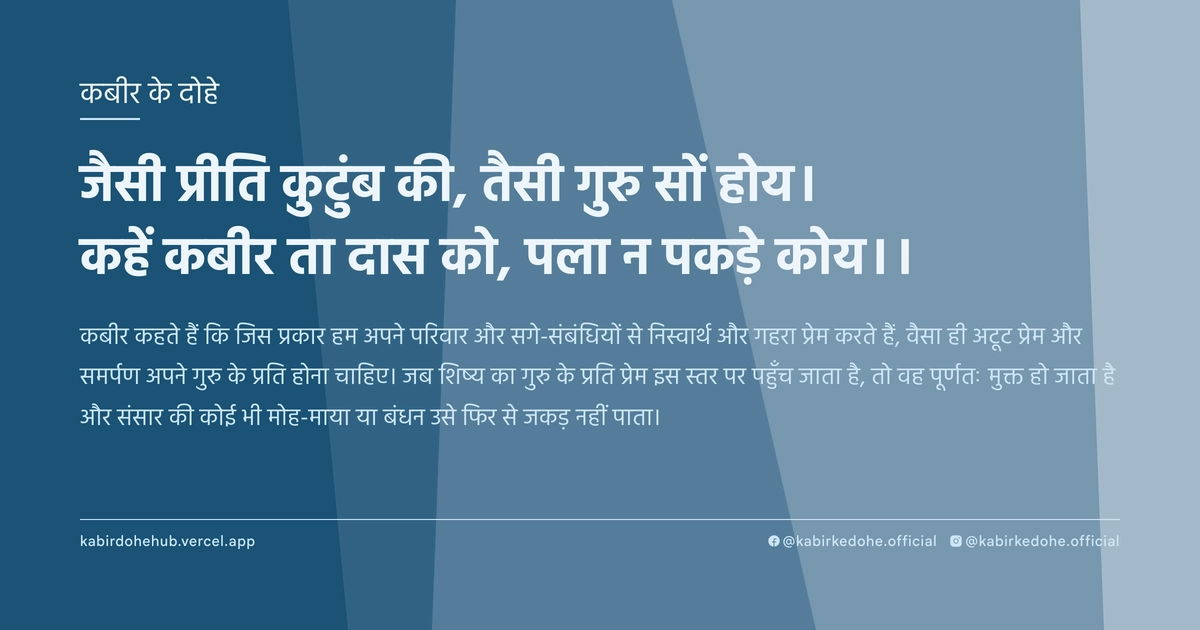
जैसी प्रीति कुटुंब की, तैसी गुरु सों होय।
कहें कबीर ता दास को, पला न पकड़े कोय।।
Jaisi preeti kutumb ki, taisi guru son hoye. Kahen Kabir ta daas ko, pala na pakde koy.
इस पृष्ठ पर इस कबीर दोहे का अर्थ (meaning), हिंदी व्याख्या और अंग्रेज़ी अनुवाद, दार्शनिक विश्लेषण और व्यावहारिक जीवन सीख दी गई है। यह दोहा गुरु महत्व (The Guru's Importance) विषय से जुड़ा है — Kabir doha meaning and explanation in Hindi and English.
अर्थ (Meaning):
कबीर कहते हैं कि जिस प्रकार हम अपने परिवार और सगे-संबंधियों से निस्वार्थ और गहरा प्रेम करते हैं, वैसा ही अटूट प्रेम और समर्पण अपने गुरु के प्रति होना चाहिए। जब शिष्य का गुरु के प्रति प्रेम इस स्तर पर पहुँच जाता है, तो वह पूर्णतः मुक्त हो जाता है और संसार की कोई भी मोह-माया या बंधन उसे फिर से जकड़ नहीं पाता।
Kabir asserts that the same unconditional, instinctive, and deep love one feels for their own family should be extended toward the spiritual teacher (Guru). When a seeker's devotion reaches this intensity of familial intimacy and trust, they attain a state of liberation where no worldly attachment or illusion can ever seize them again.
व्याख्या (Interpretation):
इस दोहे का शाब्दिक अर्थ है कि गुरु को परिवार के सदस्य की तरह प्रेम करो। लेकिन इसका आध्यात्मिक संकेत गहरा है। यहाँ 'कुटुंब' केवल रक्त संबंधों का प्रतीक नहीं है, बल्कि उस सहज सुरक्षा और विश्वास का प्रतीक है जो हम अपनों में पाते हैं। जब यह सहजता गुरु के साथ स्थापित होती है, तो 'अहंकार' समाप्त हो जाता है। यह निर्गुण भक्ति का वह शिखर है जहाँ साधक और सद्गुरु के बीच का द्वैत मिट जाता है। माया का पर्दा तब गिरता है जब प्रेम भय से बड़ा हो जाता है। 'पला न पकड़े कोय' का अर्थ है कि जब आत्मा परमात्मा (गुरु रूप में) में विलीन हो जाती है, तो संसार की कोई भी भौतिक या मानसिक जंजीर उसे वापस खींच नहीं सकती, क्योंकि वह अब द्वैत से ऊपर उठकर अद्वैत की स्थिति में पहुँच चुका है।
Literally, the verse urges the seeker to love the Guru as they love their kin. Metaphorically, 'Kutumb' (family) represents the highest form of instinctive trust and emotional security. By transferring this primal affection to the Guru, the seeker dissolves the barrier of the ego. This aligns with Nirgun Bhakti, where the formless Divine is realized through a relationship of absolute intimacy. The central paradox is that by clinging completely to the Guru (the spiritual anchor), the seeker becomes completely detached from the world. 'Pala na pakde koy' signifies the annihilation of the 'I'—once the Atman recognizes its non-duality with Brahman, the illusions of Maya lose their grip, as there is no longer a separate ego for the world to latch onto.
दार्शनिक विश्लेषण (Philosophical Analysis):
कबीर का यह दृष्टिकोण तत्कालीन समाज में व्याप्त औपचारिक और यांत्रिक गुरु-शिष्य परंपरा पर एक प्रहार है। उस समय गुरु को केवल एक बाहरी शिक्षक या अनुष्ठानिक अधिकारी माना जाता था। कबीर इसे बदलकर एक भावनात्मक और आध्यात्मिक मिलन में परिवर्तित करते हैं। वे तर्क देते हैं कि बिना प्रेम के ज्ञान केवल सूचना है, रूपांतरण नहीं।
यह विचार अद्वैत वेदांत के उस सिद्धांत से मेल खाता है जहाँ ज्ञाता, ज्ञान और ज्ञेय का भेद समाप्त हो जाता है। जब शिष्य गुरु को अपने परिवार की तरह प्रेम करता है, तो वह वास्तव में अपने भीतर के उच्चतम स्वरूप (Inner Guru) से जुड़ रहा होता है। यह सूफी मत के 'इश्क-ए-हकीकी' (दिव्य प्रेम) के समान है, जहाँ प्रेमी और प्रियतम एक हो जाते हैं।
कबीर कर्मकांडों और जातिगत श्रेष्ठता का खंडन करते हैं। उनके लिए प्रेम ही एकमात्र पात्रता है। वे समझाते हैं कि यदि आप गुरु के प्रति केवल डर या सम्मान रखते हैं, तो आप अभी भी द्वैत में हैं। लेकिन यदि आप प्रेम करते हैं, तो आप समर्पण की उस अवस्था में पहुँच जाते हैं जहाँ 'मैं' और 'तुम' का अंतर समाप्त हो जाता है।
मनोवैज्ञानिक स्तर पर, यह 'अटैचमेंट' का रूपांतरण है। सांसारिक प्रेम अक्सर स्वामित्व और असुरक्षा से प्रेरित होता है, लेकिन गुरु के प्रति ऐसा प्रेम मुक्तिदायी होता है क्योंकि यह आत्मा को उसके मूल स्रोत की ओर ले जाता है। यह अहंकार के विसर्जन की प्रक्रिया है।
अंततः, यह दोहा यह स्पष्ट करता है कि आध्यात्मिक प्रगति केवल शास्त्रों के अध्ययन से नहीं, बल्कि हृदय के विस्तार से होती है। जब हृदय इतना बड़ा हो जाए कि उसमें गुरु और परिवार एक समान हो जाएं, तब साधक वास्तव में स्वतंत्र होता है।
Kabir’s perspective is a critique of the formalistic and mechanical Guru-disciple traditions of his era, where the teacher was often viewed as a mere ritualistic authority. Kabir transforms this into a relationship of emotional and spiritual intimacy, arguing that knowledge without love is mere information, not transformation.
This aligns with Advaita Vedanta, where the distinction between the knower, the known, and the knowledge dissolves. By loving the Guru as family, the seeker is actually aligning with the Higher Self (the Inner Guru). This mirrors the Sufi concept of 'Ishq-e-Haqiqi' (Divine Love), where the lover and the Beloved merge into one entity.
Kabir rejects ritualism and caste hierarchies, asserting that love is the only prerequisite for liberation. He suggests that respect born of fear or social obligation keeps the seeker in duality. Only love facilitates the total surrender required to transcend the ego.
Psychologically, this is a transmutation of attachment. While familial love can sometimes be rooted in possessiveness, the love for the Guru is a bridge to the Infinite. It is the process of 'Fana' (annihilation of the self) in the presence of the Truth.
Ultimately, the verse clarifies that spiritual evolution is not a product of scholarly study but of the heart's expansion. When the heart expands to encompass the Guru with the same naturalness as one's own kin, the seeker attains a state of freedom that no worldly bond can disrupt.
मूल संदेश (Core Message):
- औपचारिक सम्मान बंधन है, निस्वार्थ प्रेम मुक्ति है।
- जब गुरु परिवार बन जाता है, तब अहंकार मिट जाता है।
- भक्ति का अर्थ अनुष्ठान नहीं, बल्कि हृदय का मिलन है।
- प्रेम ही वह सेतु है जो जीव को शिव से जोड़ता है।
- पूर्ण समर्पण ही संसार की सभी जंजीरों को काटने का एकमात्र तरीका है।
- Formal respect is a bond; selfless love is liberation.
- When the Guru becomes family, the ego vanishes.
- Devotion is not about ritual, but the union of hearts.
- Love is the only bridge connecting the individual to the Universal.
- Total surrender is the only way to sever all worldly chains.
व्यावहारिक उदाहरण (Practical Example):
वाराणसी के एक पुराने घाट पर रहने वाले माधव नाम के एक वृद्ध कुम्हार थे। माधव का जीवन मिट्टी और चाक के इर्द-गिर्द घूमता था। वे बहुत धार्मिक थे, लेकिन उनका धर्म केवल मंदिर जाने और मंत्र पढ़ने तक सीमित था। उनके जीवन में एक गुरु थे, जिनसे वे बहुत सम्मान करते थे, लेकिन वह सम्मान एक औपचारिक दूरी जैसा था।
माधव का एक छोटा सा परिवार था—एक पत्नी और एक बेटा। वे अपने बेटे से इतना प्रेम करते थे कि उसकी हर खुशी के लिए वे अपनी नींद और भूख त्याग देते थे। उनके लिए परिवार का अर्थ था निस्वार्थ समर्पण।
एक दिन, माधव ने अपने गुरु को एक गहरे संकट में देखा। गुरु की तबीयत बहुत खराब थी और उनके पास कोई देखभाल करने वाला नहीं था। माधव ने देखा कि जिस तरह वे अपने बीमार बेटे की सेवा करते समय समय और थकान को भूल जाते थे, वैसा ही भाव उन्हें अपने गुरु के लिए महसूस होना चाहिए।
शुरुआत में, माधव को झिझक हुई। उन्हें लगा कि गुरु एक 'ऊँचे' व्यक्तित्व हैं और वे एक साधारण कुम्हार। लेकिन तभी उन्हें कबीर का यह दोहा याद आया कि गुरु के प्रति प्रेम वैसा ही होना चाहिए जैसा परिवार के प्रति होता है।
माधव ने अपनी सारी झिझक त्याग दी। उन्होंने गुरु की सेवा ठीक उसी तरह शुरू की जैसे वे अपने परिवार की करते थे—बिना किसी औपचारिकता के, बिना यह सोचे कि वे क्या पा रहे हैं, और बिना किसी डर के। उन्होंने गुरु के पैरों की मालिश की, उन्हें समय पर भोजन कराया और उनकी रातों की नींद का ध्यान रखा।
जैसे-जैसे दिन बीते, माधव के भीतर एक अजीब बदलाव आया। उन्होंने महसूस किया कि जब वे गुरु की सेवा कर रहे थे, तो उन्हें वह सुख मिल रहा था जो उन्हें अपने बेटे की सेवा में मिलता था। लेकिन यह सुख उससे भी गहरा था क्योंकि इसमें कोई 'अपेक्षा' नहीं थी।
एक रात, जब गुरु स्वस्थ होकर उठे, उन्होंने माधव की आँखों में एक ऐसी चमक देखी जो पहले कभी नहीं थी। गुरु ने कहा, 'माधव, तुमने मुझे शिष्य की तरह नहीं, बल्कि अपने परिवार की तरह प्रेम किया। इसी प्रेम ने तुम्हारे भीतर के अहंकार को जला दिया है।'
माधव को अचानक अनुभव हुआ कि अब उन्हें दुनिया की किसी चीज़ का डर नहीं है। न तो गरीबी का, न ही मृत्यु का। उनके भीतर एक ऐसी शांति आ गई थी कि अब संसार की कोई भी चिंता उन्हें विचलित नहीं कर सकती थी। वे अब वास्तव में मुक्त थे क्योंकि उन्होंने प्रेम के माध्यम से परमात्मा को पा लिया था।
In the ancient ghats of Varanasi lived an elderly potter named Madhav. His life revolved around clay and the potter's wheel. Madhav was religious, but his faith was limited to temple visits and the rote recitation of mantras. He had a spiritual teacher, whom he respected deeply, but that respect was characterized by a formal, distant reverence.
Madhav had a small family—a wife and a son. He loved his son with an intensity that made him sacrifice his own sleep and hunger for the boy's happiness. For Madhav, family meant unconditional, instinctive surrender.
One day, Madhav found his Guru in a state of severe illness and distress, with no one to care for him. Madhav realized that the same tenderness and urgency he felt when tending to his sick son should be extended to his Guru.
Initially, Madhav hesitated. He felt the Guru was a 'high' personality and he was merely a humble potter. However, he recalled Kabir's teaching: that the love for the Guru must mirror the love for one's own kin.
Madhav cast aside his inhibitions. He began serving the Guru exactly as he served his family—without formality, without calculating the reward, and without fear. He massaged the Guru's feet, ensured timely meals, and stayed awake through the nights to monitor his health.
As days passed, a profound shift occurred within Madhav. He noticed that the joy he derived from serving the Guru was identical to the joy he felt for his son, yet it was deeper because it was devoid of possessiveness.
One night, upon recovering, the Guru looked into Madhav's eyes and saw a radiance that hadn't been there before. The Guru remarked, 'Madhav, you did not love me as a disciple loves a teacher, but as a family member loves their own. This love has incinerated your ego.'
Madhav suddenly felt a liberation he had never known. He was no longer afraid of poverty, loss, or even death. A stillness descended upon him, and the anxieties of the world could no longer grip him. He had found the Divine through the simple act of unconditional love.
अभ्यास मार्गदर्शन (Practice Guidance):
- प्रतिदिन 15 मिनट मौन ध्यान करें, जहाँ आप अपने गुरु या अपने भीतर के उच्चतम स्वरूप के प्रति कृतज्ञता का भाव लाएं, जैसे आप अपने सबसे प्रिय परिजन के लिए लाते हैं।
- एक 'प्रेम-डायरी' लिखें: उन क्षणों को दर्ज करें जब आपने किसी की सेवा बिना किसी अपेक्षा या औपचारिकता के की। विश्लेषण करें कि उस समय आपका अहंकार कितना कम था।
- व्यवहार परिवर्तन: अपने जीवन में एक ऐसे व्यक्ति को चुनें जिसे आप केवल 'सम्मान' देते हैं, और प्रयास करें कि उस सम्मान को 'स्नेह' और 'अपनापन' में बदलें।
- डायग्नोस्टिक चेकलिस्ट: क्या मैं गुरु/मार्गदर्शक के सामने केवल अपनी उपलब्धियां दिखाता हूँ? क्या मैं उनकी आलोचना से डरता हूँ? क्या मेरा समर्पण केवल बाहरी है? यदि हाँ, तो आप अभी भी द्वैत में हैं।
- Practice 15 minutes of silent meditation daily, evoking a sense of gratitude toward your Guru or Inner Self, mirroring the instinctive love you feel for your closest kin.
- Maintain a 'Love Journal': Record moments where you served others without expectation or formality. Analyze how much your ego diminished during those acts.
- Behavioral Shift: Identify someone in your life whom you treat with mere 'formal respect' and consciously attempt to transform that respect into genuine affection and kinship.
- Diagnostic Checklist: Do I only showcase my achievements to my guide? Am I afraid of their critique? Is my surrender merely external? If yes, you are still operating within duality.
चिंतन प्रश्न (Reflection Questions):
- क्या मेरा आध्यात्मिक मार्ग केवल एक सामाजिक पहचान या बौद्धिक उपलब्धि बन गया है?
- मैं अपने गुरु या मार्गदर्शक के सामने जो मुखौटा पहनता हूँ, वह वास्तव में क्या है?
- यदि मेरी सारी बाहरी उपलब्धियां छीन ली जाएं, तो क्या मेरा प्रेम और समर्पण तब भी बना रहेगा?
- क्या मैं प्रेम करने से डरता हूँ क्योंकि प्रेम में 'मैं' का अस्तित्व समाप्त हो जाता है?
- मेरे जीवन में 'सम्मान' और 'प्रेम' के बीच की बारीक रेखा कहाँ है, और वह रेखा मुझे मुक्त कर रही है या बाँध रही है?
- Has my spiritual path become merely a social identity or an intellectual achievement?
- What is the nature of the mask I wear in the presence of my Guru or mentor?
- If all my external achievements were stripped away, would my love and surrender remain intact?
- Am I afraid of loving truly because love demands the annihilation of the 'I'?
- Where does the line between 'respect' and 'love' lie in my life, and is that line liberating me or confining me?