
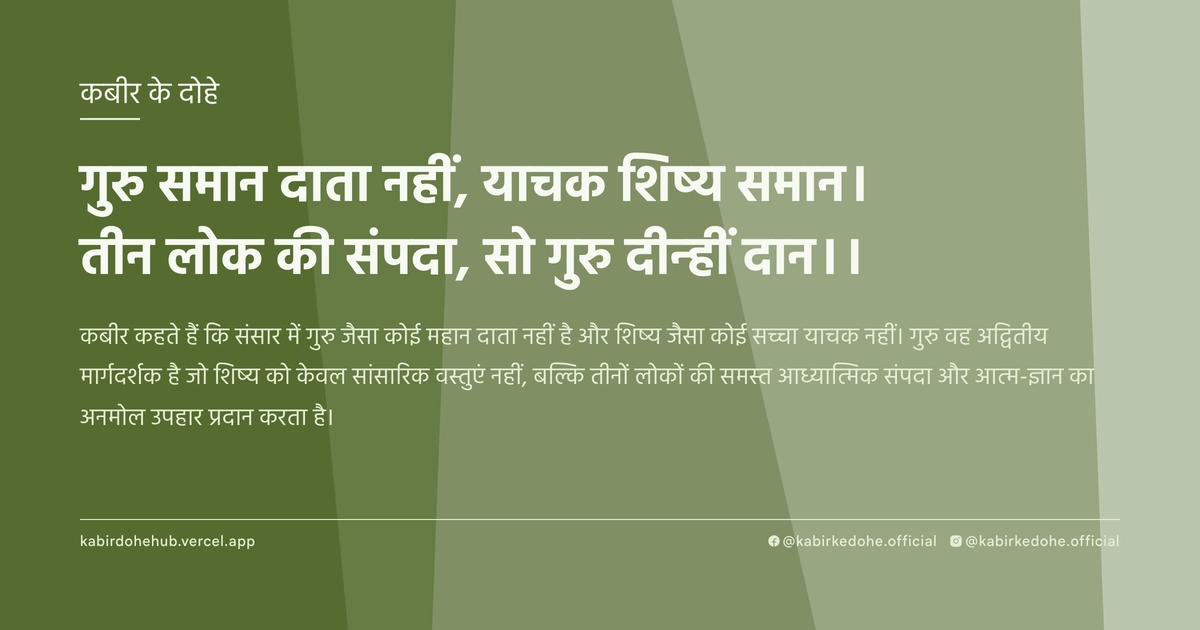
गुरु समान दाता नहीं, याचक शिष्य समान।
तीन लोक की संपदा, सो गुरु दीन्हीं दान।।
Guru saman data nahi, yaachak shishya saman. Teen lok ki sampada, so guru dinhi daan.
इस पृष्ठ पर इस कबीर दोहे का अर्थ (meaning), हिंदी व्याख्या और अंग्रेज़ी अनुवाद, दार्शनिक विश्लेषण और व्यावहारिक जीवन सीख दी गई है। यह दोहा गुरु महत्व (The Guru's Importance) विषय से जुड़ा है — Kabir doha meaning and explanation in Hindi and English.
अर्थ (Meaning):
कबीर कहते हैं कि संसार में गुरु जैसा कोई महान दाता नहीं है और शिष्य जैसा कोई सच्चा याचक नहीं। गुरु वह अद्वितीय मार्गदर्शक है जो शिष्य को केवल सांसारिक वस्तुएं नहीं, बल्कि तीनों लोकों की समस्त आध्यात्मिक संपदा और आत्म-ज्ञान का अनमोल उपहार प्रदान करता है।
Kabir asserts that there is no benefactor as generous as the Guru, nor a seeker as humble and deserving as the disciple. The Guru is the supreme giver who bestows upon the seeker not material riches, but the spiritual wealth of the three worlds—the ultimate realization of Truth.
व्याख्या (Interpretation):
शाब्दिक अर्थ में यह दोहा गुरु की उदारता का वर्णन करता है, परंतु आध्यात्मिक स्तर पर यह 'ज्ञान' के हस्तांतरण की बात करता है। यहाँ 'दाता' केवल वह नहीं जो भौतिक वस्तु दे, बल्कि वह है जो अज्ञान के अंधकार को मिटाए। 'तीन लोक की संपदा' का अर्थ स्वर्ग, पृथ्वी और पाताल की भौतिकता नहीं, बल्कि चेतना की उच्चतम अवस्था है। यह निर्गुण भक्ति का सार है जहाँ गुरु शिष्य के भीतर सोई हुई आत्मा को जगाता है। माया के आवरण को हटाकर, गुरु शिष्य को यह बोध कराता है कि वह स्वयं ब्रह्म है। यह द्वैत से अद्वैत की यात्रा है, जहाँ गुरु और शिष्य अंततः एक ही चैतन्य में विलीन हो जाते हैं। इस प्रकार, गुरु की कृपा वह कुंजी है जो मोक्ष के द्वार खोलती है।
Literally, this couplet praises the generosity of the teacher, but metaphorically, it speaks of the transmission of 'Gnosis'. The 'Giver' here is not one who provides material aid, but one who annihilates the darkness of ignorance. The 'wealth of the three worlds' does not refer to the physical realms of heaven, earth, and underworld, but to the highest state of consciousness. This aligns with Nirgun Bhakti, where the Guru awakens the dormant soul within the disciple. By stripping away the veil of Maya (illusion), the Guru reveals that the seeker is, in essence, Brahman. It is a journey from duality to non-duality (Advaita), where the distinction between teacher and student eventually dissolves into a single consciousness. Thus, the Guru's grace is the catalyst for liberation.
दार्शनिक विश्लेषण (Philosophical Analysis):
कबीर का यह दोहा उस युग की उपज है जब धर्म कर्मकांडों और बाहरी आडंबरों में जकड़ा हुआ था। कबीर ने मंदिर-मस्जिद के बजाय 'शब्द' और 'गुरु' की महत्ता पर बल दिया। यहाँ गुरु का अर्थ किसी विशेष व्यक्ति या जाति से नहीं, बल्कि उस 'तत्व' से है जो सत्य का साक्षात्कार करा सके। यह विचार अद्वैत वेदांत के करीब है, जहाँ आत्मा और परमात्मा की एकता को पहचाना जाता है।
सूफी मत में इसे 'पीर' की अवधारणा से जोड़ा जा सकता है, जहाँ मुरीद (शिष्य) अपने अहंकार को पीर के चरणों में समर्पित कर देता है। कबीर का दर्शन यह है कि जब तक शिष्य में 'याचक' (विनम्रता) का भाव नहीं होगा, तब तक ज्ञान का अवतरण संभव नहीं है। अहंकार ज्ञान का सबसे बड़ा अवरोध है।
ritualism (कर्मकांड) का विरोध करते हुए कबीर समझाते हैं कि मोक्ष किसी तीर्थ यात्रा या मंत्रोच्चार से नहीं, बल्कि गुरु द्वारा दिए गए 'ज्ञान रूपी दान' से मिलता है। यह दान निःशुल्क है, लेकिन इसकी कीमत शिष्य का अपना अहंकार है।
मनोवैज्ञानिक स्तर पर, यह गुरु-शिष्य संबंध एक दर्पण की तरह है। गुरु शिष्य के भीतर के अंधकार को प्रतिबिंबित करता है ताकि शिष्य उसे देख सके और मिटा सके। यह प्रक्रिया केवल बौद्धिक नहीं, बल्कि भावनात्मक और आध्यात्मिक रूपांतरण है।
अंततः, कबीर यह स्थापित करते हैं कि वास्तविक संपदा वह नहीं जो संचित की जाए, बल्कि वह है जो अनुभव की जाए। जब शिष्य को यह बोध होता है कि वह स्वयं अनंत है, तब वह तीनों लोकों की संपदा का स्वामी बन जाता है, क्योंकि वह अब अभाव से ऊपर उठ चुका है।
This couplet emerges from an era where religion was stifled by rigid rituals and external pomposity. Kabir shifted the focus from temples and mosques to the 'Word' and the 'Guru'. Here, the Guru is not merely a person or a member of a specific caste, but the 'Principle' capable of facilitating the realization of Truth. This resonates deeply with Advaita Vedanta, which posits the essential unity of Atman and Brahman.
In Sufism, this parallels the relationship between the Pir and the Murid, where the disciple surrenders their ego at the feet of the master. Kabir’s philosophy emphasizes that unless the disciple embodies the quality of a 'seeker' (humility), the descent of knowledge is impossible. The ego is the primary obstacle to enlightenment.
Rejecting ritualism, Kabir explains that liberation is not achieved through pilgrimages or the rote chanting of mantras, but through the 'gift of knowledge' bestowed by the Guru. This gift is free, yet its price is the total annihilation of the disciple's ego.
Psychologically, the Guru-disciple relationship acts as a mirror. The Guru reflects the disciple's internal darkness so that the disciple may recognize and dissolve it. This process is not merely intellectual but a profound emotional and spiritual transmutation.
Ultimately, Kabir establishes that true wealth is not that which is accumulated, but that which is experienced. When the disciple realizes their own infinity, they become the master of the wealth of the three worlds, for they have transcended the state of lack.
मूल संदेश (Core Message):
- अहंकार का त्याग ही ज्ञान का एकमात्र द्वार है।
- सच्चा गुरु वह है जो आपको आपसे ही मिलवा दे।
- आध्यात्मिक संपदा भौतिक धन से श्रेष्ठ और शाश्वत है।
- विनम्रता के बिना सत्य का अनुभव असंभव है।
- मोक्ष बाहरी खोज नहीं, बल्कि आंतरिक बोध है।
- The surrender of ego is the only gateway to enlightenment.
- A true Guru is one who introduces you to your own Self.
- Spiritual wealth is superior and eternal compared to material riches.
- The experience of Truth is impossible without absolute humility.
- Liberation is not an external search, but an internal realization.
व्यावहारिक उदाहरण (Practical Example):
वाराणसी के एक पुराने घाट पर माधव नाम का एक वृद्ध बुनकर रहता था। वह अपनी कला में निपुण था, लेकिन उसका मन हमेशा इस बात से अशांत रहता था कि उसकी पहचान केवल एक 'जुलाहा' के रूप में है। वह समाज में सम्मान चाहता था और अपनी गरीबी को अपनी नियति मानकर दुखी रहता था।
एक दिन उसकी मुलाकात एक फकीर से हुई, जो घाट की सीढ़ियों पर मौन बैठे थे। माधव उनके पास गया और अपनी व्यथा सुनाई कि वह जीवन भर मेहनत करता रहा, फिर भी उसके पास वह 'संपदा' नहीं है जो बड़े लोगों के पास होती है।
फकीर ने मुस्कुराते हुए माधव से कहा, 'तू रेशम के धागों में उलझा है, जबकि तेरे भीतर वह धागा है जो पूरे ब्रह्मांड को जोड़ता है। तू खुद को छोटा समझता है, यही तेरी सबसे बड़ी गरीबी है।'
माधव को पहले तो यह बात समझ नहीं आई। उसने पूछा, 'क्या आप मुझे कोई मंत्र देंगे जिससे मैं अमीर बन जाऊँ?' फकीर ने उत्तर दिया, 'मैं तुझे वह दृष्टि दूँगा जिससे तू यह देख सके कि तू कभी गरीब था ही नहीं।'
अगले कुछ महीनों तक माधव उस फकीर के साथ रहा। फकीर ने उसे कोई किताब नहीं पढ़ाई, बल्कि उसे केवल यह देखना सिखाया कि कैसे एक धागा दूसरे से जुड़कर कपड़ा बनता है, और कैसे वह कपड़ा अंततः शून्य में विलीन हो जाता है।
धीरे-धीरे माधव को अहसास हुआ कि उसकी पहचान केवल बुनकर की नहीं है, बल्कि वह उस अनंत चेतना का हिस्सा है। उसका अहंकार, जो उसे 'गरीब' और 'छोटा' महसूस कराता था, टूटने लगा।
एक दिन माधव ने महसूस किया कि जब वह अपने करघे पर बैठता है, तो वह केवल कपड़ा नहीं बुन रहा, बल्कि वह ईश्वर की रचना का हिस्सा बन रहा है। उसकी आंतरिक शांति इतनी गहरी हो गई कि अब उसे बाहरी सम्मान की भूख नहीं रही।
गाँव के लोग हैरान थे कि माधव अब पहले से कहीं अधिक खुश और शांत था, जबकि उसकी आर्थिक स्थिति वैसी ही थी। उसने पाया कि फकीर ने उसे वह 'संपदा' दे दी थी जिसे दुनिया के किसी बाजार में नहीं खरीदा जा सकता था।
माधव अब दूसरों को भी यही सिखाने लगा कि असली अमीरी आत्मा की संतुष्टि में है, न कि सोने के सिक्कों में। उसने जान लिया कि गुरु का असली दान वह दृष्टि है जो हमें हमारी वास्तविक पहचान से मिलाती है।
इस प्रकार, एक साधारण बुनकर अपनी आंतरिक पूर्णता को पाकर 'तीनों लोकों' का स्वामी बन गया, क्योंकि उसने अभाव के भ्रम को जीत लिया था।
On an ancient ghat in Varanasi lived an elderly weaver named Madhav. He was skilled in his craft, but his mind was perpetually troubled by the fact that his identity was limited to being a 'weaver'. He craved social status and suffered, believing his poverty was an inescapable destiny.
One day, he encountered a Fakir sitting in silence on the steps of the ghat. Madhav approached him and lamented that despite a lifetime of hard work, he lacked the 'wealth' possessed by the elite of society.
The Fakir smiled and told Madhav, 'You are entangled in threads of silk, while within you lies the thread that connects the entire universe. You perceive yourself as small; this is your only true poverty.'
At first, Madhav did not understand. He asked, 'Will you give me a mantra to become rich?' The Fakir replied, 'I will give you the vision to see that you were never poor to begin with.'
For the next few months, Madhav stayed with the Fakir. The master gave him no books to read; instead, he taught him to observe how one thread joins another to create a fabric, and how that fabric eventually dissolves into nothingness.
Gradually, Madhav realized that his identity was not merely that of a weaver, but that he was a part of the infinite consciousness. His ego, which had made him feel 'poor' and 'insignificant', began to crumble.
One day, Madhav felt that as he sat at his loom, he was not just weaving cloth, but participating in the divine creation of the universe. His inner peace became so profound that the hunger for external validation vanished.
The villagers were astonished that Madhav was now happier and more serene than ever, even though his financial situation remained unchanged. He realized the Fakir had bestowed upon him a 'wealth' that could not be bought in any marketplace.
Madhav began teaching others that true richness lies in the satisfaction of the soul, not in gold coins. He understood that the Guru's true gift is the vision that reconnects us with our authentic identity.
Thus, a simple weaver, by attaining inner wholeness, became the master of the 'three worlds' because he had conquered the illusion of lack.
अभ्यास मार्गदर्शन (Practice Guidance):
- प्रतिदिन 20 मिनट मौन ध्यान करें, जहाँ आप स्वयं को एक 'याचक' के रूप में देखें और ब्रह्मांड से ज्ञान की याचना करें।
- एक डायरी लिखें जिसमें आप उन मानसिक बाधाओं (अहंकार, ईर्ष्या, क्रोध) को दर्ज करें जो आपको सत्य के मार्ग पर चलने से रोक रही हैं।
- अपने जीवन में किसी ऐसे व्यक्ति को पहचानें जो आपको चुनौती देता है या आपको आईना दिखाता है; उन्हें अपना 'गुरु' मानकर उनकी सीख को स्वीकार करें।
- निदान चेकलिस्ट: क्या आप अभी भी बाहरी उपलब्धियों से अपनी कीमत आंक रहे हैं? क्या आप दूसरों को नीचा दिखाकर श्रेष्ठ महसूस करते हैं? यदि हाँ, तो आप अभी भी माया के प्रभाव में हैं।
- Practice 20 minutes of silent meditation daily, visualizing yourself as a 'seeker' requesting wisdom from the universal consciousness.
- Maintain a journal to document the mental barriers (ego, jealousy, anger) that obstruct your path toward Truth.
- Identify someone in your life who challenges you or acts as a mirror to your flaws; treat them as a 'Guru' and embrace their lessons with humility.
- Diagnostic Checklist: Are you still measuring your worth by external achievements? Do you feel superior by belittling others? If yes, you are still under the influence of Maya.
चिंतन प्रश्न (Reflection Questions):
- क्या मेरी विनम्रता वास्तविक है, या यह केवल दूसरों से प्रशंसा पाने का एक सामाजिक मुखौटा है?
- मैं किस 'संपदा' की तलाश में भटक रहा हूँ, और क्या वह वास्तव में मेरी शांति में सहायक है?
- यदि मेरा सारा सामाजिक पद और प्रतिष्ठा छीन ली जाए, तो मेरे भीतर क्या बचेगा?
- क्या मैं अपने गुरु या मार्गदर्शक की बातों को केवल बौद्धिक स्तर पर स्वीकार करता हूँ, या उन्हें अपने जीवन में उतारता हूँ?
- मेरे भीतर का 'याचक' क्या चाहता है—संसार की वस्तुएं या स्वयं का रूपांतरण?
- Is my humility genuine, or is it merely a social mask to gain admiration from others?
- What 'wealth' am I chasing, and does it truly contribute to my inner peace?
- If all my social status and prestige were stripped away, what would remain within me?
- Do I accept the teachings of my guide only on an intellectual level, or do I embody them in my actions?
- What does the 'seeker' within me truly desire—worldly possessions or a total transformation of being?