
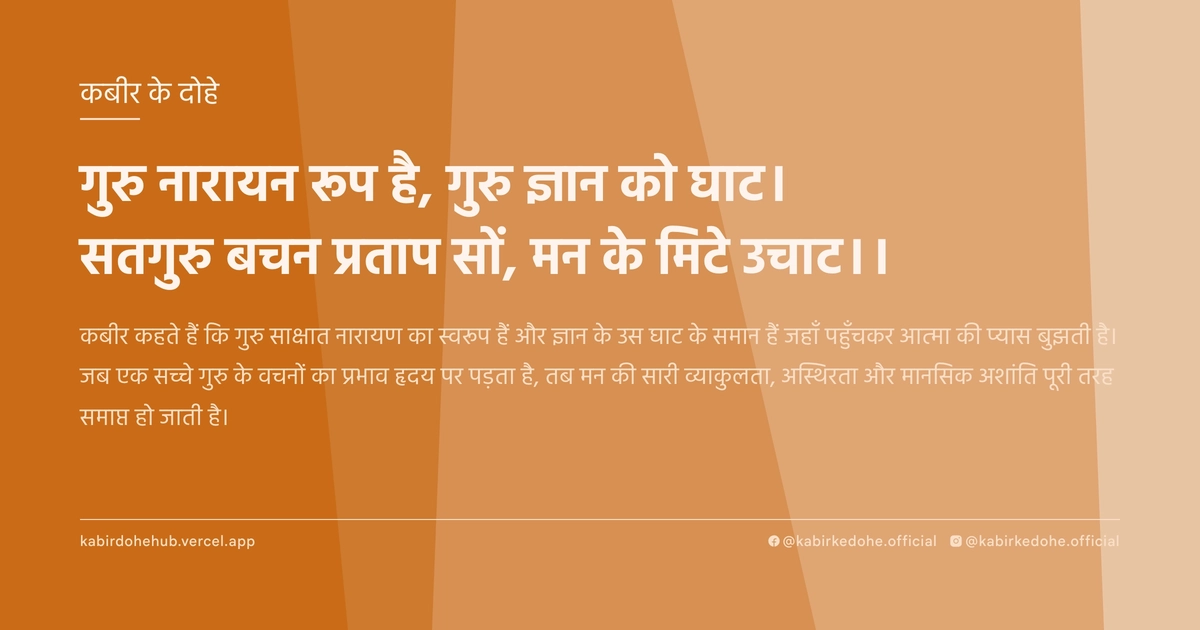
गुरु नारायन रूप है, गुरु ज्ञान को घाट।
सतगुरु बचन प्रताप सों, मन के मिटे उचाट।।
Guru Narayan roop hai, guru gyan ko ghaat. Satguru bachan pratap son, man ke mite uchaat.
इस पृष्ठ पर इस कबीर दोहे का अर्थ (meaning), हिंदी व्याख्या और अंग्रेज़ी अनुवाद, दार्शनिक विश्लेषण और व्यावहारिक जीवन सीख दी गई है। यह दोहा गुरु महत्व (The Guru's Importance) विषय से जुड़ा है — Kabir doha meaning and explanation in Hindi and English.
अर्थ (Meaning):
कबीर कहते हैं कि गुरु साक्षात नारायण का स्वरूप हैं और ज्ञान के उस घाट के समान हैं जहाँ पहुँचकर आत्मा की प्यास बुझती है। जब एक सच्चे गुरु के वचनों का प्रभाव हृदय पर पड़ता है, तब मन की सारी व्याकुलता, अस्थिरता और मानसिक अशांति पूरी तरह समाप्त हो जाती है।
Kabir asserts that the Guru is the embodiment of Lord Narayana and serves as the sacred ghat (riverbank) of wisdom. Through the transformative power and grace of the True Guru's words, the restless agitation and spiritual instability of the mind are completely dissolved, leading to profound inner peace.
व्याख्या (Interpretation):
इस दोहे का शाब्दिक अर्थ है कि गुरु ईश्वर का रूप हैं। गहरे स्तर पर, 'घाट' का प्रतीक उस स्थान को दर्शाता है जहाँ मनुष्य अपनी अज्ञानता की नदी को पार करता है। यहाँ 'नारायण' किसी व्यक्ति विशेष नहीं, बल्कि उस सार्वभौमिक चेतना (Brahman) का प्रतीक है जो गुरु के माध्यम से प्रकट होती है। यह निरगुण भक्ति का मार्ग है, जहाँ गुरु बाहरी व्यक्ति न होकर वह आंतरिक प्रकाश है जो माया के पर्दे को हटाता है। जब साधक सतगुरु के शब्दों को आत्मसात करता है, तो 'उचाट' यानी वह मानसिक भटकाव समाप्त हो जाता है जो द्वैत (duality) के कारण पैदा होता है। अंततः, यह आत्मा और परमात्मा के अभेद संबंध की पहचान है।
Literally, the verse identifies the Guru as the divine form of Narayana. Metaphorically, the 'ghat' represents the threshold of transcendence where the seeker crosses the river of ignorance. Here, 'Narayana' does not refer to a mythological deity but to the Universal Consciousness (Brahman) manifesting through the teacher. This aligns with Nirgun Bhakti, where the Guru is the catalyst that strips away the veil of Maya. The 'uchaat' or restlessness is the psychological friction caused by the illusion of separation (duality). By aligning with the Satguru's vibration, the seeker realizes the non-duality of Atman and Brahman, collapsing the distance between the human and the divine.
दार्शनिक विश्लेषण (Philosophical Analysis):
कबीर का यह दृष्टिकोण मध्यकालीन भारत के उस समय का है जब धर्म कर्मकांडों और बाहरी आडंबरों में जकड़ा हुआ था। उन्होंने 'नारायण' शब्द का प्रयोग किया, लेकिन उसे किसी मंदिर की मूर्ति तक सीमित नहीं रखा, बल्कि उसे गुरु के जीवित स्वरूप में देखा। यह अद्वैत वेदांत के उस सिद्धांत का समर्थन है जहाँ गुरु वह सेतु है जो जीव को शिव बनाता है।
सूफीवाद के 'पीर' और भक्ति मार्ग के 'गुरु' का संगम यहाँ स्पष्ट है। कबीर का तर्क है कि बिना मार्गदर्शन के मन केवल भ्रमित होता रहता है। वे जाति और वर्ण के आधार पर ज्ञान के वितरण का विरोध करते हैं, यह मानते हुए कि सत्य केवल पात्रता और समर्पण से प्राप्त होता है, न कि जन्म से।
मनोवैज्ञानिक स्तर पर, 'उचाट' उस मानसिक विखंडन को दर्शाता है जिसे आधुनिक मनोविज्ञान 'कॉग्निटिव डिसोनेंस' या अस्तित्वगत संकट कह सकता है। गुरु का वचन केवल शब्द नहीं, बल्कि एक आध्यात्मिक कंपन (vibration) है जो साधक के अहंकार (ego) को नष्ट करता है।
यहाँ 'ज्ञान का घाट' होना यह दर्शाता है कि ज्ञान कोई ऐसी वस्तु नहीं जिसे पढ़ा जाए, बल्कि एक अनुभव है जिसमें डुबकी लगानी पड़ती है। यह कर्मकांडीय पूजा के विरुद्ध एक सशक्त प्रहार है, क्योंकि असली पूजा मन की शांति और सत्य के साक्षात्कार में है।
अंततः, कबीर यह समझाते हैं कि जब तक अहंकार जीवित है, तब तक शांति असंभव है। सतगुरु का प्रताप उस अहंकार की आहुति मांगता है, जिसके बाद ही शून्य की स्थिति प्राप्त होती है, जहाँ केवल शुद्ध चेतना शेष रहती है।
Kabir’s perspective emerges from a medieval Indian landscape stifled by rigid ritualism and caste hierarchies. By invoking 'Narayana,' he does not reinforce idol worship but reclaims the divine as a living presence embodied in the Guru. This mirrors the core of Advaita Vedanta, where the Guru is the essential bridge transforming the individual soul (Jiva) into the universal spirit (Shiva).
There is a profound synthesis here between the Sufi concept of the 'Pir' and the Bhakti 'Guru.' Kabir argues that without a spiritual anchor, the mind remains a chaotic storm of desires. He vehemently rejects the notion that spiritual knowledge is the preserve of a specific caste, asserting that truth is accessible only through genuine surrender and spiritual receptivity.
Psychologically, 'uchaat' refers to the fragmentation of the self—what modern psychology might term existential angst or cognitive dissonance. The Guru's words are not mere linguistic instructions but spiritual vibrations designed to shatter the ego's defenses.
Defining the Guru as a 'ghat' (riverbank) implies that wisdom is not a commodity to be acquired through reading, but an experiential immersion. This is a direct critique of ritualistic religion; the true 'puja' is the cessation of mental turbulence and the realization of the Absolute.
Ultimately, Kabir posits that peace is impossible as long as the ego persists. The 'pratap' (power) of the Satguru demands the annihilation of the false self, leading to the state of Shunya (void), where only pure, non-dual consciousness remains.
मूल संदेश (Core Message):
- बाहरी खोज को छोड़कर आंतरिक गुरु को जागृत करें।
- शांति किसी स्थान में नहीं, बल्कि चेतना की स्थिति में है।
- अहंकार का विसर्जन ही वास्तविक ज्ञान का द्वार है।
- सत्य शब्दों में नहीं, बल्कि उनके अनुभव में निहित है।
- द्वैत का अंत ही मानसिक उथल-पुथल का एकमात्र समाधान है।
- Cease the external search and awaken the inner Guru.
- Peace is not a destination, but a state of consciousness.
- The dissolution of ego is the only gateway to true wisdom.
- Truth resides not in words, but in the experience of them.
- Ending duality is the sole remedy for mental turbulence.
व्यावहारिक उदाहरण (Practical Example):
वाराणसी के एक पुराने मोहल्ले में माधव नाम का एक बुनकर रहता था। माधव अपने काम में निपुण था, लेकिन उसका मन हमेशा अशांत रहता था। वह अक्सर सोचता था कि जीवन का उद्देश्य क्या है और वह अपनी गरीबी और सामाजिक स्थिति से गहरे असंतोष में रहता था। वह कई पंडितों के पास गया, महंगे अनुष्ठान कराए, लेकिन उसके मन की 'उचाट' यानी बेचैनी कम नहीं हुई।
एक दिन वह एक साधारण से संत के पास बैठा, जिन्होंने उसे कोई मंत्र नहीं दिया, बल्कि केवल एक बात कही: 'तू धागे बुन रहा है, पर क्या तूने उस बुनकर को देखा है जिसने तुझे बुना है?'
माधव को पहले यह बात समझ नहीं आई, लेकिन वह उस संत के सानिध्य में रहने लगा। संत ने उसे सिखाया कि उसकी बेचैनी बाहरी अभावों के कारण नहीं, बल्कि उसके भीतर के 'मैं' और 'मेरा' के संघर्ष के कारण है।
धीरे-धीरे माधव ने महसूस किया कि जब वह पूरी तरह डूबकर करघे पर काम करता है, तो वह 'माधव' नहीं रह जाता, बल्कि केवल बुनाई की प्रक्रिया बन जाता है। यही वह क्षण था जब उसे 'ज्ञान के घाट' का अनुभव हुआ।
उसने पाया कि उसकी शांति किसी बाहरी मंदिर या महंगे अनुष्ठान में नहीं, बल्कि वर्तमान क्षण में पूरी तरह उपस्थित रहने में थी।
उसकी आंतरिक उथल-पुथल शांत होने लगी। अब वह गरीबी को अभाव नहीं, बल्कि एक साधारण जीवन की सहजता के रूप में देखने लगा।
उसने देखा कि उसके आस-पास के लोग भी उसी मानसिक द्वंद्व से जूझ रहे हैं। उसने अपनी कला के माध्यम से लोगों को शांति का संदेश देना शुरू किया।
माधव का जीवन बदल गया; वह अब भी वही बुनकर था, लेकिन उसका मन अब एक शांत झील की तरह था।
उसने जान लिया कि सतगुरु का वचन केवल शब्द नहीं, बल्कि वह दर्पण है जिसमें उसने अपनी वास्तविक आत्मा को देखा।
इस प्रकार, एक साधारण बुनकर ने बाहरी शोर के बीच आंतरिक मौन की कला सीख ली।
In an ancient alley of Varanasi lived a weaver named Madhav. Though skilled in his craft, Madhav’s mind was a whirlwind of unrest. He was haunted by questions of existence and felt a deep, gnawing dissatisfaction with his poverty and social standing. He visited numerous priests and performed expensive rituals, yet the 'uchaat'—the inner restlessness—remained unabated.
One day, he sat before a simple mystic who gave him no mantra, but only a single question: 'You weave the threads, but have you seen the Weaver who wove you?'
Initially, Madhav was perplexed, but he continued to seek the mystic's company. The teacher explained that his turmoil stemmed not from external lack, but from the internal conflict between the 'I' and the 'Mine.'
Slowly, Madhav realized that when he was completely absorbed in his loom, the identity of 'Madhav' vanished, and he became nothing but the process of weaving itself. This was his encounter with the 'ghat' of wisdom.
He discovered that peace was not found in a distant temple or a costly ceremony, but in the absolute presence of the current moment.
His internal turbulence subsided. He stopped viewing his poverty as a deficiency and began to see it as the simplicity of a grounded life.
He noticed that those around him were fighting the same invisible battles of the mind. He began to share this realization through the quiet grace of his art.
Madhav’s life transformed; he remained a weaver by profession, but his mind became like a still lake.
He understood that the Satguru's word is not a lecture, but a mirror reflecting the soul's true nature.
Thus, a simple artisan discovered the art of inner silence amidst the cacophony of the world.
अभ्यास मार्गदर्शन (Practice Guidance):
- प्रतिदिन 20 मिनट मौन अभ्यास करें, जहाँ आप केवल अपनी श्वास के प्रति सजग रहें और मन में उठने वाले विचारों को बिना किसी निर्णय के देखें।
- स्व-पूछताछ (Self-Inquiry) जर्नल लिखें: 'मैं कौन हूँ?' और 'मेरी बेचैनी का मूल कारण क्या है?' इन प्रश्नों पर गहराई से विचार करें।
- व्यवहार परिवर्तन: दिन में कम से कम एक कार्य ऐसा करें जिसमें आपका अहंकार पूरी तरह विलीन हो जाए (जैसे निस्वार्थ सेवा)।
- निदान चेकलिस्ट: क्या मैं छोटी बातों पर विचलित होता हूँ? क्या मैं शांति के लिए बाहरी साधनों पर निर्भर हूँ? यदि हाँ, तो आप अभी भी 'उचाट' की स्थिति में हैं।
- Practice 20 minutes of daily silence, observing the breath and watching thoughts arise without judgment or attachment.
- Maintain a Self-Inquiry journal: Contemplate the questions 'Who am I?' and 'What is the root cause of my restlessness?'
- Behavioral Shift: Perform at least one act daily where the ego is completely dissolved (e.g., selfless service without seeking recognition).
- Diagnostic Checklist: Do I get easily agitated by trivialities? Am I dependent on external sources for peace? If yes, you are still operating in the state of 'uchaat'.
चिंतन प्रश्न (Reflection Questions):
- मेरा वह कौन सा 'मुखौटा' है जिसे मैं दुनिया के सामने पहनता हूँ, और वह मेरे आंतरिक सत्य से कितना अलग है?
- क्या मेरी मानसिक शांति दूसरों के व्यवहार पर निर्भर है? यदि हाँ, तो मैं अपनी शक्ति उन्हें क्यों सौंप रहा हूँ?
- मैं जिन परंपराओं और कर्मकांडों का पालन करता हूँ, क्या वे मुझे वास्तव में शांति देते हैं या केवल एक झूठा दिलासा?
- मेरे जीवन में 'सतगुरु' का अर्थ क्या है—एक व्यक्ति, एक विचार, या मेरी अपनी अंतरात्मा की आवाज़?
- जब मैं अकेला होता हूँ, तो वह कौन सा डर या अधूरापन है जो मुझे बेचैन करता है?
- Which 'mask' do I wear for the world, and how far is it removed from my internal truth?
- Is my inner peace contingent upon the behavior of others? If so, why have I surrendered my power to them?
- Do the rituals and traditions I follow provide genuine liberation, or merely a comforting illusion of progress?
- What does 'Satguru' mean in my life—a person, an idea, or the voice of my own intuition?
- In total solitude, what is the specific fear or void that triggers my restlessness?