
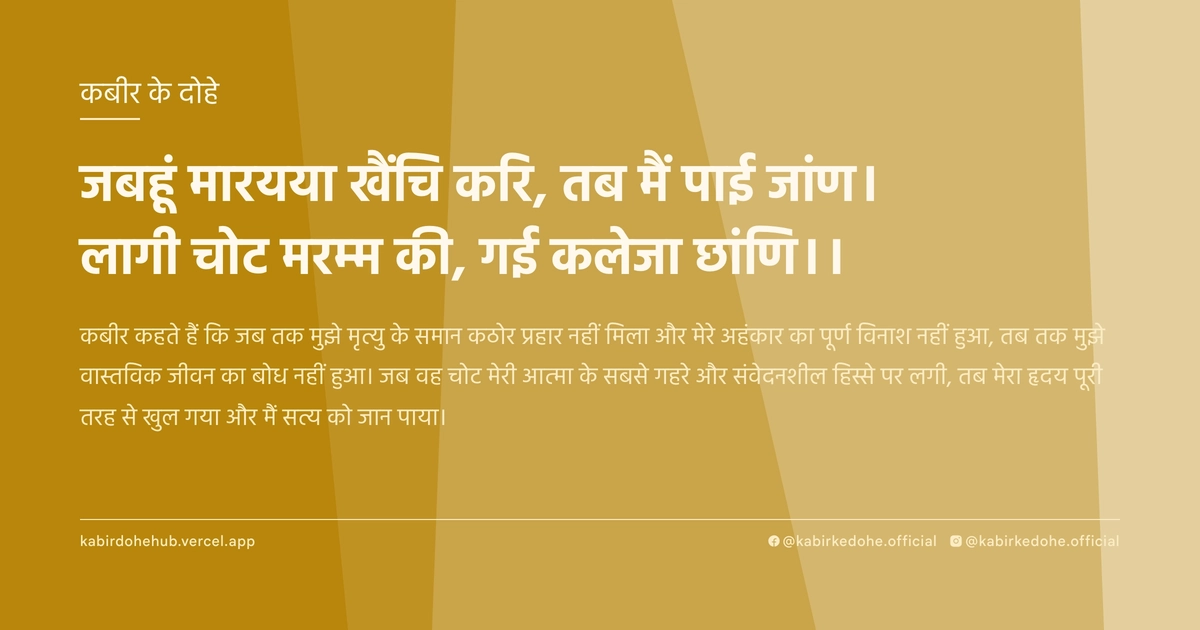
जबहूं मारयया खैंचि करि, तब मैं पाई जांण।
लागी चोट मरम्म की, गई कलेजा छांणि।।
Jabhoon maarayya khainchi kari, tab main paayi jaan. Laagi chot maramm ki, gayi kaleja chaan.
इस पृष्ठ पर इस कबीर दोहे का अर्थ (meaning), हिंदी व्याख्या और अंग्रेज़ी अनुवाद, दार्शनिक विश्लेषण और व्यावहारिक जीवन सीख दी गई है। यह दोहा भक्ति (Bhakti) विषय से जुड़ा है — Kabir doha meaning and explanation in Hindi and English.
अर्थ (Meaning):
कबीर कहते हैं कि जब तक मुझे मृत्यु के समान कठोर प्रहार नहीं मिला और मेरे अहंकार का पूर्ण विनाश नहीं हुआ, तब तक मुझे वास्तविक जीवन का बोध नहीं हुआ। जब वह चोट मेरी आत्मा के सबसे गहरे और संवेदनशील हिस्से पर लगी, तब मेरा हृदय पूरी तरह से खुल गया और मैं सत्य को जान पाया।
Kabir asserts that it was only when he was struck by a blow as devastating as death, and his ego was violently dismantled, that he truly discovered the essence of life. When the strike hit the most sensitive core of his being, his heart was torn open, allowing the light of ultimate truth to enter.
व्याख्या (Interpretation):
यह दोहा आध्यात्मिक जागृति की उस दर्दनाक प्रक्रिया का वर्णन करता है जिसे 'अहंकार की मृत्यु' कहा जाता है। यहाँ 'मारयया' या प्रहार भौतिक हिंसा नहीं, बल्कि गुरु की कृपा या जीवन के भीषण संकटों द्वारा दिए गए वह झटके हैं जो माया के पर्दे को फाड़ देते हैं। निरगुण भक्ति में, आत्मा का परमात्मा से मिलन तब तक संभव नहीं है जब तक 'मैं' (अहंकार) पूरी तरह नष्ट न हो जाए। 'कलेजा छांणि' होना उस स्थिति को दर्शाता है जहाँ व्यक्ति की पुरानी पहचान पूरी तरह टूट जाती है और वह अद्वैत वेदांत के उस सत्य का अनुभव करता है जहाँ भक्त और भगवान के बीच का अंतर समाप्त हो जाता है। यह एक विरोधाभास है: विनाश के माध्यम से ही सृजन होता है, और मृत्यु के अनुभव से ही वास्तविक जीवन प्राप्त होता है।
This couplet describes the agonizing process of spiritual awakening known as the 'death of the ego.' The 'blow' mentioned is not physical violence, but the surgical strike of a Guru's grace or the crushing weight of existential crises that tear through the veil of Maya. In Nirgun Bhakti, the union of the Atman and Brahman is impossible as long as the 'I' (the ego) persists. The phrase 'tearing the heart' symbolizes the total collapse of the conditioned identity, leading to the realization of non-duality. It presents a profound paradox: only through total annihilation of the self can one find the eternal Self. The pain is not a punishment, but a liberation from the illusion of separation.
दार्शनिक विश्लेषण (Philosophical Analysis):
कबीर का यह दर्शन मध्यकालीन भारत के उस सामाजिक और धार्मिक परिवेश में उपजा था जहाँ कर्मकांड और बाहरी दिखावे का बोलबाला था। उन्होंने स्पष्ट किया कि मोक्ष किसी मंदिर, मस्जिद या केवल माला जपने से नहीं मिलता, बल्कि आंतरिक रूपांतरण से मिलता है। यह विचार सूफी मत के 'फना' (Fana) के सिद्धांत से गहराई से जुड़ा है, जहाँ साधक अपनी व्यक्तिगत पहचान को ईश्वर की इच्छा में विलीन कर देता है।
अद्वैत वेदांत के परिप्रेक्ष्य में, यह दोहा 'अविद्या' के विनाश की बात करता है। जब तक हम स्वयं को शरीर या मन मानते हैं, हम सत्य से दूर हैं। जब यह भ्रम एक तीव्र प्रहार के माध्यम से टूटता है, तब केवल शुद्ध चेतना शेष रहती है। कबीर यहाँ यह चेतावनी दे रहे हैं कि आध्यात्मिक मार्ग केवल शांति का मार्ग नहीं है, बल्कि यह एक अग्नि-परीक्षा है जहाँ पुराने व्यक्तित्व को जलाना पड़ता है।
कबीर की अस्वीकृति केवल जाति या धर्म के प्रति नहीं थी, बल्कि उस मानसिक जड़ता के प्रति थी जो मनुष्य को उसकी अपनी दिव्यता से अलग करती है। वे बताते हैं कि अक्सर हम सुख और शांति की खोज करते हैं, लेकिन वास्तव में हमें उस 'चोट' की आवश्यकता होती है जो हमें हमारी नींद से जगा दे।
मनोवैज्ञानिक स्तर पर, यह 'डार्क नाइट ऑफ द सोल' की स्थिति है। जब व्यक्ति का पूरा सहारा छिन जाता है और वह पूर्णतः असहाय महसूस करता है, तभी वह बाहरी दुनिया से हटकर आंतरिक शून्य की ओर मुड़ता है। यही वह बिंदु है जहाँ अहंकार का अंत होता है और सत्य का उदय होता है।
अंततः, यह दोहा यह स्थापित करता है कि आध्यात्मिक प्रगति रैखिक नहीं है। यह टूटने, बिखरने और फिर से जुड़ने की प्रक्रिया है। बिना हृदय के टूटे, उसमें परमात्मा का वास नहीं हो सकता। कबीर का 'मरम्म' (मर्म) वह केंद्र बिंदु है जहाँ मानवीय पीड़ा और दैवीय आनंद एक हो जाते हैं।
Kabir's philosophy emerged from a medieval Indian landscape dominated by rigid rituals and external piety. He argued that liberation is not found in temples, mosques, or the mechanical repetition of mantras, but through a radical internal transformation. This aligns closely with the Sufi concept of 'Fana' (annihilation), where the seeker dissolves their individual identity into the Divine Will.
From the lens of Advaita Vedanta, this doha speaks of the destruction of 'Avidya' (ignorance). As long as we identify with the body or the mind, we remain estranged from the Truth. When this illusion is shattered by a violent realization, only pure consciousness remains. Kabir warns that the spiritual path is not merely one of tranquility, but a crucible where the old persona must be incinerated.
His rejection extended beyond caste and creed to the very mental inertia that separates man from his own divinity. He suggests that while we crave comfort, we actually require the 'blow'—the existential shock—that awakens us from the slumber of materialism.
Psychologically, this mirrors the 'Dark Night of the Soul.' When all external supports collapse and the individual feels utterly helpless, they are forced to turn away from the world and toward the inner void. This is the precise moment where the ego dies and the Truth is born.
Ultimately, the doha establishes that spiritual growth is not linear. It is a process of breaking, shattering, and reforming. Without the heart being broken open, the Divine cannot reside within. Kabir's 'Maramm' (the core) is the singular point where human suffering and divine bliss converge into one experience.
मूल संदेश (Core Message):
- अहंकार का विनाश ही वास्तविक ज्ञान का प्रवेश द्वार है।
- पीड़ा केवल दुख नहीं, बल्कि आत्मा की गहरी सफाई है।
- जब तक 'मैं' नहीं मरता, तब तक 'सत्य' नहीं जागता।
- बाहरी टूटन अक्सर आंतरिक पूर्णता की शुरुआत होती है।
- समर्पण वह चोट है जो हमें हमारी असली पहचान से मिलाती है।
- The annihilation of ego is the only gateway to true knowledge.
- Suffering is not merely pain, but a profound cleansing of the soul.
- Until the 'I' dies, the 'Truth' cannot awaken.
- External shattering is often the beginning of internal wholeness.
- Surrender is the blow that reconnects us to our authentic identity.
व्यावहारिक उदाहरण (Practical Example):
एक समय की बात है, वाराणसी के घाटों पर माधव नाम का एक अत्यंत अभिमानी मूर्तिकार रहता था। उसकी कला इतनी सूक्ष्म थी कि लोग कहते थे कि पत्थर बोल उठेंगे। माधव को अपनी प्रतिभा पर इतना गर्व था कि वह स्वयं को ईश्वर का समकक्ष मानने लगा था। वह मानता था कि उसकी कला ही उसकी पूजा है और उसे किसी गुरु या मार्गदर्शन की आवश्यकता नहीं है।
एक दिन, एक अज्ञात साधु उसके पास आए और उसकी सबसे प्रिय मूर्ति की ओर इशारा करते हुए कहा, "यह सुंदर है, लेकिन इसमें प्राण नहीं हैं क्योंकि इसे बनाने वाले का अहंकार इसमें पत्थर की तरह जमा हुआ है।"
माधव क्रोधित हो गया और उसने उस साधु का अपमान किया। लेकिन उसी रात, एक भीषण दुर्घटना हुई। एक भारी पत्थर उसके पैर पर गिरा, जिससे वह जीवन भर के लिए लंगड़ा हो गया। उसकी कार्यशाला में आग लग गई और उसकी जीवन भर की सारी कृतियाँ, जिन्हें वह अपनी पहचान मानता था, राख हो गईं।
माधव पूरी तरह टूट गया। जिस कला और शरीर पर उसे गर्व था, वह सब छिन गया। वह हफ्तों तक अंधेरे कमरे में रोता रहा। उसका अहंकार, जो एक अभेद्य किले की तरह था, अब पूरी तरह ढह चुका था। वह अब एक 'महान कलाकार' नहीं, बल्कि एक असहाय मनुष्य था।
इसी गहन दुख और शून्यता के क्षण में, उसे उस साधु की बात याद आई। पहली बार, उसने महसूस किया कि उसकी कला वास्तव में उसके अहंकार का विस्तार थी, न कि ईश्वर की सेवा। जब उसका 'कलेजा' दुख से फटा, तब उसे अहसास हुआ कि वह अब तक केवल पत्थर तराश रहा था, अपनी आत्मा को नहीं।
उसने अपनी बची हुई टूटी हुई छेनी उठाई, लेकिन इस बार वह प्रसिद्धि के लिए नहीं, बल्कि समर्पण के लिए काम करने लगा। उसने देखा कि अब उसकी मूर्तियों में एक ऐसी करुणा और जीवंतता थी जो पहले कभी नहीं थी।
उसकी शारीरिक अक्षमता ने उसे विनम्र बना दिया था। वह अब घाटों पर बैठकर लोगों की सेवा करता और उन्हें बताता कि कैसे उसकी सबसे बड़ी हार ही उसकी सबसे बड़ी जीत बनी।
माधव ने जान लिया कि जब तक वह 'पूर्ण' महसूस कर रहा था, वह वास्तव में अधूरा था। जब वह पूरी तरह 'टूट' गया, तभी वह वास्तव में 'जुड़' पाया। उसकी पीड़ा ही वह कुंजी थी जिसने उसके हृदय के द्वार खोल दिए।
Once in the ghats of Varanasi, there lived a sculptor named Madhav, possessed by immense pride. His art was so precise that people claimed the stones would speak. Madhav became so arrogant that he viewed himself as an equal to the Divine, believing his skill was his only true worship and that he needed no guidance.
One day, an anonymous monk visited him and pointed to his favorite sculpture, saying, "It is beautiful, but it lacks life because the sculptor's ego is frozen within it like stone."
Madhav was enraged and insulted the monk. However, that very night, a catastrophic accident occurred. A massive slab of stone fell on his leg, leaving him crippled for life. Simultaneously, a fire swept through his workshop, reducing his lifelong creations—the very pillars of his identity—to ash.
Madhav was utterly shattered. The art and the body he took pride in were gone. For weeks, he lay in a dark room, weeping. His ego, which had been an impenetrable fortress, had completely collapsed. He was no longer a 'great artist,' but a helpless human being.
In this moment of profound grief and void, the monk's words returned to him. For the first time, he realized that his art had been an extension of his ego, not a service to the Divine. As his 'heart tore open' with sorrow, he understood he had been carving stone, but neglecting his soul.
He picked up his remaining broken chisel, but this time he worked not for fame, but in total surrender. He noticed that his new sculptures possessed a compassion and vitality that were entirely absent before.
His physical disability had rendered him humble. He spent his days on the ghats serving others, sharing how his greatest failure became his greatest victory.
Madhav realized that as long as he felt 'complete,' he was actually incomplete. Only when he was completely 'broken' could he truly be 'whole.' His pain was the key that unlocked the doors of his heart.
अभ्यास मार्गदर्शन (Practice Guidance):
- प्रतिदिन 20 मिनट मौन बैठें और अपने उन हिस्सों को पहचानें जहाँ आप अभी भी 'श्रेष्ठ' होने का दावा करते हैं।
- एक 'अहंकार पत्रिका' (Ego Journal) बनाएँ: जब भी आपको क्रोध या अपमान महसूस हो, लिखें कि आपका कौन सा मुखौटा चोटिल हुआ है।
- स्वयं से पूछें: "यदि मेरी सारी उपलब्धियाँ और मेरी पहचान आज छीन ली जाए, तो मैं कौन रहूँगा?"
- निदान चेकलिस्ट: क्या मैं दूसरों की सलाह को अपनी पहचान पर हमले के रूप में देखता हूँ? क्या मैं अपनी गलतियों को स्वीकार करने में असमर्थ हूँ? यदि हाँ, तो आप अभी भी माया के बंधन में हैं।
- Sit in silence for 20 minutes daily, identifying the specific areas where you still claim 'superiority' over others.
- Maintain an 'Ego Journal': Whenever you feel anger or insult, record which specific mask of your identity was wounded.
- Ask yourself: "If all my achievements and labels were stripped away today, who would I be?"
- Diagnostic Checklist: Do I perceive constructive criticism as a personal attack? Am I unable to admit mistakes without feeling diminished? If yes, you are still bound by the illusion of the ego.
चिंतन प्रश्न (Reflection Questions):
- आपका वह कौन सा 'सफल' मुखौटा है जिसे आप खोने से सबसे ज्यादा डरते हैं?
- क्या आप अपनी पीड़ा को एक सजा के रूप में देखते हैं या एक अवसर के रूप में?
- आपकी डिजिटल पहचान (सोशल मीडिया) आपके वास्तविक आंतरिक शून्य को कैसे छिपाती है?
- क्या आप वास्तव में प्रेम करते हैं, या आप केवल उस प्रेम को पसंद करते हैं जो आपकी प्रशंसा करता है?
- वह कौन सी 'चोट' थी जिसने आपके जीवन में सबसे बड़ा सकारात्मक बदलाव लाया?
- Which 'successful' mask do you fear losing the most in your public life?
- Do you perceive your suffering as a punishment or as a transformative opportunity?
- How does your digital identity hide the actual internal void you carry?
- Do you truly love, or do you only love the reflection of yourself in someone's admiration?
- What was the specific 'blow' in your life that triggered the most significant positive change?