
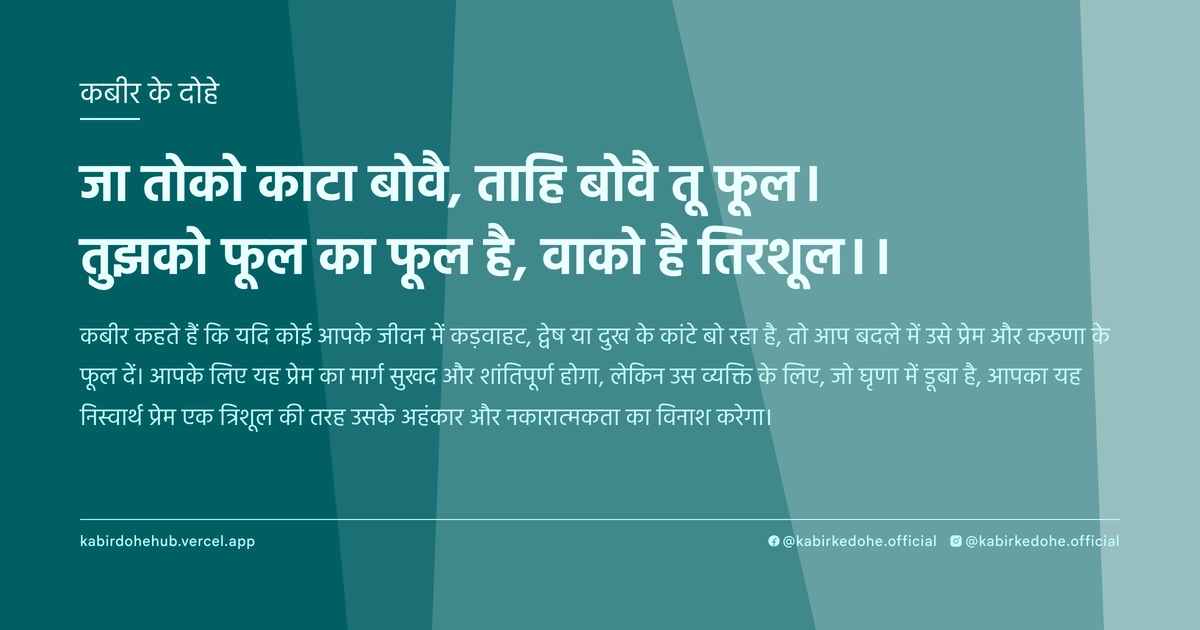
जा तोको काटा बोवै, ताहि बोवै तू फूल।
तुझको फूल का फूल है, वाको है तिरशूल।।
Ja toko kaata bovai, tahi bovai tu phool. Tujhko phool ka phool hai, vako hai tirshool.
इस पृष्ठ पर इस कबीर दोहे का अर्थ (meaning), हिंदी व्याख्या और अंग्रेज़ी अनुवाद, दार्शनिक विश्लेषण और व्यावहारिक जीवन सीख दी गई है। यह दोहा कर्म (Karma) विषय से जुड़ा है — Kabir doha meaning and explanation in Hindi and English.
अर्थ (Meaning):
कबीर कहते हैं कि यदि कोई आपके जीवन में कड़वाहट, द्वेष या दुख के कांटे बो रहा है, तो आप बदले में उसे प्रेम और करुणा के फूल दें। आपके लिए यह प्रेम का मार्ग सुखद और शांतिपूर्ण होगा, लेकिन उस व्यक्ति के लिए, जो घृणा में डूबा है, आपका यह निस्वार्थ प्रेम एक त्रिशूल की तरह उसके अहंकार और नकारात्मकता का विनाश करेगा।
Kabir advises that if someone sows thorns of bitterness, hatred, or pain in your life, you should respond by sowing flowers of love and compassion. For you, this path of love will blossom into peace and joy, but for the one steeped in malice, your selfless kindness will act like a trident, piercing and destroying their ego and negativity.
व्याख्या (Interpretation):
यह दोहा कर्म और प्रतिक्रिया के आध्यात्मिक विज्ञान को दर्शाता है। शाब्दिक रूप से, यह शत्रुता का उत्तर प्रेम से देने की बात करता है, लेकिन गहरा अर्थ 'अद्वैत' और 'निर्गुण भक्ति' में निहित है। 'कांटे' यहाँ माया और अज्ञानता के प्रतीक हैं, जबकि 'फूल' शुद्ध चेतना और आत्मिक प्रेम के प्रतीक हैं। जब हम घृणा का उत्तर घृणा से देते हैं, तो हम उसी मायाजाल में फंस जाते हैं। लेकिन जब हम प्रेम का चुनाव करते हैं, तो हम द्वैत (मैं और तू) से ऊपर उठकर ब्रह्म के स्वरूप में स्थित होते हैं। यहाँ 'त्रिशूल' विनाश का नहीं, बल्कि रूपांतरण का प्रतीक है—यह उस व्यक्ति के भीतर के 'अहंकार' का संहार करता है, जिससे उसकी आत्मा मुक्त हो सके। यह विरोधाभास है कि सबसे कोमल वस्तु (फूल) सबसे कठोर प्रहार (त्रिशूल) का कार्य करती है जब वह निस्वार्थ भाव से दी जाती है।
This couplet illustrates the spiritual science of action and reaction. Literally, it speaks of responding to enmity with love, but the deeper meaning lies in 'Advaita' and 'Nirgun Bhakti'. 'Thorns' here symbolize Maya (illusion) and ignorance, while 'flowers' represent pure consciousness and spiritual love. When we respond to hatred with hatred, we remain trapped in the same web of illusion. However, by choosing love, we transcend duality (the 'I' and 'Thou') and align with the formless Brahman. The 'trident' here does not symbolize destruction in a violent sense, but rather a transformative force—it annihilates the 'ego' of the aggressor, allowing their soul to be liberated. It is a profound paradox that the softest object (a flower) performs the sharpest task (a trident) when offered with absolute selflessness.
दार्शनिक विश्लेषण (Philosophical Analysis):
कबीर का यह दर्शन उनके समय के कट्टरपंथी धार्मिक वातावरण के विरुद्ध एक सशक्त प्रतिक्रिया था, जहाँ कर्मकांड और जातिगत श्रेष्ठता ने समाज को विभाजित किया था। वे किसी बाहरी मंदिर या मस्जिद के बजाय 'हृदय' को वास्तविक पूजा स्थल मानते थे। यह दृष्टिकोण सूफीवाद के 'इश्क-ए-हकीकी' (ईश्वरीय प्रेम) और वेदांत के 'अहं ब्रह्मास्मि' (मैं ही ब्रह्म हूँ) के करीब है।
दार्शनिक स्तर पर, कबीर यहाँ 'कर्मफल' के सिद्धांत को चुनौती दे रहे हैं। सामान्यतः लोग 'जैसे को तैसा' (Tit for Tat) में विश्वास करते हैं, लेकिन कबीर का मार्ग 'अहंकार के विसर्जन' का है। यदि आप कांटे के बदले कांटा बोते हैं, तो आप केवल घृणा के चक्र को बढ़ाते हैं। लेकिन प्रेम के माध्यम से, आप उस चक्र को तोड़ देते हैं। यह मनोवैज्ञानिक रूपांतरण की प्रक्रिया है जहाँ साधक अपनी प्रतिक्रिया को नियंत्रित कर अपनी चेतना को उच्च स्तर पर ले जाता है।
यह दोहा यह भी स्पष्ट करता है कि वास्तविक शक्ति हिंसा में नहीं, बल्कि क्षमा और करुणा में है। सूफी संतों की तरह, कबीर मानते हैं कि प्रेम ही वह एकमात्र सेतु है जो मनुष्य को परमात्मा से जोड़ सकता है। यहाँ 'त्रिशूल' का प्रयोग शिव के उस विनाशक रूप को दर्शाता है जो केवल बुराई और अज्ञान का अंत करता है ताकि सत्य प्रकट हो सके।
अद्वैत वेदांत के अनुसार, जब हम दूसरे में स्वयं को देखते हैं, तो शत्रुता समाप्त हो जाती है। यदि सामने वाला व्यक्ति अज्ञानवश कांटे बो रहा है, तो वह वास्तव में स्वयं को ही चोट पहुँचा रहा है। जब आप उसे फूल देते हैं, तो आप उसे उसकी अपनी अज्ञानता का दर्पण दिखाते हैं। यह दर्पण ही उसके अहंकार के लिए त्रिशूल बन जाता है।
अंततः, कबीर हमें सिखाते हैं कि आध्यात्मिक प्रगति बाहरी संघर्षों को जीतने में नहीं, बल्कि आंतरिक प्रतिक्रियाओं को बदलने में है। यह 'अहं' (Ego) के पूर्ण विलोपन की मांग करता है। जब 'मैं' मिट जाता है, तब केवल 'प्रेम' बचता है, और वही प्रेम संसार की सबसे शक्तिशाली औषधि और सबसे प्रभावी शस्त्र बन जाता है।
Kabir's philosophy was a powerful reaction against the dogmatic religious environment of his era, where ritualism and caste superiority divided society. He viewed the 'heart' as the true place of worship rather than external temples or mosques. This perspective aligns closely with the Sufi concept of 'Ishq-e-Haqiqi' (Divine Love) and the Vedantic realization of 'Aham Brahmasmi' (I am Brahman).
On a philosophical level, Kabir challenges the conventional law of 'Tit for Tat'. While the world believes in returning a blow for a blow, Kabir proposes the path of 'dissolution of the ego'. If you sow thorns in return for thorns, you merely perpetuate the cycle of hatred. By sowing flowers, you break that cycle. This is a process of psychological transformation where the seeker controls their reaction to elevate their consciousness.
This couplet clarifies that true power lies not in violence, but in forgiveness and compassion. Like the Sufi saints, Kabir believed that love is the only bridge connecting man to the Divine. The use of the 'trident' refers to the destructive aspect of Shiva, which destroys only evil and ignorance to allow the Truth to emerge.
According to Advaita Vedanta, when we see ourselves in others, enmity vanishes. If another person sows thorns out of ignorance, they are essentially hurting themselves. When you offer them flowers, you hold up a mirror to their own ignorance. This mirror becomes the trident that shatters their ego.
Ultimately, Kabir teaches that spiritual progress is not about winning external battles, but about transforming internal reactions. This requires the total annihilation of the 'Aham' (Ego). When the 'I' disappears, only 'Love' remains, and that love becomes the world's most potent medicine and most effective weapon.
मूल संदेश (Core Message):
- घृणा का उत्तर घृणा से देना केवल अंधकार को बढ़ाना है।
- प्रेम वह शस्त्र है जो बिना चोट पहुँचाए अहंकार को नष्ट करता है।
- सच्ची विजय शत्रु को हराने में नहीं, बल्कि शत्रुता को समाप्त करने में है।
- जब आप स्वयं को दूसरे में देखते हैं, तो कांटे फूल बन जाते हैं।
- आंतरिक शांति बाहरी उकसावे से अधिक शक्तिशाली होती है।
- Responding to hate with hate only amplifies the darkness.
- Love is the weapon that destroys the ego without causing harm.
- True victory is not in defeating the enemy, but in ending the enmity.
- When you see yourself in the other, thorns transform into flowers.
- Inner peace is far more powerful than any external provocation.
व्यावहारिक उदाहरण (Practical Example):
वाराणसी के एक पुराने मोहल्ले में रामदीन नाम का एक वृद्ध बुनकर रहता था। वह अपनी ईमानदारी और शांत स्वभाव के लिए जाना जाता था। उसी गली में एक अन्य बुनकर, गजाधर था, जो अत्यंत ईर्ष्यालु और क्रोधी था। गजाधर हमेशा रामदीन के काम की आलोचना करता, उसके ग्राहकों को भड़काता और यहाँ तक कि उसके घर के सामने कचरा फेंक देता था।
रामदीन ने कभी पलटकर जवाब नहीं दिया। जब गजाधर ने उसके कपड़ों के बंडलों को गंदा करने की कोशिश की, तो रामदीन ने चुपचाप उन्हें साफ किया और गजाधर के लिए एक सुंदर रेशमी दुपट्टा बुना, जिसे उसने बिना किसी उम्मीद के उसे भेंट कर दिया।
गजाधर को यह सब एक चाल लगी। उसने सोचा कि रामदीन उसे नीचा दिखाने के लिए दया दिखा रहा है। उसने और अधिक कड़वाहट फैलाई, रामदीन के परिवार के बारे में झूठ बोला और पूरे बाजार में उसकी छवि खराब करने का प्रयास किया।
एक दिन, रामदीन की बेटी की शादी थी। रामदीन ने गजाधर को सबसे पहले आमंत्रित किया और उसे सम्मानपूर्वक मुख्य अतिथि के रूप में बिठाया। उसने गजाधर के पैरों को छूकर उसका आशीर्वाद मांगा, जबकि गजाधर के मन में अभी भी जहर था।
जैसे ही गजाधर ने रामदीन की निस्वार्थ आंखों में देखा, उसे महसूस हुआ कि वह जिस युद्ध को लड़ रहा था, उसमें उसका कोई प्रतिद्वंदी था ही नहीं। वह अकेले ही एक दीवार से सिर टकरा रहा था।
रामदीन का वह 'फूल' जैसा व्यवहार गजाधर के भीतर के अहंकार के लिए 'त्रिशूल' बन गया। गजाधर की वर्षों की नफरत एक पल में ढह गई। उसे अपनी तुच्छता का अहसास हुआ और वह फूट-फूट कर रोने लगा।
उसने महसूस किया कि रामदीन की शांति उसकी कमजोरी नहीं, बल्कि उसकी सबसे बड़ी ताकत थी। गजाधर ने उसी क्षण रामदीन से क्षमा मांगी और अपने जीवन की दिशा बदल ली।
अब गजाधर नफरत नहीं, बल्कि सहयोग बोने लगा। रामदीन के प्रेम ने न केवल एक शत्रु को मित्र बनाया, बल्कि एक अंधेरे मन को प्रकाश से भर दिया।
In an old neighborhood of Varanasi lived an elderly weaver named Ramdeen. He was known for his honesty and calm demeanor. In the same lane lived another weaver, Gajadhar, who was intensely jealous and prone to anger. Gajadhar constantly criticized Ramdeen's work, misled his customers, and even threw trash in front of his house.
Ramdeen never retaliated. When Gajadhar tried to soil his bundles of cloth, Ramdeen silently cleaned them and wove a beautiful silk scarf for Gajadhar, gifting it to him without any expectation of return.
Gajadhar perceived this as a trick. He thought Ramdeen was showing pity to make him feel inferior. He spread more bitterness, lied about Ramdeen's family, and attempted to ruin his reputation in the entire market.
One day, it was Ramdeen's daughter's wedding. Ramdeen invited Gajadhar first and respectfully seated him as the chief guest. He touched Gajadhar's feet and asked for his blessings, even though Gajadhar's heart was still full of poison.
As Gajadhar looked into Ramdeen's selfless eyes, he realized that the war he had been fighting had no opponent. He had been crashing his head against a wall all alone.
Ramdeen's 'flower-like' behavior became a 'trident' to the ego within Gajadhar. Years of hatred collapsed in a single moment. He felt the sheer insignificance of his malice.
Gajadhar realized that Ramdeen's peace was not a weakness, but his greatest strength. He broke down in tears and begged for Ramdeen's forgiveness, changing the course of his life.
From that day on, Gajadhar stopped sowing hate and began sowing cooperation. Ramdeen's love did not just turn an enemy into a friend; it filled a darkened mind with light.
अभ्यास मार्गदर्शन (Practice Guidance):
- प्रतिदिन 15 मिनट मौन ध्यान करें और विचार करें कि आपके जीवन में 'कांटे' बोने वाले लोग वास्तव में आपके धैर्य की परीक्षा ले रहे हैं।
- एक 'प्रतिक्रिया डायरी' लिखें: जब कोई आपके साथ बुरा व्यवहार करे, तो तुरंत प्रतिक्रिया देने के बजाय उसे लिखें और विश्लेषण करें कि आपका अहंकार क्या चाहता है और आपकी आत्मा क्या चाहती है।
- सचेत व्यवहार परिवर्तन: दिन में कम से कम एक बार ऐसे व्यक्ति के प्रति दयालु बनें जिससे आप असहज महसूस करते हैं, बिना किसी उम्मीद के।
- निदान चेकलिस्ट: क्या मैं दूसरों की गलती पर क्रोधित होता हूँ? क्या मैं बदला लेने की योजना बनाता हूँ? यदि हाँ, तो मैं अभी भी द्वैत और अहंकार के जाल में हूँ।
- Practice 15 minutes of silent meditation daily, contemplating that those who sow 'thorns' in your life are actually testing your patience and spiritual maturity.
- Maintain a 'Reaction Journal': When someone treats you poorly, instead of reacting instantly, write it down and analyze what your ego wants versus what your soul desires.
- Conscious Behavioral Shift: At least once a day, perform an act of kindness for someone who makes you uncomfortable, expecting absolutely nothing in return.
- Diagnostic Checklist: Do I get angry at others' mistakes? Do I secretly plan revenge? If yes, I am still trapped in the web of duality and ego.
चिंतन प्रश्न (Reflection Questions):
- मेरे जीवन में वह कौन है जिसे मैं 'कांटा' मानता हूँ, और क्या मेरा उनके प्रति व्यवहार उन्हें और अधिक कड़वा बना रहा है?
- जब मैं किसी के प्रति 'दया' दिखाता हूँ, तो क्या वह वास्तव में प्रेम है या मेरे अहंकार की एक सूक्ष्म जीत कि 'मैं उनसे बेहतर हूँ'?
- मेरे भीतर का वह कौन सा हिस्सा है जो बदला लेने की इच्छा रखता है, और वह हिस्सा मुझे किस पहचान से बांधे हुए है?
- क्या मैं अपनी डिजिटल पहचान (सोशल मीडिया) पर दूसरों की आलोचना करके अपने भीतर के 'कांटों' को संतुष्ट कर रहा हूँ?
- यदि मैं आज पूरी तरह से निस्वार्थ हो जाऊं, तो मेरे व्यक्तित्व का कौन सा हिस्सा नष्ट हो जाएगा?
- Who in my life do I perceive as a 'thorn', and is my behavior toward them making them more bitter?
- When I show 'kindness' to someone, is it true love or a subtle victory of my ego thinking 'I am better than them'?
- Which part of me craves revenge, and what identity is that part clinging to?
- Am I feeding my internal 'thorns' by criticizing others through my digital identity on social media?
- If I were to become completely selfless today, which part of my constructed personality would be destroyed?