
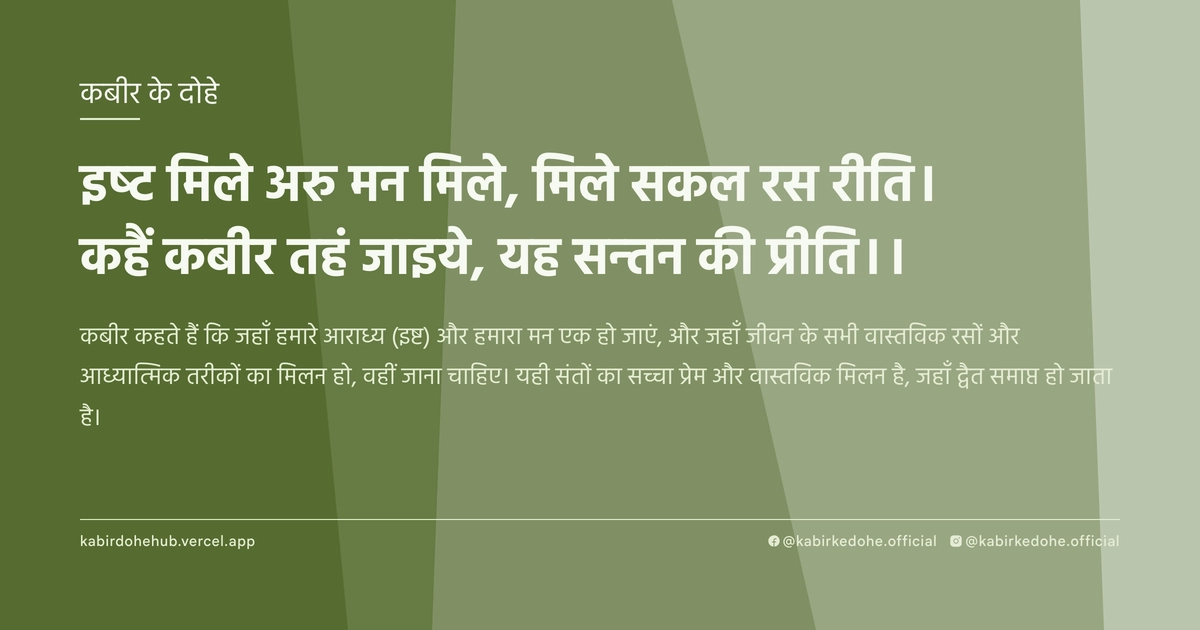
इष्ट मिले अरु मन मिले, मिले सकल रस रीति।
कहैं कबीर तहं जाइये, यह सन्तन की प्रीति।।
Isht mile aru man mile, mile sakal ras reeti. Kahein Kabir taha jaiye, yeh santan ki preeti.
इस पृष्ठ पर इस कबीर दोहे का अर्थ (meaning), हिंदी व्याख्या और अंग्रेज़ी अनुवाद, दार्शनिक विश्लेषण और व्यावहारिक जीवन सीख दी गई है। यह दोहा सत्संग (Satsang) विषय से जुड़ा है — Kabir doha meaning and explanation in Hindi and English.
अर्थ (Meaning):
कबीर कहते हैं कि जहाँ हमारे आराध्य (इष्ट) और हमारा मन एक हो जाएं, और जहाँ जीवन के सभी वास्तविक रसों और आध्यात्मिक तरीकों का मिलन हो, वहीं जाना चाहिए। यही संतों का सच्चा प्रेम और वास्तविक मिलन है, जहाँ द्वैत समाप्त हो जाता है।
Kabir suggests that one should seek that state or company where the chosen deity (Ishta) and the individual mind merge into one, and where all the essential essences and spiritual paths converge. This unification of desire, mind, and divine essence is the true love of the saints.
व्याख्या (Interpretation):
इस दोहे का शाब्दिक अर्थ है कि जब भक्त का इष्ट और उसका मन एक हो जाते हैं, तो उसे पूर्णता का अनुभव होता है। रूपक के स्तर पर, 'इष्ट' यहाँ केवल बाहरी देवता नहीं, बल्कि आत्मा के भीतर स्थित वह सर्वोच्च चेतना है जिसे हम खोजते हैं। जब मन की चंचलता समाप्त होती है और वह उस आंतरिक प्रकाश में विलीन हो जाता है, तब 'सकल रस' यानी ब्रह्मांड के सभी आनंद एक बिंदु पर मिल जाते हैं। यह निर्गुण भक्ति का सार है, जहाँ भक्त और भगवान के बीच का अंतर मिट जाता है। यह अद्वैत वेदांत की उस स्थिति को दर्शाता है जहाँ 'मैं' और 'वह' का भेद समाप्त हो जाता है। माया का पर्दा गिर जाता है और केवल शुद्ध अस्तित्व शेष रहता है। यह एक ऐसा विरोधाभास है जहाँ खोकर ही सब कुछ प्राप्त किया जाता है।
Literally, the verse speaks of the union between the deity and the mind. Metaphorically, 'Ishta' represents not an external idol, but the supreme consciousness residing within the self. When the fluctuations of the mind cease and merge into this inner light, 'Sakal Ras'—the totality of cosmic essences—converge. This is the core of Nirgun Bhakti, where the duality between the devotee and the Divine vanishes. It mirrors the Advaita Vedanta concept of non-duality, where the illusion of 'I' and 'Thou' dissolves. The veil of Maya is lifted, leaving only pure existence. It presents the spiritual paradox: only by annihilating the individual ego can one attain the universal whole.
दार्शनिक विश्लेषण (Philosophical Analysis):
कबीर का यह दोहा उस युग की प्रतिक्रिया है जहाँ धर्म बाहरी कर्मकांडों, मूर्तियों और कठोर जातिगत विभाजनों में बँटा हुआ था। कबीर ने 'इष्ट' शब्द का प्रयोग किया, लेकिन उन्होंने इसे किसी विशिष्ट संप्रदाय से नहीं जोड़ा। उनका दर्शन यह है कि ईश्वर किसी मंदिर या मस्जिद में नहीं, बल्कि मन की गहराई में है। यह दृष्टिकोण सूफी मत के 'फना' (अहंकार का विनाश) और वेदांत के 'ब्रह्म' के समान है।
यहाँ 'रस' का अर्थ केवल स्वाद नहीं, बल्कि आध्यात्मिक आनंद है। कबीर तर्क देते हैं कि जब तक मन बाहरी दुनिया की इच्छाओं में भटकता है, वह खंडित रहता है। लेकिन जब मन अपने मूल स्रोत (इष्ट) से मिलता है, तो वह पूर्ण हो जाता है। यह मनोवैज्ञानिक रूपांतरण की प्रक्रिया है जहाँ व्यक्ति अपनी पहचान को संकुचित 'मैं' से हटाकर व्यापक 'हम' या 'परमात्मा' में बदल देता है।
कबीर का विरोध उन पाखंडियों से था जो केवल माला जपने या तीर्थ यात्रा करने को मोक्ष का मार्ग मानते थे। उनके लिए वास्तविक तीर्थ वह हृदय है जहाँ प्रेम और सत्य का मिलन हो। यह सामाजिक समानता का संदेश भी है, क्योंकि आत्मा का कोई धर्म या जाति नहीं होती।
इस विश्लेषण से स्पष्ट होता है कि कबीर 'प्रेम' को ही सर्वोच्च ज्ञान मानते हैं। उनके लिए ज्ञान केवल बौद्धिक उपलब्धि नहीं, बल्कि एक भावनात्मक और आध्यात्मिक अनुभव है। जब मन और इष्ट मिलते हैं, तो तर्क समाप्त हो जाता है और केवल अनुभव बचता है।
अंततः, यह दोहा हमें सिखाता है कि आध्यात्मिक यात्रा बाहर की ओर नहीं, बल्कि भीतर की ओर है। जब हम अपने भीतर के विरोधाभासों को सुलझा लेते हैं, तब हम उस 'संत प्रीति' या संतों के प्रेम को पा सकते हैं जो सार्वभौमिक और कालातीत है।
This Doha emerges as a critique of an era dominated by rigid ritualism, idol worship, and caste hierarchies. While Kabir uses the term 'Ishta' (chosen deity), he detaches it from sectarian boundaries. His philosophy posits that the Divine is not housed in temples or mosques but resides in the depths of the human mind. This aligns closely with the Sufi concept of 'Fana' (annihilation of the self) and the Vedantic realization of 'Brahman'.
'Ras' here refers not to physical taste, but to spiritual ecstasy. Kabir argues that as long as the mind wanders in external desires, it remains fragmented. However, when the mind aligns with its primordial source, it achieves wholeness. This is a psychological transformation where the individual shifts their identity from the constricted 'I' to the expansive 'Universal Self'.
Kabir’s rebellion was directed at those who viewed bead-counting or pilgrimages as the sole path to liberation. For him, the only true pilgrimage is the heart where love and truth converge. This is also a call for social equality, as the Atman (soul) possesses no caste or creed.
It becomes evident that Kabir views 'Love' as the highest form of knowledge. To him, spirituality is not an intellectual achievement but an emotional and experiential realization. When the mind and the Ishta merge, logic yields to direct experience.
Ultimately, the verse teaches that the spiritual journey is inward. By resolving internal contradictions, one attains 'Santan ki Preeti'—the love of the saints—which is universal, timeless, and beyond the reach of formal religion.
मूल संदेश (Core Message):
- बाहरी खोज को छोड़कर आंतरिक मिलन की ओर बढ़ें।
- जब मन शांत होता है, तभी ईश्वर का अनुभव संभव है।
- अहंकार का विसर्जन ही वास्तविक प्रेम की पहली शर्त है।
- जीवन के सभी विरोधाभास अद्वैत की स्थिति में समाप्त हो जाते हैं।
- सच्ची भक्ति कर्मकांड में नहीं, बल्कि चेतना के एकीकरण में है।
- Shift from external searching to internal unification.
- Divine experience is only possible when the mind is still.
- The dissolution of ego is the primary condition for true love.
- All life's contradictions vanish in the state of non-duality.
- True devotion lies in the integration of consciousness, not in rituals.
व्यावहारिक उदाहरण (Practical Example):
वाराणसी के एक पुराने घाट पर रामदीन नाम का एक वृद्ध नाविक रहता था। वह जीवन भर नाव चलाता रहा, लेकिन उसका मन हमेशा अशांत रहता था। वह खुद को एक तुच्छ नाविक मानता था और सोचता था कि मोक्ष केवल उन विद्वानों को मिलता है जो संस्कृत के श्लोक पढ़ते हैं। वह हर दिन मंदिर जाता, पूजा करता, लेकिन उसके भीतर एक खालीपन था।
एक दिन उसकी मुलाकात एक फकीर से हुई जो घाट की सीढ़ियों पर बैठा था। फकीर ने रामदीन से पूछा, 'तुम किसे खोजने मंदिर जाते हो?' रामदीन ने कहा, 'ईश्वर को।' फकीर मुस्कुराया और बोला, 'नाव चलाने वाले, तू तो लहरों को देख रहा है, कभी उस गहराई को देख जहाँ सारी नदियाँ मिलती हैं। तेरा मन और तेरा ईश्वर अलग-अलग किनारों पर खड़े हैं, उन्हें एक कर।'
रामदीन को यह बात समझ नहीं आई, लेकिन उसने फकीर की बात मानकर एक प्रयोग किया। उसने तय किया कि वह केवल मंदिर में नहीं, बल्कि अपनी नाव चलाने के हर क्षण में, हर लहर के स्पर्श में और हर यात्री की मुस्कान में उसी ईश्वर को खोजेगा। उसने अपनी मेहनत को ही अपनी पूजा बना लिया।
धीरे-धीरे, रामदीन का अहंकार कि वह 'केवल एक नाविक है' मिटने लगा। उसने महसूस किया कि जब वह पूरी तन्मयता से चप्पू चलाता है, तो वह और उसकी नाव, दोनों एक हो जाते हैं। वह अब खुद को ईश्वर से अलग नहीं मानता था।
एक समय ऐसा आया जब रामदीन को अब मंदिर जाने की व्याकुलता नहीं रही। वह घाट पर बैठा रहता और उसके चेहरे पर एक असीम शांति होती। लोग उससे पूछते कि उसने क्या पाया। वह बस इतना कहता, 'मेरा मन और मेरा मालिक अब एक ही नाव में सवार हैं।'
उसका व्यवहार बदल गया। वह अब यात्रियों से पैसे के लिए नहीं, बल्कि सेवा के भाव से बात करता। वह गरीब यात्रियों को मुफ्त में पार करा देता, क्योंकि उसे उनमें अपना ही अक्स दिखता था।
उसकी इस आंतरिक शांति ने उसे एक ऐसा व्यक्तित्व बना दिया कि लोग उसके पास विवाद सुलझाने आने लगे। वह बिना किसी उपदेश के, केवल अपनी उपस्थिति से लोगों के मन को शांत कर देता था।
रामदीन की कहानी यह दिखाती है कि जब कर्म और भक्ति एक हो जाते हैं, तो जीवन का हर रस—चाहे वह दुख हो या सुख—एक ही दिव्य आनंद में बदल जाता है। यही कबीर की 'संत प्रीति' है।
On an ancient ghat in Varanasi lived an elderly boatman named Ramdeen. He had spent his life rowing, yet his mind was perpetually restless. He viewed himself as a lowly boatman, believing that liberation was reserved for scholars who could recite Sanskrit shlokas. He visited temples daily, but a void persisted within him.
One day, he met a wandering dervish sitting on the stone steps. The dervish asked, 'Who is it that you seek in the temple?' Ramdeen replied, 'God.' The dervish smiled and said, 'Boatman, you look only at the ripples; look instead at the depths where all rivers merge. Your mind and your God are standing on opposite shores; bring them together.'
Ramdeen didn't fully grasp the meaning, but he decided to experiment. He resolved that he would seek the Divine not just in the temple, but in every stroke of his oar, in the touch of every wave, and in the smile of every passenger. He transformed his labor into his prayer.
Gradually, Ramdeen's ego—the belief that he was 'merely a boatman'—began to dissolve. He realized that when he rowed with total mindfulness, he and the boat became one. He no longer perceived himself as separate from the Divine.
Eventually, the desperate urge to visit the temple vanished. He would sit on the ghat with a profound, unshakeable peace. People asked him what he had found. He would simply say, 'My mind and my Master are now sailing in the same boat.'
His behavior shifted. He no longer interacted with passengers for money, but with a spirit of service. He began ferrying the poor for free, seeing his own reflection in them.
This inner stillness transformed him into a beacon of peace; people began coming to him to resolve their disputes. Without preaching, his mere presence calmed the agitated minds of others.
Ramdeen's story illustrates that when action and devotion merge, every 'ras' of life—whether sorrow or joy—is transmuted into a single divine ecstasy. This is the 'Santan ki Preeti' that Kabir speaks of.
अभ्यास मार्गदर्शन (Practice Guidance):
- दैनिक ध्यान: प्रतिदिन 20 मिनट मौन बैठें और यह कल्पना करें कि आपका मन एक नदी है जो धीरे-धीरे एक विशाल समुद्र (इष्ट) में विलीन हो रहा है।
- आत्म-पूछताछ जर्नल: प्रतिदिन एक ऐसी घटना लिखें जहाँ आपने अपने अहंकार (Ego) को किसी दूसरे व्यक्ति की खुशी के लिए पीछे रखा।
- कर्म योग: अपने किसी भी एक सांसारिक कार्य (जैसे खाना बनाना या सफाई करना) को पूरी तन्मयता से करें, जैसे कि आप वह कार्य स्वयं ईश्वर के लिए कर रहे हों।
- निदान चेकलिस्ट: क्या मैं अभी भी 'मैं' और 'परमात्मा' को अलग मानता हूँ? क्या मेरी शांति बाहरी परिस्थितियों पर निर्भर है? यदि हाँ, तो समझें कि मन और इष्ट का मिलन अभी शेष है।
- Daily Meditation: Sit in silence for 20 minutes, visualizing your mind as a river slowly merging into a vast ocean (the Ishta).
- Self-Inquiry Journal: Record one daily instance where you consciously stepped aside from your ego to prioritize another's happiness.
- Karma Yoga: Perform one mundane task (like cooking or cleaning) with absolute mindfulness, as if the act itself is an offering to the Divine.
- Diagnostic Checklist: Do I still perceive a separation between 'I' and the 'Divine'? Is my peace dependent on external circumstances? If yes, the union of mind and Ishta is yet to be realized.
चिंतन प्रश्न (Reflection Questions):
- मेरे जीवन में 'इष्ट' कौन है—एक बाहरी छवि या मेरे भीतर की कोई सच्चाई?
- वह कौन सा डर है जो मुझे मेरे वास्तविक स्वरूप में विलीन होने से रोकता है?
- क्या मेरी धार्मिक पहचान मेरी आध्यात्मिक प्रगति में बाधा बन रही है?
- यदि मैं अपनी सभी उपाधियों (नाम, पद, जाति) को हटा दूँ, तो वास्तव में मैं कौन हूँ?
- क्या मैं दूसरों में उसी 'रस' को देख पाता हूँ जिसे मैं अपने भीतर खोज रहा हूँ?
- Who is the 'Ishta' in my life—an external image or an internal truth?
- What is the specific fear preventing me from merging into my true nature?
- Is my religious identity acting as a barrier to my spiritual progress?
- If I strip away all my labels (name, rank, caste), who remains?
- Do I recognize the same 'essence' in others that I seek within myself?