
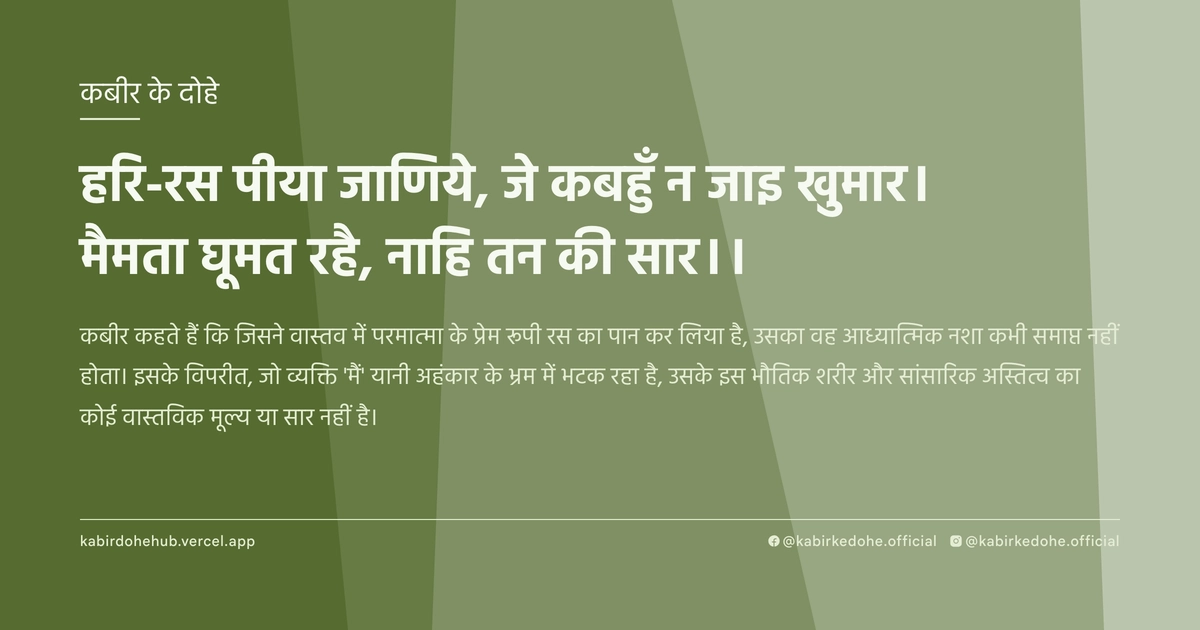
हरि-रस पीया जाणिये, जे कबहुँ न जाइ खुमार।
मैमता घूमत रहै, नाहि तन की सार।।
Hari-ras peeya jaaniye, je kabahun na jaai khumaar. Maimata ghumat rahai, naahi tan ki saar.
इस पृष्ठ पर इस कबीर दोहे का अर्थ (meaning), हिंदी व्याख्या और अंग्रेज़ी अनुवाद, दार्शनिक विश्लेषण और व्यावहारिक जीवन सीख दी गई है। यह दोहा भक्ति (Bhakti) विषय से जुड़ा है — Kabir doha meaning and explanation in Hindi and English.
अर्थ (Meaning):
कबीर कहते हैं कि जिसने वास्तव में परमात्मा के प्रेम रूपी रस का पान कर लिया है, उसका वह आध्यात्मिक नशा कभी समाप्त नहीं होता। इसके विपरीत, जो व्यक्ति 'मैं' यानी अहंकार के भ्रम में भटक रहा है, उसके इस भौतिक शरीर और सांसारिक अस्तित्व का कोई वास्तविक मूल्य या सार नहीं है।
Kabir asserts that one who has truly tasted the divine nectar of God's love enters a state of spiritual intoxication that never fades. In contrast, those who remain trapped in the cycle of 'I-ness' or ego are merely wandering in illusion, and their physical existence remains devoid of any true spiritual essence or lasting value.
व्याख्या (Interpretation):
इस दोहे में 'हरि-रस' केवल भक्ति नहीं, बल्कि उस अद्वैत अनुभूति का प्रतीक है जहाँ भक्त और भगवान एक हो जाते हैं। 'खुमार' यहाँ सांसारिक नशे का नहीं, बल्कि उस परमानंद का है जो माया के पर्दे को हटा देता है। कबीर स्पष्ट करते हैं कि जब तक 'मैमता' (अहंकार) जीवित है, तब तक आत्मा अपनी वास्तविक प्रकृति को नहीं पहचान सकती। यह विरोधाभास है कि शरीर होने के बावजूद, अहंकार के कारण व्यक्ति 'सारहीन' है। निर्गुण भक्ति के अनुसार, ईश्वर बाहर नहीं बल्कि भीतर है, और उस तक पहुँचने का एकमात्र मार्ग अहंकार का विसर्जन है। जब 'मैं' मिटता है, तभी वह अनंत रस प्रकट होता है जो कभी समाप्त नहीं होता।
In this couplet, 'Hari-ras' symbolizes not mere devotion, but the non-dual realization where the devotee and the Divine merge into one. The 'intoxication' mentioned is not a worldly stupor but a transcendental bliss that dissolves the veil of Maya. Kabir illustrates that as long as 'Maimata' (the egoic sense of self) persists, the soul remains blind to its true nature. It is a profound paradox: though the body exists physically, it is 'essence-less' because it is occupied by the illusion of separation. According to Nirgun Bhakti, the Formless Divine resides within; the only barrier is the ego. When the 'I' is annihilated, the eternal nectar of consciousness emerges, creating a permanent state of spiritual awakening.
दार्शनिक विश्लेषण (Philosophical Analysis):
कबीर का यह विचार 15वीं शताब्दी के सामाजिक और धार्मिक संघर्षों के बीच उपजा था, जहाँ कर्मकांड और बाहरी आडंबर चरम पर थे। वे मंदिर-मस्जिद के बजाय 'हृदय' को इबादतगाह मानते थे। यह दोहा सीधे तौर पर अद्वैत वेदांत के 'अहं ब्रह्मास्मि' और सूफीवाद के 'फना' (अहंकार का विनाश) के सिद्धांतों से मेल खाता है। कबीर तर्क देते हैं कि धर्म केवल ग्रंथों को पढ़ने में नहीं, बल्कि उस अनुभव में है जो व्यक्ति को उसके सीमित व्यक्तित्व से मुक्त कर दे।
यहाँ 'मैमता' का अर्थ केवल घमंड नहीं, बल्कि वह सूक्ष्म पहचान है जो हमें दूसरों से अलग करती है। यह द्वैत ही दुख का मूल कारण है। जब व्यक्ति स्वयं को शरीर या सामाजिक पद मानता है, तो वह समय और मृत्यु के अधीन हो जाता है। कबीर इस भौतिक पहचान को 'सारहीन' कहते हैं क्योंकि यह परिवर्तनशील और नश्वर है।
सूफी परंपरा के 'इश्क-ए-हकीकी' (ईश्वरीय प्रेम) की तरह, कबीर का 'हरि-रस' एक ऐसी अग्नि है जो अशुद्धियों को जला देती है। वे ritualism का विरोध इसलिए करते हैं क्योंकि बाहरी क्रियाएं अहंकार को और पुष्ट करती हैं ('मैंने यह पूजा की', 'मैंने वह दान दिया')। वास्तविक भक्ति वह है जहाँ 'कर्ता' ही समाप्त हो जाए।
मनोवैज्ञानिक स्तर पर, यह दोहा संज्ञानात्मक पुनर्गठन की बात करता है। जब व्यक्ति अपनी पहचान को वैश्विक चेतना (Universal Consciousness) के साथ जोड़ता है, तो भय और असुरक्षा समाप्त हो जाते हैं। यह 'अहं' से 'स्व' की ओर संक्रमण है।
अंततः, कबीर यह संदेश देते हैं कि आध्यात्मिक उपलब्धि का पैमाना कोई बाहरी चिन्ह नहीं, बल्कि वह आंतरिक स्थिरता और आनंद है जो किसी भी बाहरी परिस्थिति से अप्रभावित रहता है। यही वह 'खुमार' है जो मृत्यु के बाद भी बना रहता है।
Kabir's insights emerged from the socio-religious turbulence of the 15th century, a time dominated by rigid rituals and outward displays of piety. He shifted the sanctuary from temples and mosques to the human heart. This couplet aligns seamlessly with the Advaita Vedanta principle of 'Aham Brahmasmi' (I am Brahman) and the Sufi concept of 'Fana' (the annihilation of the self in the Divine).
'Maimata' here does not merely refer to vanity, but to the subtle psychological construct of a separate identity. This duality is the root of all human suffering. When an individual identifies with the body or a social role, they become subject to the laws of decay and death. Kabir labels this identification as 'essence-less' because it is transient and illusory.
Mirroring the Sufi 'Ishq-e-Haqiqi' (Divine Love), Kabir's 'Hari-ras' is a transformative fire that incinerates the impurities of the ego. He rejects ritualism because external acts often reinforce the ego ('I performed this prayer', 'I gave this charity'). True devotion occurs only when the 'doer' vanishes entirely.
Psychologically, this teaching advocates for a cognitive shift. By expanding one's identity from the limited 'me' to the universal consciousness, fear and insecurity are eradicated. It is the transition from the egoic self to the essential Self.
Ultimately, Kabir suggests that the benchmark of spiritual attainment is not an external badge of holiness, but an internal stability and bliss that remains undisturbed by external circumstances. This is the 'intoxication' that transcends even the threshold of death.
मूल संदेश (Core Message):
- अहंकार वह पर्दा है जो हमें परमात्मा के रस से अलग करता है।
- सच्ची भक्ति बाहरी दिखावे में नहीं, बल्कि आंतरिक विसर्जन में है।
- जब 'मैं' मिटता है, तभी अनंत आनंद का उदय होता है।
- सांसारिक पहचान नश्वर है; केवल आध्यात्मिक चेतना ही शाश्वत है।
- प्रेम का नशा ही एकमात्र ऐसा मार्ग है जो मुक्ति की ओर ले जाता है।
- Ego is the veil that separates us from the nectar of the Divine.
- True devotion lies not in outward display, but in internal dissolution.
- Only when the 'I' vanishes does infinite bliss arise.
- Worldly identity is transient; only spiritual consciousness is eternal.
- The intoxication of love is the only path leading to liberation.
व्यावहारिक उदाहरण (Practical Example):
वाराणसी के घाटों पर रहने वाले एक वृद्ध बुनकर, माधव, का जीवन केवल धागों के खेल तक सीमित था। वह अपनी कला में सर्वश्रेष्ठ था, लेकिन उसका अहंकार उसकी पहचान बन गया था। वह अक्सर अन्य बुनकरों को नीचा दिखाता और अपनी श्रेष्ठता का दावा करता। उसके लिए उसकी साड़ियाँ ही उसका अस्तित्व थीं।
एक दिन, माधव की मुलाकात एक फकीर से हुई जिसने उसे यह दोहा सुनाया। फकीर ने उससे पूछा, 'माधव, यदि तुम्हारी सारी साड़ियाँ जल जाएं, तो क्या तुम बचोगे?' माधव हँसा और बोला, 'मैं तो मेरी कला हूँ।' फकीर ने शांति से उत्तर दिया, 'यही तुम्हारी सबसे बड़ी भूल है। तुम कपड़े को अपना सार मान रहे हो, जबकि तुम स्वयं उस अनंत रस के प्यासे हो जिसे तुम पहचानते ही नहीं।'
माधव को पहले तो यह बात समझ नहीं आई, लेकिन वह फकीर के शब्दों में एक अजीब खिंचाव महसूस करने लगा। उसने महसूस किया कि उसकी श्रेष्ठता की भावना वास्तव में एक बोझ थी, जो उसे दूसरों से अलग कर रही थी। वह जितना अधिक 'श्रेष्ठ' महसूस करता, उतना ही अकेला होता जाता।
उसने धीरे-धीरे अपनी कला को 'अहंकार' से हटाकर 'सेवा' में बदलना शुरू किया। उसने गरीब बच्चों को मुफ्त में बुनाई सिखानी शुरू की। अब वह यह नहीं कहता था कि 'मैंने उन्हें सिखाया', बल्कि वह महसूस करता था कि वह केवल एक माध्यम है।
एक समय ऐसा आया जब माधव की दृष्टि बदल गई। वह अब केवल धागों को नहीं देखता था, बल्कि हर धागे में उस परमात्मा की उपस्थिति महसूस करता था। उसकी साड़ियों में अब एक अलग ही चमक थी, क्योंकि वे अब अहंकार से नहीं, बल्कि प्रेम से बुनी गई थीं।
उसकी आंतरिक शांति इतनी गहरी हो गई कि लोग उसके पास केवल कपड़े खरीदने नहीं, बल्कि मानसिक शांति पाने आने लगे। उसने पाया कि जब उसने 'मैं' को छोड़ा, तो उसे वह 'रस' मिला जो उसे कभी अपनी श्रेष्ठता में नहीं मिला था।
उसका जीवन अब एक निरंतर उत्सव बन गया था। वह अब भी बुनता था, लेकिन अब वह धागों का गुलाम नहीं था। वह उस 'खुमार' में था जहाँ उसे हर इंसान में अपना ही अक्स दिखाई देता था।
अंत में, माधव ने समझा कि शरीर और उसकी उपलब्धियाँ केवल एक खोल हैं। असली सार तो वह प्रेम है जो हमें सबके साथ जोड़ता है। वह अब वास्तव में 'सारयुक्त' जीवन जी रहा था।
Madhav, an elderly weaver living on the ghats of Varanasi, spent his entire life entwined in the play of threads. He was a master of his craft, but his skill had morphed into a towering ego. He frequently belittled other weavers, claiming his work was the only true art. For Madhav, his exquisite sarees were his entire identity.
One day, Madhav encountered a wandering mystic who recited this specific Doha to him. The mystic asked, 'Madhav, if all your sarees were to burn in a fire tomorrow, would anything of you remain?' Madhav laughed and replied, 'I am my art!' The mystic calmly responded, 'That is your greatest delusion. You mistake the fabric for your essence, while you remain thirsty for the eternal nectar you refuse to recognize.'
Initially, Madhav dismissed the words, but a strange longing began to stir within him. He realized that his sense of superiority was actually a heavy burden, isolating him from the world. The more 'superior' he felt, the more profound his loneliness became.
Slowly, Madhav began to shift his craft from a tool of 'ego' to an act of 'service.' He started teaching weaving to underprivileged children in the colony for free. He stopped saying 'I taught them' and began feeling that he was merely a channel for a higher wisdom.
Eventually, Madhav's perception shifted. He no longer saw just threads; he saw the Divine presence in every weave. His sarees acquired a new, ethereal glow, for they were no longer woven with pride, but with pure love.
His inner peace became so palpable that people began visiting him not just for fabrics, but for spiritual solace. He discovered that by letting go of the 'I', he accessed a joy that his superiority had never provided.
His life became a continuous celebration. He continued to weave, but he was no longer a slave to the loom. He lived in that 'intoxication' where he saw his own reflection in every human being he encountered.
In the end, Madhav understood that the body and its achievements are merely a shell. The true essence is the love that connects all existence. He was finally living a life of true substance.
अभ्यास मार्गदर्शन (Practice Guidance):
- प्रतिदिन 20 मिनट मौन ध्यान करें, जहाँ आप अपने विचारों को केवल एक दर्शक की तरह देखें, बिना उनमें शामिल हुए।
- एक 'अहंकार डायरी' लिखें: दिन भर में उन क्षणों को नोट करें जब आपने 'मैं', 'मेरा' या 'मेरी श्रेष्ठता' महसूस की, और फिर विचार करें कि उस समय आप वास्तव में क्या छिपा रहे थे (डर या असुरक्षा)।
- सेवा का अभ्यास: सप्ताह में एक बार ऐसा कार्य करें जिसके लिए आपको कोई श्रेय न मिले और जिसके बारे में किसी को पता न चले।
- निदान चेकलिस्ट: क्या आप दूसरों की सफलता से ईर्ष्या महसूस करते हैं? क्या आप अपनी पहचान अपने पद या संपत्ति से जोड़ते हैं? यदि हाँ, तो आप अभी भी 'मैमता' के प्रभाव में हैं।
- Practice 20 minutes of silent meditation daily, observing your thoughts as a detached witness without becoming entangled in them.
- Maintain an 'Ego Journal': Note moments during the day when you felt 'I', 'Mine', or a sense of superiority, then analyze what you were actually masking (fear or insecurity).
- Practice Anonymous Service: Once a week, perform an act of kindness where you receive no credit and no one knows you were the benefactor.
- Diagnostic Checklist: Do you feel envy at others' success? Do you tie your identity to your title or possessions? If yes, you are still under the influence of 'Maimata'.
चिंतन प्रश्न (Reflection Questions):
- यदि आपसे आपकी सारी उपलब्धियाँ और आपकी सामाजिक पहचान छीन ली जाए, तो आपके पास क्या बचेगा?
- आपकी 'डिजिटल पहचान' (सोशल मीडिया) आपके वास्तविक स्वरूप को कितना ढक रही है?
- क्या आपका धर्म और आध्यात्मिकता आपको दूसरों से ऊपर महसूस कराते हैं या सबके साथ जोड़ते हैं?
- वह कौन सा डर है जो आपको पूरी तरह से 'मैं' को छोड़ने से रोकता है?
- क्या आप वास्तव में प्रेम करते हैं, या आप केवल उस प्रेम के बदले मिलने वाले सम्मान से प्रेम करते हैं?
- If all your achievements and social identities were stripped away, what would remain of you?
- To what extent does your 'digital identity' mask your authentic self?
- Does your practice of religion or spirituality make you feel superior to others, or does it connect you with them?
- What is the specific fear that prevents you from completely letting go of the 'I'?
- Do you truly love, or do you merely love the recognition and validation that comes from loving?