
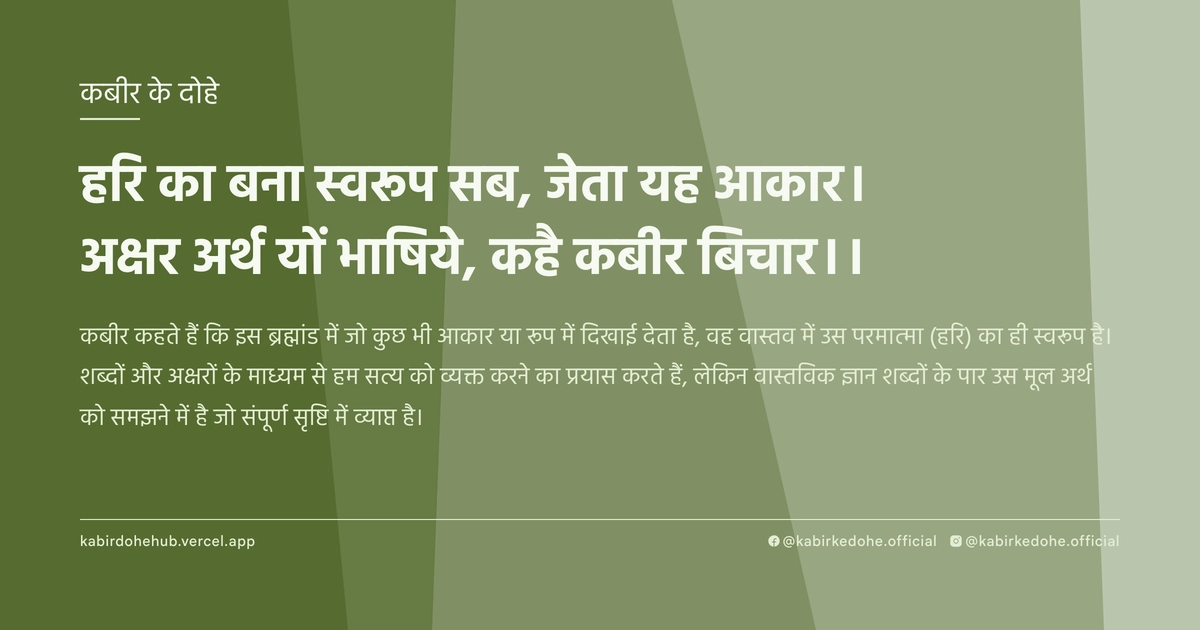
हरि का बना स्वरूप सब, जेता यह आकार।
अक्षर अर्थ यों भाषिये, कहै कबीर बिचार।।
Hari ka bana swaroop sab, jeta yeh aakaar. Akshar arth yon bhashiye, kahe Kabir bichaar.
इस पृष्ठ पर इस कबीर दोहे का अर्थ (meaning), हिंदी व्याख्या और अंग्रेज़ी अनुवाद, दार्शनिक विश्लेषण और व्यावहारिक जीवन सीख दी गई है। यह दोहा निर्गुण ब्रह्म (Nirguna Brahman) विषय से जुड़ा है — Kabir doha meaning and explanation in Hindi and English.
अर्थ (Meaning):
कबीर कहते हैं कि इस ब्रह्मांड में जो कुछ भी आकार या रूप में दिखाई देता है, वह वास्तव में उस परमात्मा (हरि) का ही स्वरूप है। शब्दों और अक्षरों के माध्यम से हम सत्य को व्यक्त करने का प्रयास करते हैं, लेकिन वास्तविक ज्ञान शब्दों के पार उस मूल अर्थ को समझने में है जो संपूर्ण सृष्टि में व्याप्त है।
Kabir asserts that everything manifesting as a form or shape in this universe is essentially a manifestation of the Divine (Hari). While we use letters and words to describe truth, the true essence lies in understanding the underlying meaning that permeates all existence beyond mere linguistic expression.
व्याख्या (Interpretation):
इस दोहे का शाब्दिक अर्थ है कि समस्त सृष्टि ईश्वर का प्रतिबिंब है। कबीर यहाँ 'आकार' और 'अर्थ' के बीच के द्वंद्व को समझा रहे हैं। वे बताते हैं कि हम अक्सर बाहरी रूप (माया) को ही सत्य मान लेते हैं, जबकि वह केवल एक माध्यम है। निर्गुण भक्ति के परिप्रेक्ष्य में, यह संकेत है कि ईश्वर किसी एक मूर्ति या मंदिर में नहीं, बल्कि हर कण में मौजूद है। यह अद्वैत वेदांत के उस सिद्धांत को पुष्ट करता है जहाँ आत्मा और ब्रह्म एक ही हैं। जब साधक शब्दों (अक्षर) के मोह को त्यागकर उनके पीछे छिपे वास्तविक अर्थ (तत्व) को पहचानता है, तब वह द्वैत से मुक्त हो जाता है। यह विरोधाभास है कि हम जिसे 'अलग' देखते हैं, वही वास्तव में 'एक' है।
The literal meaning suggests that the entire creation is a reflection of the Divine. Kabir explores the duality between 'form' (aakaar) and 'meaning' (arth). He posits that humans often mistake the external shell—the illusion of Maya—for the ultimate reality, whereas the form is merely a vehicle. In the context of Nirgun Bhakti, this indicates that the Divine does not reside in a single idol or temple but permeates every atom. This reinforces the Advaita Vedanta principle of non-duality, where the Atman and Brahman are one. When a seeker transcends the attachment to words (letters) and realizes the underlying essence, they are liberated from duality. The central paradox is that what we perceive as 'separate' is actually 'One'.
दार्शनिक विश्लेषण (Philosophical Analysis):
कबीर का यह विचार उनके समय के कट्टरपंथी धार्मिक माहौल के विरुद्ध एक सशक्त प्रहार था। उस युग में धर्म को केवल कर्मकांडों, वेदों के अक्षरों और बाहरी प्रतीकों तक सीमित कर दिया गया था। कबीर ने इस 'अक्षर' (literalism) को चुनौती दी और 'अर्थ' (essence) पर जोर दिया। उनका दर्शन सूफीवाद के 'वहदत-अल-वजूद' (अस्तित्व की एकता) से मेल खाता है, जहाँ खुदा और उसकी रचना के बीच कोई वास्तविक अंतर नहीं है।
वे तर्क देते हैं कि यदि ईश्वर सर्वव्यापी है, तो उसे केवल एक विशेष जाति, धर्म या पवित्र स्थान तक सीमित करना अज्ञानता है। यह दृष्टिकोण जाति व्यवस्था और धार्मिक श्रेष्ठता के अहंकार को नष्ट करता है। जब हम हर मनुष्य और प्रकृति के हर अंश में 'हरि' का स्वरूप देखते हैं, तो घृणा और भेदभाव स्वतः समाप्त हो जाते हैं।
दार्शनिक स्तर पर, यह दोहा 'नाम' और 'रूप' के खेल को उजागर करता है। कबीर के अनुसार, संसार एक दर्पण है। यदि हम दर्पण में केवल कांच देखते हैं, तो हम अज्ञानी हैं; यदि हम उसमें प्रतिबिंब देखते हैं, तो हम जागरूक हैं; लेकिन यदि हम यह समझ जाते हैं कि प्रतिबिंब और देखने वाला एक ही ऊर्जा का हिस्सा हैं, तो हम मुक्त हैं।
यह मनोवैज्ञानिक रूपांतरण की प्रक्रिया है। अहंकार (Ego) हमेशा 'मैं' और 'वह' का भेद करता है। कबीर इस भेद को मिटाकर साधक को उस शून्य में ले जाते हैं जहाँ केवल शुद्ध चेतना बचती है। यह केवल बौद्धिक समझ नहीं, बल्कि एक अनुभवजन्य सत्य है जिसे केवल अंतर्मुखी होकर प्राप्त किया जा सकता है।
अंततः, कबीर यह स्पष्ट करते हैं कि शास्त्र और ग्रंथ केवल उंगली हैं जो चंद्रमा की ओर इशारा करती हैं। मूर्ख व्यक्ति उंगली को ही चंद्रमा मान लेता है। वास्तविक ज्ञान वह है जो शब्दों के माध्यम से शुरू होकर शब्दों के अंत में समाप्त हो जाए, जिससे केवल मौन और अनुभव शेष रहे।
Kabir's insight was a powerful strike against the dogmatic religious atmosphere of his era. During his time, religion had been reduced to mere rituals, the literal recitation of Vedic letters, and external symbols. Kabir challenged this 'Akshar' (literalism) and emphasized the 'Arth' (essence). His philosophy aligns with the Sufi concept of 'Wahdat-al-Wujud' (Unity of Existence), where there is no real separation between the Creator and the creation.
He argues that if the Divine is omnipresent, limiting God to a specific caste, religion, or sacred site is pure ignorance. This perspective dismantles the ego of caste hierarchies and religious superiority. When we perceive the form of 'Hari' in every human and every fragment of nature, hatred and discrimination naturally dissolve.
On a philosophical level, this doha exposes the play of 'Name' and 'Form'. According to Kabir, the world is a mirror. If we see only the glass, we are ignorant; if we see the reflection, we are aware; but if we realize that the reflection and the observer are parts of the same energy, we are liberated.
This is a process of psychological transformation. The ego always creates a divide between 'I' and 'Other'. Kabir erases this boundary, leading the seeker toward the void where only pure consciousness remains. This is not merely an intellectual understanding but an experiential truth attainable only through introspection.
Ultimately, Kabir clarifies that scriptures and texts are like fingers pointing toward the moon. The fool mistakes the finger for the moon. True knowledge is that which begins with words but ends in the transcendence of words, leaving behind only silence and direct experience.
मूल संदेश (Core Message):
- बाहरी रूप केवल एक आवरण है, सत्य उसके भीतर छिपा है।
- शब्द सत्य की ओर इशारा करते हैं, वे स्वयं सत्य नहीं हैं।
- अद्वैत का अर्थ है—सब कुछ एक ही चेतना का विस्तार है।
- अहंकार का अंत ही परमात्मा का वास्तविक साक्षात्कार है।
- सृष्टि का हर कण ईश्वर की जीवित कविता है।
- External forms are mere veils; the truth lies hidden within.
- Words point toward the truth; they are not the truth themselves.
- Non-duality means everything is an extension of one consciousness.
- The annihilation of ego is the only true encounter with the Divine.
- Every particle of creation is a living poem of God.
व्यावहारिक उदाहरण (Practical Example):
एक समय की बात है, वाराणसी के घाटों पर माधव नाम का एक वृद्ध कुम्हार रहता था। माधव अपनी कला में निपुण था, लेकिन उसका मन हमेशा अशांत रहता था। वह मानता था कि उसकी मिट्टी की मूर्तियाँ केवल मिट्टी हैं और ईश्वर कहीं दूर स्वर्ग में रहता है। वह अपनी कला को केवल जीविका का साधन मानता था और मंदिर के पुजारियों के सामने खुद को तुच्छ समझता था।
एक दिन माधव ने देखा कि एक छोटा बच्चा मिट्टी के एक टूटे हुए ढेले को बड़े प्यार से सहला रहा था और उसे एक खिलौना मानकर बातें कर रहा था। बच्चे की आँखों में वह श्रद्धा थी जो माधव ने बड़े-बड़े मंदिरों के पंडितों की आँखों में नहीं देखी थी।
माधव ने बच्चे से पूछा, "बेटा, इस मिट्टी के टुकड़े में तुम्हें क्या दिख रहा है?"
बच्चे ने मासूमियत से जवाब दिया, "बाबा, इसमें तो वही जादू है जो आपकी बड़ी मूर्तियों में है, बस यह अभी छोटा है।"
यह बात माधव के हृदय पर गहरे प्रहार की तरह लगी। उसे कबीर का वह विचार याद आया कि हर आकार में हरि का स्वरूप है। उसने महसूस किया कि वह अब तक मिट्टी को केवल 'पदार्थ' समझ रहा था, जबकि वह स्वयं उस परमात्मा का विस्तार थी।
उस क्षण माधव का अहंकार टूट गया। उसने महसूस किया कि जब वह मिट्टी को आकार देता है, तो वह केवल बर्तन नहीं बना रहा, बल्कि उस अनंत चेतना के साथ संवाद कर रहा है।
उसकी कला बदल गई। अब वह केवल बेचने के लिए नहीं, बल्कि भक्ति के लिए बर्तन बनाने लगा। उसके काम में एक ऐसी शांति आ गई कि जो भी उसके बर्तनों को देखता, उसे एक अनजानी तृप्ति महसूस होती।
उसने पुजारियों के प्रति अपनी हीन भावना त्याग दी। उसने समझा कि पुजारी और कुम्हार, दोनों ही उस एक ही 'अर्थ' के अलग-अलग 'अक्षर' हैं।
माधव अब घाट पर बैठकर केवल मिट्टी नहीं गूँथता था, बल्कि अपने भीतर के अहंकार को भी गूँथकर उसे विनम्रता में बदल देता था।
उसका जीवन अब एक निरंतर प्रार्थना बन गया था, जहाँ हर मिट्टी का ढेला उसे ईश्वर की याद दिलाता था।
Once, on the ghats of Varanasi, lived an elderly potter named Madhav. Madhav was skilled in his craft, but his mind was perpetually restless. He believed that his clay idols were merely dirt and that God resided far away in some celestial heaven. He viewed his art solely as a means of survival and felt insignificant in the presence of the temple priests.
One day, Madhav noticed a small child gently stroking a broken lump of clay, talking to it as if it were a precious toy. The child's eyes held a devotion that Madhav had never seen in the eyes of the most learned pundits.
Madhav asked the child, "Son, what do you see in this piece of mud?"
The child replied innocently, "Baba, it has the same magic as your big idols; it's just smaller right now."
These words struck Madhav's heart like a thunderbolt. He recalled Kabir's teaching that every form is a manifestation of Hari. He realized that he had been treating clay as mere 'matter,' whereas it was actually an extension of the Divine.
In that moment, Madhav's ego shattered. He understood that when he shaped the clay, he wasn't just making pots, but was in a dialogue with the infinite consciousness.
His art transformed. He no longer created solely for commerce, but as an act of devotion. A profound peace entered his work, such that anyone who saw his pottery felt an inexplicable sense of fulfillment.
He abandoned his feelings of inferiority toward the priests. He understood that the priest and the potter were simply different 'letters' (forms) of the same 'meaning' (essence).
Madhav no longer just kneaded clay on the ghats; he kneaded his own ego, transforming it into humility.
His life became a continuous prayer, where every lump of earth reminded him of the Divine presence.
अभ्यास मार्गदर्शन (Practice Guidance):
- दैनिक अवलोकन: दिन भर में मिलने वाले हर व्यक्ति और वस्तु को एक 'दिव्य प्रतिबिंब' के रूप में देखने का प्रयास करें। यह सोचें कि सामने वाला व्यक्ति ईश्वर का ही एक अलग रूप है।
- मौन चिंतन: प्रतिदिन 20 मिनट के लिए शब्दों और विचारों को पूरी तरह छोड़ दें। यह अनुभव करें कि जब 'अक्षर' (शब्द) शांत होते हैं, तब 'अर्थ' (सत्य) प्रकट होता है।
- आत्म-पूछताछ जर्नल: लिखें कि आप किन लोगों या वस्तुओं को 'अशुद्ध' या 'निम्न' मानते हैं। फिर विश्लेषण करें कि यह निर्णय आपके अहंकार का है या सत्य का।
- व्यवहार परिवर्तन: किसी ऐसे व्यक्ति की सेवा करें जिसे समाज उपेक्षित करता है, यह भाव रखते हुए कि आप साक्षात परमात्मा की सेवा कर रहे हैं।
- निदान चेकलिस्ट: यदि आप अभी भी लोगों को उनके धर्म, जाति या पद से पहचान रहे हैं, तो आप 'अक्षर' में फंसे हैं। यदि आप उनमें एक साझा चेतना देखते हैं, तो आप 'अर्थ' की ओर बढ़ रहे हैं।
- Daily Observation: Practice perceiving every person and object you encounter as a 'divine reflection.' Remind yourself that the other person is simply another form of the Divine.
- Silent Contemplation: Spend 20 minutes daily completely letting go of words and thoughts. Experience how the 'Meaning' (Truth) reveals itself when the 'Letters' (words) fall silent.
- Self-Inquiry Journal: List the people or objects you perceive as 'impure' or 'inferior.' Analyze whether this judgment stems from your ego or from actual truth.
- Behavioral Shift: Serve someone marginalized by society with the conscious realization that you are serving the Divine in human form.
- Diagnostic Checklist: If you still identify people by their religion, caste, or status, you are trapped in the 'Letter.' If you see a shared consciousness in them, you are moving toward the 'Meaning'.
चिंतन प्रश्न (Reflection Questions):
- क्या मैं लोगों को उनके गुणों से अधिक उनकी पहचान (नाम, पद, धर्म) से जानता हूँ?
- मेरे जीवन का वह कौन सा 'अक्षर' (बाहरी दिखावा) है जिसे मैं 'अर्थ' (वास्तविक सत्य) मान बैठा हूँ?
- जब मैं किसी से घृणा करता हूँ, तो क्या मैं उस व्यक्ति से घृणा कर रहा हूँ या उस छवि से जो मैंने उसके लिए बनाई है?
- क्या मेरी आध्यात्मिक साधना मुझे दूसरों से श्रेष्ठ बनाती है, या मुझे सबके साथ एक करती है?
- यदि आज मेरे पास कोई सामाजिक पहचान न रहे, तो मेरे भीतर क्या शेष बचेगा?
- क्या मैं मौन में रहने से डरता हूँ क्योंकि वहाँ मेरा अहंकार बोलने के लिए शब्द नहीं पाता?
- Do I know people more by their identities (name, status, religion) than by their inherent qualities?
- Which 'Letter' (external facade) in my life have I mistaken for the 'Meaning' (actual truth)?
- When I feel hatred, am I hating the person or the image I have constructed of them?
- Does my spiritual practice make me feel superior to others, or does it unite me with them?
- If all my social identities were stripped away today, what would remain within me?
- Do I fear silence because my ego finds no words to sustain itself there?