
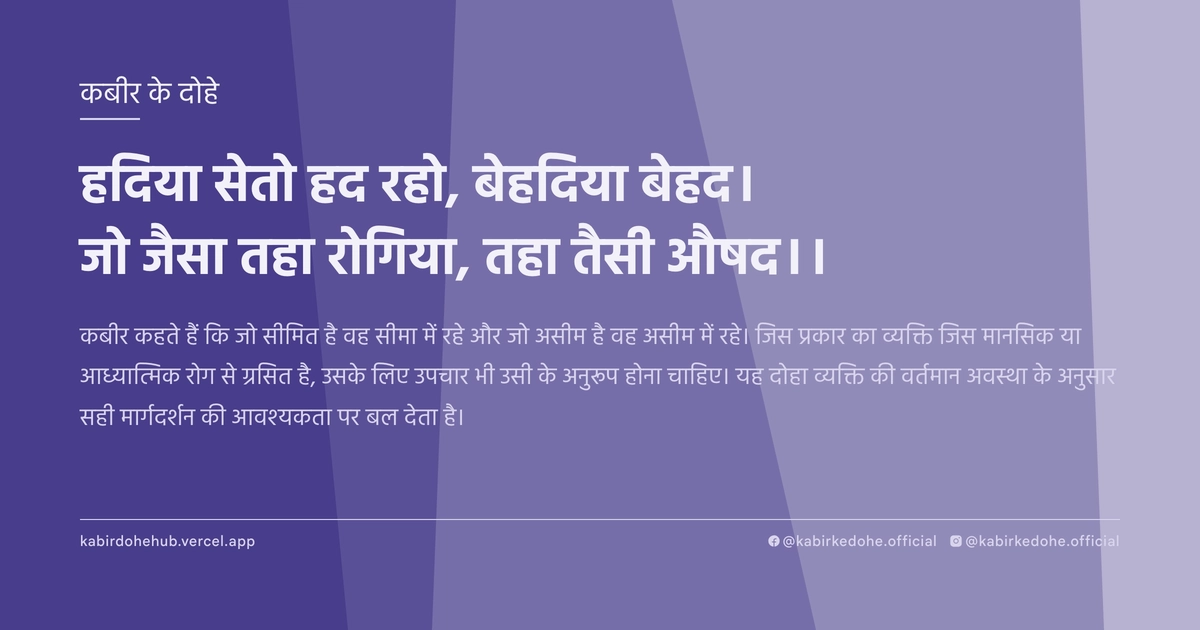
हदिया सेतो हद रहो, बेहदिया बेहद।
जो जैसा तहा रोगिया, तहा तैसी औषद।।
Hadiya seto had raho, behadiya behad. Jo jaisa taha rogiya, taha taisi aushad.
इस पृष्ठ पर इस कबीर दोहे का अर्थ (meaning), हिंदी व्याख्या और अंग्रेज़ी अनुवाद, दार्शनिक विश्लेषण और व्यावहारिक जीवन सीख दी गई है। यह दोहा सहज योग (Sahaja Yoga) विषय से जुड़ा है — Kabir doha meaning and explanation in Hindi and English.
अर्थ (Meaning):
कबीर कहते हैं कि जो सीमित है वह सीमा में रहे और जो असीम है वह असीम में रहे। जिस प्रकार का व्यक्ति जिस मानसिक या आध्यात्मिक रोग से ग्रसित है, उसके लिए उपचार भी उसी के अनुरूप होना चाहिए। यह दोहा व्यक्ति की वर्तमान अवस्था के अनुसार सही मार्गदर्शन की आवश्यकता पर बल देता है।
Kabir asserts that the limited should remain within its bounds and the infinite should dwell in infinity. He suggests that the remedy must correspond precisely to the nature of the ailment. In a spiritual sense, the cure for a soul's suffering must be tailored to the specific delusion or 'disease' that binds that individual.
व्याख्या (Interpretation):
इसका शाब्दिक अर्थ है कि सीमित और असीमित के बीच एक स्पष्ट अंतर है। रूपक के तौर पर, 'हदिया' या सीमा हमारे अहंकार और भौतिक शरीर का प्रतीक है, जबकि 'बेहदिया' उस निराकार ब्रह्म का प्रतीक है जो सीमाओं से परे है। यह दोहा बताता है कि जब तक मनुष्य स्वयं को शरीर (सीमित) मानता है, वह दुखी रहता है। निरगुण भक्ति के अनुसार, आत्मा वास्तव में असीम है, लेकिन माया के कारण वह स्वयं को सीमित मान बैठी है। अद्वैत वेदांत के नजरिए से, यह रोग 'अज्ञान' (Avidya) है। जब व्यक्ति अपनी वास्तविक प्रकृति को पहचान लेता है, तो वह सीमा से असीम की ओर बढ़ता है। यहाँ 'औषद' या औषधि वह ज्ञान है जो अहंकार का नाश कर आत्मा को परमात्मा से जोड़ता है।
Literally, the verse distinguishes between the bounded and the boundless. Metaphorically, 'Hadiya' (limit) represents the ego and the physical vessel, while 'Behadiya' (limitless) symbolizes the formless Brahman. Kabir posits that human suffering stems from the paradox of being an infinite soul trapped in a finite identity. In the context of Nirgun Bhakti, the 'disease' is the illusion of separation (Maya), where the Atman forgets its non-duality with the Absolute. The 'remedy' is not a generic ritual but a specific realization tailored to the seeker's level of consciousness. By aligning the cure with the cause, the seeker transcends the boundary of the self to merge with the infinite, resolving the tension between the temporal and the eternal.
दार्शनिक विश्लेषण (Philosophical Analysis):
कबीर का यह दृष्टिकोण उनके समय के कट्टरपंथी धार्मिक ढांचे पर एक प्रहार है। उन्होंने देखा कि लोग एक ही प्रकार की रीतियों और कर्मकांडों को हर किसी पर थोप रहे थे, जबकि हर व्यक्ति की आध्यात्मिक प्यास और मानसिक बाधाएं अलग थीं। वे ritualism के सख्त खिलाफ थे क्योंकि बाहरी आडंबर आंतरिक रोगों का उपचार नहीं कर सकते।
दार्शनिक रूप से, यह दोहा अद्वैत वेदांत के 'विवेक' (discrimination) से जुड़ा है। यहाँ कबीर यह समझा रहे हैं कि जब तक आप स्वयं को एक अलग इकाई (Sagar की एक बूंद) मानते हैं, आप सीमित रहेंगे। लेकिन जब आप यह जान लेते हैं कि आप स्वयं सागर हैं, तो सीमा समाप्त हो जाती है। यह 'अहं' का विलोपन है।
सूफीवाद के प्रभाव में, कबीर 'फना' (अहंकार का विनाश) की बात करते हैं। जैसे एक रोगी को उसकी बीमारी के अनुसार दवा चाहिए, वैसे ही एक अहंकारी को विनम्रता की और एक संशयवादी को अनुभव की औषधि चाहिए। बिना आत्म-विश्लेषण के कोई भी आध्यात्मिक मार्ग केवल एक बोझ बन जाता है।
कबीर यहाँ यह भी संकेत देते हैं कि ईश्वर कोई बाहरी वस्तु नहीं है जिसे खोजा जाए, बल्कि वह एक अवस्था है जिसे प्राप्त किया जाता है। जो व्यक्ति स्वयं को सीमित मानता है, वह ईश्वर को भी सीमित (मूर्ति या मंदिर) में खोजता है। जो स्वयं को असीम मानता है, वह ईश्वर को कण-कण में देखता है।
अंततः, यह विश्लेषण हमें इस निष्कर्ष पर ले जाता है कि आध्यात्मिक प्रगति रैखिक नहीं है, बल्कि यह एक व्यक्तिगत रूपांतरण है। यह 'रोग' और 'औषधि' का रूपक यह स्पष्ट करता है कि सत्य का मार्ग व्यक्तिगत अनुभव से होकर गुजरता है, न कि किसी थोपे गए सिद्धांत से।
Kabir's perspective serves as a critique of the rigid religious structures of his era. He observed that the clergy imposed uniform rituals on diverse seekers, ignoring that spiritual ailments are deeply personal. By rejecting ritualism, Kabir argues that external ceremonies cannot cure internal existential crises; they are mere bandages on a deep wound.
Philosophically, this verse aligns with the concept of 'Viveka' (discrimination) in Advaita Vedanta. Kabir suggests that as long as one perceives themselves as a separate entity—a single drop—they remain within the 'Hadiya' or limit. The realization that the drop is the ocean itself is the transition to 'Behadiya'. This is the annihilation of the ego, the primary obstacle to liberation.
Influenced by Sufi thought, Kabir echoes the concept of 'Fana' (extinction of the self). He posits that the remedy must match the malady: the arrogant require humility, and the skeptic requires direct experiential evidence. Without this precise diagnostic approach, spiritual practice becomes a mechanical exercise rather than a transformative journey.
Furthermore, Kabir suggests that the perception of the Divine is a reflection of one's own state of consciousness. One who views themselves as limited will seek a limited God in idols or shrines. Conversely, one who recognizes their own infinity will perceive the Formless (Nirgun) Divine pervading every atom of existence.
Ultimately, this analysis reveals that spiritual evolution is not a linear progression through dogma, but a personalized alchemy. The metaphor of 'disease' and 'medicine' emphasizes that truth is accessed through individual realization and the shedding of specific mental delusions, rather than the blind adoption of collective beliefs.
मूल संदेश (Core Message):
- बाहरी कर्मकांड आंतरिक शून्यता को नहीं भर सकते।
- अहंकार ही वह सीमा है जो हमें असीम होने से रोकती है।
- प्रत्येक व्यक्ति का आध्यात्मिक रोग अलग है, अतः उपचार भी व्यक्तिगत होना चाहिए।
- स्वयं को शरीर मानना रोग है; स्वयं को ब्रह्म मानना औषधि है।
- सत्य का अनुभव सीमाओं के विलोपन में निहित है।
- External rituals cannot fill an internal void.
- The ego is the only boundary preventing us from experiencing infinity.
- Spiritual ailments are unique; therefore, the cure must be personalized.
- Identifying with the body is the disease; identifying with the Absolute is the cure.
- The experience of Truth lies in the dissolution of all perceived limits.
व्यावहारिक उदाहरण (Practical Example):
एक समय की बात है, वाराणसी के घाटों पर माधव नाम का एक वृद्ध बुनकर रहता था। माधव अपनी कला में निपुण था, लेकिन उसका मन हमेशा अशांत रहता था। वह मानता था कि उसकी सारी परेशानियां उसकी गरीबी और भाग्य की वजह से हैं। वह घंटों मंदिरों में माथा टेकता और दान करता, यह सोचकर कि शायद इससे उसकी मानसिक शांति लौट आएगी।
एक दिन उसकी मुलाकात एक घुमंतू संत से हुई। माधव ने संत से कहा, "महाराज, मैं हर संभव पूजा करता हूँ, फिर भी मेरे भीतर एक खालीपन है, एक बेचैनी है जो खत्म नहीं होती। मुझे कोई ऐसा मंत्र बताइये जिससे मैं मुक्त हो जाऊँ।"
संत ने माधव की आँखों में देखा और मुस्कुराकर पूछा, "तुम्हें क्या लगता है, तुम्हारा रोग क्या है? क्या तुम गरीबी से दुखी हो या इस बात से कि तुम गरीब हो?"
माधव ठिठक गया। उसने महसूस किया कि वह गरीबी से नहीं, बल्कि इस 'बोध' से दुखी था कि वह दूसरों से कमतर है। उसका रोग 'गरीबी' नहीं, बल्कि 'हीन भावना' और 'तुलना' का अहंकार था।
संत ने कहा, "तुम मंदिर जा रहे हो, जो कि एक बाहरी औषधि है। लेकिन तुम्हारा रोग भीतर है। तुम्हारी औषधि यह पहचानना है कि तुम्हारी कीमत तुम्हारे कपड़ों से नहीं, बल्कि तुम्हारी आत्मा की अनंतता से है।"
माधव को अपनी गलती समझ आई। उसने महसूस किया कि वह अपनी सीमाओं (गरीबी, जाति, सामाजिक स्तर) को ही अपनी पहचान मान बैठा था। उसने बाहरी अनुष्ठानों को छोड़कर अंतर्मुखी होना शुरू किया।
उसने अपनी बुनाई को ही अपनी साधना बना लिया। अब वह धागों को केवल कपड़ा बनाने के लिए नहीं, बल्कि ब्रह्मांड के अंतहीन विस्तार के प्रतीक के रूप में बुनने लगा।
धीरे-धीरे उसकी बेचैनी गायब हो गई। वह अब भी गरीब था, लेकिन वह अब 'सीमित' नहीं था। उसने जान लिया था कि वह उस असीम परमात्मा का हिस्सा है।
उसका व्यवहार बदल गया; वह अब दूसरों की मदद बिना किसी उम्मीद के करने लगा। उसकी शांति देखकर लोग उसके पास आने लगे, और वह उन्हें भी यही सिखाता कि अपनी विशिष्ट बीमारी को पहचानो, तभी सही इलाज मिलेगा।
माधव का जीवन अब एक जीवित प्रमाण था कि जब औषधि (ज्ञान) रोग (अहंकार) के अनुरूप होती है, तो रूपांतरण निश्चित है।
Once, on the ghats of Varanasi, lived an elderly weaver named Madhav. Madhav was a master of his craft, yet his mind was a storm of unrest. He believed his misery was rooted in his poverty and ill fate. He spent hours bowing in temples and giving alms, hoping these rituals would bring him peace.
One day, he encountered a wandering mystic. Madhav pleaded, "Maharaj, I perform every possible ritual, yet a void persists within me, a restlessness that will not cease. Give me a mantra for liberation."
The mystic looked into Madhav's eyes and smiled, asking, "What do you believe your disease to be? Are you suffering from poverty, or from the idea that you are poor?"
Madhav paused. He realized he wasn't suffering from a lack of coins, but from a sense of inferiority and the ego of comparison. His 'disease' was not poverty, but the delusion of being 'less than'.
The mystic replied, "You seek refuge in temples, which is an external remedy. But your ailment is internal. Your medicine is the realization that your worth is not defined by your rags, but by the infinity of your soul."
Madhav understood his error. He had mistaken his limitations—his poverty, his caste, his social standing—for his true identity. He ceased the external performances and turned his gaze inward.
He transformed his weaving into a meditation. He no longer wove threads merely to make cloth, but saw them as symbols of the endless interconnectedness of the universe.
Gradually, his restlessness vanished. He remained poor in material terms, but he was no longer 'limited'. He recognized himself as a spark of the infinite Divine.
His behavior shifted; he began helping others without expectation. People were drawn to his serenity, and he taught them to diagnose their own specific spiritual ailments before seeking a cure.
Madhav's life became a living testament that when the medicine (knowledge) matches the disease (ego), transformation is inevitable.
अभ्यास मार्गदर्शन (Practice Guidance):
- दैनिक आत्म-निरीक्षण: प्रतिदिन 20 मिनट मौन बैठें और यह विश्लेषण करें कि आज आपको किस बात पर क्रोध या दुख हुआ। क्या वह दुख आपकी 'सीमित' पहचान (अहंकार) के कारण था?
- जर्नलिंग प्रॉम्प्ट: लिखें—"मैं वह नहीं हूँ जो दुनिया मुझे देखती है, मैं वह हूँ जो..." और इस वाक्य को बिना सोचे पूरा करें। अपनी सीमाओं और अपनी अनंतता के बीच के अंतर को खोजें।
- व्यवहारिक परिवर्तन: जब भी आप किसी की आलोचना करें, रुकें और सोचें कि आप सामने वाले की 'सीमा' को देख रहे हैं या उसकी 'असीम' आत्मा को। अपनी प्रतिक्रिया को करुणा में बदलें।
- डायग्नोस्टिक चेकलिस्ट: क्या आप अभी भी बाहरी validation खोज रहे हैं? क्या आप अपनी खुशी को परिस्थितियों से जोड़ रहे हैं? यदि हाँ, तो आप 'सीमित' रोग से ग्रसित हैं और आपको 'अद्वैत' की औषधि की आवश्यकता है।
- Daily Self-Observation: Spend 20 minutes in silence analyzing the triggers of your anger or sorrow. Ask: "Was this pain caused by my 'limited' identity (ego) or my true self?"
- Journaling Prompt: Write—"I am not who the world perceives me to be; I am that which..." and complete the sentence spontaneously. Explore the gap between your perceived limits and your inherent infinity.
- Behavioral Shift: Whenever you judge someone, pause and ask if you are reacting to their 'limitations' (mask) or their 'infinite' soul. Consciously shift your reaction from judgment to compassion.
- Diagnostic Checklist: Are you still seeking external validation? Do you tie your happiness to external circumstances? If yes, you are suffering from the 'disease of limitation' and require the 'medicine of non-duality'.
चिंतन प्रश्न (Reflection Questions):
- आपकी वह कौन सी 'सीमा' (पहचान, पद, धर्म) है जिसे आप सबसे अधिक पकड़कर रखते हैं और जिसके बिना आप खुद को अधूरा महसूस करते हैं?
- क्या आप अपनी आध्यात्मिक यात्रा में केवल वही पढ़ रहे हैं जो आपकी मान्यताओं की पुष्टि करता है, या आप उस सत्य के लिए तैयार हैं जो आपके अहंकार को नष्ट कर दे?
- डिजिटल युग में, आपका 'ऑनलाइन व्यक्तित्व' आपकी किस सीमा को बढ़ा रहा है और आपकी वास्तविक आत्मा को कैसे ढक रहा है?
- यदि आपकी सारी सामाजिक उपलब्धियां और रिश्ते छीन लिए जाएं, तो जो बचेगा, क्या वह 'सीमित' होगा या 'असीम'?
- क्या आप वास्तव में शांति चाहते हैं, या आप केवल अपनी इच्छाओं की पूर्ति चाहते हैं और उसे ही शांति का नाम दे रहे हैं?
- Which 'limit' (identity, title, religion) do you cling to most fiercely, feeling incomplete without it?
- In your spiritual journey, are you only consuming what confirms your biases, or are you ready for a truth that annihilates your ego?
- In the digital age, how does your 'online persona' expand your perceived limits while masking your authentic soul?
- If all your social achievements and relationships were stripped away, would what remains be 'limited' or 'infinite'?
- Do you truly seek peace, or are you merely seeking the fulfillment of desires and mislabeling it as peace?