
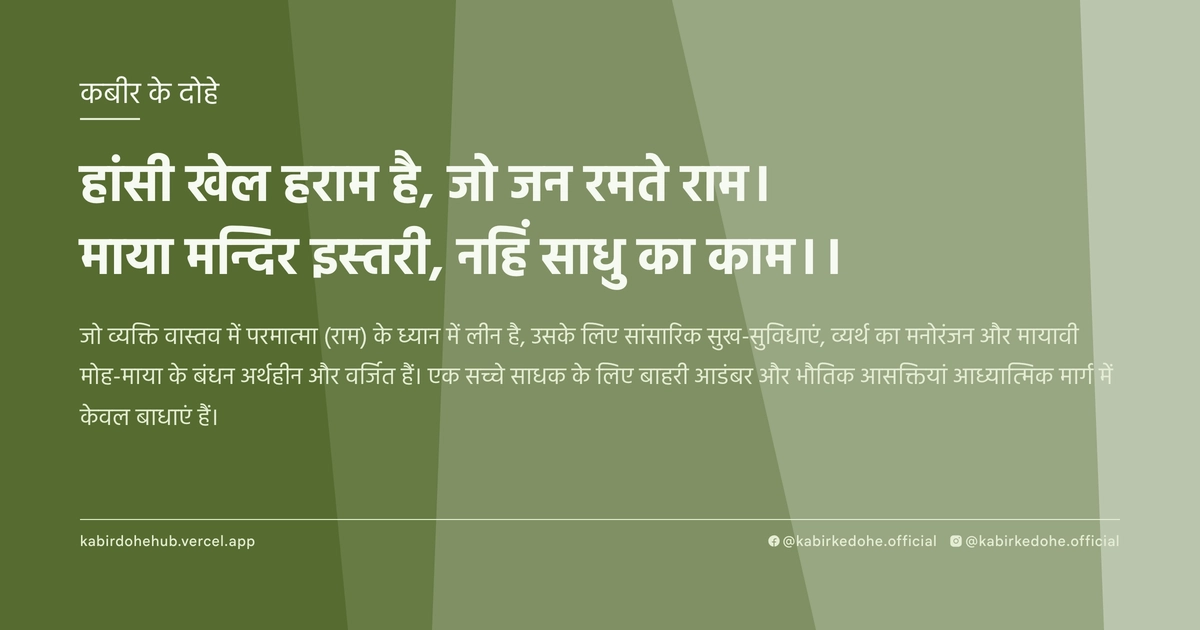
हांसी खेल हराम है, जो जन रमते राम।
माया मन्दिर इस्तरी, नहिं साधु का काम।।
Haansi khel haraam hai, jo jan ramte raam. Maya mandir istari, nahin sadhu ka kaam.
इस पृष्ठ पर इस कबीर दोहे का अर्थ (meaning), हिंदी व्याख्या और अंग्रेज़ी अनुवाद, दार्शनिक विश्लेषण और व्यावहारिक जीवन सीख दी गई है। यह दोहा माया (Maya) विषय से जुड़ा है — Kabir doha meaning and explanation in Hindi and English.
अर्थ (Meaning):
जो व्यक्ति वास्तव में परमात्मा (राम) के ध्यान में लीन है, उसके लिए सांसारिक सुख-सुविधाएं, व्यर्थ का मनोरंजन और मायावी मोह-माया के बंधन अर्थहीन और वर्जित हैं। एक सच्चे साधक के लिए बाहरी आडंबर और भौतिक आसक्तियां आध्यात्मिक मार्ग में केवल बाधाएं हैं।
For the one who is truly immersed in the remembrance of the Divine (Raam), the trivial amusements and distractions of the worldly life are meaningless. The lures of Maya—material wealth, ritualistic structures, and carnal attachments—hold no value for a seeker dedicated to the path of liberation.
व्याख्या (Interpretation):
यहाँ 'राम' किसी व्यक्ति विशेष नहीं, बल्कि निर्गुण ब्रह्म का प्रतीक है। 'हांसी खेल' का अर्थ केवल हंसी-मजाक नहीं, बल्कि वह मानसिक चंचलता है जो आत्मा को वर्तमान क्षण से भटकाती है। कबीर यहाँ माया के तीन रूपों—संपत्ति (मन्दिर), मोह (इस्त्री/सांसारिक संबंध), और अहंकार—की चर्चा कर रहे हैं। यह दोहा द्वैत से अद्वैत की ओर संक्रमण है, जहाँ साधक यह समझता है कि बाहरी दुनिया एक भ्रम है। जब आत्मा परमात्मा के साथ एकाकार होती है, तो सांसारिक इच्छाएं स्वतः ही विलीन हो जाती हैं। यह विरोधाभास है कि जिसे हम सुख समझते हैं, वह वास्तव में बंधन है।
In this verse, 'Raam' does not refer to a mythological figure but to the Nirgun Brahman—the formless, omnipresent consciousness. 'Haansi khel' symbolizes the superficial distractions and the restless mind that drifts away from the center of being. Kabir identifies the triad of Maya: material accumulation (mandir), emotional entanglement (istari), and the ego's desire for possession. The transition here is from duality to Advaita (non-duality), where the seeker realizes that the external world is a shimmering mirage. When the Atman merges with the Universal Consciousness, worldly desires do not just vanish; they are recognized as irrelevant. It presents the central paradox: what the world calls 'pleasure' is actually the chain that binds the soul.
दार्शनिक विश्लेषण (Philosophical Analysis):
कबीर का यह दृष्टिकोण 15वीं शताब्दी के सामाजिक और धार्मिक परिवेश की प्रतिक्रिया है, जहाँ धर्म केवल कर्मकांडों और बाहरी दिखावे तक सीमित हो गया था। वे 'मन्दिर' शब्द का प्रयोग केवल ईंट-पत्थर की इमारत के लिए नहीं, बल्कि उस मानसिक ढांचे के लिए करते हैं जो ईश्वर को एक स्थान पर सीमित कर देता है। यह सूफी मत के 'फना' (अहंकार का विनाश) और अद्वैत वेदांत के 'माया' सिद्धांत का संगम है। कबीर तर्क देते हैं कि जब तक मन बाहरी सुखों में रमा है, वह आंतरिक शांति का अनुभव नहीं कर सकता।
उनका विरोध किसी व्यक्ति या वस्तु से नहीं, बल्कि उस 'आसक्ति' (attachment) से है जो मनुष्य को उसकी वास्तविक प्रकृति से दूर करती है। जाति और वर्ण के भेदभाव को नकारते हुए, वे बताते हैं कि सच्ची साधना आंतरिक शुद्धता में है, न कि बाहरी वेशभूषा में। यह मनोवैज्ञानिक रूपांतरण की प्रक्रिया है जहाँ साधक अपनी पहचान को 'शरीर' से हटाकर 'चेतना' पर केंद्रित करता है।
यहाँ 'हराम' शब्द का प्रयोग धार्मिक निषेध के बजाय आध्यात्मिक अनुपयुक्तता के लिए किया गया है। जिस प्रकार एक गंभीर विद्यार्थी के लिए कक्षा में शोर करना अनुपयुक्त है, उसी प्रकार एक जागृत आत्मा के लिए माया का खेल व्यर्थ है। यह संदेश हमें सिखाता है कि मुक्ति का मार्ग त्याग में नहीं, बल्कि वैराग्य में है—वस्तुओं का त्याग नहीं, बल्कि वस्तुओं के प्रति मोह का त्याग।
कबीर का दर्शन यह स्पष्ट करता है कि ईश्वर किसी मंदिर या मस्जिद में नहीं, बल्कि स्वयं के भीतर है। जब हम बाहरी दुनिया में 'राम' को खोजते हैं, तो हम केवल माया के जाल में उलझते हैं। वास्तविक भक्ति वह है जो मौन और एकांत में घटित होती है, जहाँ कोई दूसरा नहीं होता, केवल साक्षी भाव शेष रहता है।
अंततः, यह दोहा हमें चेतावनी देता है कि आध्यात्मिक यात्रा में 'सुख' की खोज ही सबसे बड़ी बाधा है। जब तक हम सुख और दुख के द्वंद्व में फंसे रहेंगे, हम उस परम सत्य को नहीं जान पाएंगे जो इन दोनों से परे है। यह अहंकार के पूर्ण विसर्जन की पुकार है।
Kabir’s perspective is a visceral reaction to the 15th-century socio-religious climate, where spirituality had been reduced to empty rituals and external displays. He uses the word 'mandir' not merely to describe a physical structure, but to critique the mental construct that limits the Infinite Divine to a specific location. This philosophy is a confluence of the Sufi concept of 'Fana' (annihilation of the ego) and the Advaita Vedanta principle of 'Maya' (the cosmic illusion).
His opposition is not directed at people or objects, but at 'Asakti' (attachment)—the psychic glue that binds the soul to the transient. By rejecting caste and creed, Kabir asserts that true practice lies in internal purity rather than external attire. This is a process of psychological transmutation where the seeker shifts their identity from the 'physical body' to 'pure consciousness'.
The term 'haraam' here is used not as a religious prohibition, but as a spiritual incongruity. Just as noise is inappropriate for a student in a deep state of study, worldly distractions are incongruous for a soul awakened to the Divine. This teaches us that liberation is found not in 'Tyaga' (renunciation of things) but in 'Vairagya' (dispassion toward things).
Kabir clarifies that the Divine does not reside in temples or mosques but within the self. When we seek 'Raam' in the external world, we only further entangle ourselves in the web of Maya. True devotion occurs in the silence of the interior, where the duality of 'I' and 'Thou' dissolves into a state of pure witnessing.
Ultimately, this couplet warns that the pursuit of 'happiness' is the greatest obstacle on the spiritual path. As long as we oscillate between the poles of pleasure and pain, we remain blind to the Truth that transcends both. It is a call for the total dissolution of the ego into the ocean of existence.
मूल संदेश (Core Message):
- बाहरी शोर को शांत करें ताकि आंतरिक संगीत सुनाई दे।
- माया का खेल केवल तब तक चलता है जब तक आप जागते नहीं।
- ईश्वर मंदिर की दीवारों में नहीं, चेतना के विस्तार में है।
- असली वैराग्य वस्तुओं का त्याग नहीं, बल्कि मोह का अंत है।
- स्वयं को जानना ही परमात्मा को जानने का एकमात्र मार्ग है।
- Silence the external noise to hear the internal symphony.
- The game of Maya persists only until you awaken.
- God is not within temple walls, but in the expansion of consciousness.
- True detachment is not the absence of things, but the absence of clinging.
- Knowing the self is the only path to knowing the Divine.
व्यावहारिक उदाहरण (Practical Example):
वाराणसी के घाटों पर रहने वाले एक वृद्ध बुनकर, माधव, का जीवन अत्यंत सरल था। वह दिन भर सूत कातता और शाम को गंगा किनारे बैठता। माधव के पास बहुत धन नहीं था, लेकिन उसके मन में एक गहरी बेचैनी थी। वह अक्सर देखता कि लोग महंगे वस्त्र पहनकर मंदिर जाते और दान-पुण्य का दिखावा करते, जबकि उनके व्यवहार में अहंकार और क्रोध भरा होता।
एक दिन माधव ने एक प्रसिद्ध विद्वान को देखा जो अपनी विद्वत्ता का प्रदर्शन कर रहा था और लोगों को बता रहा था कि कैसे बाहरी अनुष्ठानों से मोक्ष मिलता है। माधव ने उनसे पूछा, 'महाराज, यदि मैं केवल अपने काम में ईमानदारी रखूँ और मन में राम को बसा लूँ, तो क्या मुझे भी मोक्ष मिलेगा?' विद्वान ने हँसकर कहा, 'मूर्ख, बिना मंदिर गए और बिना शास्त्र पढ़े तू क्या जाने ईश्वर को?'
माधव इस बात से आहत नहीं हुआ, बल्कि उसने गहराई से सोचना शुरू किया। उसने महसूस किया कि वह भी अब तक अपनी गरीबी और अपनी स्थिति को लेकर दुखी था, जो कि एक प्रकार की 'माया' ही थी। उसने तय किया कि वह अब बाहरी दुनिया की तुलना करना छोड़ देगा।
उसने अपने करघे को ही अपना मंदिर बना लिया। जब वह धागों को बुनता, तो वह हर धागे में उस परमात्मा की उपस्थिति महसूस करता। उसने अपनी हंसी-मजाक और व्यर्थ की चर्चाओं को कम कर दिया और अपना पूरा ध्यान वर्तमान क्षण की एकाग्रता पर लगाया।
धीरे-धीरे, माधव के चेहरे पर एक ऐसी शांति आई जो किसी मंदिर के पुजारी में भी नहीं थी। वह अब न तो गरीबी से डरता था और न ही अमीरी की इच्छा करता था। उसके लिए उसका काम ही उसकी पूजा बन गया था।
एक समय ऐसा आया जब वही विद्वान, जो मानसिक तनाव और पारिवारिक कलह से परेशान था, माधव के पास आया। उसने देखा कि माधव के पास कुछ नहीं है, फिर भी वह इतना प्रसन्न है। विद्वान ने पूछा, 'तुम्हारी इस शांति का रहस्य क्या है?'
माधव ने मुस्कुराते हुए कहा, 'मैंने मंदिर और मोह के शोर को शांत कर दिया है। अब मेरे भीतर केवल वह राम बजता है, जिसे पाने के लिए आप बाहर भटक रहे थे।'
विद्वान को समझ आया कि असली साधना बाहरी आडंबरों में नहीं, बल्कि आंतरिक मौन और कर्म की पवित्रता में है। माधव ने बिना किसी उपदेश के, केवल अपने जीवन से कबीर की बात को सच कर दिखाया।
माधव का जीवन अब एक जीवंत उदाहरण था कि जब व्यक्ति माया के खेल से ऊपर उठकर अपने स्वभाव में स्थित हो जाता है, तो पूरा संसार ही उसका मंदिर बन जाता है।
उसने सिखाया कि ईश्वर को पाने के लिए घर छोड़ने की जरूरत नहीं, बस घर के भीतर के 'अहंकार' को छोड़ना पर्याप्त है।
Madhav, an elderly weaver living on the ghats of Varanasi, led a very simple life. He spent his days spinning yarn and his evenings sitting by the Ganges. Madhav possessed little wealth, but a deep restlessness lingered in his heart. He often observed people wearing expensive clothes to visit temples, flaunting their charity while their behavior remained steeped in arrogance and anger.
One day, Madhav encountered a renowned scholar who was boasting about his erudition, claiming that salvation could only be achieved through elaborate external rituals. Madhav asked, 'Maharaj, if I simply remain honest in my work and keep Raam in my heart, will I also attain liberation?' The scholar laughed, 'Fool, what do you know of God without visiting temples or reading scriptures?'
Madhav was not offended; instead, he began to reflect deeply. He realized that he too had been suffering from a form of 'Maya'—the grief over his poverty and his social standing. He decided to stop comparing his life with others.
He turned his loom into his temple. As he wove the threads, he felt the presence of the Divine in every fiber. He reduced his idle chatter and superficial amusements, focusing his entire consciousness on the precision of the present moment.
Gradually, a profound peace settled on Madhav's face, a serenity that even the high priests of the city lacked. He no longer feared poverty, nor did he crave wealth. His work had become his worship.
Eventually, the same scholar, now plagued by mental stress and family disputes, came to Madhav. He noticed that despite having nothing, Madhav was radiating joy. The scholar asked, 'What is the secret of your peace?'
Madhav smiled and replied, 'I have silenced the noise of the temple and the lures of attachment. Now, only that Raam resonates within me, whom you were searching for in the outside world.'
The scholar realized that true spiritual practice is not found in external pomp, but in internal silence and the sanctity of one's action. Without a single sermon, Madhav had embodied the essence of Kabir's wisdom.
Madhav's life became a living testament that when a person rises above the game of Maya and settles into their true nature, the entire universe becomes their temple.
He proved that to find God, one does not need to leave their home; they only need to leave the 'ego' residing within that home.
अभ्यास मार्गदर्शन (Practice Guidance):
- दैनिक मौन अभ्यास: प्रतिदिन 30 मिनट पूर्ण मौन रहें, जहाँ न केवल वाणी, बल्कि मानसिक संवाद भी शांत हो।
- साक्षी भाव का अभ्यास: दिन भर में जब भी कोई तीव्र इच्छा या मोह जागे, तो उसे एक बाहरी दर्शक की तरह देखें और पूछें, 'यह इच्छा किसकी है?'
- सादा जीवन, उच्च विचार: भौतिक वस्तुओं के संग्रह की प्रवृत्ति को पहचानें और केवल अनिवार्य वस्तुओं का उपयोग करें।
- निदान चेकलिस्ट: क्या मैं अपनी खुशी बाहरी प्रशंसा पर निर्भर करता हूँ? क्या मैं ईश्वर को केवल विशेष स्थानों पर खोजता हूँ? क्या मेरा मन व्यर्थ की बातों में अधिक समय बिताता है?
- Daily Silence Practice: Spend 30 minutes in absolute silence, quieting not just the voice but the internal mental dialogue.
- Practice of Witnessing: Whenever a strong desire or attachment arises during the day, observe it as an external spectator and ask, 'To whom does this desire belong?'
- Simple Living, High Thinking: Identify the tendency to accumulate material objects and consciously limit yourself to the essentials.
- Diagnostic Checklist: Do I depend on external validation for my happiness? Do I seek the Divine only in specific locations? Does my mind spend more time in trivialities than in presence?
चिंतन प्रश्न (Reflection Questions):
- मेरे जीवन में 'मन्दिर' (बाहरी दिखावा) क्या है जिसे मैं सत्य मान बैठा हूँ?
- मैं अपनी पहचान किन भौतिक वस्तुओं या रिश्तों से जोड़ता हूँ, और यदि वे छिन जाएं तो मेरा 'मैं' क्या बचेगा?
- क्या मेरी आध्यात्मिक खोज वास्तव में सत्य की प्यास है, या केवल मानसिक शांति पाने का एक और तरीका?
- मेरे भीतर का वह कौन सा 'खेल' है जो मुझे वर्तमान क्षण में उपस्थित होने से रोकता है?
- क्या मैं वास्तव में निर्गुण (निराकार) को स्वीकार कर सकता हूँ, या मुझे अभी भी किसी सहारे या रूप की आवश्यकता है?
- What is the 'temple' (external facade) in my life that I have mistaken for the Truth?
- Which material objects or relationships do I tie my identity to, and if they were gone, what would remain of my 'I'?
- Is my spiritual quest a genuine thirst for Truth, or just another method to achieve mental comfort?
- What is the 'game' within me that prevents me from being fully present in the now?
- Can I truly embrace the Nirgun (formless), or do I still require a crutch or a form to lean on?